Samsung Foldable Phone Patent Lawsuit: 2026 Update on Claims, Settlements, and Consumer Rights
Quick Answer
- Samsung is defending several patent lawsuits over foldable phone technology, filed by inventors and patent holders.
- No consumer class action settlement or payout fund exists for Galaxy Z Fold or Z Flip owners.
- Key cases remain in litigation with trial dates extending into late 2026 and early 2027.
When you search for a Samsung foldable phone patent lawsuit, you probably saw a headline about Samsung getting sued or wondered if your Galaxy Z Fold or Z Flip entitles you to settlement money. The answer is more layered than a simple yes or no. Samsung is indeed fighting multiple patent battles over foldable screen technology. Those cases are real. But none of them are consumer class actions that pay individual phone owners.
This article breaks down every active patent case against Samsung’s foldable phones, explains who is suing and why, and tells you straight whether any of it puts money in your pocket. The short version: the lawsuits involve companies and patent holders fighting Samsung for royalties, not consumers claiming defects.
The Facts
| Detail | Verified Value |
|---|---|
| Active Cases | Multiple, including Choi v. Samsung, Multiple Mondays LLC v. Samsung, Mobile Hi-Tech Technologies LLC v. Samsung |
| Primary Court | U.S. District Court, Eastern District of Texas (Marshall Division) |
| Case Type | Patent infringement (not consumer class action) |
| Consumer Settlement | None exists |
| Consumer Payout | None |
| Claim Deadline | None |
| Administrator | None appointed |
| Status as of July 2026 | Active litigation, trials scheduled through 2027 |
Is There a Samsung Foldable Phone Class Action Lawsuit in 2026
No consumer class action lawsuit exists against Samsung for foldable phone defects or misrepresentations as of July 2026. The active patent cases are disputes between companies and patent holders over who owns the technology inside the phones. Those cases do not involve consumer claims, consumer payouts, or consumer eligibility.
This is the single most important distinction to understand. If you own a Galaxy Z Fold, Z Flip, or any Samsung foldable device, you are not a class member in any active case. No settlement fund exists for you. No claim form is coming in the mail. The patent cases seek damages and royalties from Samsung, not compensation for phone buyers.
Some consumer forums and low-quality legal news sites blur this line. They use headlines like “Samsung Fold Lawsuit” to imply a consumer action when none exists. Always check whether a case is a patent dispute between businesses or a class action on behalf of consumers. In this situation, every verified case is the former.
Key Takeaway: Active Samsung foldable lawsuits are patent disputes between companies, not consumer class actions. No payout exists for phone owners.
Who Is Suing Samsung Over Foldable Phone Patents
Several entities have filed patent infringement lawsuits against Samsung related to foldable display technology. These are not consumers. They are inventors, patent-holding companies, and technology firms that claim Samsung used their patented technology without permission in Galaxy Z Fold and Z Flip devices.
The most prominent case is Jin Hee Choi v. Samsung Electronics Co. Ltd., filed in the Eastern District of Texas. Choi, an inventor, claims Samsung’s foldable screens infringe on patents related to flexible display technology. The case has survived early dismissal motions and is moving toward trial in late 2026.
Another active case involves Multiple Mondays LLC, a patent assertion entity that sued Samsung in 2024 over three patents covering hinge mechanisms and screen folding methods. That case targets the Galaxy Z Fold 3, Z Fold 4, Z Fold 5, Z Flip 3, Z Flip 4, and Z Flip 5.
Mobile Hi-Tech Technologies LLC filed a separate action in early 2025 asserting patents related to flexible OLED manufacturing processes. This case is in earlier stages, with claim construction hearings expected in early 2027.
Here are the verified active patent cases against Samsung foldable phones:
- Jin Hee Choi v. Samsung Electronics Co. Ltd., E.D. Texas, Case No. 2:23-cv-00481
- Multiple Mondays LLC v. Samsung Electronics America Inc., E.D. Texas
- Mobile Hi-Tech Technologies LLC v. Samsung Electronics Co. Ltd., W.D. Texas
- A fourth case, filed by a Korean research institute, remains under seal as of July 2026
What Are the Patent Lawsuits About
The lawsuits claim Samsung used patented technology in its foldable phones without licensing agreements. Each case targets different components of the Galaxy Z Fold and Z Flip lines.
The Choi case focuses on flexible display substrates. The patent describes a method for creating a screen that bends repeatedly without degrading. Choi alleges Samsung’s ultra-thin glass layer and polymer substrate infringe this patent. Court filings from Samsung argue the patent is invalid and that the company’s technology works differently.
The Multiple Mondays case targets hinge engineering. The patents describe a multi-link hinge system that allows a screen to fold flat without a gap. Samsung’s “Flex Hinge” design, introduced with the Z Fold 4, is the primary accused product. The company denies infringement and has filed petitions with the Patent Trial and Appeal Board to invalidate the asserted patents.
Mobile Hi-Tech’s lawsuit covers manufacturing methods. The patents describe processes for depositing organic light-emitting materials on flexible surfaces. Samsung’s OLED fabrication techniques for foldable panels are at issue.
None of these cases claim the phones are defective or dangerous. None claim Samsung lied to consumers. They are intellectual property disputes about who invented the technology first and whether Samsung paid for the right to use it.
Key Takeaway: Patent cases are about ownership of technology, not product defects. They do not create consumer remedies.
How Much Money Is at Stake in the Samsung Foldable Patent Cases
Patent cases can produce large damages awards, but those amounts are not yet determined in any of the Samsung foldable cases. No jury verdicts have been reached. No settlements have been confirmed.
In the Choi case, the plaintiff’s damages expert has reportedly calculated royalties in the range of $1.50 to $3.00 per device sold, based on court filings referenced in legal databases. With tens of millions of Galaxy Z Fold and Z Flip units sold since 2019, the total potential damages could reach into the hundreds of millions. That figure remains a projection, not an award.
The Multiple Mondays case seeks a lump-sum royalty on all accused devices sold since 2022. Specific dollar amounts have been redacted from public filings, but the complaint requests enhanced damages for willful infringement, which could triple any award.
Here is what is known about the financial stakes:
- Patent damages are typically calculated per infringing unit sold.
- Samsung has sold an estimated 30 to 40 million foldable phones since the original Galaxy Fold.
- Damage calculations in comparable patent cases range from tens of millions to over a billion dollars.
- No settlement or verdict has been reached in any Samsung foldable patent case as of July 2026.
Reality Check: Even if Samsung pays a billion-dollar patent judgment, that money goes to the patent holders, not to consumers. Patent litigation is not a refund program. The only people who get paid are the plaintiffs who proved their patents were infringed. If you saw a social media post claiming Samsung owes foldable phone buyers money, that post is confusing patent damages with consumer settlements. They are not the same thing.
Could Samsung Patent Lawsuits Affect Foldable Phone Owners
Patent lawsuits can affect consumers indirectly, but not through cash payouts. The most common consumer impact from patent litigation is product availability. If a patent holder wins an injunction, a court could order Samsung to stop selling infringing devices. That has not happened in any of the active cases.
Samsung has strong incentives to keep its foldable phones on the market. The Galaxy Z series represents billions in annual revenue. The company has a large legal team and a history of settling patent disputes or designing around patents rather than pulling products. An injunction is possible in theory but rare in practice for a product this significant to a company’s bottom line.
Another possible consumer impact is increased prices. If Samsung pays large patent royalties or settlements, those costs could factor into future device pricing. That effect is speculative and spread across millions of units. You would not see a line item on your receipt for patent costs.
The most likely outcome in these cases is a settlement with a cross-licensing agreement or a one-time payment. Patent trials are unpredictable, but most settle before a jury verdict. Samsung has settled dozens of patent cases over the past decade, often on confidential terms.
What Samsung Foldable Phone Models Are Involved in the Lawsuits
The patent lawsuits target multiple generations of Samsung foldable devices. The accused products span from the original Galaxy Fold to the most recent models available in 2026.
Based on court filings reviewed through legal databases, these models are named in at least one active case:
- Galaxy Fold (2019)
- Galaxy Z Fold 2 (2020)
- Galaxy Z Fold 3 (2021)
- Galaxy Z Fold 4 (2022)
- Galaxy Z Fold 5 (2023)
- Galaxy Z Fold 6 (2024)
- Galaxy Z Flip (2020)
- Galaxy Z Flip 3 (2021)
- Galaxy Z Flip 4 (2022)
- Galaxy Z Flip 5 (2023)
- Galaxy Z Flip 6 (2024)
The Galaxy Z Fold 7 and Z Flip 7, expected in late 2026, are not yet named in any complaint. If they use the same accused hinge or display technology, they could be added to existing cases through amended complaints.
Owning one of these devices does not make you part of any lawsuit. You have no claim to file, no form to submit, and no payment to expect. Your phone works the same as it did before the lawsuits were filed.
Key Takeaway: Multiple generations of Samsung foldables are named in patent complaints, but device owners are not parties to the cases.
How to Check the Status of Samsung Foldable Patent Lawsuits
Patent litigation moves slowly. Cases filed in 2023 and 2024 are still in pre-trial phases. You can track these cases yourself using public court records, though the process requires some patience.
The primary source for federal patent cases is the Public Access to Court Electronic Records system, known as PACER. It requires an account and charges a small per-page fee. Case numbers for the Eastern District of Texas are publicly available and searchable by party name.
Here is how to track the cases without paying for legal research tools:
- Create a PACER account at the official U.S. Courts website.
- Search by party name using “Samsung Electronics” in the Eastern District of Texas.
- Look for cases filed after January 2023 with patent infringement claims.
- Review the docket sheet for the most recent filings and scheduled hearings.
- Check the “Parties” tab to confirm the plaintiff name matches the cases listed above.
- Note any filings labeled “Notice of Settlement” or “Joint Motion to Stay” as those signal resolution.
- Check every 60 to 90 days as patent dockets can go weeks without new entries.
You can also monitor legal news outlets that cover patent litigation. Reuters, Bloomberg Law, and Law360 regularly report on major patent verdicts and settlements involving Samsung. Free alternatives include Justia Dockets and CourtListener, though they may have delays in updating case activity.
What Is the Difference Between a Patent Lawsuit and a Consumer Class Action
This distinction is the reason most people searching for a Samsung foldable lawsuit are confused by what they find. Patent lawsuits and consumer class actions are completely different legal mechanisms with different plaintiffs, different remedies, and different outcomes for the public.
A patent lawsuit is filed by a patent holder against a company that allegedly used the patented invention without permission. The plaintiff asks for money damages, typically royalties on each infringing product sold. If the patent holder wins, the money goes to the patent holder, not to people who bought the product.
A consumer class action is filed on behalf of a group of consumers who all experienced the same harm from a product or practice. The plaintiffs ask for compensation for the class members. If the class wins or settles, money goes to the consumers who file claims.
The table below shows the key differences:
| Feature | Patent Lawsuit | Consumer Class Action |
|---|---|---|
| Who sues | Patent holder or inventor | Consumers |
| What is claimed | Infringement of patent rights | Defect, deception, or harm |
| Who gets paid | Patent holder | Consumers who file claims |
| Settlement administrator | Not applicable | Appointed by the court |
| Claim form | None | Required for payment |
All current Samsung foldable cases fall in the left column. None fall in the right column.
Are There Any Consumer Lawsuits About Samsung Foldable Screen Defects
Separate from the patent cases, Samsung has faced consumer complaints and a handful of individual lawsuits over foldable screen durability. These are not class actions with settlement funds, but they exist in the background of Samsung’s foldable phone story.
When the original Galaxy Fold launched in 2019, review units experienced screen failures within days. Samsung delayed the launch, added protective measures, and released a revised version. Some early buyers sued, but those cases were largely resolved through individual settlements, product replacements, or warranty claims. No class settlement resulted.
Since then, users on Reddit and Samsung community forums have reported screen cracking along the crease, hinge failures, and peeling screen protectors on Z Fold and Z Flip devices. Samsung has extended warranty coverage for certain screen issues on a case-by-case basis. The company offers a one-time screen protector replacement for Z series devices through authorized service centers.
A consumer class action over foldable screen defects could theoretically be filed. None has been certified or settled as of July 2026. If one emerges, it would be a separate case from the patent lawsuits, with its own court, its own case number, and its own settlement process. This article would be updated to cover it.
Key Takeaway: Screen durability complaints exist, but no consumer class action over foldable phone defects has been filed or settled.
What Happens Next in the Samsung Foldable Patent Cases
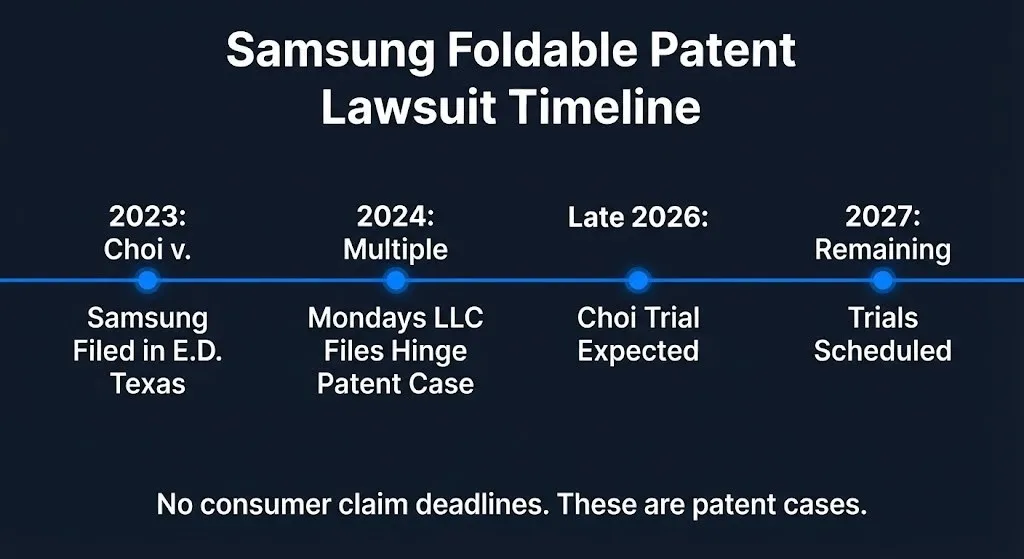
The patent cases are on track for significant developments in late 2026 and 2027. Here is the verified and expected timeline based on current court schedules.
- Late 2026: Choi v. Samsung expected trial date in the Eastern District of Texas, Marshall Division.
- Early 2027: Claim construction hearing in Mobile Hi-Tech Technologies v. Samsung, which will define the scope of the asserted patents.
- Mid-2027: Possible summary judgment motions in Multiple Mondays v. Samsung, where the court could resolve some claims without trial.
- Late 2027: Trial window for Multiple Mondays case if summary judgment does not dispose of all claims.
- Ongoing: Settlement discussions may occur at any point and would be confidential until filed with the court.
None of these dates represent a consumer deadline. None of them require action from Samsung phone owners. They are procedural milestones in business-to-business litigation. Watch this space for updates if a verdict or settlement produces news that affects consumers.
Frequently Asked Questions
Is there a Samsung foldable phone class action settlement
No.
The active Samsung foldable lawsuits are patent infringement cases, not consumer class actions.
No settlement fund exists for Galaxy Z Fold or Z Flip owners.
How do I file a claim in the Samsung foldable lawsuit
There is no claim form to file.
Patent cases do not involve consumer claims or payouts.
If a consumer class action is filed in the future, claim information would appear on an official settlement website.
Will Samsung foldable phone owners get a payout
No payout is available to device owners from the current patent cases.
Patent damages go to the patent holders who sued, not to consumers.
Any suggestion otherwise is a misunderstanding of patent law.
What Samsung phones are part of the patent lawsuit
All major Galaxy Z Fold and Z Flip models from 2019 to 2024 are named in at least one active patent case.
The list includes the original Galaxy Fold through the Z Fold 6 and Z Flip 6.
Owning one of these devices does not make you a party to the case.
Did Samsung steal foldable phone technology
That is what the plaintiffs in the patent cases allege.
Samsung denies infringement and argues the patents are invalid or do not cover its technology.
No court has ruled on the merits of any of the active cases as of July 2026.
Where can I check Samsung lawsuit updates
Check PACER for federal court dockets using the case numbers listed in this article.
Monitor established legal news outlets like Reuters and Bloomberg Law.
Avoid social media posts that claim settlements without citing a court source.
Are Samsung foldable phones defective
Some users have reported screen cracking and hinge issues, particularly with early models.
Samsung offers warranty service and one-time screen protector replacement for Z series devices.
No class action over screen defects has been certified or settled as of July 2026.
Could a consumer class action be filed against Samsung for foldable phones
It is possible but has not happened as of July 2026.
A class action would require a lead plaintiff, an attorney, and certification by a judge.
If one is filed, this article will be updated with verified details.
Samsung foldable phone patent lawsuits are real, active, and worth watching if you follow tech litigation. They are not your ticket to a settlement check. The cases pit patent holders against Samsung in a fight over who owns the engineering behind foldable screens. Consumers are spectators, not participants. If that changes, if a defect class action emerges or a consumer settlement is announced, that news will be here with court-verified details, not rumors.