RICO Lawsuit 2026: Elements, Treble Damages, and Deadlines
Quick Answer
- What it is: a federal claim that a pattern of listed crimes, like mail or wire fraud, injured your business or property.
- Money: not yet determined. Winners recover three times proven damages plus costs and a reasonable attorney’s fee.
- Deadline: courts generally allow four years from when you discovered, or should have discovered, the injury.
A RICO lawsuit is a federal claim that a pattern of listed crimes, such as mail or wire fraud, injured your business or property. A winning plaintiff recovers three times proven damages.
It reaches businesses, insurers, employees, consumers, and even cities that can show a financial loss. The date that matters most: courts generally allow four years from when you discovered the injury.
This guide covers elements, money, deadlines, defenses, and 2026 cases. One surprising detail: the Supreme Court ruled 5 to 4 in 2025 that lost employment tied to a personal injury can qualify.
| The Facts | |
|---|---|
| Case | No single case: a general guide to civil RICO claims under 18 U.S.C. § 1964(c) |
| Status | Active area of law; newest Supreme Court ruling is Medical Marijuana, Inc. v. Horn (April 2, 2025) |
| Fund Size | Not applicable. Damages are set case by case |
| Est. Per Person | Not yet determined; the statute allows three times proven damages |
| Claim Deadline | Generally four years from discovery of the injury |
| Administrator | None. A federal court manages each case |
| Proof Needed | Enterprise, pattern of predicate acts, and injury to business or property |
Can you really sue someone under RICO?
Yes, you can sue under RICO if a pattern of listed crimes injured your business or property. Federal law then allows treble damages.
RICO stands for the Racketeer Influenced and Corrupt Organizations Act. Section 1964(c) says any person injured in business or property by a violation of section 1962 may sue in federal district court. A winner recovers threefold damages, the cost of suit, and a reasonable attorney’s fee.

Plaintiffs in recent cases include:
- Insurers suing alleged fraud networks
- Trucking carriers suing freight brokers
- A city suing a law firm
- Employees and small businesses claiming lost income
An allegation isn’t a finding. Most of the cases below are at the complaint stage, and defendants deny wrongdoing.
Is a RICO lawsuit only for organized crime?
No. Civil RICO isn’t limited to mobsters, and most filings today allege ordinary business fraud.
The law counts mail fraud, wire fraud, extortion, and bribery as racketeering activity. Practitioners say mail and wire fraud are among the most used. One commentary notes that since 1985 plaintiffs have favored RICO because courts read it broadly and trebling raises the stakes.
Take the October 2026 filings. New York City alleges a law firm ran a personal injury fraud scheme. Six trucking carriers allege freight brokers moved loads through networks tied to wire fraud and forced labor. These are allegations that a court hasn’t decided.
How much money can you win under RICO?
Not yet determined for any plaintiff, because RICO awards depend on the damages a court finds proven. The statute then multiplies them by three.
| Component | What the statute provides |
|---|---|
| Actual damages | Proven injury to business or property, tripled |
| Costs of suit | Recoverable by a winning plaintiff |
| Attorney’s fee | A reasonable fee, set by the court |
| Court orders | Divestiture, restrictions, or dissolution of an enterprise under § 1964(a) |
An illustration, not a real case: a proven $100,000 business loss becomes $300,000 before fees. Practitioners describe trebling as mandatory once liability and damages are proven.
Two limits apply. Pain-and-suffering damages from a personal injury aren’t recoverable under RICO. And you can’t rely on conduct that would have been actionable as securities fraud, with narrow exceptions.
Key Takeaway: Civil RICO triples only the business or property loss you prove, and nobody can promise that number in advance.
Can you recover attorney’s fees under RICO?
Yes, a winning civil RICO plaintiff recovers the cost of suit plus a reasonable attorney’s fee under § 1964(c).
“Reasonable” means a judge reviews the fee, so it isn’t automatic at any figure. The fee-shifting adds to what defense lawyers call outsized exposure, because trebled damages and fees stack. That pressure is why defendants fight the claim early.
Reality Check: Treble damages aren’t a bonus on any loss. Only business or property harm you can prove counts, and a personal injury by itself doesn’t qualify. A RICO label also doesn’t skip the strict pleading rules, and courts dismiss weak claims.
How do you file a RICO lawsuit?
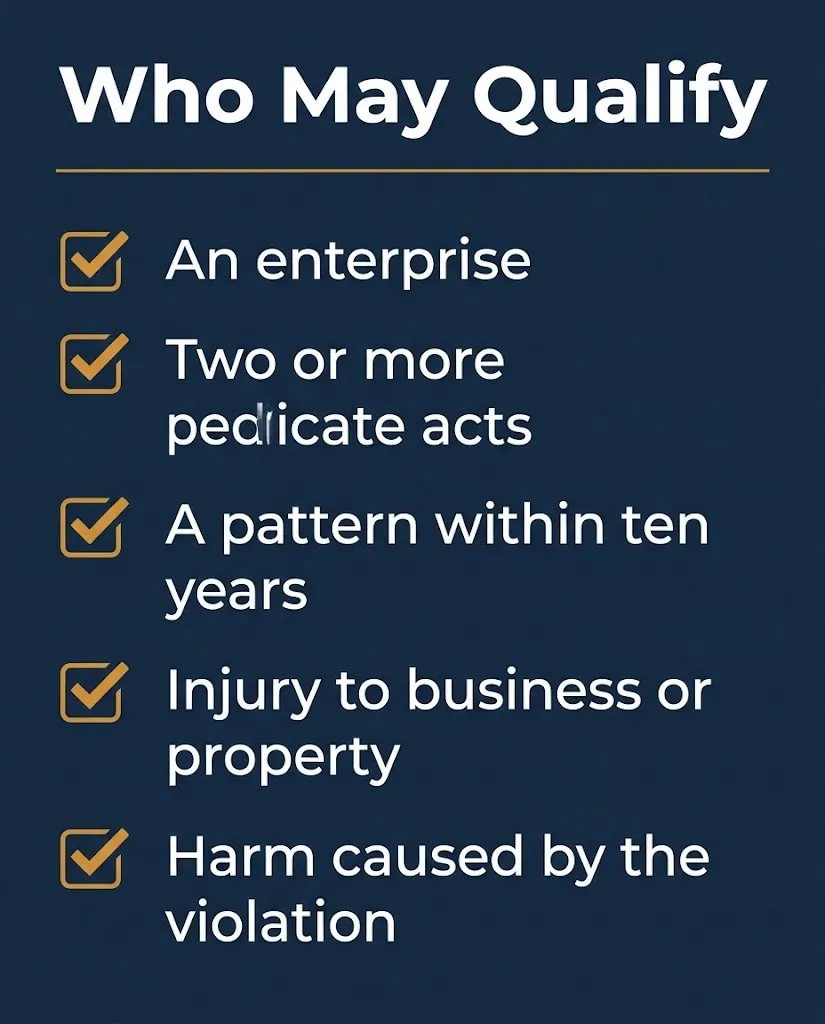
A RICO lawsuit is filed in federal district court and must plead specific elements, usually through a lawyer. Here’s what a complaint generally has to show:
- Identify the enterprise, such as a company, group, or association.
- Identify the person who conducted or took part in it.
- List at least two predicate acts within ten years.
- Plead fraud-based acts with particularity under Rule 9(b).
- Show an injury to your business or property.
- Show the violation proximately caused that injury.
- File in federal court within four years.
Fraud-based claims face the particularity requirement, which means dates, speakers, and specific statements. Vague allegations of a “scheme” are a common reason claims fail. This describes how courts treat these cases and isn’t legal advice.
What is the deadline to file a RICO lawsuit?
The deadline is generally four years, and it runs from when you discovered or should have discovered your injury.
The Supreme Court set the four-year period in Agency Holding Corp. Courts measure it from the date the claim accrued, not from the date of the predicate acts. That difference can add or subtract years.
| Event | Clock effect |
|---|---|
| Predicate act happens | Doesn’t start the clock by itself |
| You discover, or should have discovered, the injury | Four-year clock generally starts |
| Four years pass | A defendant can move to dismiss as untimely |
It works like a warranty claim window. The period often starts when you find the defect, not when the product was made.
Key Takeaway: Write down the date you first learned of the loss, because the four-year clock generally starts there.
What changed for RICO lawsuits in 2026?
Courts in 2026 are testing who has standing to sue, and insurers have won some rulings and lost others.
| Date | Ruling | What it signals |
|---|---|---|
| Jan. 14, 2026 | Fifth Circuit, Allstate Indemnity Co. v. Bhagat | A carrier alleging mail-fraud RICO needn’t plead first-party reliance |
| Aug. 14, 2026 | E.D.N.Y., Union Mutual v. Subin Associates (No. 1:25-cv-02652) | Insurer’s RICO claims dismissed for lack of statutory standing |
The Eastern District of New York judge wrote that the insurer stood at least two steps beyond the alleged racketeering. A new report counts 25 civil RICO actions filed from January 2024 to July 2026 that name attorneys, law firms, or litigation funders. These rulings come from a RICO tracking publication, so check the dockets.
Which RICO lawsuits are in the news right now?
Several RICO lawsuits are live as of October 2026, and all rest on allegations.
| Case | Court | Filed or reported | What’s alleged |
|---|---|---|---|
| New York City v. Asher & Associates | S.D.N.Y. | Oct. 5, 2026 | A personal injury fraud scheme; the city seeks treble damages |
| Six carriers v. C.H. Robinson and TQL | E.D. Texas | Reported Sept. 29, 2026 | Brokers used “illegal carrier” networks tied to wire fraud and forced labor |
| Greater New York Mutual v. Liakas Law | E.D.N.Y. | Jan. 2026 | A 207-page complaint against a law firm and medical providers |
| California tequila suit against Diageo | Federal court | 2025 | Included a RICO count; current status not yet confirmed |
None of these has a final ruling on the RICO merits that I could confirm. Defendants’ full responses aren’t confirmed for every case.
Did the Supreme Court change RICO lawsuits in 2025?
Yes. In Medical Marijuana, Inc. v. Horn, decided April 2, 2025, the Court held 5 to 4 that business or property loss can be recovered even if it came from a personal injury.
Douglas Horn, a truck driver, lost his job after a THC drug test. He blamed a CBD product marketed as THC-free. The Court agreed with the Second Circuit and rejected the “antecedent personal injury” bar that several circuits had used.
The ruling ended a split between the Second and Ninth Circuits on one side and the Sixth, Seventh, and Eleventh on the other. The majority said other limits still constrain civil RICO claims. It doesn’t make pain and suffering recoverable.
Key Takeaway: After Horn, lost income tied to a personal injury can support a RICO claim, but the injury itself still can’t.
What are the elements of a RICO claim?
A RICO plaintiff generally must show an enterprise, a pattern of racketeering, a culpable person, and an effect on interstate commerce. Civil plaintiffs also need injury to business or property that the violation caused.
Think of it as a recipe. Miss one ingredient and the dish fails, which is why defendants attack each element.
- Enterprise: a legal entity or group that carries out the conduct.
- Pattern: at least two predicate acts within ten years.
- Culpable person: someone who knowingly committed predicate acts.
- Interstate commerce: the enterprise’s activities affect it.
- Proximate cause: in Holmes v. SIPC, the Supreme Court said indirectly injured plaintiffs can’t sue.
What counts as a predicate act?
Predicate acts are the crimes listed in 18 U.S.C. § 1961(1). They include mail fraud, wire fraud, extortion, bribery, and many drug offenses.
A pattern needs at least two such acts within ten years. Practitioners say two acts alone rarely suffice, because courts look for continuity or regularity. Isolated incidents can fail.
One exclusion matters. Section 1964(c) bars reliance on conduct that would have been actionable as fraud in the purchase or sale of securities. Courts have applied it to individual and class claims alike, with a narrow exception for defendants criminally convicted of the fraud.
What are the common defenses to a RICO claim?
Defendants commonly argue the claim is late, lacks a pattern, lacks standing, is pleaded too loosely, or is barred by the securities-fraud exclusion.
- Statute of limitations: the four-year period runs from discovery of the injury.
- No pattern: isolated acts or acts too far apart.
- Standing and proximate cause: the injury is too indirect, as in Union Mutual.
- Rule 9(b): fraud predicates need specifics.
- Securities exclusion: the PSLRA bar in § 1964(c).
- Domestic injury: under RJR Nabisco (2016), a private plaintiff must allege and prove a domestic injury.
Key Takeaway: Most civil RICO fights are decided on technical defenses like timing, standing, and pleading, long before a jury.
What’s the difference between civil and criminal RICO?
Civil RICO is a private lawsuit for money, and criminal RICO is a government prosecution for prison, fines, and forfeiture.
| Civil RICO | Criminal RICO | |
|---|---|---|
| Who brings it | A private plaintiff (or the government) | The government |
| Statute | § 1964(c) | § 1963 |
| Main remedy | Treble damages, costs, attorney’s fee | Prison, fines, forfeiture |
| Burden of proof | Lower than in criminal cases | Beyond a reasonable doubt |
Criminal RICO can carry up to 20 years in prison and forfeiture, according to one law firm summary. The Attorney General can also bring civil proceedings under § 1964(b).
Where did RICO come from?
Congress passed RICO in 1970 as part of the Organized Crime Control Act, aiming at racketeering. The same law tells courts to construe it liberally to serve its remedial purposes.
Private plaintiffs adopted it in force by the mid-1980s. In Horn, the majority acknowledged that civil RICO has evolved well beyond its original conception. Justice Jackson’s brief concurrence stressed the liberal-construction instruction.
That history explains today’s debate. Plaintiffs say RICO reaches modern fraud networks, and defendants say it’s turned ordinary disputes into treble-damages suits.
What happens next in a RICO lawsuit?
Most civil RICO cases follow a familiar path, and the timing varies by court.
Expected, first months: The defendant answers or files a motion to dismiss, often on standing, pattern, or pleading.
Expected, if the case survives: The parties exchange evidence in discovery.
Expected, later: The court rules on summary judgment or the case goes to trial.
Expected, after a win: The court trebles proven damages and awards costs and a reasonable fee.
Expected, afterward: Either side may appeal, which adds time.
Frequently Asked Questions
Can an individual file a RICO lawsuit?
Yes, any person injured in business or property by a RICO violation may sue.
The case goes in federal district court.
The injury must be financial, not purely personal.
How much is a RICO lawsuit worth?
It depends on proven damages, which the court triples.
The winner also recovers costs and a reasonable attorney’s fee.
There’s no standard payout.
Is RICO only for the Mafia?
No, civil RICO covers many fraud and bribery schemes.
Recent 2026 filings involve insurers, freight carriers, and a city.
What is the statute of limitations for a RICO claim?
It’s generally four years.
The clock runs from when you discovered, or should have discovered, the injury.
It doesn’t run from the date of the predicate acts.
Can you sue under RICO for securities fraud?
Generally no, because § 1964(c) bars reliance on conduct actionable as securities fraud.
A narrow exception applies to defendants criminally convicted in connection with the fraud.
Why do courts dismiss RICO claims?
Common reasons are lack of standing, no pattern, weak pleading, and lateness.
In August 2026, an E.D.N.Y. judge dismissed an insurer’s claims for lack of statutory standing.
Can a RICO case lead to prison?
Only criminal RICO can, and the government brings those cases.
One law firm summary says penalties can reach 20 years plus forfeiture.
Civil RICO seeks money.
Before you act, write down the date you first learned of your loss. Gather contracts, invoices, emails, and bank records that show business or property harm.
Many plaintiffs then consult a licensed attorney about whether the facts fit RICO. The date to protect: four years from discovery.