Indiana Patient Compensation Fund 2026: The $1.8 Million Cap and How Payouts Work
Quick Answer
- The PCF is a state-administered fund that pays malpractice damages exceeding a provider’s $500,000 cap .
- Total recovery is capped at $1.8 million for malpractice after June 30, 2019 .
- Only qualified providers who pay PCF surcharges get cap protection .
The Indiana Patient’s Compensation Fund is a state-administered pool that pays medical malpractice damages beyond what a qualified health care provider’s insurance covers. It was created in 1975 as part of the Indiana Medical Malpractice Act to stabilize the state’s medical liability system .
If you’re pursuing a malpractice claim in Indiana, the PCF can be the difference between collecting the full value of your damages and being stuck with a provider’s limited policy. The fund pays up to $1.3 million on top of the provider’s $500,000, bringing the total possible recovery to $1.8 million .
This article breaks down how the fund works, who qualifies, how payments are split, the deadlines that govern claims, and what happens if the provider isn’t qualified.
The Facts
| Detail | Status |
|---|---|
| Fund Name | Indiana Patient’s Compensation Fund (PCF) |
| Administrator | Indiana Department of Insurance |
| Total Damage Cap (post-June 2019) | $1.8 million |
| Provider Liability Limit | $500,000 per occurrence |
| PCF Excess Payment | Up to $1.3 million |
| Statute of Limitations | Two years from date of malpractice |
| Minor Exception | Until 8th birthday if under 6 at time of injury |
| Pre-Suit Requirement | Medical Review Panel before filing suit |
| Filing Fee | $5 per defendant plus $2 each additional |
What is the Indiana Patient Compensation Fund?
The Indiana Patient’s Compensation Fund is a state trust fund that pays medical malpractice damages exceeding a qualified health care provider’s individual liability limit . It’s funded entirely by annual surcharges paid by participating providers .
The fund was created in 1975 by the Indiana General Assembly as a core component of the Medical Malpractice Act. The goal was to keep malpractice insurance affordable and maintain access to health care in the state .
Money in the fund doesn’t belong to the state’s general budget. Indiana law requires it to be held in trust, deposited in a segregated account, and invested by the insurance commissioner .
The Indiana Department of Insurance administers the PCF. The department qualifies health care providers, collects surcharges, maintains records, and reviews proposed complaints .
Key Takeaway: The PCF is a state-run excess payment system funded by provider surcharges, not tax dollars. It only pays after a qualified provider’s own liability limit is exhausted.
How much does the Indiana Patient Compensation Fund pay?
The PCF pays up to $1.3 million in excess damages, bringing the total recovery in a qualified malpractice case to $1.8 million . The fund pays nothing until the provider’s $500,000 limit is reached .
Here’s how the split works for malpractice occurring after June 30, 2019:
| Layer | Who Pays | Amount |
|---|---|---|
| First layer | Qualified provider’s insurance | $500,000 |
| Excess layer | Indiana PCF | Up to $1.3 million |
| Total cap | Combined | $1.8 million |
The $1.8 million cap covers all damages combined: economic losses like medical bills and lost income, plus noneconomic losses like pain and suffering . Indiana doesn’t cap only noneconomic damages the way some states do. The total recovery is capped, period.
Not yet determined: No annual maximum payout per claimant exists beyond the cap. The PCF pays as many valid claims as meet statutory requirements, subject to fund solvency .
Reality Check
The PCF is not a shortcut around the malpractice cap. It doesn’t add money on top of the $1.8 million limit. It only fills the gap between the provider’s $500,000 payment and the total cap . If your damages are $400,000, the PCF pays nothing. The provider’s insurance covers it. The fund only activates when damages exceed the provider’s individual limit.
How do you qualify for payment from the Indiana Patient Compensation Fund?
You qualify for PCF payment if a qualified provider’s liability exceeds $500,000 and you have a valid malpractice claim . The provider must have been qualified at the time of the alleged malpractice, not just when you file .
Here’s what determines eligibility:
- The provider must be qualified. They must carry at least $500,000 per occurrence and $1.5 million annual aggregate in malpractice coverage, plus pay PCF surcharges .
- The claim must be malpractice under Indiana law. Not every bad outcome qualifies .
- You must complete the medical review panel process. Indiana requires a pre-suit panel review before litigation against qualified providers .
- The provider’s liability must exceed $500,000. If your total damages are under that amount, the PCF pays nothing .
You can verify whether a provider is qualified through the Indiana Department of Insurance, which maintains the PCF database .
How is a malpractice payment split between the provider and the PCF?
The payment split works in two stages. First, the qualified provider’s insurance pays up to its $500,000 limit. Then the PCF pays the remainder up to the $1.8 million total cap .
This structure affects how settlements are negotiated. A provider’s insurer has no incentive to settle above $500,000 because the PCF handles everything above that amount. The PCF, meanwhile, can challenge whether the MMA applies to your claim at all .
Indiana law requires a specific process for settlements involving the PCF:
- A petition must be filed with the court seeking approval of the agreed settlement .
- The commissioner and provider must receive a copy at least 10 days before filing .
- The commissioner has 20 days to agree or file written objections .
- The court holds a hearing and determines the amount the fund is liable for .
A settlement approved by the court cannot be appealed . A contested judgment can be appealed .
What happens if a health care provider is not qualified?
If a provider is not qualified under the Medical Malpractice Act, the damage cap and PCF payment system do not apply . Your claim proceeds as a standard negligence case.
That means:
- No $1.8 million cap. You can pursue damages above that amount.
- No medical review panel requirement. You can file directly in court .
- The provider’s personal assets are at risk. There’s no PCF backstop .
This is why checking qualification status early matters. A non-qualified provider can be a bigger recovery target, but also a harder one to collect from if they lack insurance.
How long do you have to file an Indiana malpractice claim?
You have two years from the date of the alleged malpractice to file a claim . If the patient is under six years old, the deadline extends to their eighth birthday .
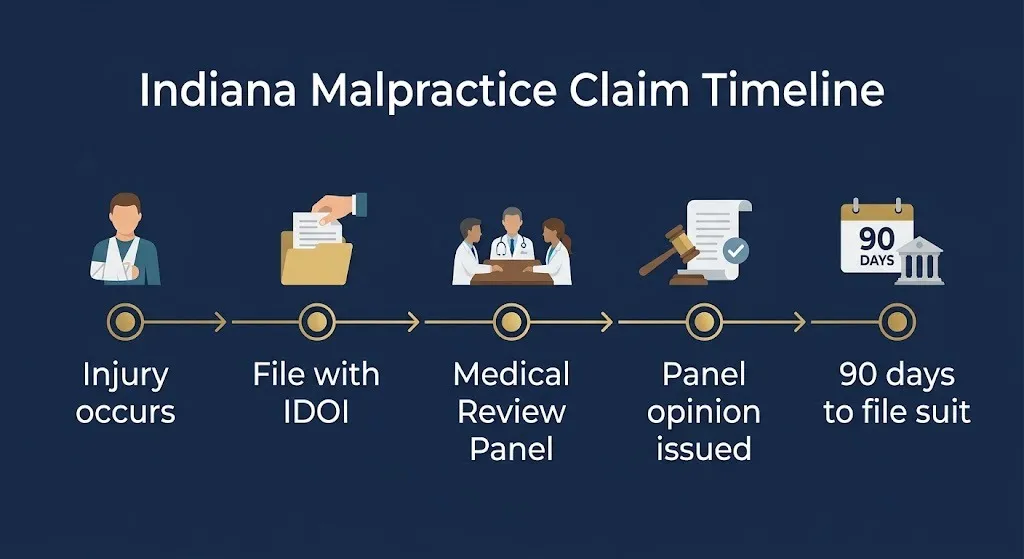
Filing a proposed complaint with the Indiana Department of Insurance tolls the statute of limitations while the medical review panel considers the case, plus 90 days after the panel issues its opinion .
Missing that 90-day window after the panel opinion can permanently bar your claim, even if the malpractice was clear . Indiana courts and the IDOI treat deadlines strictly. Filing a few days late can sink a case.
What is the medical review panel requirement?
Indiana requires most malpractice claims against qualified providers to go through a medical review panel before you can file a lawsuit . The panel issues a nonbinding opinion on whether the provider breached the standard of care.
The panel consists of:
- One non-voting attorney chair
- Three Indiana-licensed health care providers
The panel has 180 days to issue its opinion, though extensions are possible . The opinion doesn’t bind either side, but it shapes settlement negotiations and trial strategy.
You can waive the panel by written agreement from both parties, but you can’t assume waiver just because the other side seems willing .
What happens next
Ongoing: The PCF continues paying excess damages on valid claims against qualified providers.
July 1, 2026: Current PCF surcharge rates remain unchanged from 2025-2026 .
Ongoing: Providers must maintain $500,000 per occurrence and $1.5 million annual aggregate coverage to remain qualified .
TBD: No legislative changes to the $1.8 million cap have been enacted since 2019 .
Frequently Asked Questions
What is the Indiana Patient Compensation Fund?
It’s a state-administered fund that pays medical malpractice damages exceeding a qualified provider’s $500,000 liability limit, up to a total cap of $1.8 million .
How much can you recover from the Indiana PCF?
Up to $1.3 million in excess damages, bringing the combined total with the provider’s payment to $1.8 million .
Who qualifies for PCF payment?
Patients with valid malpractice claims against providers who were qualified under the Medical Malpractice Act at the time of the alleged injury .
What happens if the provider isn’t qualified?
The damage cap and PCF system don’t apply. You can pursue uncapped damages in a standard negligence case .
How long do you have to file an Indiana malpractice claim?
Two years from the date of malpractice. Minors under six have until their eighth birthday .
Do you need a medical review panel before suing?
Yes, for claims against qualified providers. The panel issues a nonbinding opinion before litigation can proceed .
Can the PCF challenge whether your claim qualifies?
Yes. The fund can contest whether the MMA applies to your claim even after you settle with the provider .
How is the PCF funded?
Through annual surcharges paid by qualified health care providers as part of their malpractice insurance premiums .
The Indiana Patient Compensation Fund is a critical backstop for serious malpractice cases, but it only works if the provider is qualified and you follow the procedural rules. Check the provider’s qualification status early, file within two years, and complete the medical review panel process before filing suit.
The single most important number to remember: $1.8 million is the total cap, and the PCF only pays above $500,000 .