Sell My Structured Settlement 2026: How the Process Works and What It Really Costs You
Quick Answer
- Is it real? Yes, selling structured settlement payments is a legal, court-supervised transaction regulated by state law in every U.S. state.
- How much? You will receive less than the face value of your payments; buyers apply a discount rate typically ranging from 9% to 18%, reducing your total cash received.
- Deadline: No universal deadline applies, but court approval adds 45 to 90 days to any transaction, so plan accordingly before committing to a buyer’s offer.
You can sell your structured settlement payments for a lump sum of cash right now. This is a legal, established financial transaction regulated by state law. The catch is that every buyer applies a discount rate to your future payments, meaning you will always receive less than the total face value of what you are selling.
Anyone currently receiving periodic payments from a personal injury settlement, workers’ compensation award, or wrongful death case may be eligible to sell some or all of those future payments. The process requires a judge to approve the transaction in your state’s court before any money changes hands. No buyer can legally pay you without that court order.
This article covers exactly how the process works in 2026, what discount rates actually mean for your wallet, and the specific steps required by law. One fact that surprises most sellers is that you can sell a portion of your payments, not just all of them, giving you more flexibility than most buyers advertise.
The Facts
| Feature | Details |
|---|---|
| Process | Structured settlement factoring transaction |
| Legal Status | Legal in all 50 states under structured settlement protection acts |
| Governing Law | IRC Section 5891; individual state structured settlement protection acts |
| Typical Discount Rate | 9% to 18% (varies by buyer, payment schedule, and state) |
| Court Approval Required | Yes, mandatory in every state before payment |
| Timeline | 45 to 90 days from application to receipt of funds |
| Proof Needed | Original settlement agreement, annuity policy details, government-issued ID |
Is selling your structured settlement payments legal?
Selling structured settlement payments is completely legal in every U.S. state. The transaction is called a “structured settlement factoring transaction” under federal law. Congress codified the rules in Internal Revenue Code Section 5891, which was enacted in 2002. That law imposes a 40% excise tax on any buyer who purchases your payments without obtaining a court approval order, which is why every legitimate buyer files for court approval before paying you.
Every state has its own structured settlement protection act (SSPA). These laws set the rules for how buyers must treat sellers, what disclosures are required, and what the court must find before approving the sale. The court must determine that the transfer is in your “best interest,” considering your financial situation, your dependents, and whether you have independent legal advice.

The legal framework exists precisely because sellers were historically taken advantage of by aggressive buyers. The 2002 federal law and the state SSPAs together created a consumer protection system. It is not perfect, but it does require a neutral judge to review the deal before your money moves.
How much cash will you actually get when you sell your structured settlement?
The amount of cash you receive when you sell your structured settlement depends on the discount rate your buyer applies and the total value of the payments you are selling. The discount rate is the buyer’s profit margin, expressed as a percentage. A higher discount rate means less money for you.
Discount rates in 2026 typically range from 9% to 18% annually. That range is not a small spread. On a $100,000 payment stream, the difference between a 9% and an 18% discount rate can mean tens of thousands of dollars less in your pocket.
Here is how the math works in plain terms. If you are owed $100,000 in future payments and a buyer applies a 12% discount rate, you might receive approximately $75,000 to $85,000 today, depending on the timing and structure of those payments. The buyer earns the difference by collecting your full future payments over time.
| Illustrative Example | Detail |
|---|---|
| Face Value of Payments Being Sold | $100,000 (example only) |
| Buyer Discount Rate Applied | 12% (illustrative range: 9% to 18%) |
| Approximate Lump Sum Received | Less than face value; get competing quotes to compare |
| Buyer’s Profit | The gap between what you receive and what they collect |
Reality Check: If a company contacts you unsolicited with an offer to buy your settlement, treat that call with skepticism. Aggressive buyers often cold-call structured settlement recipients using public court records. Their first offer is rarely their best offer. Getting quotes from at least three buyers before signing anything is the single most effective way to protect yourself, and it costs you nothing.
How do you sell your structured settlement payments step by step?
Selling your structured settlement payments is a multi-step, court-supervised process. It is not as fast as refinancing a car loan. Think of it like selling a house: there is paperwork, a waiting period, and a third party (the court) that must sign off before the deal closes.
- Gather your original settlement agreement and annuity policy documents.
- Contact at least three structured settlement buyers to request written quotes.
- Compare each quote’s effective discount rate, not just the lump sum offered.
- Select a buyer and review their purchase agreement carefully before signing.
- Confirm that the buyer will handle all court filing costs and legal fees on your behalf.
- Your buyer files a petition in your state court requesting approval of the transfer.
- You receive a “best interest” hearing notice; attend this hearing or confirm its date.
- A judge reviews the transaction and issues an approval order if it meets legal standards.
- After the court order is issued, your buyer releases your lump sum payment.
Each state has slightly different procedural requirements for steps 6 through 9. Some states require you to have independent legal counsel. Others require a specific waiting period between application and hearing. Your buyer’s legal team handles most of the court paperwork, but you remain the party the judge is protecting.
What discount rate should you expect when selling structured settlement payments?
The discount rate you can expect when selling structured settlement payments in 2026 ranges from approximately 9% to 18%, depending on several factors. This rate is the most important number in the entire transaction. It determines how much of your money you keep.
Lower discount rates are better for you. A buyer offering a 9% rate gives you significantly more cash than one offering 18%. Rates vary based on the total value of your payments, how far in the future they are scheduled, the financial strength of the annuity issuer, and how competitive the buyer wants to be for your business.
The annuity issuer’s credit rating matters because buyers price risk. If your payments come from a top-rated insurance company, the buyer sees lower risk and may offer a better rate. Payments from a less financially secure issuer carry more uncertainty for the buyer, which often results in a higher discount rate applied to you.
| Factor | Effect on Your Discount Rate |
|---|---|
| Payments far in the future | Higher discount rate (more risk for buyer) |
| Payments from highly rated insurer | Lower discount rate (less risk) |
| Large total payment value | Potentially lower rate (economies of scale) |
| Strong competition among buyers | Lower rate (shop around) |
| Urgency on your part | Higher rate (buyers sense desperation) |
Can you sell just part of your structured settlement?
You can sell a portion of your structured settlement payments rather than the entire remaining stream. This is called a “partial transfer,” and it is one of the most under-discussed options in the industry. Most buyers prefer to purchase larger blocks of payments because it is more profitable for them. That does not mean partial sales are unavailable.
A partial sale works by selecting specific future payments to sell while retaining others. For example, you might sell five years of monthly payments while keeping everything scheduled after that. The court approves only the transferred portion. Your remaining payments continue arriving unchanged.
This flexibility is genuinely useful. If you need a specific amount of cash for a medical expense or a home repair, a partial sale can cover that need without sacrificing your entire long-term income stream. You should ask every buyer you contact whether they handle partial transfers and what their minimum transaction size is.
Key Takeaway: Selling only a portion of your structured settlement payments is legally available and can protect your long-term financial security while still getting you the cash you need today.
What documents do you need to sell your structured settlement?
The documents you need to sell your structured settlement are primarily those that prove ownership of the payments and define the payment schedule. Missing any of these will delay your transaction by weeks. Gathering them before you contact buyers speeds the entire process.
- Original settlement agreement: The signed document from your original lawsuit resolution.
- Annuity policy or contract: Issued by the life insurance company funding your payments.
- Recent payment statements: Showing your current payment schedule and amounts.
- Government-issued photo ID: Driver’s license or passport for identity verification.
- Social Security number: Required for tax documentation of the transaction.
- Any prior transfer orders: If you have sold payments before, provide those court orders.
- Proof of guardianship: Required if you are selling on behalf of a minor.
If you do not have your original settlement agreement, your attorney from the original case may have a copy. The annuity company issuing your payments can also provide policy documents. Contacting the annuity issuer early is a good idea because they must be notified of any transfer under most state laws.
How long does it take to sell a structured settlement in 2026?
Selling a structured settlement takes 45 to 90 days from the moment you sign a purchase agreement to the moment cash arrives in your account. This timeline is driven almost entirely by the court approval requirement, not by the buyer’s processing speed.
The court scheduling process is the biggest variable. Some state courts schedule structured settlement transfer hearings quickly, within 30 days of filing. Others have backlogs that push hearings to 60 or 75 days out. Your buyer’s legal team will file the petition and monitor the docket, but neither you nor the buyer can force a court to schedule faster.
Planning for 60 days is a safe assumption for most sellers in 2026. If a buyer promises you cash in two weeks, ask them specifically how they plan to get court approval in that time. If they cannot explain it, the timeline is not realistic. Legitimate buyers know the court process and give honest timelines.
What is the court approval process for selling structured settlement payments?
The court approval process for selling structured settlement payments is a mandatory legal hearing where a judge reviews your transaction before it can proceed. This process is required by every state’s structured settlement protection act. No legitimate buyer can skip it.
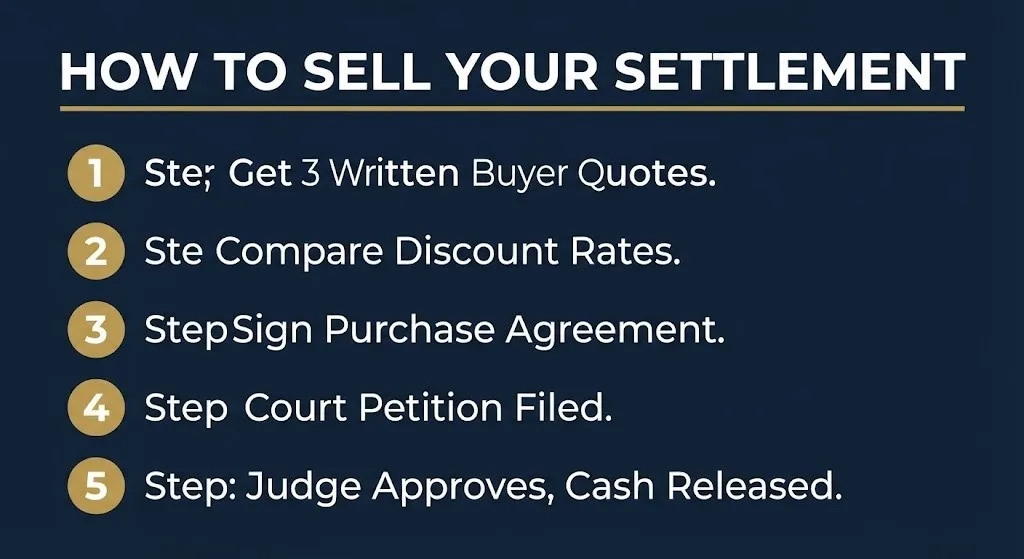
The buyer’s attorneys file a petition in the court of your state of residence. The petition includes the purchase agreement, the discount rate, your financial situation as you have described it, and a statement about why the sale is in your best interest. The annuity issuer and the original defendant or their insurer are notified and have the right to object.
At the hearing, the judge may ask you questions directly. They want to confirm that you understand the transaction, that you are not being pressured, and that selling is genuinely in your financial interest. If the judge is not satisfied, they can deny the petition. This does not happen often when buyers follow the legal requirements, but it is a real protection for you.
Key Takeaway: Court approval is not a formality. A judge must affirmatively find that selling your payments is in your best interest, and they can and do reject transactions that appear exploitative or financially harmful to the seller.
What are the tax implications of selling your structured settlement?
The tax implications of selling your structured settlement are largely favorable because of how the original settlement was structured. Under IRC Section 104, payments from personal injury or physical sickness settlements are generally excluded from federal income tax. When you sell those tax-free payments for a lump sum, the lump sum itself is generally also tax-free.
This is one of the most important financial advantages of a structured settlement sale compared to other types of asset sales. If you had a savings account and withdrew a large sum, you would owe taxes on the interest. With a personal injury structured settlement sale, the lump sum typically carries the same tax exclusion as the original payments.
There are exceptions. Workers’ compensation payments, punitive damages, and emotional distress awards not connected to physical injury may have different tax treatment. You should verify the original tax status of your settlement with a qualified tax professional before completing any sale. The buyer cannot advise you on your personal tax situation.
What are the risks of selling your structured settlement?
The biggest risk of selling your structured settlement is permanently giving up guaranteed future income for a reduced lump sum today. Once a court approves the transfer and you receive your cash, that decision is final. You cannot undo a completed structured settlement sale.
The second major risk is working with a predatory buyer. Some companies in this industry use high-pressure sales tactics, misleading discount rate disclosures, and contract language designed to obscure the true cost of the transaction. Getting independent legal advice before signing any contract is the strongest protection against these practices.
A third risk involves selling more payments than you actually need. Buyers profit by purchasing more, so they often encourage sellers to transfer larger blocks. If you only need $20,000 today, selling $150,000 worth of future payments is almost certainly not in your financial interest. The court is supposed to catch this, but the judge relies on the information you provide.
How to compare structured settlement buyers and avoid bad deals
Comparing structured settlement buyers requires looking at the effective discount rate, not just the lump sum number in the headline offer. A buyer might advertise “$75,000 cash today” but the discount rate behind that number could be 17%. Another buyer might offer $72,000 at a 10% rate. Over the life of your payments, the second offer is the better deal despite the smaller initial number.
Request a written quote that includes the total face value of payments being purchased, the lump sum offered, and the effective annual discount rate. Any legitimate buyer will provide this in writing. If they refuse to put the discount rate in writing, stop talking to them.
Key questions to ask every buyer before signing:
- What is your effective annual discount rate on this transaction?
- Will you pay all court filing fees and legal costs?
- How long has your company been in business, and are you registered with your state?
- Do I need my own independent attorney, and will you cover that cost?
- What happens if the court denies the petition?
What happens after the judge approves the sale of your settlement?
After the judge approves the sale of your structured settlement payments, the transfer order is entered into the court record. The buyer’s attorneys then serve the annuity issuer with the court order. This instructs the insurance company to redirect future payments to the buyer instead of to you.
The buyer then releases your agreed lump sum to you. Payment typically arrives within 3 to 7 business days of the court order being issued, depending on the buyer’s internal processing and your chosen payment method. Most buyers offer wire transfer or check.
Your remaining payments, if you did a partial sale, continue arriving from the annuity issuer on their original schedule. You should confirm directly with the annuity issuer that the redirect is set up correctly and that your retained payments are not affected. This confirmation step takes one phone call and can prevent confusion later.
What are the alternatives to selling your structured settlement?
Selling your structured settlement is not your only option if you need cash. Several alternatives exist and may serve you better depending on your specific financial situation. Each has its own costs and trade-offs.
- Structured settlement loans: Some companies offer loans against future settlement payments. These are technically separate financial products, not sales, but they carry their own fees and risks.
- Personal loans: If your credit is strong, a personal loan from a bank or credit union may carry a lower effective cost than a settlement sale discount rate.
- Home equity line of credit: If you own property, a HELOC may offer lower rates than a settlement buyer’s discount.
- Negotiating with creditors: If debt is driving the need for cash, many creditors will negotiate directly without requiring you to liquidate assets.
- Government assistance programs: Depending on your situation, hardship programs for utilities, medical bills, or housing may reduce the cash need.
None of these alternatives works for everyone. If your credit is poor or your financial need is urgent, a structured settlement sale may genuinely be the best available option. The key is to evaluate alternatives before committing, not after.
Key Takeaway: Exploring alternatives including personal loans, credit lines, and creditor negotiations before selling your structured settlement could save you tens of thousands of dollars compared to a high-discount-rate transfer.
What Happens Next
- Immediately: Contact at least three licensed structured settlement buyers to request written discount rate quotes before signing anything.
- Within 1 to 2 weeks: Gather your original settlement agreement, annuity policy, and payment statements to have ready when you select a buyer.
- Within 2 to 4 weeks of signing: Your chosen buyer files the court petition in your state; you receive a hearing notice with a scheduled date.
- Expected 45 to 90 days from signing: Your court hearing takes place and the judge issues an approval order, or requests additional information.
- Within 3 to 7 business days of approval: Your lump sum is released by the buyer via wire transfer or check after the court order is served on the annuity issuer.
Frequently Asked Questions
Can I sell my structured settlement if it is from a workers’ compensation case?
Workers’ compensation structured settlements have additional restrictions in many states beyond standard personal injury settlements.
Some states prohibit the sale of workers’ compensation structured settlement payments entirely.
Check your specific state’s workers’ compensation laws or consult a licensed attorney before proceeding.
How do I find a reputable structured settlement buyer?
Look for buyers who are members of the National Association of Settlement Purchasers and have verifiable business histories.
Ask each buyer for their state registration information and check for complaints with your state attorney general’s office.
Always get at least three written quotes with discount rates disclosed in writing before choosing.
Will selling my structured settlement affect my government benefits?
Receiving a large lump sum may affect eligibility for means-tested programs like Medicaid or Supplemental Security Income.
The specific impact depends on the program rules and the amount of cash received.
Consult a benefits counselor or attorney before selling if you receive any government assistance.
Can a minor’s structured settlement be sold?
A minor’s structured settlement can be sold, but courts apply even stricter scrutiny to these transactions.
A parent or legal guardian must petition the court, and the judge will give extra weight to the child’s long-term financial security.
Many courts require independent legal representation for the minor in these transactions.
What if my buyer’s court petition gets denied?
If the court denies the petition, the transfer does not happen and you receive no cash from that buyer.
You may refile with a revised agreement that addresses the judge’s concerns, or choose a different buyer with better terms.
A denial does not permanently bar you from selling; it simply means the specific deal as structured was not approved.
Do I have to sell all of my remaining payments?
No, you can sell a specific portion of your future payments while retaining others through a partial transfer.
Buyers set their own minimum transaction sizes, so ask each buyer about their partial sale policy upfront.
A partial sale preserves more of your long-term income while still getting you the cash you need today.
How is the discount rate different from an interest rate?
The discount rate and an interest rate measure similar concepts but from opposite directions.
An interest rate tells you how much you pay to borrow money; a discount rate tells you how much of your future value a buyer takes as profit.
A higher discount rate always means less cash for you, just as a higher interest rate means more you pay on a loan.
Can the annuity company block my sale?
The annuity company issuing your payments cannot block an approved court order, but they must be notified and have the right to object at the hearing.
In most cases, annuity issuers do not actively oppose transfers that comply with state law.
Some original settlement agreements contain anti-assignment clauses that courts may consider, though many states have laws limiting the enforceability of those clauses against transfers.
Before you sign anything, pull your original settlement agreement and locate your annuity issuer’s contact information. Those two documents are the foundation of any transaction. Request written quotes from at least three buyers this week and compare the discount rates side by side.
The court approval process is your strongest protection in this transaction. A judge who finds your deal exploitative can and will reject it. That protection only works if you show up to your hearing informed and prepared. The 45 to 90 day timeline is the one number to keep in your calendar from this day forward.