Agent Orange Compensation Back Pay 2026: Who Qualifies, How Nehmer Works, and What You Can Claim
Quick Answer
- Agent Orange back pay is VA disability compensation retroactive to your claim’s effective date, not the date of exposure.
- Nehmer court rules can push effective dates back decades for previously denied claims involving specific conditions.
- There is no deadline to file, but the VA must receive your Intent to File to lock in today’s date.
The Agent Orange compensation system is not a settlement fund. There is no claims administrator mailing checks. It is a benefits program run by the Department of Veterans Affairs, and the money you receive depends on when the VA says your disability began, not when you served in Vietnam.
That distinction matters because thousands of veterans and surviving spouses have left money on the table by assuming back pay works like a class action payout. It doesn’t.
Back pay in the VA system is called retroactive compensation. It accrues from your effective date, which is a legal determination the VA makes based on your claim history and the Nehmer court orders. For some veterans, that date reaches back to the 1980s. For others, it starts the day the VA received their paperwork.
This guide covers who may qualify, how Nehmer changes the math, what conditions are presumptive in 2026, how to file, and the documentation that actually moves a claim forward.
The Facts
| Program Type | VA disability compensation, not a class action settlement |
| Eligible Groups | Vietnam veterans, Blue Water Navy, certain locations outside Vietnam |
| Presumptive Conditions | 14+ conditions including cancers, diabetes, heart disease, Parkinson’s |
| Back Pay Basis | Effective date under 38 CFR 3.816 (Nehmer) or standard rules |
| Claim Deadline | None, but Intent to File locks in your effective date |
| Filing Form | VA Form 21-526EZ |
| Survivor Form | VA Form 21P-534EZ |
| Nehmer Retroactive Total | Over $4.9 billion paid since the consent decree |
Is Agent Orange compensation back pay legit or a scam?
Agent Orange compensation back pay is a legitimate VA benefits program governed by federal law. The Nehmer consent decree, the Agent Orange Act of 1991, and the PACT Act of 2022 all created and expanded the legal basis for these payments.
That legitimacy creates a scam opportunity. Companies that charge fees to “find” your Agent Orange benefits are unnecessary. Accredited Veterans Service Organizations file claims for free.
Here’s what the real process looks like:
- You file a claim with the VA, either online, by mail, or through an accredited representative.
- The VA reviews your service records and medical evidence.
- If you have a presumptive condition and qualifying service, the VA grants service connection.
- The VA assigns an effective date and calculates retroactive pay.
No legitimate service asks for your credit card before filing. No one calls you first saying you’re owed Agent Orange money. The VA contacts veterans directly when it identifies potential eligibility, like the readjudication program that began in April 2021 for approximately 70,000 Blue Water Navy veterans.
If someone promises a specific back pay amount before reviewing your records, that’s a warning sign. Effective dates are fact-specific.
How is Agent Orange back pay calculated?
Agent Orange back pay is calculated by multiplying your monthly disability rating by the number of months between your effective date and the date the VA grants your claim. The rating comes from the severity of your condition. The effective date comes from your claim history.
The math has two parts:
| Factor | What It Determines |
|---|---|
| Disability rating (0% to 100%) | Monthly compensation amount |
| Effective date | How far back the VA pays |
| Dependents | Additional monthly amounts for spouse and children |
| Special Monthly Compensation | Extra pay for specific severe conditions |
A veteran rated 100% for active prostate cancer receives $3,938.58 per month in 2026 as a single veteran. If the effective date reaches back two years, that’s over $94,000 in retroactive pay.
Nehmer claims change the calculation because they often result in effective dates that predate the regulation establishing the presumption. If the VA denied your claim in the late 1980s for a condition now recognized as Agent Orange-related, Nehmer may require an effective date back to that original denial.
Not yet determined applies until the VA completes its review. The amount depends on your rating, your dependents, and whether the Nehmer rules apply to your claim history.
Key Takeaway: The two variables that matter most in any back pay calculation are your disability rating and your effective date, and the effective date is where most errors and disputes happen.
What is the Nehmer ruling and how does it affect back pay?
The Nehmer ruling is a 1991 consent decree in Nehmer v. U.S. Department of Veterans Affairs that requires the VA to pay retroactive benefits to veterans and survivors whose Agent Orange claims were previously denied. It is the single most important legal development for Agent Orange back pay.
Three groups may qualify as Nehmer class members:
- A Vietnam veteran with a covered herbicide disease.
- A surviving spouse of a deceased Vietnam veteran who died from a covered herbicide disease.
- A surviving child or parent of a deceased Vietnam veteran who died from a covered herbicide disease.
The Nehmer effective date rules work like this:
| Claim Scenario | Effective Date Rule |
|---|---|
| Denied between Sept. 25, 1985 and May 3, 1989 | Later of the date VA received the claim or the date disability arose |
| Pending or filed between May 3, 1989 and the regulation date | Later of the date VA received the claim or the date disability arose |
| Claim filed within 1 year of discharge | Day following separation from active service |
The consent decree has paid over $4.9 billion in retroactive benefits to hundreds of thousands of veterans and families since 1991.
A separate but related issue involves veterans who filed direct service connection claims before the PACT Act and also have presumptive eligibility. A 2025 Federal Circuit decision held that the VA must adjudicate the direct service connection claim separately, because those claims are “separate and distinct” from PACT Act claims.
How do you file an Agent Orange claim in 2026?
You file an Agent Orange claim by submitting VA Form 21-526EZ to the Department of Veterans Affairs. The form is available online, at VA regional offices, or through an accredited representative who can file on your behalf.
Here are the steps:
- File an Intent to File. VA Form 21-0966 locks in today’s date as your potential effective date while you gather evidence.
- Get a current diagnosis. Every condition you claim must be documented in medical records.
- Gather service records. Your DD-214 and, for Blue Water Navy veterans, ship documentation.
- Complete VA Form 21-526EZ. List every presumptive condition you have. The VA rates each separately.
- Submit medical and service evidence. Include treatment records and proof of qualifying service location.
- Consider a Fully Developed Claim. Submitting all evidence upfront can speed adjudication.
- Respond to VA requests. If the VA asks for more information, provide it promptly.
The VA’s Inspector General found that incorrect effective dates affected nearly a quarter of PACT Act claims reviewed. That means reviewing your decision letter carefully matters as much as filing correctly.
Reality Check: No one texts you VA back pay before you file a claim. The VA does not ask for bank account information over the phone to “release” retroactive benefits. If someone contacts you first claiming you’re owed Agent Orange money and needs payment or personal information to process it, that’s a scam. Real VA benefits start with your application, not a cold call.
Which Agent Orange presumptive conditions qualify for back pay in 2026?
The VA presumes service connection for 14 Agent Orange conditions under 38 CFR 3.309(e), and the PACT Act added hypertension and monoclonal gammopathy of undetermined significance in 2022.
The current presumptive list includes:
| Condition | Type |
|---|---|
| AL amyloidosis | Blood disorder |
| Chronic B-cell leukemias | Cancer |
| Chloracne | Skin condition |
| Diabetes mellitus Type 2 | Metabolic |
| Hodgkin lymphoma | Cancer |
| Ischemic heart disease | Cardiovascular |
| Multiple myeloma | Cancer |
| Non-Hodgkin lymphoma | Cancer |
| Parkinson’s disease | Neurological |
| Peripheral neuropathy, early-onset | Neurological |
| Porphyria cutanea tarda | Skin condition |
| Prostate cancer | Cancer |
| Respiratory cancers | Cancer |
| Soft-tissue sarcoma | Cancer |
| Hypertension (PACT Act) | Cardiovascular |
| MGUS (PACT Act) | Blood disorder |
If you have any condition on this list and served in a qualifying location, you may qualify for service connection without proving a direct link between the condition and your service.
Secondary conditions count too. If your ischemic heart disease causes erectile dysfunction, that’s a separate claim. If your diabetes leads to neuropathy, that can be rated separately.
Who qualifies for Agent Orange compensation in 2026?
You may qualify for Agent Orange compensation if you served in a qualifying location during a qualifying time period and have a current diagnosis of a presumptive condition. The VA presumes exposure based on your service record, not on proof you handled the chemical.
The qualifying locations expanded under the PACT Act to include:
- The Republic of Vietnam between January 9, 1962 and May 7, 1975
- Blue Water Navy service within 12 nautical miles of Vietnam
- Thailand at U.S. or Royal Thai bases between January 9, 1962 and June 30, 1976
- Laos between December 1, 1965 and September 30, 1969
- Cambodia at Mimot or Krek, Kampong Cham Province, April 16 to April 30, 1969
- Guam or American Samoa between January 9, 1962 and July 31, 1980
- Johnston Atoll between January 1, 1972 and September 30, 1977
- Korean DMZ between 1968 and 1971
The Blue Water Navy Vietnam Veterans Act of 2019 extended the presumption to sailors who operated offshore, effective January 1, 2020.
Surviving spouses, dependent children, and dependent parents of deceased veterans who died from a covered herbicide disease may qualify for Dependency and Indemnity Compensation (DIC) and retroactive benefits under Nehmer.
What conditions are covered for survivors and dependents?
Survivors and dependents may qualify for DIC and other benefits if a veteran died from an Agent Orange presumptive condition. The Nehmer consent decree applies to survivors too, and retroactive DIC payments can reach back to the original denial date.
The DIC benefit for an eligible surviving spouse is over $1,600 per month, plus additional amounts for dependent children.
Children of Vietnam veterans born with spina bifida may qualify for monthly benefits, VA healthcare, and vocational rehabilitation under 38 USC 1821. Children of women Vietnam veterans born with certain birth defects have a separate benefit program under 38 USC 1815.
Survivors should file VA Form 21P-534EZ to apply for DIC, Survivors Pension, or accrued benefits. The form was revised in August 2025, and the Blue Water Navy provision applies to survivors of veterans whose claims were previously denied.
What happens next in your Agent Orange back pay claim?
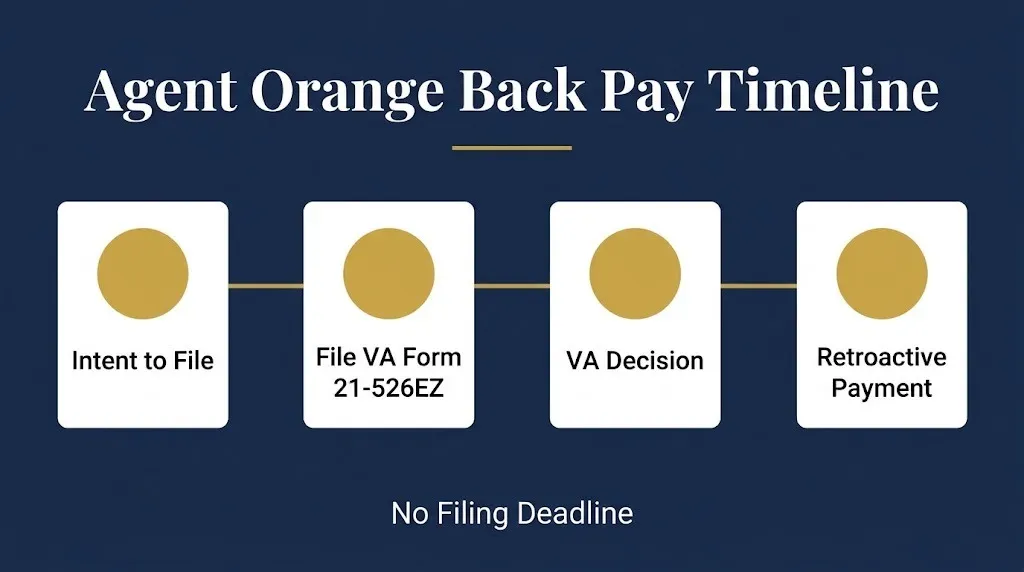
Immediately: File an Intent to File (VA Form 21-0966) to lock in your effective date.
Within weeks: Gather your DD-214, medical records, and ship documentation if applicable.
Within months: Submit VA Form 21-526EZ with all evidence.
Within 4 to 8 months (estimated): The VA reviews and issues a decision. Timelines vary widely by regional office backlog.
If denied: You have one year to appeal through Supplemental Claim, Higher-Level Review, or the Board of Veterans’ Appeals.
If approved: Retroactive pay is issued based on your effective date, and monthly compensation begins.
Frequently Asked Questions
Is there a deadline to file for Agent Orange back pay?
No. There is no deadline to apply for VA disability benefits. But filing an Intent to File locks in today’s date as your potential effective date, which directly affects how much back pay you may receive.
How far back can Agent Orange back pay go?
Under Nehmer rules, back pay can reach back to the date of a previously denied claim if that claim was for a condition now recognized as Agent Orange presumptive. Some effective dates reach into the 1980s.
Do I need to prove I was exposed to Agent Orange?
No. If you served in a qualifying location during a qualifying time period, the VA presumes exposure. You need to prove service location and a current diagnosis.
What if my Agent Orange claim was denied years ago?
You can file a Supplemental Claim with new evidence. The VA reviews previously denied claims under Nehmer and may grant retroactive benefits if your condition is now presumptive.
What is the PACT Act deadline for back pay?
The PACT Act’s one-year window for expanded back pay ran through August 9, 2023. Claims filed after that date still qualify for disability compensation but may not receive the same retroactive treatment.
Can surviving spouses claim Agent Orange back pay?
Yes. Surviving spouses, dependent children, and parents may qualify for DIC and retroactive benefits if the veteran died from a covered herbicide disease. File VA Form 21P-534EZ.
What is a Nehmer claim?
A Nehmer claim is a disability or DIC claim that falls under the 1991 consent decree in Nehmer v. U.S. Department of Veterans Affairs. It requires the VA to pay retroactive benefits based on the original claim date for previously denied Agent Orange conditions.
How long does a VA Agent Orange claim take?
Processing times vary. The VA’s average claim processing time has been reported at nearly 280 days in past backlogs, with some regional offices averaging over 500 days. Fully Developed Claims may move faster.
The Bottom Line
Agent Orange back pay is not a settlement. It’s retroactive VA compensation tied to your effective date, and the Nehmer consent decree is the reason many veterans and survivors receive decades of back pay. There is no filing deadline, but the Intent to File locks in your date.
The VA’s own data shows effective date errors affect a significant share of PACT Act claims. Review your decision letter carefully. If something looks wrong, appeal within one year. Your retroactive payment may depend on it.