Liletta IUD Lawsuit 2020: The Original Claims and Where They Stand in 2026
Quick Answer
- The Liletta IUD lawsuit is not a single case or settlement. Claims filed in 2020 were individual product liability and malpractice lawsuits.
- No Liletta MDL or class action settlement exists as of October 2026. Payouts, if any, depend on individual case outcomes.
- The FDA reviewed Liletta safety data through December 2024 and identified no new safety concerns .
If you are searching for the Liletta IUD lawsuit from 2020, you are likely trying to figure out what happened to claims filed around that time. The short answer: those were individual injury lawsuits, not a coordinated settlement. No national Liletta settlement fund exists.
The Liletta IUD was approved by the FDA on February 26, 2015, for pregnancy prevention . Unlike the Mirena IUD, which faced thousands of consolidated lawsuits in a multidistrict litigation, Liletta has not generated a comparable wave of federal court consolidation .
This article breaks down what the 2020-era lawsuits actually claimed, why no mass settlement has formed, and what your options are if you believe you were injured by Liletta. One key detail: the FDA’s most recent pediatric safety review found no new safety signals and no deaths directly associated with the device .
The Facts
| Case | Liletta IUD Litigation (individual claims, no MDL or class action) |
|---|---|
| Status | No nationwide settlement. Individual lawsuits only. |
| Fund Size | Not yet confirmed |
| Est. Per Person | Not yet determined |
| Claim Deadline | State-specific statute of limitations applies |
| Administrator | Not yet appointed |
| Proof Needed | Medical records, surgical reports, device identification |
Is the Liletta IUD Lawsuit Legit or a Scam Risk?
The Liletta IUD lawsuit is a legitimate legal avenue for women who believe they were injured by the device. Individual product liability and medical malpractice claims have been filed against manufacturers and healthcare providers .

The scam risk comes from two directions. First, some websites promote a “Liletta settlement” that does not exist. There is no active settlement fund to claim from as of October 2026. Second, unlicensed “claim helpers” may charge fees to file claims that a licensed attorney would handle on contingency.
Legitimate product liability attorneys do not charge upfront fees. They work on contingency, meaning they get paid only if you recover. If someone asks for payment before filing, that is a red flag.
Key Takeaway: The Liletta IUD lawsuit is real, but there is no settlement fund. Legitimate attorneys work on contingency with no upfront fees.
How Much Could You Get From a Liletta IUD Lawsuit?
There is no confirmed settlement amount for Liletta IUD claims because no settlement has been announced. The amount you could recover depends on the specific injuries, medical costs, lost wages, and legal claims you can prove .
Individual product liability cases can recover medical expenses, lost income, pain and suffering, and potentially punitive damages. But these amounts vary widely by case. A successful claim for surgical removal of a migrated IUD might recover thousands of dollars in medical costs. A claim involving permanent organ damage or hysterectomy could recover far more.
Not yet determined: No per-person payout has been established for Liletta claims. Any recovery depends on individual case facts and whether a settlement or verdict is reached.
Key Takeaway: Without a settlement fund, there is no fixed payout. Recovery depends on individual case outcomes and proven damages.
What Did the 2020 Liletta IUD Lawsuits Claim?
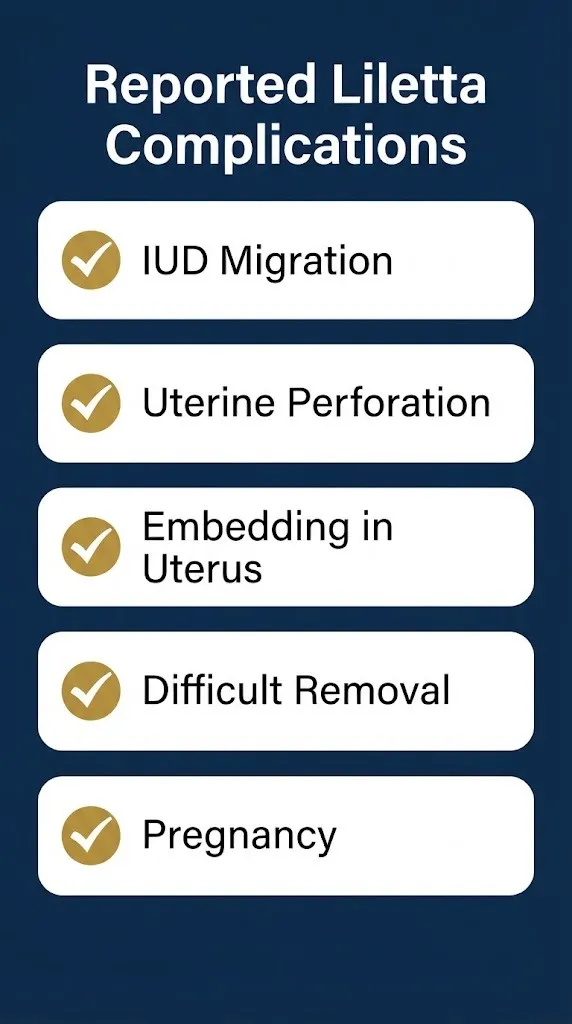
The lawsuits filed around 2020 typically alleged that the Liletta IUD caused injuries including migration, embedding in the uterus, and difficulty with removal. Some claims also alleged that healthcare providers failed to diagnose pregnancy or properly check the device .
One documented case involved a woman who had a Liletta IUD placed in 2015 and later learned she was 31 weeks pregnant. She had gone for an IUD check when she was already 14 or 15 weeks pregnant, but the nurse practitioner did not detect the pregnancy . The case settled confidentially .
Another category of claims involves IUD migration. Women reported that the device moved from its proper position or became embedded in the uterine wall, requiring surgical removal . Some cases alleged that the device perforated the uterus .
Product liability claims against the manufacturer would need to show that the device was defectively designed or manufactured, or that the manufacturer failed to warn of known risks .
Why Is There No Liletta MDL or Class Action?
There is no Liletta MDL or class action because the number of federal lawsuits has not reached the threshold that triggers consolidation. The Mirena IUD, by contrast, faced thousands of lawsuits that were consolidated into a multidistrict litigation .
MDL consolidation happens when the Judicial Panel on Multidistrict Litigation determines that centralizing similar cases would serve convenience and efficiency. For Liletta, the volume of federal claims has not been high enough to warrant that step.
Class actions are also poorly suited to product liability injury claims. Each plaintiff has different injuries, different medical histories, and different damages. That makes individual lawsuits more appropriate than a single class action .
Key Takeaway: Liletta lawsuits remain individual claims because the volume has not triggered MDL consolidation and the injuries are too varied for a class action.
Reality Check: No one can promise you a Liletta settlement payout because no settlement exists. Any website or service claiming there is a “Liletta settlement fund” you can claim from is misleading you. Product liability claims must be evaluated individually.
What Are the Reported Side Effects of the Liletta IUD?
The most commonly reported Liletta side effects include irregular bleeding, spotting, pelvic pain, and mood changes. The FDA’s safety review identified no new safety signals in its 2025 pediatric review .
More serious complications, while rare, include uterine perforation, IUD migration, and embedding in the uterine wall . Pelvic inflammatory disease is a risk, particularly in the first 20 days after insertion .
The device labeling warns that the IUD could puncture the uterus, that the uterus could expel the device, and that pregnancy could occur despite the IUD . These risks are disclosed in the prescribing information.
A 2025 FDA review of adverse event reports for Liletta in patients under 18 found only two serious reports, both excluded from further discussion, and no new safety concerns .
How Do You File a Liletta IUD Lawsuit?
Filing a Liletta IUD lawsuit requires proving that the device caused your injury and that the manufacturer or healthcare provider was legally responsible. Here are the general steps:
- Gather your medical records. You need documentation of the IUD placement, any complications, and removal procedures.
- Identify the specific injury. Migration, perforation, embedding, or other complications must be documented.
- Consult a product liability attorney. Most offer free consultations and work on contingency.
- Determine the statute of limitations. Deadlines vary by state and claim type.
- File the lawsuit in the correct court. Product liability claims may be filed in state or federal court.
- Prove causation. You must show that the Liletta IUD caused your injury, not a pre-existing condition.
The statute of limitations for product liability claims typically runs from the date of injury or discovery. Consulting an attorney promptly is important because deadlines are strict.
What Happens Next
Ongoing: No Liletta MDL or settlement is pending. Individual lawsuits continue to be filed on a case-by-case basis.
Ongoing: The FDA continues routine pharmacovigilance monitoring for Liletta .
If you believe you were injured: Consult a product liability attorney promptly. The statute of limitations may bar your claim if you wait too long.
If a settlement is announced: Monitor official court records and the manufacturer’s announcements. No official Liletta settlement website exists as of October 2026.
Frequently Asked Questions
Is there a Liletta IUD lawsuit settlement?
No. There is no nationwide Liletta IUD settlement fund as of October 2026. Claims are individual lawsuits, not a class action or MDL.
Can I sue the maker of Liletta?
You may be able to file a product liability lawsuit if you can prove the device was defective or the manufacturer failed to warn of risks. Consult an attorney to evaluate your case .
How much can I get from a Liletta lawsuit?
There is no set amount. Recovery depends on your injuries, medical costs, lost wages, and whether you can prove causation. No settlement payout has been established.
What injuries are linked to the Liletta IUD?
Reported complications include migration, uterine perforation, embedding, pelvic pain, irregular bleeding, and pregnancy . Serious complications are rare according to the FDA .
Is Liletta the same as Mirena?
No. Liletta and Mirena are different IUDs, though both release levonorgestrel. Mirena faced thousands of lawsuits consolidated into an MDL. Liletta has not generated a comparable litigation wave.
Do I need a lawyer for a Liletta claim?
Yes. Product liability claims are complex. An experienced attorney can evaluate whether you have a viable case and handle the legal process on contingency.
What is the deadline to file a Liletta lawsuit?
The statute of limitations varies by state, typically one to three years from the date of injury or discovery. Consult an attorney promptly because deadlines are strict.
Did the FDA recall Liletta?
No. The FDA has not recalled Liletta. The agency’s 2025 safety review found no new safety concerns .