GCU Lawsuit 2026: FTC Case Dismissed, $28 Million Settlement Paid, and the Student Class Action Still Moving
Quick Answer
- The federal FTC lawsuit against GCU was dismissed in August 2025, so there is no consumer payout from that case.
- GCU paid $28 million to settle a separate whistleblower fraud case, but that money went to the government, not students.
- The main student lawsuit is still in litigation, with class certification pending and no settlement fund yet.
You searched for the GCU lawsuit because you saw a headline about Grand Canyon University being sued, or you are a student wondering if you are owed money. The honest answer is that the most publicized federal case is over, and the money that changed hands did not go to students.
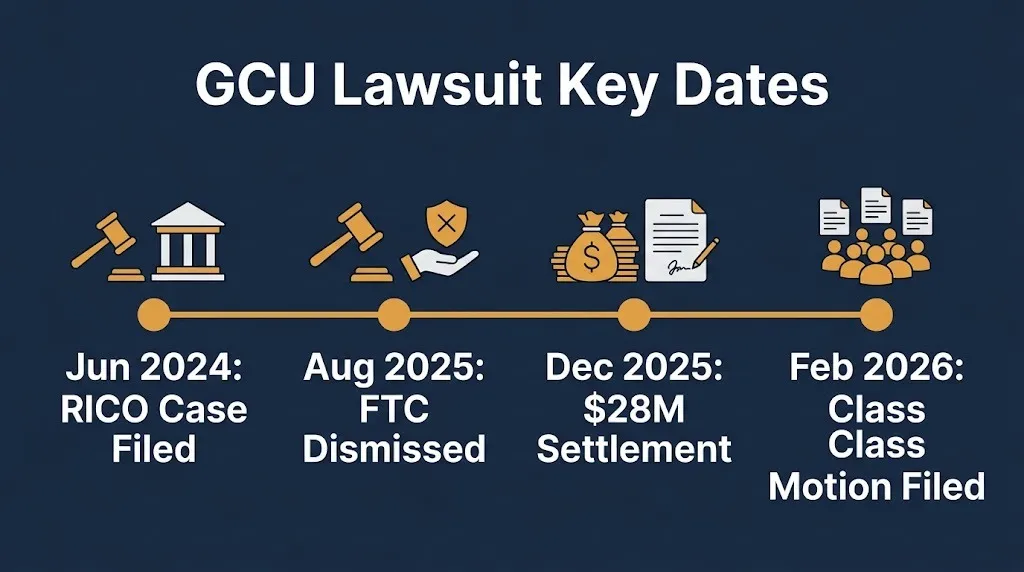
The FTC dismissed its deceptive practices case against GCU and its CEO in August 2025 . A separate whistleblower case settled for $28 million, with most of that returning to federal taxpayers .
This article separates the closed cases from the live one, explains what the student class action is actually asking for, and shows you why no claim form exists yet. One detail worth knowing up front: a federal judge already refused to throw out the student RICO case in May 2025, which is why it is still alive .
The Facts
| Item | Verified Detail |
|---|---|
| FTC Case Status | Dismissed August 2025 |
| FTC Case Number | 2:23-cv-02711-JZB |
| False Claims Act Settlement | $28 million, approved December 2025 |
| Student RICO Case | Filed June 2024, active in U.S. District Court for Arizona |
| Class Certification Motion | Filed February 26, 2026 |
| Settlement Fund for Students | None. No settlement or judgment in student case. |
| Estimated Payout | Not yet determined |
| Claim Deadline | Not applicable yet |
Is the GCU Lawsuit Real or a Scam?
The GCU lawsuits are real, but they are not a single case with a single outcome. There are at least three separate legal matters, and only one of them involves money that could eventually reach students. The FTC case and the False Claims Act settlement are closed. The student RICO class action is still open.
The scam risk sits with websites promising a GCU settlement payout. No court has approved a student settlement fund. The FTC case ended without any payment to consumers. The $28 million False Claims Act settlement went to the federal government, not to students .
If a site tells you to register for a GCU settlement check, it is not describing a real process. The student case has not settled.
How Much Money Will GCU Students Get?
GCU students will get nothing right now because no settlement or judgment exists in the student class action. The amount is not yet determined, and the reason is straightforward: the case is still fighting over whether it can proceed as a class action.
The motion for class certification was filed on February 26, 2026 . Grand Canyon Education’s response was due March 30, and the plaintiffs’ reply was due April 26 . Until the judge rules on that motion, there is no certified class, no claims process, and no payout formula.
The FTC case, which could have produced consumer relief, was dismissed entirely. The FTC’s own statement said the case offered “very little upside relative to the cost of pursuing it to completion” . That is agency language for: we are not spending more money on this.
How Do You File a Claim in the GCU Lawsuit?
You cannot file a claim because no claims process exists. The student RICO case has no settlement, no administrator, and no deadline. The FTC case is dismissed. The False Claims Act case is closed and paid.
Here is what you can do if you believe you were harmed by GCU’s doctoral program promises:
- Save your enrollment agreement, catalog, and any cost disclosures you received.
- Keep records of what you were told about total program cost and continuation courses.
- Track any continuation course charges you paid.
- Do not pay a third party to “file” a GCU claim.
- Watch the Arizona federal court docket for case updates.
- Consult a consumer attorney if you are considering an individual claim.
The student lawsuit alleges that GCU and GCE knew nearly all doctoral graduates needed costly continuation courses, but did not disclose that to students or recruiters . That allegation is the core of the case, but it has not been proven or settled.
Key Takeaway: The only live GCU case with potential student money is the RICO class action, and it has no settlement fund until a judge certifies the class and the parties reach a deal.
Reality Check: No one texts you a GCU settlement check. The FTC case is dismissed, and the $28 million settlement went to the government. Any site charging a fee to “register” you for a GCU payout is selling access to something that does not exist.
What Happened to the FTC Lawsuit Against GCU?
The FTC lawsuit against GCU was dismissed in August 2025, with a 3-0 commission vote . The FTC had alleged that GCU and CEO Brian Mueller deceived doctoral students about program costs and misrepresented the school’s nonprofit status, while also using abusive telemarketing practices .
The dismissal did not come with a settlement payment or an admission of wrongdoing. The FTC’s statement explained that the case had already lost twice on motions to dismiss, and that other developments undermined it: the Ninth Circuit ruled against the Education Department on GCU’s nonprofit status, the Department rescinded a $37.7 million fine, and the IRS reaffirmed GCU’s tax-exempt status .
The FTC concluded that continuing the case would not be a good use of resources. That means no consumer redress is coming from the FTC matter.
What Was the $28 Million GCU Settlement About?
The $28 million settlement resolved a False Claims Act lawsuit brought by a former GCU recruiter, Michelle Mackillop, not by the government. She alleged that GCU paid recruiters based on enrollment numbers, which violates federal rules for schools receiving student aid .
The settlement was approved in December 2025. Of the $28 million, $19.9 million returned to federal taxpayers, and the rest went to Mackillop and her lawyers as a finder’s fee . GCU admitted no liability.
This is not a student compensation fund. It is a whistleblower recovery. If you were a GCU student, this settlement does not create a claim for you.
What Is the GCU Student RICO Lawsuit About?
The student RICO lawsuit alleges that GCU and Grand Canyon Education defrauded doctoral students by hiding the true cost of their degrees. The case was filed in June 2024 in the U.S. District Court for the District of Arizona by Student Defense and DiCello Levitt .
The core allegation is that from 2017 through 2023, GCE misled prospective students about doctoral program costs. The motion for class certification claims that GCU knew almost all doctoral graduates needed costly continuation courses, but did not share that information with students or with the recruiters who enrolled them .
A federal judge denied GCU’s motion to dismiss in May 2025, allowing the RICO claims to proceed . That ruling kept the case alive and led to the class certification fight now underway. GCE’s response to the certification motion was due March 30, 2026, and the plaintiffs’ reply was due April 26 .
There is no settlement and no judgment. The case is still in the class certification phase.
What Is the GCU Accreditation Class Action?
A separate class action in Arizona state court alleges that GCU deceived students into enrolling in degree programs that did not meet licensure requirements in their home states. The case was argued in February 2026 before Judge Douglass Rayes .
The lead plaintiff, Katie Ogdon, says she enrolled in a master’s in psychology program intending to become a licensed therapist in California, only to learn the program was not accredited there . GCU argued she lacks standing because her student loans were forgiven, and that the academic catalog disclosed the licensure limitation .
This case is also not a settlement. It is a live lawsuit with no fund and no claim deadline.
What Happens Next
- Pending: Judge rules on class certification in the student RICO case.
- Pending: Further proceedings in the Arizona state accreditation class action.
- No date set: Any settlement in the student RICO case would require court approval and a claims process.
- Closed: FTC case dismissed August 2025; False Claims Act settlement paid December 2025.
- Ongoing: Watch the Arizona federal court docket for case number updates.
Frequently Asked Questions
Is there a GCU lawsuit settlement I can claim?
No. The FTC case was dismissed, and the student RICO case has no settlement. The $28 million False Claims Act settlement went to the government, not students.
How much will GCU students get from the lawsuit?
Not yet determined. No settlement or judgment exists in the student case, and class certification is still pending.
What happened to the FTC lawsuit against Grand Canyon University?
The FTC dismissed its case in August 2025, with a 3-0 vote, after losing twice on motions to dismiss and citing other unfavorable developments .
What was the $28 million GCU settlement about?
It resolved a whistleblower False Claims Act case alleging GCU paid recruiters based on enrollment numbers. Most of the money returned to federal taxpayers .
Is the GCU student RICO lawsuit still active?
Yes. A motion for class certification was filed February 26, 2026, and the case is proceeding in Arizona federal court .
Do I need a lawyer to join the GCU lawsuit?
There is no class to join yet. If the class is certified and a settlement is reached, the court will appoint an administrator and publish instructions.
Where can I check for GCU lawsuit updates?
The U.S. District Court for the District of Arizona docket and the Student Defense case page. Not social media or third-party claim sites.