NTI Night Guard Lawsuit 2026: What the Court Record Shows
Quick Answer
- The NTI night guard lawsuit is real, but the only verified ruling is a 2009 federal dismissal as time-barred.
- Settlement amount: not yet determined. No fund, class, or claims administrator could be verified.
- The deadline that matters is your state’s injury filing limit, which cost the one verified plaintiff her case.
The NTI night guard lawsuit refers to injury claims over the NTI-tss dental device, and the verified record is thin. One federal case, Douglass v. NTI-TSS, Inc., was dismissed in 2009. No payout program exists.
This affects people who wore an NTI-tss guard and developed bite changes or jaw problems. The number that matters most is time. The one verified plaintiff lost because she waited too long.
This article sticks to the court record, FDA data, and the manufacturer’s own words. One surprising detail: a federal judge wrote that NTI’s own website listed a 5% open-bite rate in 2004.
The Facts
| Item | Detail |
|---|---|
| Case | Douglass v. NTI-TSS, Inc., Civil No. CCB-09-558, 632 F. Supp. 2d 486 (D. Md. 2009) |
| Status | Dismissed as time-barred. No class action or settlement confirmed as of October 19, 2026 |
| Fund Size | Not yet confirmed |
| Est. Per Person | Not yet determined |
| Claim Deadline | None confirmed. Individual injury deadlines vary by state |
| Administrator | Not yet appointed |
| Proof Needed | No claim form exists. For an injury suit: dental records, consent form, device receipt |
Is the NTI night guard lawsuit real?
Yes, but the verified record is one federal case, not a wave of litigation. Douglass v. NTI-TSS, Inc. was decided by Judge Catherine C. Blake in the U.S. District Court for the District of Maryland.
The plaintiff said a nightly NTI mouth guard caused severe open anterior bite. That’s a condition where the front teeth no longer meet. The court granted NTI’s motion to dismiss and closed the case.
Other pages describe “several class-action lawsuits.” I couldn’t find a docket, case number, or court order for any of them. Pages without a case number aren’t reporting a case, they’re repeating each other.
| Claim | Verified? |
|---|---|
| Federal injury lawsuit against NTI-TSS, Inc. | Yes, Douglass (D. Md. 2009) |
| Outcome of that lawsuit | Dismissed as time-barred |
| Multiple class actions | Not yet confirmed |
| Any settlement payout | Not yet confirmed |
Is there an NTI night guard class action or settlement in 2026?
No NTI night guard class action or settlement could be verified as of October 19, 2026. No administrator notice, court order, or official settlement website turned up.
The pages that claim otherwise contradict each other. One page says a 2013 lawsuit by a single woman settled out of court for an undisclosed amount. Another page from the same publisher calls it a class action still in discovery.
Both can’t be true. Neither cites a case number.
Think of it like a store return with no receipt. Without a document, nobody can process it. A settlement with no docket number is a rumor.
If a real class action appears, it will carry a court name, a case number, and a claims website. Until then, treat payout claims as unconfirmed.
Did the FDA recall the NTI night guard?
No recall appears in FDA public data for NTI-TSS, Inc. A regulatory profile compiled from FDA records lists zero recalls and zero compliance actions.
The device was cleared, not tested to a recall standard. NTI-TSS, Inc., of Mishawaka, Indiana, received 510(k) clearance K010876 on June 20, 2001. That clearance covers a mouthguard for migraine and tension headache, and for preventing bruxism and TMJ symptoms.
A second clearance, K041184, came May 3, 2005, for a snoring application. A 510(k) clearance means the FDA found the device substantially equivalent to an earlier one. It isn’t proof the device is free of side effects.
Some pages cite an FDA “public health notification” about the device. I couldn’t verify one. That claim is not yet confirmed.
Key Takeaway: The verified record is one dismissed lawsuit and two FDA clearances, with no confirmed class action, recall, or settlement fund.
How much is an NTI night guard lawsuit worth?
Not yet determined. No settlement fund, verdict, or payout schedule has been confirmed, so no honest per-person figure exists.
| Item | Status |
|---|---|
| Settlement fund | Not yet confirmed |
| Per-person payout | Not yet determined |
| Court verdict for a plaintiff | None found |
| Known case result | Douglass dismissed, no award |
| Device price | About $600 per one consumer health site |
The one verified lawsuit ended with no money. That’s the real benchmark, and it’s rarely mentioned.
A claim’s value would depend on documented injury, treatment cost, the state, and who is sued. Those are case facts, not table values. Amounts depend on evidence and on whether a claim survives its filing deadline.
Are the NTI night guard payout figures online real?
No source I checked ties those figures to a verdict, settlement, or docket. Some pages list injury tiers, such as an open bite needing orthodontics at $5,000 to $15,000.
Those numbers read like estimates, not results. No court order, agreement, or administrator notice backs them.
Picture a price tag on a house nobody has sold. It tells you what someone hopes, not what a buyer paid.
The only verified outcome is a dismissal. Any payout table should come with a case name and number, or you can skip it.
Reality Check: No NTI settlement fund exists to file against, so a form asking for your bank or Social Security details to “release” NTI money is a red flag. Law firm advertising isn’t a settlement notice. A real settlement claim is always free to file.
Who may qualify to bring an NTI night guard claim?
Nobody can file a class claim now, but you may have an individual claim if specific facts line up. No open settlement class exists.
In Douglass, the plaintiff was fitted with the device on or about April 21, 2003, and wore it nightly. By February 25, 2004, she reported that her front teeth didn’t meet. A dentist diagnosed severe open anterior bite.
You may have grounds to explore a claim if these fit:
- You wore an NTI-tss or similar partial-coverage guard.
- A dentist documented a bite change or jaw injury after use.
- You weren’t told about the open-bite risk, or can’t find a signed consent form.
- Your state’s filing deadline hasn’t passed.
- You can show when you first learned the device might be the cause.
Whether you qualify depends on those facts. Only a court decides.
Key Takeaway: Qualifying means building an individual injury claim with records and timing, since no class payout exists to join.
How do you file an NTI night guard claim?
You file an individual injury lawsuit, since no settlement claim form exists. These are the steps people typically take.
- See a dentist or orthodontist and get the bite change documented.
- Request your complete dental chart and any signed consent form.
- Keep the device, the receipt, and any packaging or instruction sheet.
- Look up your state’s injury filing deadline right away.
- Talk to a product liability attorney or a legal aid office about options.
- Ask whether the dentist, the manufacturer, or both could be named.
- File before the deadline, not near it.
- Report the injury to the FDA’s MedWatch program.
Step 4 is where Douglass failed. Everything else can be repaired later, but a missed deadline can’t.
How long do you have to sue over an NTI night guard injury?
It depends on your state. In Douglass, Maryland’s three-year limit applied, and the court found her claims time-barred as of December 31, 2007.
The clock started when she learned the device might be the cause. The court assumed that was December 31, 2004, when she read NTI’s website statistic. She filed on December 31, 2008.
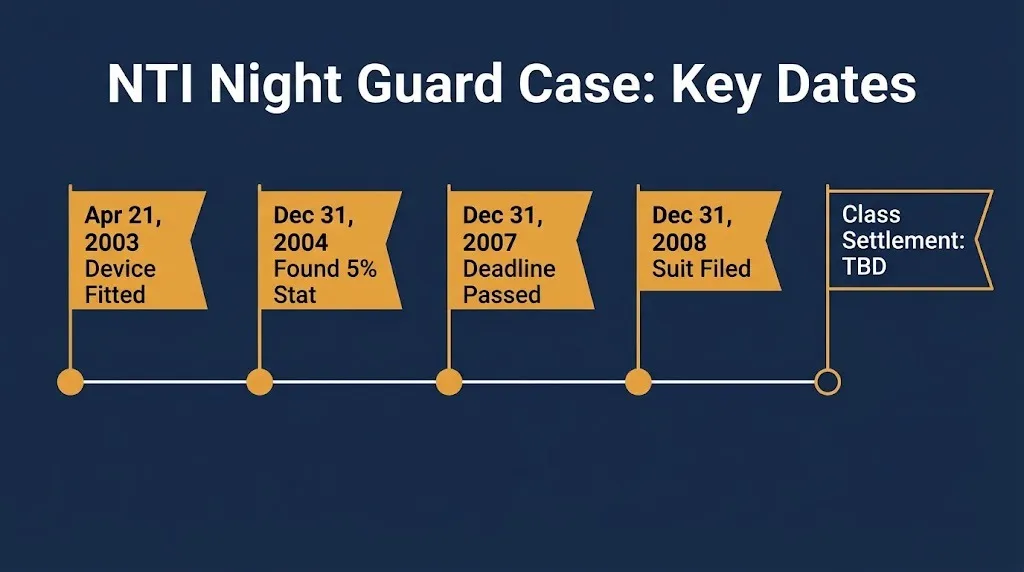
| Date | Event |
|---|---|
| April 21, 2003 | Device fitted |
| February 25, 2004 | Reported front teeth didn’t meet |
| December 31, 2004 | Found NTI website statistics |
| March 3, 2006 | NTI’s lawyer replied to her attorney’s letter |
| December 31, 2007 | Limitation period expired, per the court |
| December 31, 2008 | Lawsuit filed in state court |
She argued NTI’s letter delayed her. The court disagreed and said she hadn’t pursued her rights diligently. Other states set different limits, and I didn’t verify them.
Can you sue the dentist or the maker of the NTI night guard?
You may be able to pursue either, depending on who failed to warn you. Douglass tried both routes.
In January 2007, she filed a claim with Maryland’s Health Care Alternative Dispute Resolution Office against her dentist for failing to get informed consent. Later she sued NTI.
| Possible defendant | Theory in Douglass | Notes |
|---|---|---|
| Dentist | No warning of open-bite risk, no informed consent | Claim filed January 2007 |
| NTI-TSS, Inc. | Failure to warn, product liability, warranty, fraud | Dismissed as time-barred |
The finger-pointing is the story. NTI said it shipped warnings with the kit. The dentist’s lawyer said he never received any.
Key Takeaway: Failure-to-warn cases often turn on who told whom, which is why the dentist’s chart and consent form matter.
What proof do you need for an NTI night guard injury claim?
You need records that show the device, the injury, and the timing. Gather these before talking to anyone.
- The dentist’s chart notes from the fitting visit
- Any signed informed consent form, or proof none exists
- The device, receipt, and instruction materials
- Photos and X-rays showing your bite before and after
- A dentist’s diagnosis of open bite or jaw injury
- Treatment estimates and bills
- Dates you first noticed symptoms, such as trouble eating or speaking
- The date you first suspected the device
Douglass reported talking differently and struggling to eat. Those symptoms came about ten months after fitting. Write down your own timeline now.
What is the latest NTI night guard lawsuit update?
As of October 19, 2026, no newer court ruling than the 2009 Douglass decision could be verified. Nothing in my searches showed a new class action or settlement.
| Date | Verified development |
|---|---|
| June 20, 2001 | FDA clears NTI Tension Suppression System (K010876) |
| May 3, 2005 | FDA clears snoring application (K041184) |
| 2009 | Douglass dismissed in D. Md. |
| November 25, 2013 | FDA adverse event report received about an NTI-tss user |
| October 2018 | British Dental Journal presents cases of open bite after night guard use |
The 2013 report came from a patient who said a dentist raised an open-bite concern. It’s one report, not a count. I found no verified total of adverse event reports.
What happened in Douglass v. NTI-TSS, Inc.?
A Maryland woman sued NTI over open bite, and the court threw it out for missing the filing deadline. It’s the only verified NTI night guard court ruling.
She alleged six counts: negligence, willful and wanton misconduct, strict products liability, breach of warranty, fraud, and negligent misrepresentation. NTI removed the case to federal court and moved to dismiss.
Judge Blake granted the motion. The negligence, products liability, and warranty claims were time-barred. The fraud and negligent misrepresentation claims failed because she hadn’t shown reasonable reliance on NTI’s letter.
The court never ruled on whether the device caused her injury. It ruled on timing and pleading. That’s a gap worth knowing about, because a dismissal isn’t a finding that the device is safe.
Key Takeaway: Douglass was lost on the calendar, not on whether the NTI device caused the injury.
Does the NTI night guard cause open bite?
The manufacturer’s own website once said about 5% of patients develop open anterior bite, as quoted in the Douglass opinion. A consumer health site repeats that figure and calls it rare.
A British Dental Journal article in October 2018 presented cases where night guard use led to anterior open bite. It discussed a review citing 24-hour use of a miniature anterior discluding appliance.
The science isn’t one-sided. A systematic review found randomized trial evidence that the NTI-tss device may work for bruxism and jaw disorders. It also noted controversy in the dental community.
A dentist writing in Dentaltown disputes one explanation, that forces on the front teeth cause the open bite. Cause is contested, and I won’t present it as settled.
What does NTI say about the open bite risk?
NTI’s position, in a March 3, 2006 letter, was that it warned dentists. The company said kits shipped with literature and a video noting that a rare number of patients develop open bite.
The letter also said dentists should explain the risk and have patients sign a consent form. NTI’s lawyer wrote that the cause of the plaintiff’s symptoms didn’t lie with NTI.
Here the story gets murky. The court noted the letter said this was NTI’s standard practice, not that it sent materials to her specific dentist. Her dentist’s lawyer later said he never received them.
The judge didn’t decide who was right. The case ended before any evidence on that point.
When a company says “we warned the dentist” and the dentist says “no, you didn’t,” a signed consent form becomes the tiebreaker.
Should you keep wearing your NTI night guard?
Ask your dentist, because only a dentist can judge your bite. If your front teeth no longer meet, don’t wait for the next checkup.
Warning signs in Douglass included changed speech, trouble eating, and headaches. Your symptoms may differ.
- Check whether your front teeth still touch when you bite.
- Note any new difficulty chewing or speaking.
- Tell your dentist, and ask for a written record of what you reported.
- Ask whether a different guard design fits your case.
- Report the problem to the FDA’s MedWatch program.
Document before you change anything. Photos of your bite today are evidence tomorrow.
Key Takeaway: Bite changes are worth reporting early, both for your teeth and for the paper trail.
What is an NTI night guard and how does it differ from other guards?
An NTI night guard is a small clear plastic device worn over the front teeth to reduce clenching force. NTI-tss stands for nociceptive trigeminal inhibition tension suppression system.
It’s a partial-coverage appliance. It keeps the back teeth from touching, unlike a full guard that covers a whole arch. Its maker lists uses for bruxism, jaw disorders, and tension headache.
NTI-TSS, Inc. was based in Mishawaka, Indiana, per FDA records. A National Dentex Labs product page lists the NTI-tss Plus, which suggests it’s sold through dental labs.
One consumer health site puts the average cost near $600. Because the guard touches only the front teeth, bite effects get more scrutiny than with full guards.
What Happens Next
No settlement timeline exists, so these are the stages to watch.
- Now: No class action or settlement is confirmed. Your state’s filing deadline is the date that matters.
- Expected, if a suit is filed: A complaint names the maker, the dentist, or both, followed by a motion to dismiss, as in Douglass.
- Expected, if a class action appears: Court notice, a claims website, and a named administrator.
- Expected after that: A claim deadline, an opt-out deadline, then a final approval hearing. Dates are not yet confirmed.
- Ongoing: Watch for new court rulings and FDA safety communications. None are verified as of October 19, 2026.
Frequently Asked Questions
Is there an NTI night guard class action?
No class action could be verified as of October 19, 2026.
The only confirmed case is Douglass v. NTI-TSS, Inc., dismissed in 2009.
Pages claiming otherwise gave no case number.
Was the NTI night guard recalled?
No recall appears in FDA public data for NTI-TSS, Inc.
The device holds 510(k) clearances from 2001 and 2005.
A public health notification is not yet confirmed.
Can I sue over an NTI night guard injury?
You may be able to, depending on your state and your records.
Deadlines vary, and Douglass was dismissed as time-barred.
A product liability attorney can explain your options.
How much is an NTI night guard settlement?
No settlement amount has been confirmed.
No fund or payout schedule exists in the sources checked.
Online payout tables lack a case number.
Does the NTI night guard cause open bite?
NTI’s website once cited a 5% open-bite rate, per a federal court opinion.
A 2018 British Dental Journal article presented cases after night guard use.
Cause remains contested in the dental literature.
Is the NTI night guard FDA approved?
It’s FDA cleared, not approved.
Clearance came through the 510(k) path in 2001 and 2005.
That path finds equivalence to an earlier device.
Who makes the NTI night guard?
NTI-TSS, Inc., of Mishawaka, Indiana, is the FDA applicant.
Dental labs such as National Dentex Labs list NTI products.
Check your device paperwork for the exact maker.
If you wore an NTI guard and your bite changed, write down your timeline today. Note when you were fitted, when you noticed symptoms, and when you first suspected the device.
Find your state’s injury filing deadline this week. In the one verified case, a missed deadline ended the lawsuit before the device’s role was ever decided.