How Much Is Burn Pit Compensation in 2026? VA Rates, PACT Act Payouts, and the One Class Action That Actually Paid
Quick Answer
- Is there a lump sum? No. Burn pit compensation is monthly VA disability pay, not a one-time settlement check.
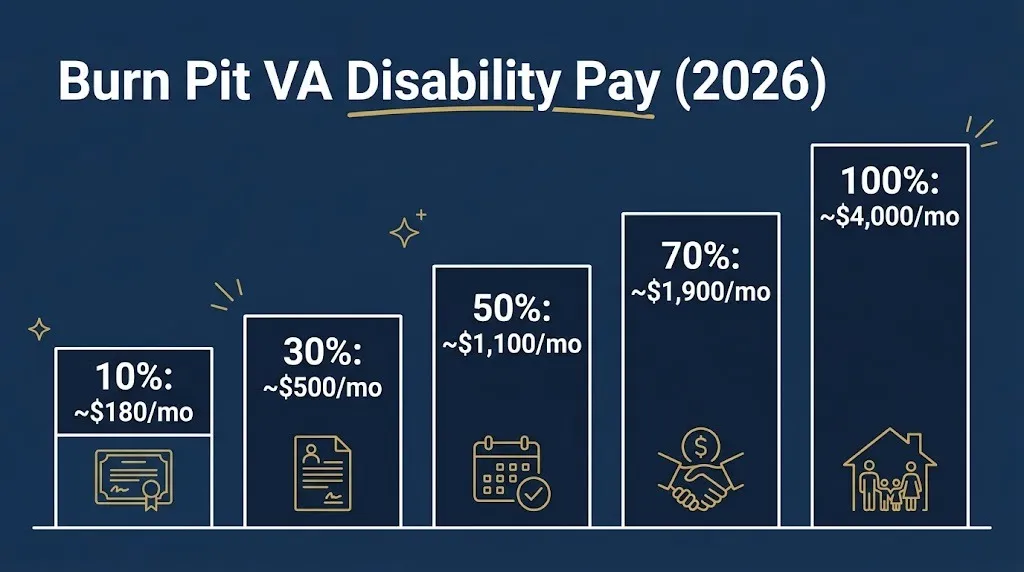
- How much per month? About $180 at 10% disability, roughly $1,100 at 50%, and near $4,000 at 100% .
- What is the deadline? There is no PACT Act claim deadline. File anytime, but back pay is limited to the intent-to-file date .
You searched for a number because someone told you burn pit exposure was worth money. The honest answer is that “burn pit compensation” is not a settlement fund with a per-person payout. It is a VA disability rating, and the dollar amount depends entirely on how sick you are and what the VA rates you at.
The PACT Act, signed in August 2022, created presumptions that make it easier for veterans to connect certain illnesses to burn pit exposure. If you have a presumptive condition and qualifying service, the VA assumes the connection without you proving it .
This article explains the actual 2026 payment ranges, which conditions qualify, how the PACT Act changed the math, and the one burn pit class action that did produce a real benefit (a tax exemption, not a check).
The Facts
| Item | Verified Detail |
| Program | VA disability compensation under the PACT Act (Sergeant First Class Heath Robinson Honoring our Promise to Address Comprehensive Toxics Act) |
| Status | Active and paying. Veterans can file claims now. |
| Fund Size | No capped fund. VA paid over $1.85 billion in PACT Act claims in the first year . |
| Est. Per Person | Monthly, tax-free. About $180 (10%) to $4,000 (100%) depending on rating . |
| Claim Deadline | None. PACT Act claims can be filed anytime . |
| Administrator | U.S. Department of Veterans Affairs |
| Proof Needed | Qualifying service location and dates, plus a current diagnosis for presumptive conditions. |
Is burn pit compensation real or a scam?
Burn pit compensation is real, but it does not come as a check from a lawsuit. It comes from the VA as monthly disability compensation. The PACT Act is federal law, not a settlement administrator, and the VA is the only agency that pays it .
Scams target veterans because the terminology is confusing. A website promising a “burn pit settlement payout” is either describing the old KBR contractor lawsuits (which most veterans lost) or inventing a number. The Supreme Court effectively closed the contractor-lawsuit path in 2019 .
The legitimate path is a VA claim. Filing is free. You do not need a lawyer to file, though a VA-accredited representative can help with appeals.
Key Takeaway: Burn pit compensation is real, but it is VA disability pay, not a class action settlement, and no private company is authorized to “register” you for a payout.
How much is burn pit compensation per month in 2026?
Burn pit compensation is a monthly, tax-free VA payment based on your disability rating. The exact amount depends on your rating percentage and your dependents. For 2026, a single veteran with no dependents can expect roughly these ranges :
| Disability Rating | Approximate Monthly Payment (2026) |
| 10% | $180 to $190 |
| 30% | About $500 to $550 |
| 50% | About $1,100 |
| 70% | About $1,800 to $2,000 |
| 100% | About $3,900 to $4,000 |
These figures are approximations from published 2026 rate tables. The VA publishes official rates each December. Your actual payment depends on your rating, dependents, and whether you receive other benefits that offset VA pay.
The VA combines ratings for multiple conditions using a “whole person” formula, not simple addition. Two 50% ratings do not equal 100%. They combine to 75%, which rounds to 80% .
Reality Check: No one will text you a burn pit settlement link. Filing a VA claim is free, and the VA does not charge you to process it. Any “claims helper” charging an upfront fee to file your PACT Act claim is unnecessary. Accredited representatives work on contingency or free, and the VA’s own website lets you file directly.
Who qualifies for burn pit compensation under the PACT Act?
You may qualify if you served in a covered location during a covered period and have a condition the VA presumes is linked to burn pit exposure .
Covered locations and periods:
- On or after August 2, 1990: Bahrain, Iraq, Kuwait, Oman, Qatar, Saudi Arabia, Somalia, United Arab Emirates (UAE), and the airspace above them.
- On or after September 11, 2001: Afghanistan, Djibouti, Egypt, Jordan, Lebanon, Syria, Uzbekistan, Yemen, and the airspace above them.
You also need a current diagnosis of a presumptive condition. The VA added more than 20 burn pit presumptive conditions under the PACT Act . They include:
- Cancers: Brain, gastrointestinal, glioblastoma, head, kidney, lymphoma, melanoma, neck, pancreatic, reproductive, respiratory.
- Respiratory illnesses: Asthma diagnosed after service, chronic bronchitis, COPD, chronic rhinitis, chronic sinusitis, constrictive bronchiolitis, emphysema, interstitial lung disease, pleuritis, pulmonary fibrosis, sarcoidosis.
If your condition is not on the presumptive list, you can still file, but you must prove a medical link (a “nexus”) between your service and your illness .
How do I file a burn pit compensation claim?
You file a VA disability claim online, by mail, in person, or with a VA-accredited representative. The VA encourages filing an “intent to file” as early as possible to preserve your effective date for back pay .
Here are the steps:
- Gather your service records. You need proof of your deployment locations and dates.
- Get a current diagnosis. A doctor must confirm your condition. Vague symptoms are not enough .
- File your claim or intent to file. The intent to file holds your place for up to one year while you gather evidence.
- Submit your evidence. Include service records, medical records, and any buddy statements about exposure .
- Attend any VA exams. The VA may schedule a Compensation and Pension exam.
- Review your decision. If denied or rated too low, you can file a supplemental claim or appeal.
If the VA denied your claim in the past and your condition is now presumptive, file a supplemental claim. The VA will review it again .
Key Takeaway: File an intent to file immediately, even before you have all your records, because that date controls how far back your back pay can go.
What was the Smoke v. Driscoll burn pit class action about?
Smoke et al. v. Driscoll was a class action against the U.S. Army, not a settlement fund. It challenged the Army’s refusal to designate burn pit-related disabilities as “combat-related” for medical retirement purposes. The settlement, reached in March 2026, did not pay a cash award to a class .
The benefit is a tax exemption. Veterans who are medically retired for combat-related conditions get tax-free retirement pay. The Army had been denying that designation for burn pit presumptive conditions. Under the settlement, the Army agreed to treat open-air burn pits in combat zones as “instrumentalities of war” and to review prior denials .
If you were medically retired from the Army on or after August 10, 2022, for a PACT Act condition and were denied combat-related status, the Army has agreed to review your record. The review was targeted for completion within six months of the March 6, 2026 settlement .
This is not a claims process you file into. It is an internal Army review. If you believe you are affected, contact a veterans service organization or the NVLSP, which brought the case.
What conditions are presumed caused by burn pits?
The VA presumes more than 20 conditions are caused by burn pit exposure. The list includes several cancers and a range of respiratory illnesses .
The cancer list covers brain, gastrointestinal, glioblastoma, head, kidney, lymphoma, melanoma, neck, pancreatic, reproductive, and respiratory cancers. The respiratory list includes asthma diagnosed after service, chronic bronchitis, COPD, chronic rhinitis, chronic sinusitis, constrictive or obliterative bronchiolitis, emphysema, granulomatous disease, interstitial lung disease, pleuritis, pulmonary fibrosis, and sarcoidosis.
A surprising detail: high blood pressure (hypertension) and monoclonal gammopathy of undetermined significance (MGUS) also appear on some VA PACT Act summary documents, though they are not always included in shorter lists .
If your condition is not presumptive, you can still claim it, but you will need a medical nexus opinion linking it to burn pit exposure .
What happens next after you file a burn pit claim?
After you file, the VA reviews your service records and medical evidence, may schedule exams, and issues a decision. The timeline varies by claim complexity and VA backlog .
Here is the typical sequence:
- Immediately: File your intent to file to lock in your effective date.
- Within days to weeks: The VA acknowledges your claim and may request evidence.
- Within months: You may receive a C&P exam request.
- After evidence gathering: The VA issues a rating decision.
- If denied: You can file a supplemental claim, request a higher-level review, or appeal to the Board of Veterans’ Appeals.
The VA completed 458,659 PACT Act-related claims in the first year and delivered more than $1.85 billion in benefits . The agency says it processes claims as quickly as possible, but backlogs remain.
Frequently Asked Questions
Is burn pit compensation a one-time payment?
No. It is a monthly, tax-free VA disability payment that continues as long as you maintain your rating.
How much is burn pit compensation at 100% disability?
About $3,900 to $4,000 per month for a single veteran with no dependents, based on 2026 rate tables .
Do I need a lawyer to file a burn pit claim?
No. Filing is free and you can do it yourself. A VA-accredited representative can help with complex appeals, usually at no upfront cost.
What is the deadline to file a PACT Act claim?
There is no deadline. You can file anytime. But back pay is limited to the date of your intent to file, so filing sooner preserves more retroactive pay .
Can I get burn pit compensation if I was exposed but not diagnosed yet?
No. The VA requires a current diagnosis. You can file an intent to file while you seek diagnosis, but the claim cannot be granted without medical evidence .
Is the KBR burn pit lawsuit still an option?
For most veterans, no. The Supreme Court declined to revive the contractor lawsuits in 2019, and the PACT Act is the primary path now .
What if my condition is not on the presumptive list?
You can still file a claim, but you must provide a medical nexus opinion connecting your condition to burn pit exposure. The burden is higher .
Does the Smoke v. Driscoll settlement pay money?
No. It provides a tax exemption on medical retirement pay for eligible Army veterans and requires the Army to review prior denials. There is no cash settlement fund .
What You Should Do Now
File an intent to file on the VA website today if you have qualifying service and any diagnosis that might be linked to burn pits. That date preserves your back pay. Then gather your deployment records and medical documentation.
The number that matters most is not a settlement figure. It is your disability rating, and that rating starts with a filed claim. The PACT Act has no deadline, but your back pay clock starts when you file.