Is workers compensation nerve damage a real claim or a scam?
Quick Answer
- Workers’ compensation nerve damage claims are real, but there is no nationwide settlement fund or universal claim form.
- Payouts are not standardized; amounts depend on your state’s wage laws, medical impairment rating, and lost earning capacity.
- The most important deadline is your state’s injury reporting window, which can be as short as 10 days in some states.
Workers’ compensation nerve damage is a legitimate claim category, but it does not operate like a product liability class action. There is no single settlement administrator, no national claims deadline, and no guaranteed per-person payout amount. If you injured a nerve on the job, your claim runs through your employer’s workers’ compensation insurance carrier and the rules of the state where you worked.
You are likely reading this because you have tingling, numbness, weakness, or burning pain that started after a shift, a repetitive task, or an accident at work. The number that matters most is not a settlement figure. It is the reporting deadline in your state. In Colorado, for example, you must notify your employer in writing within ten days after the injury under HB 22-1112 . Missing a notice window can weaken or kill an otherwise valid claim.
This article covers how nerve damage claims actually work, what medical evidence insurers look for, why carpal tunnel and spinal nerve injuries get disputed, and the steps you can take before a deadline passes. One detail that surprises many workers: insurance carriers are not obligated to settle at all, even when they accept that the injury happened .
The Facts
| Item | Status |
|---|---|
| Case Type | State workers’ compensation claim, not a class action |
| Status | Ongoing, claim-by-claim system |
| Fund Size | Not applicable, no national fund exists |
| Est. Per Person | Not yet determined, varies by state and impairment rating |
| Claim Deadline | Varies by state (examples: 10 days to report in Colorado, 2 years to file in many states) |
| Administrator | Your employer’s workers’ comp carrier, not a settlement administrator |
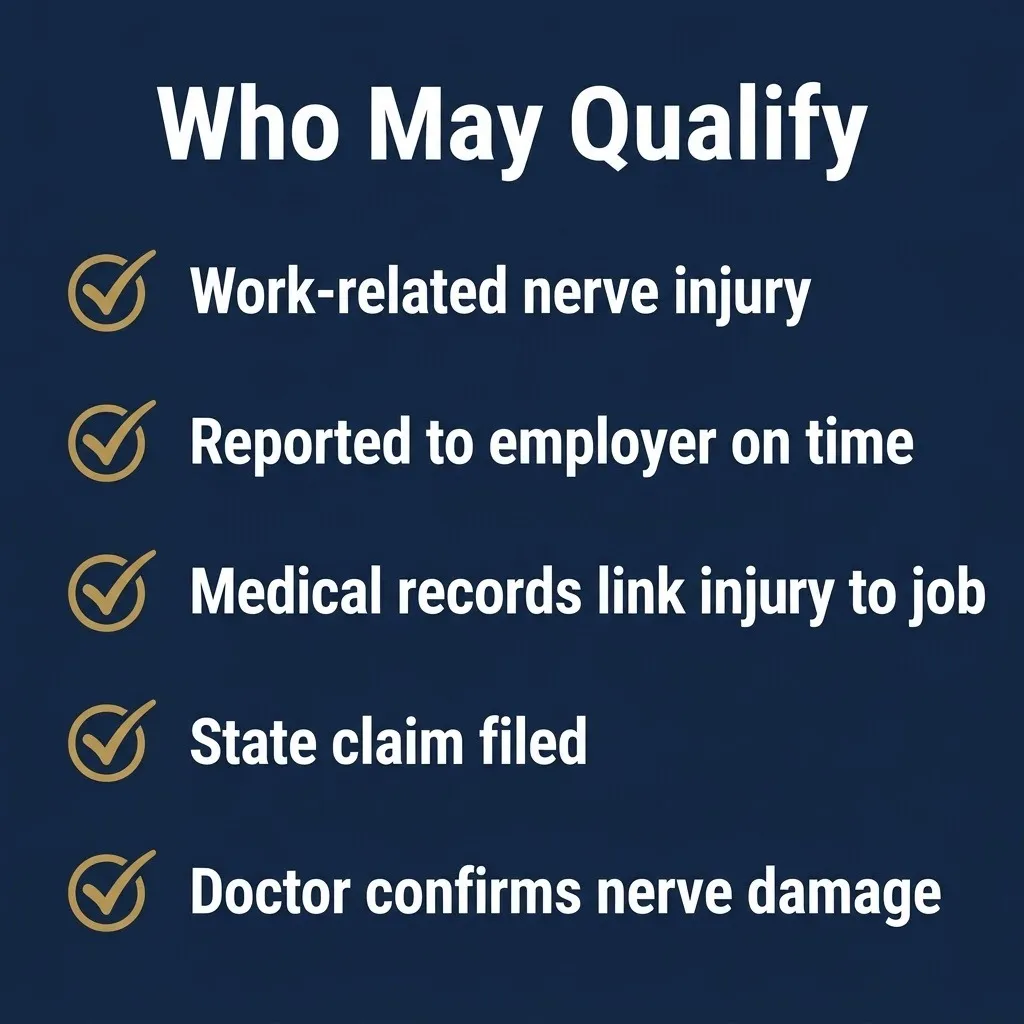
| Proof Needed | Medical records linking nerve damage to work duties, timely notice to employer |
Is workers compensation nerve damage a real claim or a scam?
It is a real claim, but the “scam” risk sits with people who promise a national payout. Workers’ compensation nerve damage claims are filed under state law, not under a federal settlement. No one is distributing money from a central fund. If a text message or social media ad tells you a workers’ comp nerve damage settlement has been approved and asks for a fee to claim it, that is not how the system works.

The legitimate process starts with you reporting the injury to your employer and seeing a doctor who documents the nerve problem. Your state’s workers’ comp agency, not a private claims desk, oversees the dispute process. Amounts depend on your average weekly wage, your medical impairment rating under the state’s schedule, and whether you can return to your old job .
How much is a workers compensation nerve damage settlement?
There is no verified average or standard payout for nerve damage because no two claims are identical. One older legal commentary suggested a range of $2,000 to $40,000, but that figure is not a current official benchmark and should not be treated as a rule . Modern settlements are calculated from wage loss, medical costs, and permanency ratings, not from a published table of nerve damage amounts.
Not yet determined is the honest answer for any specific case before medical records are reviewed. A mild nerve compression that improves with rest may resolve with medical coverage and limited wage replacement. A severe nerve injury that ends your ability to work in your trade can support a much larger full-and-final settlement. The factors that move the number up or down include:
- Your pre-injury average weekly wage
- Whether the nerve damage is rated as a permanent impairment
- Whether you can return to light-duty work at reduced pay
- The body part affected and whether your state uses a scheduled loss schedule
- The cost of future medical care, including surgery or pain management
What medical evidence proves nerve damage is work-related?
The strongest evidence is a nerve conduction study or electromyogram (EMG) that confirms nerve dysfunction, paired with a doctor’s opinion that your job duties caused or aggravated it. Insurers rarely accept a bare complaint of tingling. They look for objective testing, treatment records, and a clear timeline connecting your symptoms to work exposure.
Repetitive motion cases are harder to prove than sudden accident cases. A carpal tunnel claim from years of typing or assembly work may be disputed because the insurer will argue the condition developed outside work. A spinal nerve injury from a specific lifting incident has a clearer causal chain. In West Virginia, a miner’s bilateral carpal tunnel claim from impact wrenches and hammer drills went through multiple impairment ratings before the court upheld an increased award . The lesson: documentation and persistence matter.
How long do you have to report a nerve injury at work?
You must report within your state’s notice window, and those windows are shorter than most workers expect. Colorado requires written notice to your employer within ten days after the injury under current law . Other states use different clocks. Missing the notice deadline can give the insurer a defense even if your medical evidence is strong.
The deadline for filing a formal claim is separate from the notice deadline. Many states allow up to two years from the injury or from the date you knew the condition was work-related, but gradual-onset nerve injuries make that start date arguable . If you are already past a few weeks and have not reported anything in writing, do not wait for the tingling to get worse. Put the symptoms in writing to your employer and keep a copy.
Key Takeaway: The most dangerous mistake in a nerve damage claim is silence, because a missed reporting window can end a valid case before a doctor ever rates your impairment.
How do you file a workers compensation nerve damage claim?
Filing means putting your injury on the record with your employer and then following your state’s claim process. The exact forms differ by state, but the sequence is consistent. Do not skip the written notice even if your supervisor says it is unnecessary.
- Report the injury in writing to your employer, keep a dated copy.
- Ask for a list of approved doctors or go to the designated clinic.
- Tell the doctor exactly which job tasks you believe caused the nerve symptoms.
- Get objective testing if the doctor recommends it, such as a nerve conduction study.
- File the state workers’ compensation claim form with your employer or the state agency.
- Track every medical appointment, restriction, and lost wage day.
- Check whether a third party, such as an equipment maker, may also be responsible.
Why do insurance companies dispute nerve damage claims?
Insurers dispute nerve damage claims because nerve symptoms can be subjective and because pre-existing conditions are common. A doctor cannot always see nerve pain on an X-ray. The insurer may argue that your carpal tunnel came from age, diabetes, or hobbies, not from work. They may also point to a prior injury or a degenerative condition to reduce what they owe.
This is why the medical record must connect your duties to the diagnosis. A Colorado law firm notes that insurers may push low impairment ratings or offer premature settlements before the full impact of a permanent nerve injury is known . If your doctor says you have reached maximum medical improvement and assigns an impairment rating, you do not have to accept the first number without review. Many states allow you to request an independent evaluation or dispute the rating through a hearing process.
What is the difference between a lump sum and structured settlement for nerve damage?
A lump sum, often called a full-and-final settlement, pays you once and usually closes your medical benefits for that injury. A structured settlement pays over time, often through an annuity, and may be chosen when you have permanent disability and ongoing care needs . Neither is automatically better. The choice depends on whether you can accurately estimate your future medical costs.
The risk of a lump sum is that you may waive your right to reopen the claim for future treatment. In Arizona, a full-and-final settlement requires approval by the Industrial Commission and permanently closes the claim once approved . If you underestimate future nerve treatment, you cannot go back for more. A structured settlement can protect against that risk, but it may offer less control over the money.
Reality Check: No legitimate workers’ comp agency or settlement administrator will text you first to offer nerve damage money, and filing a claim never requires paying a third-party “claim helper” upfront. Your state’s official workers’ compensation agency and your employer’s carrier are the only legitimate channels.
What happens after you reach maximum medical improvement?
Maximum medical improvement (MMI) means your doctor believes your condition will not improve further with treatment. At that point, the doctor may assign a permanent impairment rating using a guide such as the AMA Guides. That rating becomes the basis for any permanent disability benefits or settlement negotiation.
Do not confuse MMI with “fully healed.” You can be at MMI while still having permanent numbness, weakness, or pain. The rating is meant to measure what function you have lost, not whether you feel better. If the rating seems too low, ask your doctor to explain how it was calculated and whether objective testing supports a higher number. In some states, you can request a division independent medical examination (DIME) to challenge a low rating .
What happens next in 2026 and beyond?
The workers’ compensation system does not have a single national settlement calendar. Your case timeline depends on your state’s agency and your medical treatment. These are the stages to expect if you file a claim:
Now to 30 days: Report the injury in writing and get medical care. Your employer should file a first report of injury with the state or its carrier.
30 to 90 days: The insurer accepts or disputes the claim. You may be sent for an independent medical exam or a specialist consultation.
Months 3 to 12: Treatment continues. Temporary disability benefits may apply if you cannot work. Your doctor tracks your progress toward MMI.
Month 6 to 18: If you reach MMI with permanent impairment, you may receive a rating and begin settlement discussions or a hearing process.
Beyond 18 months: Disputed cases can go to a workers’ compensation judge or appeals board. Payment timing depends on the outcome.
Frequently Asked Questions
Is there a national workers compensation nerve damage settlement in 2026?
No. Workers’ compensation is a state-based system. There is no national settlement fund, no universal claim deadline, and no single administrator for nerve damage claims. Any ad claiming otherwise is not describing a real national settlement.
Can I get workers’ comp for carpal tunnel nerve damage?
Yes, if a doctor links the condition to your work duties and you report it on time. Carpal tunnel is one of the most common nerve compression claims, but insurers often dispute it in repetitive-motion jobs. Objective testing and a clear job-task history help.
How much does a nerve damage settlement pay per person?
There is no verified per-person amount. Payouts depend on your state’s wage replacement rules, your impairment rating, your lost earning capacity, and future medical costs. A mild case may resolve with medical coverage and limited wage benefits. A permanent disabling injury may support a larger settlement, but no honest source can give you a number before reviewing your records.
What is the deadline to file a workers compensation nerve damage claim?
The deadline varies by state. You must first report the injury within your state’s notice window, which can be as short as ten days. The formal claim filing deadline is often longer, such as two years, but gradual-onset nerve injuries can make the start date disputed . Check your state’s workers’ compensation agency for the exact rule that applies to you.
Do I need a lawyer to file a nerve damage claim?
You are not required to have a lawyer to file a workers’ compensation claim. Many workers file initial reports and attend doctor visits on their own. A lawyer may be useful if the insurer disputes the claim, assigns a low impairment rating, or offers a settlement before you reach MMI. Legal fees in workers’ comp are often regulated by the state.
What if my employer says there was no accident?
Nerve damage from repetitive motion often has no single accident. That does not mean you have no claim. Gradual-onset injuries can still be compensable if a doctor relates them to your job duties and you report them within the state’s deadline. Put your symptoms in writing even if there was no dramatic incident.
Can I sue my employer for nerve damage instead of filing workers comp?
In most states, workers’ compensation is the exclusive remedy for a work injury, which means you cannot sue your employer in court for negligence. There are narrow exceptions, such as intentional harm. You may have a separate claim against a third party, like a machine manufacturer, if their product caused the nerve damage. That is a different legal path from the workers’ comp claim.
Key Takeaway: If you take nothing else from this article, know your state’s reporting deadline and put your nerve symptoms in writing before it passes.