Emuaid Lawsuit 2026: ADA Case Facts, and Why No Payout Exists
Quick Answer
- The case is real, but it’s a 2020 website accessibility complaint filed by one plaintiff, Karen Clark.
- Payout: none identified. No settlement fund, administrator, or claim form turned up in any record we checked.
- Deadline: none found. Any page showing an Emuaid claim date isn’t citing a court record.
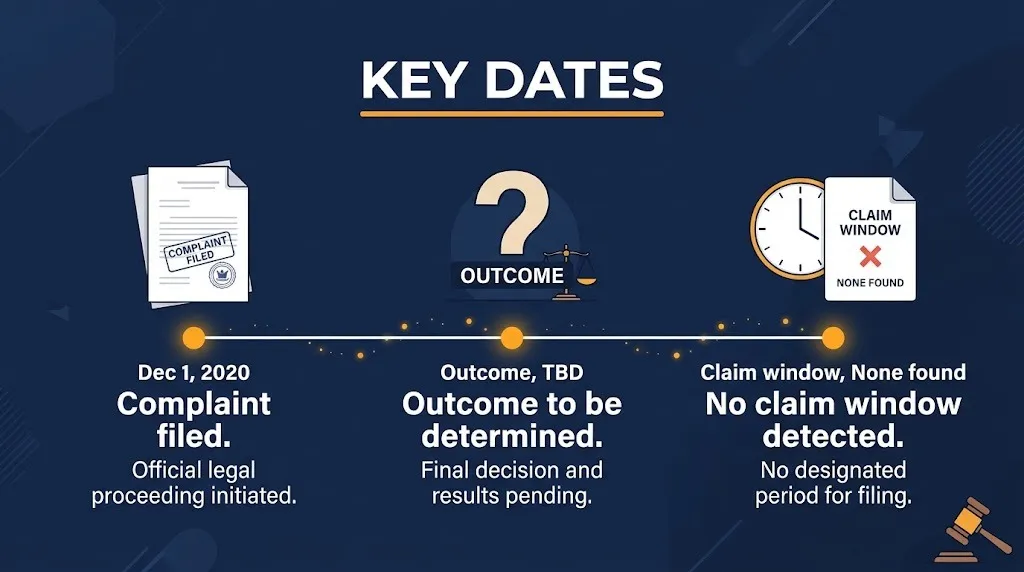
The Emuaid lawsuit is a federal ADA complaint over website accessibility, not a consumer payout case. Karen Clark sued Speer Laboratories, the maker of Emuaid, on December 1, 2020.
If you got a text or saw a site promising Emuaid money, slow down. We found no class action, no fund, and no claims administrator tied to this case.
This guide covers what the complaint alleged and what the record confirms. It also shows how to check the docket yourself. One surprise: some pages quote payout ranges without citing a single case number.
The Facts
| Case | Clark v. Speer Laboratories, LLC (ADA website accessibility complaint) |
| Status | Outcome not confirmed in the public sources we checked |
| Fund Size | None found in any record checked |
| Est. Per Person | None found, because this isn’t a payout case |
| Claim Deadline | None found |
| Administrator | None appointed or identified |
| Proof Needed | Not applicable, since no claim process exists |
Is the Emuaid lawsuit real?
Yes, the case is real, but it’s a website accessibility complaint, not a payout case.
Karen Clark filed it on December 1, 2020, in a Pennsylvania federal court. She named Speer Laboratories, the maker of Emuaid, as the defendant. Her complaint said the shopping pages on the Emuaid website didn’t work for people using screen readers.
The legal hook is Title III of the Americans with Disabilities Act. That law bars disability discrimination at places of public accommodation. Plaintiffs in cases like this argue an online store counts.
Here’s the verified record in one view:
| Confirmed | Not confirmed |
|---|---|
| Complaint filed December 1, 2020 | Final outcome of the case |
| Plaintiff: Karen Clark | Docket number |
| Defendant: Speer Laboratories | Any settlement terms |
| Claim: site not usable with screen readers | Any consumer class or fund |
That table is the whole confirmed record. Everything beyond it is inference, or invention.
Is there an Emuaid class action lawsuit?
No class action turned up in any court record, case summary, or agency release we checked. The 2020 complaint names one plaintiff, and the summaries we reviewed describe no consumer class.
Some pages say a false-advertising class action is underway. They point to testimonials and before-and-after photos as the core allegation. None of those pages names a court, a case caption, or a docket number.
That gap matters. A real class action leaves a paper trail you can follow:
- A case caption with named plaintiffs and defendants
- A court and a docket number
- A judge’s order certifying the class
- A notice sent to class members
- A claims website run by an administrator
Without those five items, “class action” is just a label. The pages we reviewed offered none of them.
Is the Emuaid settlement real?
No Emuaid settlement is publicly confirmed, and no settlement fund appears in any record we checked. If the 2020 ADA case settled, the terms haven’t surfaced in the sources we found.
That silence is common. Legal commentary says most ADA website cases end privately. The company fixes the site and pays attorney fees. Shoppers don’t get a check.
Here’s a plain comparison. A building inspector orders a broken ramp repaired. The owner fixes it and covers the inspector’s costs. Nobody who walked past the ramp gets a refund.
So when a page says “Emuaid settlement,” ask three questions. Where’s the case number? Who’s the administrator? What’s the claim deadline?
If the page can’t answer, it isn’t reporting a settlement. It’s repeating a search term.
Key Takeaway: The only verified Emuaid case is a one-plaintiff ADA website complaint from 2020, with no class, fund, or settlement on record.
How much is the Emuaid lawsuit payout?
No payout has been identified, because no fund or payment program appears in any record checked.
Not yet determined is the honest answer, and the reason is simple. No class has been certified, no settlement has been approved, and no administrator is counting claims. Without those, there’s nothing to divide.
| Payout item | Verified status |
|---|---|
| Total settlement fund | None identified |
| Per-person payment | None identified |
| Payment tiers | None identified |
| Relief the complaint requested | Court declaration, injunction, attorney fees |
Private lawsuits under Title III of the ADA generally seek court-ordered fixes and legal fees. They don’t usually seek cash for shoppers. That’s why the requested relief reads like a repair order, not a payment request.
If a fund ever appears, amounts would depend on valid claims and the proof you can show. Until then, any dollar figure is a guess.
Why do some websites list Emuaid payout amounts?
Some sites list Emuaid payout amounts because dollar figures attract clicks, not because a fund exists. One page we reviewed projects a payment of $10 to $100 per product.
That page gives no case caption, no court, and no docket number. It describes what a settlement “would likely” look like. That’s a forecast, not a record.
Another habit is borrowing numbers from other health-product cases. One page says such settlements ranged from a few million dollars to over $50 million. Those cases belong to other companies.
Treat these figures like a sale tag on an item that isn’t in the store. The tag looks official. The item isn’t on the shelf.
You can also test any figure with a quick check. Does the page cite a court order, an administrator, or a notice? If not, the number has no source.
Reality Check: We found no payout program for this case, so treat any Emuaid claim site as unverified. Filing a real claim is always free, so never pay a “claim helper.” Never share bank details with a text sender who promises settlement money.
How do you file an Emuaid claim?
You can’t file an Emuaid claim for money, because no claim process exists for this case. What you can do is verify, protect yourself, and report real problems.
Follow these steps:
- Ignore any site or text that charges a fee to “file” your claim.
- Never share bank, card, or Social Security details with a settlement sender.
- Search the party names in the federal court records system.
- Look for a notice listing a case number, administrator, and deadline.
- Dispute unexpected charges directly with your card issuer.
- Report deceptive marketing or billing to the Federal Trade Commission.
- Report a website access barrier through the Department of Justice ADA complaint process.
- Keep receipts and order emails in case a real notice ever appears.
Step four is the filter. A legitimate notice carries all three details. A fake one skips at least one.
None of these steps costs money. That’s by design. A genuine claims process never asks you to pay to participate.
Key Takeaway: No Emuaid claim process exists, so anyone asking you for a fee or bank details isn’t working from a court notice.
What is the Emuaid claim deadline?
There’s no Emuaid claim deadline, because there’s no claim period. A deadline only exists after a court approves a settlement and an administrator opens claims.
Real settlement notices carry a set of dates. We found none of them for Emuaid:
| Date type | What we found |
|---|---|
| Claim deadline | None found |
| Opt-out deadline | None found |
| Objection deadline | None found |
| Final approval hearing | None found |
| Payment window | None found |
If a page shows a countdown timer for Emuaid, the timer is invented urgency. Real dates come from a court order or an official notice, not a banner.
Watch for pressure tactics. Phrases like “last chance” or “claim now” with no case number are red flags. A court doesn’t rush you with a pop-up.
How can you check the Emuaid lawsuit status yourself?
You can check the case yourself by searching the party names in PACER, the federal court records system. Registration is free, but viewing pages carries small per-page fees.
Think of it like tracking a package. A confirmation email isn’t the tracking page. The docket is the tracking page.
Follow this mini-checklist:
- Create a PACER account.
- Choose the party search option.
- Enter “Speer Laboratories” as the party name.
- Filter to civil cases filed in December 2020.
- Open the docket and read the newest entries first.
- Look for a dismissal, settlement notice, or judgment entry.
Pennsylvania has three federal districts: Eastern, Middle, and Western. One secondary report places this case in the Eastern District. We couldn’t confirm that against the docket, so search all three if the first search comes back empty.
What is the latest Emuaid lawsuit update in 2026?
The latest verified update is that no 2026 ruling, settlement, or notice has surfaced for this case. The last confirmed event is the December 1, 2020 filing.
Several pages published in spring 2026 repackage the story as fresh news. Their publication dates are new. The facts inside them aren’t.
| What we checked | What we found |
|---|---|
| Case summaries | Filing details from December 2020 only |
| Settlement notices | None located |
| Court-focused commentary | No ruling reported in this case |
| FDA and FTC releases | None tied to Emuaid in the sources checked |
Absence of news isn’t proof the case is closed. It means the public record we could reach shows nothing new. The docket is the only place to confirm more.
Key Takeaway: The December 1, 2020 filing is the last confirmed Emuaid event, and no 2026 ruling or settlement notice has surfaced.
Did Speer Laboratories settle the ADA case?
Whether Speer Laboratories settled isn’t publicly confirmed in the sources we checked. We found no dismissal order, consent decree, or settlement notice.
Silence isn’t proof of a deal. It isn’t proof of a loss either. Each possible ending looks different on a docket:
- Voluntary dismissal: the plaintiff withdraws, and a short notice appears.
- Consent decree: the court approves agreed terms, and they’re usually public.
- Private settlement: the case closes with little detail shown.
- Court ruling: a written opinion explains the decision.
Commentary on these suits says most end through private agreements. A typical agreement includes a website fix and attorney fees. That pattern fits the relief Clark requested.
Still, “typical” isn’t “confirmed.” Until a docket entry says otherwise, the outcome stays unconfirmed. We won’t guess.
What is the Emuaid lawsuit about?
The case is about whether a blind shopper could use the Emuaid website without sighted help. The complaint says no.
Case summaries list three specific barriers on the shop section of the site:
- A product comparison matrix that screen readers announced only as “label”
- A menu bar where the tab key reached “Home” and then skipped the rest
- A “how to use” section whose tab content screen reader users couldn’t hear
A screen reader reads page content aloud. It depends on text labels and keyboard-friendly menus. When those are missing, whole sections go silent for the user.
Notice what’s absent. The complaint doesn’t accuse Emuaid of selling a dangerous or ineffective product. It targets how the website was built, nothing more.
Who is Karen Clark, and what did she ask the court for?
Karen Clark is the individual plaintiff who filed the December 1, 2020 complaint. Public summaries don’t give more personal detail than that.
Case summaries list a declaratory judgment, and a second report adds a permanent injunction and attorney fees. Here’s what each means:
| Request | Plain-English meaning |
|---|---|
| Declaratory judgment | A court finding that the ADA was violated |
| Permanent injunction | A court order to fix the site and keep it accessible |
| Attorney fees | Payment of legal costs, as the ADA allows |
The summaries we reviewed describe no demand for damages. That’s typical for these filings. The goal is compliance, not compensation.
Think of a warranty claim that asks the store to repair the item, not refund everyone who ever bought one. Same logic here.
Key Takeaway: The complaint asked for a court finding, a website fix, and legal fees, not payments to shoppers.
Why was Emuaid’s website sued under the ADA?
Plaintiffs argue an online store is a place of public accommodation under ADA Title III. Courts haven’t settled that question, which is why cases like this keep getting filed.
Pennsylvania federal courts show the split. In a 2020 Eastern District case, Mahoney v. Bittrex, the judge held that a website alone wasn’t a public accommodation. That court tied the ADA to physical places.
Western District judges have often gone the other way. Legal commentary from 2024 says a Western District judge dismissed Murphy v. Spongelle on the physical-place reasoning. The same commentary says the Third Circuit hadn’t resolved the question.
For shoppers, that means outcomes depend on which court hears the case. Businesses often fix sites to avoid the risk entirely. The common benchmark is WCAG, the Web Content Accessibility Guidelines.
Which court is handling the Emuaid case?
A Pennsylvania federal court is handling it, but the exact district isn’t confirmed by a docket we could reach. One case summary says only “Pennsylvania Federal court.” A secondary report says the Eastern District.
The case number is also unconfirmed. We won’t print one we can’t trace.
| Item | Status |
|---|---|
| State | Pennsylvania (confirmed) |
| District | Eastern per one secondary report, unconfirmed |
| Case number | Not yet confirmed |
| Appeals court, if any | Third Circuit |
Federal appeals from Pennsylvania go to the Third Circuit. We found no sign of an appeal in this case.
If you need the exact caption, use the PACER steps above. A docket sheet lists the judge, the filing date, and every entry since.
Who makes Emuaid, and which products are involved?
Speer Laboratories makes Emuaid. A retailer brand page says the company was founded by the late Richard Nicolo.
Products named in the sources we reviewed include Emuaid First Aid Ointment, EmuaidMAX, and Emuaid First Defense. One report also lists a concentrate serum. The same retailer page says the products are made in an FDA-registered over-the-counter drug and homeopathic drug facility.
The ADA complaint didn’t target any product. It targeted the shop pages of the website. None of our sources tie the case to a recall, an injury claim, or a safety finding.
That distinction protects you from bad advice. A website access case says nothing about whether an ointment works or is safe. Those are separate questions for regulators and doctors.
Key Takeaway: The ADA case is about website access, not product safety, and none of our sources tie it to a recall or injury claim.
Are there other Emuaid complaints about refunds or billing?
Other complaints may exist, but they’re separate from the ADA case. One report cites Better Business Bureau complaints about refund rules, subscription billing, and order problems. We couldn’t verify those independently.
A complaint to the BBB works like a note in a suggestion box. A lawsuit is a court filing with a case number. Don’t mix them up.
If you’ve got a billing or refund problem, use these routes:
- Dispute the charge with your credit card issuer.
- File a complaint with the Better Business Bureau.
- Report deceptive billing to the Federal Trade Commission.
Our searches turned up no FDA warning letter or FTC action tied to Emuaid in the sources checked. That could change. Check agency sites directly for anything newer.
What happens next in the Emuaid case?
Nothing is scheduled that we can verify. Here’s the realistic path, with dates only where confirmed:
December 1, 2020: Karen Clark files the ADA complaint in a Pennsylvania federal court.
Not yet confirmed: The docket outcome, whether a dismissal, a private resolution, or a ruling.
Expected only if a class case emerges: A court-approved notice with a case number and administrator.
Expected only after that notice: A claim deadline, a final approval hearing, and a payment window.
Any time: New docket entries can appear, so recheck PACER now and then.
Frequently Asked Questions
Is there an Emuaid class action lawsuit I can join?
No class action turned up in any record we checked.
The only documented case is a 2020 ADA complaint by one plaintiff.
If a class case appears, expect a notice with a case number and administrator.
Can I get money from Emuaid?
No payout program has been identified.
No fund, claim form, or administrator exists in the records we found.
Any site promising money without a case number isn’t citing a court record.
Who sued Speer Laboratories?
Karen Clark sued Speer Laboratories on December 1, 2020.
She alleged the Emuaid shop pages weren’t usable with screen readers.
The case was filed in a Pennsylvania federal court.
Did Emuaid fix its website?
That isn’t confirmed in the public sources we checked.
We didn’t test the site against accessibility standards.
A docket entry or an independent audit would be the way to confirm it.
Is Emuaid a scam?
Nothing in the ADA case accuses Emuaid of fraud.
The complaint covers website access, not product claims.
We found no FDA or FTC action tied to Emuaid in the sources checked.
Where can I see the actual court filings?
Search the party names in PACER, the federal court records system.
Try all three Pennsylvania federal districts if the first search is empty.
Registration is free, and page views carry small fees.
What should I do if I got a text about an Emuaid settlement?
Don’t click the link or reply with personal details.
No Emuaid claims process exists in any record we found.
Report the text to the Federal Trade Commission and delete it.
Before you act on any Emuaid payout claim, look for a case number and an official claims website. If neither exists, you’ve got nothing to file.
Save your receipts anyway, and check the docket now and then. The key fact hasn’t changed: the only verified case was filed on December 1, 2020, and no claim deadline exists.