Personal Injury Settlement Exemption 2026: Can Creditors Take Your Money?
Quick Answer
- Is it protected? Often yes, but protection varies by state and the kind of settlement you received.
- How much? Federal bankruptcy exemption for bodily injury sits at $31,575, adjusted for inflation.
- Key risk: Child support, taxes, and medical liens can reach money that ordinary creditors cannot.
If you just got a personal injury settlement and a collector is circling, the answer to whether they can take it is not a simple yes or no. Most states offer some protection for injury compensation. But those protections are written in state statutes that differ wildly, and a few categories of debt slice through almost every shield.
This guide breaks down where exemptions actually apply, where they fail, and what you can do to keep the money you were awarded for your injury. The rules are technical, and getting them wrong is expensive.
The Facts
| Item | Verified Detail |
|---|---|
| Legal Basis | State exemption statutes and 11 U.S.C. § 522(d)(11)(D) for bankruptcy |
| Federal Bodily Injury Exemption | $31,575, adjusted periodically for inflation |
| State Variation | Some states opt out of federal exemptions entirely |
| Key Exception Categories | Child support, federal tax debts, criminal restitution, medical liens |
| Protection Weak Point | Commingling settlement funds with other deposits |
| Administrator | Not applicable; exemptions are claimed in court or asserted against garnishment |
Is the personal injury settlement exemption real or a myth?
The personal injury settlement exemption is real, but it is not automatic and it is not universal. Every state has its own list of property you can protect from creditors, and personal injury awards appear on many of those lists. But the protection only matters if you assert it correctly and if the debt falls into a category the exemption actually covers.
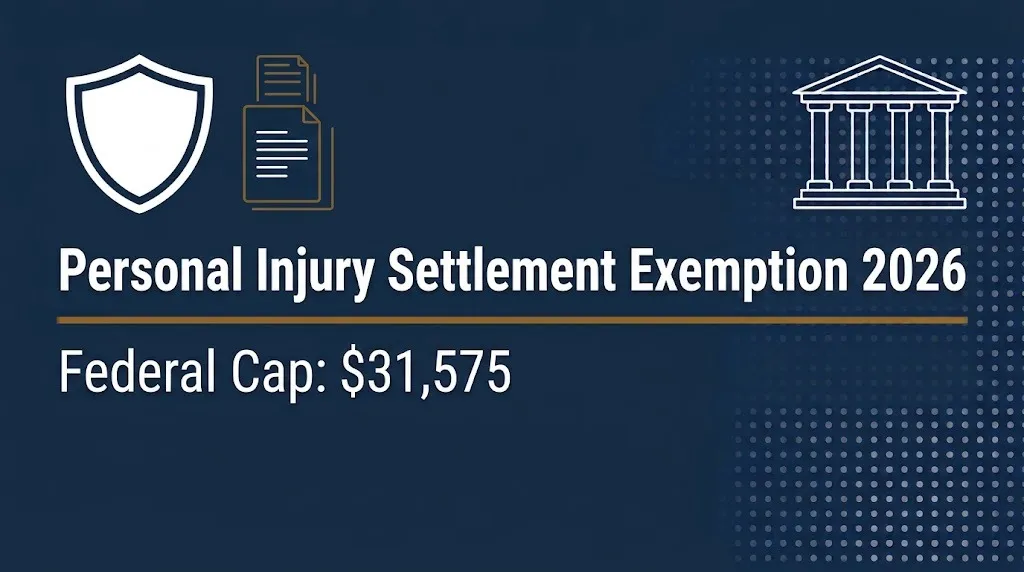
Federal bankruptcy law contains its own exemption at 11 U.S.C. § 522(d)(11)(D). That provision exempts a payment on account of personal bodily injury up to $31,575, a figure that gets adjusted for inflation . The catch is that states can opt out of the federal list and force debtors to use state exemptions instead. Some states allow you to choose between the two lists. Others lock you into state law only.
The myth is that settlement money is always safe once it lands in your hands. It is not. The protection depends on where you live, what kind of debt you owe, and what you did with the money after you received it.
How much of a personal injury settlement is protected?
The protected amount of a personal injury settlement depends on your state’s exemption statute and whether you are in bankruptcy. There is no uniform national figure outside of bankruptcy.
Inside bankruptcy, the federal bodily injury exemption is $31,575 for the bodily injury component . But that number carries a quirk that has confused courts for decades. By its text, the federal bodily injury exemption excludes pain and suffering and compensation for actual pecuniary loss. A separate provision covers loss of future earnings, but only to the extent reasonably necessary for your support.
Here is how the federal exemptions break down:
| Exemption Category | Amount or Limit | Key Restriction |
|---|---|---|
| Personal bodily injury | $31,575 | Excludes pain and suffering and pecuniary loss |
| Loss of future earnings | Reasonably necessary for support | Not a fixed dollar cap |
| State exemption | Varies by state | May be higher or lower than federal |
Outside of bankruptcy, state exemption statutes control. Some states protect personal injury awards broadly. Others carve out specific exceptions for pain and suffering or limit the dollar amount you can shield.
Key Takeaway: The federal bankruptcy exemption for bodily injury is capped at $31,575, but state law controls outside of bankruptcy and can offer broader or narrower protection.
Can creditors take my personal injury settlement for credit card debt?
General creditors like credit card companies typically cannot reach an exempt personal injury settlement without first suing you, winning a judgment, and then attempting to garnish the funds. Even then, your state’s exemption statute may block the garnishment entirely.
The key word is “exempt.” If your state protects personal injury awards from general creditors, a credit card company cannot simply demand your settlement money. It has to follow the legal process. That process usually involves filing a lawsuit, obtaining a judgment, and then seeking a writ of garnishment against a specific account or asset.
Most unsecured debts fall into this category. Credit cards, personal loans, medical bills you owe personally, and similar obligations do not carry special collection powers. They rely on standard judgment enforcement, and exemptions are designed to block that enforcement for protected assets.
That said, the protection is not self-executing. If a creditor garnishes your bank account, you may have to file an exemption claim to get the money back. Silence can mean losing the fight by default.
What debts can reach a personal injury settlement anyway?
Some debts carry legal tools that ordinary creditors do not have, and they can reach settlement money that would otherwise be protected. Child support and alimony arrears, federal tax debts, criminal restitution, and valid medical liens are the main categories.
Child support enforcement can typically reach income streams and assets that private creditors cannot touch. Many state exemption statutes expressly carve out support obligations from the protected list . If you owe back support, your settlement is not a safe harbor.
Federal tax debts are another exception. The IRS levy power reaches nearly everything, and the exemption list at 26 U.S.C. § 6334 does not include commercial annuity or settlement payments . The statute is blunt: no property is exempt from levy except what the subsection specifically lists.
Criminal restitution orders can also reach assets that private creditors cannot. And medical liens for treatment related to the injury often get paid before you see a dollar, because the providers who treated you have a direct claim on the recovery.
| Debt Type | Can It Reach Exempt Settlement? | Why |
|---|---|---|
| Credit card debt | Usually no, without judgment and exemption challenge | Standard unsecured debt |
| Child support arrears | Often yes | Support enforcement exceptions in exemption statutes |
| Federal taxes | Yes | IRS levy power overrides most exemptions |
| Medical liens from injury treatment | Yes, often paid first | Direct lien on the recovery |
| Criminal restitution | Sometimes yes | Government enforcement tools |
Key Takeaway: Child support, federal taxes, and injury-related medical liens can reach settlement money that ordinary creditors cannot touch.
Reality Check: No collector can force you to sell your structured settlement payments to pay an unsecured debt. A sale requires court approval, and judges scrutinize transfers meant to pay old debts when other options exist. If someone pressures you to cash out your settlement to satisfy a credit card, that is a pressure tactic, not a legal requirement.
How do you protect a personal injury settlement from creditors?
Protecting a personal injury settlement from creditors starts before the money lands in your bank account. The single most important step is keeping the funds separate from your everyday money.
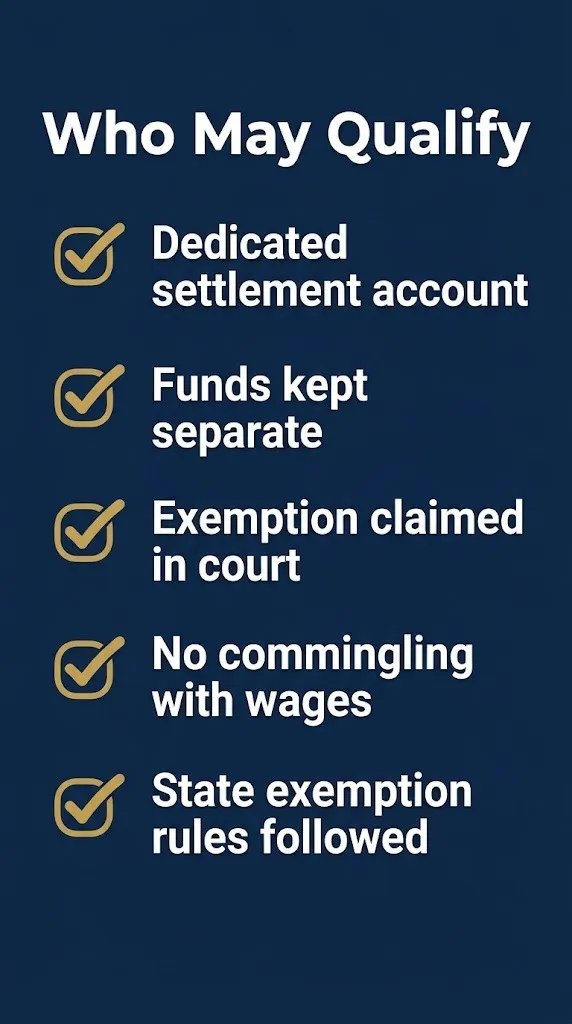
Commingling is the quiet killer of exemption claims. The moment settlement funds mix with wages, tax refunds, or other deposits, proving which dollars came from the injury becomes an evidentiary fight . Courts in many states require you to trace exempt funds. A dedicated account that receives only settlement money makes that tracing straightforward.
Here are the steps to protect your settlement:
- Open a dedicated account that receives only settlement deposits.
- Keep the settlement money separate from wages and other income.
- Save the documentation: settlement agreement, deposit records, and account statements.
- Do not drain and refill the account with other money.
- Claim your exemption if a creditor files a garnishment.
- Consult a lawyer in your state about specific exemption rules.
Some people also use trusts to hold settlement funds. A properly drafted spendthrift trust or special needs trust can add a layer of protection, especially for minors or disabled recipients . But trusts are not a do-it-yourself project. They must be drafted and funded correctly, and a revocable trust does not shield assets from your own creditors.
What happens next if a creditor tries to garnish your settlement?
If a creditor tries to garnish your personal injury settlement, the first thing that happens is usually a notice from your bank or a court filing. You have a limited window to respond, and doing nothing is the worst option.
The exact timeline depends on your state. In general, a judgment creditor files for a writ of garnishment, the court issues the writ to your bank, and the bank freezes the funds. You then receive notice and must file an exemption claim to get the money released.
The process looks something like this:
- Notice received: Bank or court informs you of the garnishment.
- Deadline to respond: Often 10 to 30 days, depending on state.
- File exemption claim: Assert your state’s personal injury exemption.
- Hearing: Court decides whether the funds are protected.
- Release or turnover: If exempt, funds return to you. If not, they go to the creditor.
Missing the response deadline can result in default judgment against your exemption claim. That is how protected money gets taken: not because the law failed, but because no one asserted the protection in time.
Frequently Asked Questions
Can creditors take my personal injury settlement?
Sometimes. General creditors usually cannot reach an exempt settlement without a judgment and a failed exemption claim. Child support, taxes, and medical liens often can.
Is my personal injury settlement protected in bankruptcy?
It depends on your state. The federal bodily injury exemption is $31,575, but some states opt out and use their own exemption amounts instead.
What is the biggest mistake people make with settlement money?
Commingling. Mixing settlement funds with wages or other deposits makes it much harder to prove which money is exempt if a creditor garnishes your account.
Can a credit card company garnish my settlement?
Not directly without a lawsuit and judgment. Even then, your state’s personal injury exemption may block the garnishment entirely.
Do I have to pay taxes on a personal injury settlement?
Personal injury settlements are generally not taxable income for the physical injury portion. Punitive damages and interest may be taxable. Consult a tax professional for your specific case.
Can I put my settlement in a trust to protect it?
Yes, but the trust must be properly drafted and funded. A revocable trust does not protect assets from your own creditors. Irrevocable spendthrift trusts can offer more protection.
What if the settlement is for pain and suffering only?
The federal bankruptcy exemption by its text excludes pain and suffering from the bodily injury cap. State law may treat pain and suffering differently, so check your state’s rules.
What You Should Do Now
If you are expecting a settlement or just received one, open a dedicated account before the money arrives. Do not let it mingle with your regular checking account, even for a day.
Then find out what your state actually protects. The rules vary enough that a general answer is not good enough. A single consultation with a consumer law attorney in your state can tell you whether your settlement is safe and what debts could still reach it.