NC Workers’ Comp Settlement Chart 2026: What the Schedule Actually Pays (And Why Your Number Isn’t on It)
Quick Answer
- North Carolina uses a statutory schedule under N.C.G.S. § 97-31, not a payout chart published by the state.
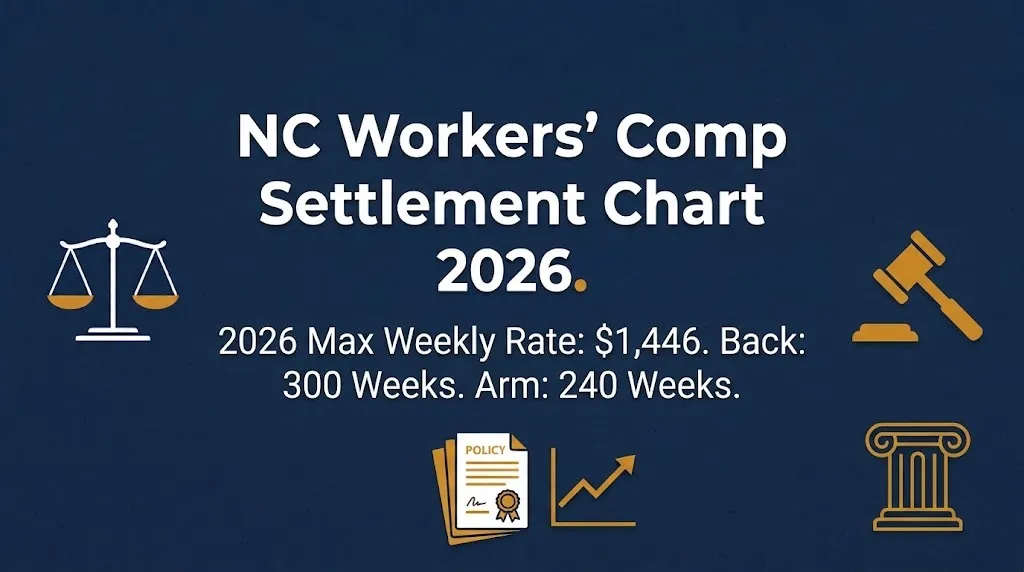
- The 2026 maximum weekly benefit is $1,446.00, up from $1,380.00 in 2025.
- A back injury is worth up to 300 weeks; an arm, 240; a hand, 200; the numbers are fixed, but your rating is not.
You want a number. A chart that tells you what your knee is worth. The state of North Carolina does not publish one, and no lawyer can hand you a guaranteed figure before a doctor rates your impairment.
What does exist is a schedule. N.C.G.S. § 97-31 assigns a fixed number of weeks to each body part . Your settlement is that week count, multiplied by your impairment rating percentage, multiplied by your weekly compensation rate . The chart is a formula, not a menu.
This article breaks down what the schedule actually says, what the 2026 rate cap means for your math, which settlements require Industrial Commission approval, and why the first number the insurer offers is almost never the final one. The surprising part: a back injury carries the highest scheduled value in the state, but North Carolina does not recognize “whole body” impairment, which changes the calculation entirely .
The Facts
| Item | Detail |
|---|---|
| Governing Law | N.C.G.S. § 97-31 (scheduled injuries), § 97-29 (wage benefits) |
| 2026 Maximum Weekly Rate | $1,446.00 for injuries occurring in 2026 |
| Wage Replacement Rate | 66 2/3% of average weekly wage, capped at the state maximum |
| Claim Filing Deadline | Two years from the accident under § 97-24 |
| Settlement Approval | Required by the NC Industrial Commission under § 97-17 |
| Typical Moderate Injury Range | $25,000 to $80,000 for around 15% impairment |
| Administrator | North Carolina Industrial Commission (not a class settlement administrator) |
Is the NC Workers’ Comp Settlement Chart Real or a Myth?
The NC workers’ comp settlement chart is real as a statutory schedule, but it is not a published payout table you can look up by injury name. The “chart” is N.C.G.S. § 97-31, a list of body parts and the weeks of compensation each is worth for total loss .
The confusion comes from websites that publish tables with dollar ranges. Those ranges are estimates, not official figures. Workerscompestimator.com, for example, publishes a 2026 North Carolina chart with ranges like $5,741 to $22,964 for a back strain and $180,009 to $432,022 for a severe traumatic brain injury . Those numbers are calculated from the statutory formula at a hypothetical $1,200 average weekly wage. They are useful as a starting point, not a promise.
The Industrial Commission does not publish a settlement chart. It publishes forms, rules, and maximum rates. The schedule lives in the statute, and the dollar figure lives in your medical record.
Reality Check: No one texts you a settlement offer. The insurer’s first number is an opening bid, not a valuation. Filing with the Industrial Commission costs nothing, and you do not need a paid “claim helper” to request a hearing or submit a Form 26A.
How Much Is My NC Workers’ Comp Settlement Worth in 2026?
Your NC workers’ comp settlement is worth the sum of unpaid wage benefits, a permanent partial disability award based on your impairment rating, and the buyout value of future medical care. The formula is weeks × rating × weekly rate, plus medical .
The 2026 weekly maximum is $1,446.00 . If your average weekly wage was $1,200, your compensation rate is $800 (66 2/3% of wage), because $800 is below the cap. If your average weekly wage was $3,000, your rate is capped at $1,446.
Here is how the schedule converts to money for common injuries, using a $900 average weekly wage (a $600 weekly rate) and the statutory week values:
| Body Part | Total Weeks | 10% Rating Pays | 25% Rating Pays |
|---|---|---|---|
| Back | 300 | $18,000 | $45,000 |
| Arm | 240 | $14,400 | $36,000 |
| Hand | 200 | $12,000 | $30,000 |
| Leg | 200 | $12,000 | $30,000 |
| Foot | 144 | $8,640 | $21,600 |
| Eye | 120 | $7,200 | $18,000 |
Those figures are the PPD award alone. They do not include unpaid TTD checks, future medical costs, or disfigurement awards. A surgical back claim with a 20% rating and significant future care commonly settles far above the bare schedule math .
Key Takeaway: The schedule gives you a floor, not a ceiling. Future medical care and disputed wage loss are where the real negotiations happen.
What Is the 2026 NC Workers’ Comp Weekly Maximum Rate?
The 2026 NC workers’ comp weekly maximum rate is $1,446.00 for injuries occurring between January 1 and December 31, 2026 . That is an increase from $1,380.00 in 2025 and $1,330.00 in 2024 .
The rate matters because every scheduled award is capped by it. If your average weekly wage is high enough that two-thirds of it exceeds $1,446, your compensation rate is $1,446, not your actual wage. For high earners, the schedule’s week values are effectively discounted by the cap.
Two other numbers matter. The minimum weekly rate is $30.00 for injuries before July 1, 2027 . And the waiting period rule: no wage benefits for the first seven calendar days of disability, but if disability lasts more than 21 days, you are paid from day one .
A comparison: the weekly cap works like a salary cap in a sport. Your value might be higher, but the system will not pay above the ceiling, no matter what your numbers say.
Who Decides My Impairment Rating in North Carolina?
Your treating physician assigns your impairment rating under the AMA Guides to the Evaluation of Permanent Impairment. In North Carolina, your employer or its insurer generally chooses that treating doctor .
That is the structural problem with the schedule. The week values are fixed by statute, but the percentage applied to them comes from a doctor selected by the side that pays the claim. A 2026 legal guide notes that initial ratings from insurance company doctors “are often lower than what your injury warrants” .
You have a right to a second opinion. Under North Carolina practice, if you disagree with the rating, you can request an independent medical evaluation at the employer’s expense . You can also challenge the rating before it becomes the basis for an award .
The Industrial Commission publishes a Rating Guide that physicians use. For back injuries, the guide provides ranges from 0% for a fully recovered strain to 25% to 30% for post-surgical fusion cases with ongoing symptoms . Those ranges are wide because back injuries are wide. A doctor’s judgment call inside that range can move your settlement by tens of thousands of dollars.
How Do You File an NC Workers’ Comp Claim?
You file an NC workers’ comp claim by reporting the injury to your employer in writing within 30 days and filing a claim with the Industrial Commission within two years of the accident .
Here are the steps:
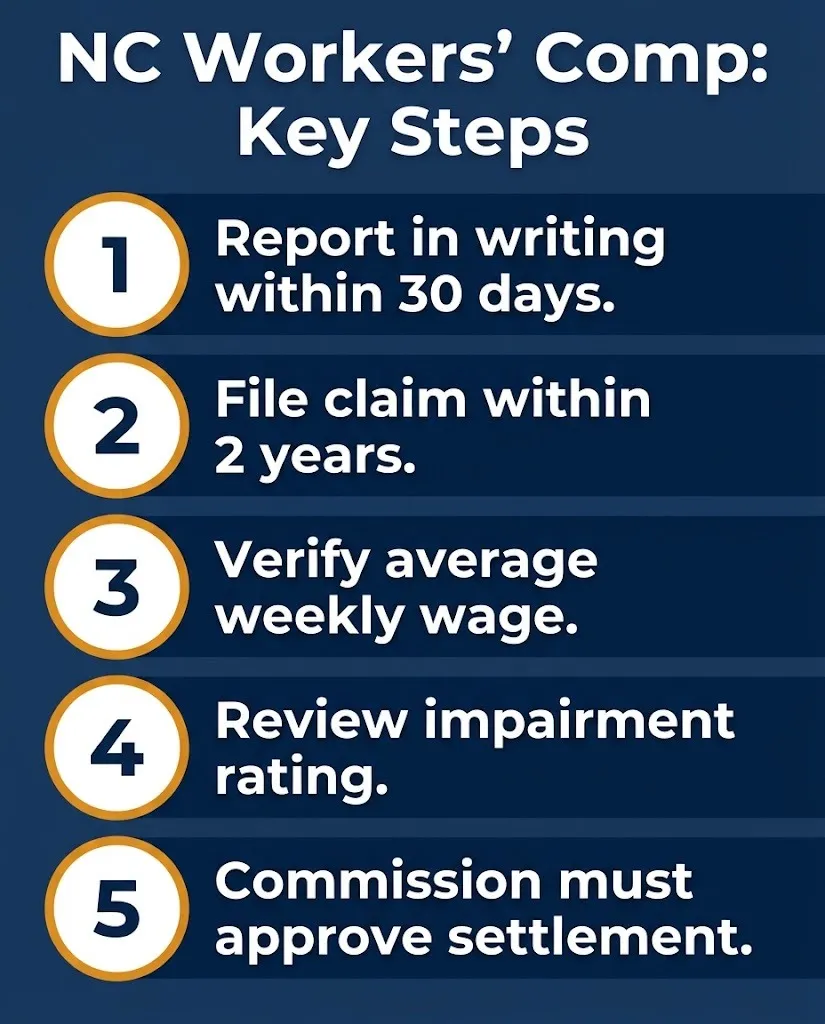
- Report the injury to your employer in writing within 30 days and keep a copy .
- See the employer-directed doctor. Do not switch doctors on your own without Commission approval .
- Keep every record: pay stubs, medical bills, mileage, and dates off work .
- Verify the average weekly wage the insurer uses. A low figure lowers every benefit .
- File a Form 18 with the Industrial Commission to preserve your claim within two years .
- Do not accept the first impairment rating or settlement offer without review .
- Get a free consultation with a NC workers’ comp attorney before signing anything.
The two-year deadline is unforgiving. Under § 97-24, the right to compensation is “forever barred” if no claim is filed and no compensation is paid within that window . Missing it is like missing a tax filing deadline: the penalty is the entire refund.
What Is the Difference Between a Form 26A and a Clincher Settlement?
A Form 26A pays your permanent partial disability rating without closing future medical benefits. A clincher settlement closes everything, including your right to future medical care, in exchange for a negotiated lump sum .
The Form 26A is the narrower agreement. It is used when the parties agree on a PPD rating and the insurer pays the scheduled weeks. Future medical stays open. If your condition worsens, you can still seek treatment .
The clincher, formally a Compromise Settlement Agreement, is the full buyout. It resolves disability and medical compensation in one negotiated amount. Once approved by the Industrial Commission, you cannot reopen the claim for the same injury .
A 2026 legal analysis puts it plainly: a clincher “closes everything,” while a Form 26A “addresses PPD compensation without necessarily closing future medical benefits” . Choosing between them is the single most consequential decision in most NC workers’ comp cases.
Does the NC Industrial Commission Have to Approve My Settlement?
Yes. All North Carolina workers’ comp settlements must be approved by the NC Industrial Commission under N.C.G.S. § 97-17 . The Commission reviews whether the settlement is fair and in the worker’s best interest.
Approval typically takes two to six weeks after submission of the signed agreement . Settlements involving unrepresented workers receive particularly close scrutiny, because the Commission wants to ensure the worker understood what they were giving up.
The Commission can reject a settlement it finds inadequate. That does not mean it will negotiate for you. It means the agreement goes back to the parties for revision. A clincher that undervalues future medical care is the most common reason for a rejection.
Key Takeaway: The Commission is a safety net, not your advocate. It reviews the paperwork, not your medical future.
How Long Does an NC Workers’ Comp Settlement Take?
An NC workers’ comp settlement typically takes three to 18 months from the point you reach maximum medical improvement (MMI) . The timeline runs from the final disability rating through negotiation and Commission approval.
The stages break down like this: obtaining the final rating takes one to three months after MMI. Gathering medical cost projections and negotiating with the adjuster takes another one to three months. Drafting and executing the agreement takes two to four weeks. Industrial Commission approval takes two to six weeks .
Complex cases take longer. Disputed causation, multiple injuries, and Medicare Set-Aside requirements all add time. A case with a Medicare Set-Aside can take months longer because the allocation must be reviewed and administered separately .
Pre-MMI, you are receiving TTD checks at 66 2/3% of your wage. The insurer cannot force you to settle before MMI. Post-MMI, the clock on negotiations starts.
What Happens Next in Your NC Workers’ Comp Case?
Here is the expected sequence, with verified deadlines where they exist:
Within 30 days of injury: Report in writing to your employer and keep a copy .
Within two years of accident: File your claim with the Industrial Commission under § 97-24 .
At MMI: Your treating doctor assigns a permanent impairment rating.
Post-MMI: Negotiate the PPD award or clincher. Expect three to 18 months .
After agreement: Submit to the Industrial Commission for approval. Expect two to six weeks .
July 1, 2027: Disfigurement caps and minimum weekly rate change under Session Law 2026-14 .
Frequently Asked Questions
What is the NC workers’ comp settlement chart?
It is the statutory schedule under N.C.G.S. § 97-31, which assigns weeks of compensation to each body part.
How much is a back injury worth in NC workers’ comp?
The back is scheduled at 300 weeks. At a $600 weekly rate and 20% rating, the PPD award is $36,000 before future medical.
What is the 2026 maximum weekly benefit in NC?
The 2026 maximum is $1,446.00 per week for injuries occurring in 2026.
Can I settle my NC workers’ comp case without a lawyer?
Yes, but the Industrial Commission scrutinizes unrepresented settlements closely, and the insurer’s first offer is rarely the best one.
What is a clincher settlement in NC?
A clincher is a full and final Compromise Settlement Agreement that closes the claim, including future medical care.
How long do I have to file a NC workers’ comp claim?
You have two years from the accident to file with the Industrial Commission under § 97-24.
Does the Industrial Commission have to approve my settlement?
Yes. All NC workers’ comp settlements require Commission approval under § 97-17.
The Bottom Line
The NC workers’ comp settlement chart is a formula, not a fortune teller. Your body part has a week value. Your doctor assigns a percentage. Your wage sets the rate. The 2026 cap is $1,446.00.
Before you sign anything, verify the average weekly wage the insurer used, get your rating reviewed if it seems low, and ask whether a Form 26A preserves future medical care that a clincher would close. The two-year deadline under § 97-24 is the one date you cannot miss.