DoorDash Settlement 2026: Class Action Payouts, Claim Deadlines, and Who Qualifies
Quick Answer:
- DoorDash settlements are real, court-approved class actions covering drivers misclassified as contractors and consumers charged hidden fees.
- Driver settlements have paid thousands per person. Consumer settlements typically pay $10 to $50 per valid claim.
- The most active 2026 claim deadlines apply to newer state-level settlements. Check the official administrator site for your case.
You clicked this because you either drove for DoorDash and heard about a settlement, ordered food and got charged a fee you did not expect, or saw a headline promising cash. The short answer: DoorDash has been sued dozens of times, and several of those lawsuits turned into real settlements that paid real money to real drivers and customers. The longer answer: which settlement you qualify for, and whether the deadline has already passed, is what actually determines whether any money is coming your way.
This affects you if you delivered for DoorDash at any point since the company launched, or if you ordered food through the app and paid delivery or service fees that were not clearly disclosed. Millions of drivers and tens of millions of customers fall into those groups. Not everyone gets paid. Only those who filed timely claims in approved settlements do.
This article covers every major DoorDash class action settlement active or paying in 2026, including driver misclassification cases, tip-subsidy settlements, consumer fee lawsuits, and the newer state-level actions. One surprising verified detail: DoorDash paid $100 million to settle claims that it subsidized driver pay with customer tips, and the payout per driver in some older settlements reached five figures.
The Facts
| Detail | Information |
|---|---|
| Cases | Multiple: worker misclassification (CA, MA, IL), tip subsidy, consumer fee disclosure, ADA accessibility, data privacy |
| Status | Tip subsidy settlement: paying. CA driver settlement: paying. Consumer settlements: mixed, some closed, some pending approval |
| Fund Size | Combined settlements exceed $350 million. $100 million (tip subsidy, 2019). $85 million (CA drivers). $11.25 million (IL privacy). State settlements vary |
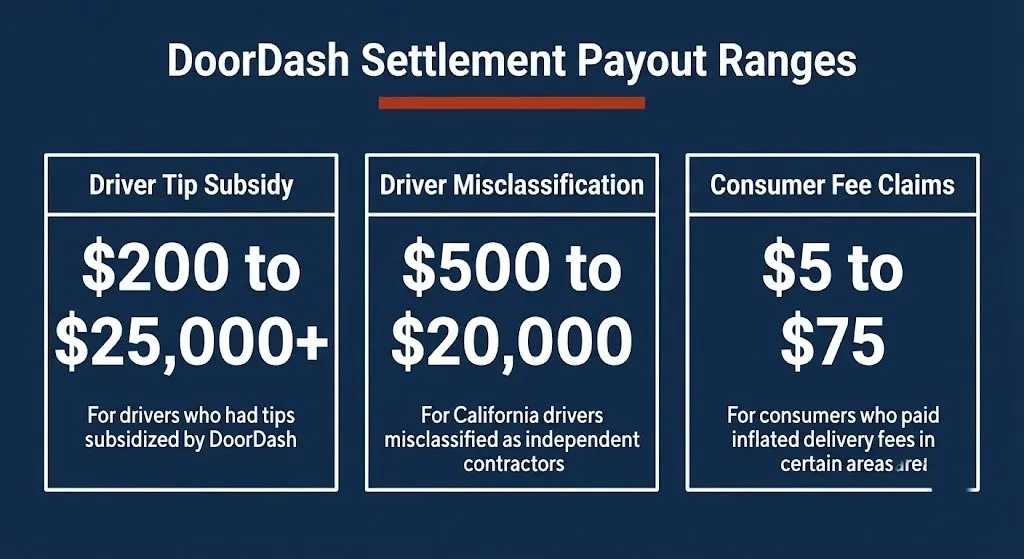
| Est. Per Person | Drivers: $200 to $25,000+ depending on hours worked. Consumers: $5 to $75 per claim |
| Claim Deadlines | Vary by case. Tip subsidy: closed. CA driver: closed. IL biometric: check official site. New 2026 cases: TBD |
| Administrator | Various including Epiq, Kroll, JND Legal Administration |
| Proof Needed | Drivers: Dasher account records, mileage logs. Consumers: order receipts, account email |
Is the DoorDash Class Action Lawsuit Legitimate?
Yes, DoorDash class action lawsuits are legitimate, court-supervised legal proceedings. They have been filed in state and federal courts across the country, overseen by judges, and in many cases resulted in approved settlements administered by major claims firms like Epiq, Kroll, and JND Legal Administration. These are not internet rumors or phishing schemes. When you receive a notice about a DoorDash settlement, it is almost certainly real.
The most prominent cases include the $100 million tip-subsidy settlement in California and Massachusetts, the $85 million California driver misclassification settlement, and a series of consumer fee-disclosure cases. Each was approved by a court after notice to affected drivers or customers, a fairness hearing, and an opportunity to object or opt out. This is the standard process for class action settlements in the United States. It is slow, it is public, and it leaves a paper trail in court dockets.
Scam notices do exist, but they follow a different pattern. A fake notice pressures you with a 24-hour deadline, asks for a processing fee, or comes from a Gmail account rather than a court-appointed administrator. Real notices list a case name, a court, a settlement website ending in .com or .org, and never ask for payment. If you are unsure, do not click the link. Search the case name on the court’s public docket system or the administrator’s known website instead.
How Much Money Can I Get From a DoorDash Settlement?
DoorDash settlement payouts range from a few dollars for consumer fee claims to five-figure awards for drivers who worked thousands of hours during the class periods. The largest payouts have gone to delivery drivers misclassified as independent contractors. Some drivers received more than $25,000 from the California settlement. Others received a few hundred dollars. The difference came down to how many deliveries they completed during the class period.
For consumer settlements, the payouts are smaller. The typical DoorDash consumer settlement pays $10 to $50 per person. The funds are divided among a much larger class, sometimes tens of millions of people, which means each individual share is modest. The Illinois biometric privacy settlement, which covered DoorDash drivers whose facial recognition or other biometric data was allegedly collected without consent, paid qualifying drivers hundreds of dollars. These amounts reflect the per-person economics of a class action: large aggregate funds, but spread across large classes.
For newer DoorDash settlements filed or pending in 2026, no payout amounts have been confirmed. Cases still in litigation have no approved settlement fund and no claims administrator. Any specific dollar figure you see attached to an unsettled case is speculation from plaintiff’s attorneys or recycled from an older case.
| Settlement | Fund | Typical Payout | Who Got Paid |
|---|---|---|---|
| Tip Subsidy (CA/MA) | $100 million | $200 to $25,000+ | Drivers who delivered during class period |
| CA Driver Misclassification | $85 million | $500 to $20,000 | California Dashers |
| IL Biometric Privacy | $11.25 million | $300 to $1,000 | Illinois drivers |
| Consumer Fee Disclosure (various) | $2M to $10M each | $5 to $75 | Customers who placed orders |
| ADA Accessibility | Not yet confirmed | Not yet determined | Pending court approval |
Key Takeaway: Driver settlements have paid thousands of dollars to individual claimants. Consumer settlements typically pay enough to cover a few meals, not a month’s rent.
What Is the DoorDash Driver Misclassification Settlement?
The DoorDash driver misclassification settlements resolved allegations that DoorDash illegally treated delivery drivers as independent contractors rather than employees. The argument, which was settled without a full trial in most jurisdictions, was that DoorDash controlled how drivers did their jobs, set their pay, and could deactivate them at will, all characteristics of an employment relationship, while avoiding payroll taxes, workers’ compensation, overtime pay, and minimum wage guarantees.
The California settlement, valued at $85 million, covered drivers who worked for DoorDash in California during the class period. Payouts were calculated based on miles driven and hours worked. Drivers who completed thousands of deliveries received the largest checks. Drivers who dashed occasionally received proportionally less. The settlement also included non-monetary terms requiring DoorDash to change certain practices, including providing more transparency around pay calculations and deactivation decisions.
Massachusetts and Illinois have reached similar settlements with DoorDash, though the fund sizes and per-driver payouts differ. Each state’s case was filed under that state’s specific labor laws. The Massachusetts settlement followed the California pattern, paying drivers based on delivery volume. The Illinois settlement added a biometric privacy component because DoorDash allegedly collected driver fingerprint or facial scan data through its identity verification system without the consent required by Illinois’s Biometric Information Privacy Act.
What Was the DoorDash Tip Subsidy Settlement?
The DoorDash tip subsidy settlement was a $100 million resolution of claims that DoorDash used customer tips to cover driver base pay rather than adding tips on top of the guaranteed delivery amount. Before the policy changed in 2019, DoorDash would guarantee a driver $7 for a delivery. If the customer tipped $5, DoorDash would contribute only $2 rather than the full $7, meaning the tip did not increase the driver’s total pay. It just reduced what DoorDash paid.
The settlement covered drivers in California and Massachusetts who delivered during the period when this pay model was in effect. Payouts were substantial because the class was limited to two states and the harm was easy to calculate: each tipped delivery where DoorDash reduced its contribution effectively stole the tip from the driver. Some drivers received checks exceeding $25,000. The average payout was in the low thousands.
The claim deadline for this settlement has passed. If you filed a valid claim, you should have received payment by now. If you did not file, you cannot file now. This settlement is closed. It is also the one most commonly cited in social media posts that overpromise what new DoorDash settlements will pay, since the tip-subsidy amounts were unusually high for a gig-economy class action. Newer settlements have not reached these per-person levels, and may not, because the legal theories and class sizes differ.
Key Takeaway: The tip-subsidy settlement paid more per driver than most gig-economy cases because the harm was easy to quantify and the class was geographically limited. Most settlements do not match those payout levels.
What Consumer Fee Settlements Has DoorDash Paid?
DoorDash has settled multiple consumer class actions alleging it charged undisclosed or misleading delivery fees, service fees, and small-order fees at checkout. These cases argued that customers saw one price when browsing the app or website and a different, higher price when they checked out, violating state consumer protection laws that require clear, upfront pricing.
The settlements typically created funds of $2 million to $10 million each. Per-person payouts ranged from $5 to $75, with the exact amount depending on the number of valid claims filed. These settlements followed a pattern: customers who placed orders during the class period could submit a claim with their account email and some proof of purchase, such as a receipt or order confirmation. The deadline windows for most of these cases have closed.
A small number of consumer fee cases remain open to claims in 2026. These are typically newer state-level cases, not the larger multi-state settlements that resolved earlier. If you received a notice about a DoorDash consumer fee settlement in 2026, check the settlement website for the specific case name and claim deadline. Do not assume you missed the window just because older cases are closed.
How Do I File a DoorDash Settlement Claim?
Filing a DoorDash settlement claim starts with determining which case you are in and whether the claim window is still open. Most older DoorDash settlements have closed their claim periods. For active 2026 cases, the process is standardized and free. No legitimate settlement ever charges a filing fee. If someone asks you to pay to submit a claim, you are looking at a scam or a third-party service that does nothing you cannot do yourself.
Here is how the claims process works for DoorDash settlements that are still accepting filings:
- Identify the exact case from your notice, including the case name and court.
- Visit the official settlement website listed on the notice.
- Read the class definition to confirm you are covered before filing.
- Gather required documentation: Dasher account details for driver cases or order receipts for consumer cases.
- Complete the online claim form with accurate information matching your documentation.
- Submit before the deadline and save your confirmation number.
This is like filing a warranty claim for a defective product. You need proof of purchase or use, you need to fill out the form correctly, and you need to meet the deadline. Messing up any of those three steps gets your claim delayed or denied. The administrator does not chase you for missing information.
Reality Check: No DoorDash settlement sends a text message with a link asking you to click and claim your money. Real notices arrive by mail or email from a known administrator like Epiq, Kroll, or JND. They direct you to a settlement website with a .com or .org domain. They never ask for your bank password or a processing fee. If the message came through WhatsApp or a random text, delete it.
Who Qualifies for a DoorDash Settlement?
Qualifying for a DoorDash settlement depends on your role, your location, and the specific class period defined in the settlement agreement. Drivers qualify for worker misclassification and tip subsidy settlements if they delivered for DoorDash during the covered period in the covered state. Consumers qualify for fee-disclosure settlements if they placed orders during the class period. There is no single DoorDash settlement that covers everyone.
For driver settlements, the key factor is usually the state where you dashed. California, Massachusetts, Illinois, and New York have all produced settlements with different eligibility windows. A driver in Texas does not qualify for the California settlement, even if the same company policies were in effect there. State labor laws differ, and class actions are typically filed under a specific state’s statutes.
For consumer settlements, eligibility is usually broader geographically but narrower in time. You may qualify if you placed an order on the DoorDash platform during a specific date range, often a two- or three-year window. The settlement notice will list the exact class period. Your order confirmation emails from that period are the best proof you have. If you deleted them, DoorDash account records can be subpoenaed, but the claims process expects you to provide the documentation, not the defendant.
| Settlement Type | Who Qualifies | Typical Class Period |
|---|---|---|
| Driver Misclassification | Dashers in specific states | 2 to 5 years before filing |
| Tip Subsidy | CA and MA Dashers | Pre-2019 policy change |
| Consumer Fee Disclosure | Customers who placed orders | 2 to 4 year window |
| Biometric Privacy | IL Dashers | Period when biometric data collected |
Key Takeaway: Eligibility is case-specific. A settlement for California drivers does nothing for a driver in Florida. A settlement for 2018 orders does nothing for a 2024 order.
When Will My DoorDash Settlement Check Arrive?
DoorDash settlement check delivery depends on where the case is in the approval and claims-processing pipeline. For settlements that have already received final approval and resolved any appeals, payments typically go out within 60 to 120 days of the claims deadline. For settlements still awaiting final approval, the timeline extends to 6 to 18 months after the deadline, since the court must hold a fairness hearing and any objectors have time to appeal.
The tip-subsidy settlement and several driver misclassification cases have already distributed payments. If you filed a valid claim in one of those cases and have not received money, your payment may have been returned as undeliverable. This happens more often than you would think, the claimant moved and never updated their address with the administrator. Most settlement websites have a claim-status lookup tool. Use it to check whether your payment was issued and whether the address on file is correct.
For settlements that are still in the claims-filing phase in 2026, no checks have been mailed because the administrator is still collecting and verifying claims. After the deadline passes, the administrator must audit submissions, reject incomplete or fraudulent claims, calculate the per-person payout by dividing the net fund among all valid claims, and submit the distribution plan for court approval. Only then do checks go out. This takes months.
Are There New DoorDash Lawsuits in 2026?
Yes, new DoorDash lawsuits have been filed in 2026. These cases focus on different legal theories than the older misclassification and tip-subsidy cases. The most active new litigation involves fee-transparency claims in states with aggressive consumer protection laws, data privacy suits under state biometric statutes, and algorithmic discrimination claims alleging DoorDash’s dispatch and pay systems disadvantage certain drivers or neighborhoods.
The fee-transparency cases argue that DoorDash continues to bury service fees, delivery fees, and regulatory response fees in ways that violate updated state disclosure laws. Some cities and states have passed specific delivery-fee transparency ordinances since the pandemic, and these new laws provide fresh legal grounds for class actions. The claims are similar to the older consumer cases but rest on newer statutes with different penalty structures and class definitions.
None of these new 2026 cases have reached a settlement or been certified as a class. They are in early litigation stages. That means no claim deadlines exist, no settlement funds have been created, and no payments are scheduled. Any article or social media post claiming these new lawsuits will pay out a specific amount in 2026 is making up numbers that do not appear anywhere in the court record.
Why Was DoorDash Sued in Class Actions?
DoorDash faced class actions primarily because its business model created legal risks on multiple fronts. Treating millions of delivery drivers as independent contractors, while controlling their pay, routes, and continued access to the platform, created exposure under state wage-and-hour laws. Using customer tips to offset the company’s own pay obligations created exposure under state tip-protection statutes. Charging fees that were not clearly disclosed at the start of the transaction created exposure under consumer protection laws.
The driver lawsuits argued that DoorDash’s control over the delivery process, from setting pay rates to determining which orders a driver sees to deactivating drivers who decline too many orders, makes the company an employer under state law. Employers must pay minimum wage, overtime, and payroll taxes. They must carry workers’ compensation insurance. DoorDash avoided these costs by classifying drivers as independent contractors. The settlements forced the company to pay some of what it would have owed under an employment model, without legally conceding that drivers are employees.
The consumer lawsuits argued a simpler theory: the price DoorDash showed on the menu and at checkout did not match. Service fees, delivery fees, small-order fees, and regulatory response fees added dollars to every order, often disclosed only at the final payment screen. State consumer laws require clear and conspicuous pricing. The settlements compensated customers for the difference between what they thought they would pay and what they were actually charged.
What Did DoorDash Do Wrong?
DoorDash’s primary legal problem was paying drivers less than they were owed while charging customers more than they expected. The tip-subsidy model was the most egregious example. For a period before 2019, DoorDash guaranteed drivers a minimum per-delivery amount, say $7. If the customer tipped $5, DoorDash contributed $2 instead of $7. The driver still got $7, but the customer’s $5 tip effectively went to DoorDash, not the driver. The company’s public statements called this a “pay model.” The settlement called it $100 million worth of unpaid wages.
On the consumer side, DoorDash’s fee structure was the problem. The company advertised one price and charged another. A $12 burrito could become $20 at checkout with delivery fees, service fees, small-order fees, and regulatory fees. State attorneys general and class-action lawyers argued this violated laws requiring upfront pricing. DoorDash eventually changed its fee disclosures, adding more prominent breakdowns at checkout. The settlements compensated customers who ordered before those changes took effect.
The newer 2026 cases add allegations that DoorDash’s algorithm discriminates in assigning orders, that its deactivation process denies drivers due process, and that its biometric identity verification system violates state privacy laws. These cases are less advanced than the wage and fee cases. DoorDash has denied wrongdoing in all of them while the litigation proceeds.
How Do DoorDash Settlements Compare to Other Gig-Economy Settlements?
DoorDash settlements fall in the middle range of gig-economy class actions. Uber paid $20 million to settle driver misclassification claims in California and Massachusetts, far less than DoorDash’s combined $185 million for similar claims in the same states. Lyft settled a California driver suit for $27 million. Instacart has paid out tens of millions across various settlements. Postmates, now owned by Uber, settled for smaller amounts.
The reasons for the differences are case-specific. DoorDash faced stronger facts in the tip-subsidy case because internal documents showed the company knew tips were being used to offset its own pay obligations. The California Attorney General’s office was more aggressive in pursuing DoorDash than in some parallel cases. And DoorDash’s driver base in California, the largest state by Dasher population, was enormous, meaning even a modest per-driver formula produced a large aggregate settlement.
| Company | Largest Settlement | Type |
|---|---|---|
| DoorDash | $100 million | Tip subsidy |
| DoorDash | $85 million | Misclassification |
| Uber | $20 million | Misclassification |
| Lyft | $27 million | Misclassification |
| Instacart | $46.5 million | Tip subsidy |
| Postmates | $15 million (approx.) | Misclassification |
Key Takeaway: DoorDash has paid more in gig-economy settlements than most competitors, driven by the strength of the tip-subsidy evidence and California’s aggressive enforcement posture.
Can I Still File for a DoorDash Settlement in 2026?
Yes, you can still file for some DoorDash settlements in 2026, but only the ones with open claim windows. Most older settlements, including the large driver tip-subsidy and California misclassification cases, have closed their claim periods permanently. No new claims are accepted for those. If someone tells you they can get you into a closed settlement for a fee, they are lying.
Active 2026 claim windows exist for newer state-level settlements. Illinois and New York have open cases with varying deadlines. Check the specific settlement website for the case name on your notice. If you did not receive a notice, you can search the administrator’s site or the court docket, but you are responsible for confirming your own eligibility and meeting the deadline.
Do not rely on third-party aggregator sites to tell you which settlements are open. These sites often list closed cases as active because it drives traffic and ad revenue. The only authoritative source for a settlement’s status is the official settlement website run by the court-appointed administrator, or the court docket itself.
What Happens Next
The DoorDash settlement landscape in late 2026 includes ongoing payments from approved settlements and active litigation in newer cases. Here is the expected timeline:
Late 2026: Continued distribution of payments from approved settlements. Some residual funds may be redistributed if initial checks go uncashed.
Expected Q4 2026 to Q1 2027: Possible preliminary approval of one or more new state-level consumer fee settlements. If approved, claim periods will open.
Ongoing: Algorithmic discrimination and deactivation lawsuits proceed through discovery. No trial dates set as of July 2026.
Watch for: Official notices from administrators like Epiq, Kroll, or JND. These are the only legitimate sources of claim-filing information. Anyone else promising you DoorDash settlement money is guessing or scamming.
Frequently Asked Questions
Is There a DoorDash Class Action Settlement in 2026?
Yes, DoorDash class action settlements are active in 2026, with some paying claims and new ones in litigation.
Older major settlements have closed their claim windows, but newer state-level cases are still accepting filings.
Check the official settlement website for the specific case referenced in any notice you receive.
How Much Is the DoorDash Settlement Per Person?
Driver settlements have paid from $200 to over $25,000 depending on hours worked during the class period.
Consumer settlements typically pay $5 to $75 per valid claim.
New 2026 cases have no confirmed payout amounts because no settlement funds have been approved yet.
Can I Get Money From the DoorDash Lawsuit?
You can get money if you file a valid claim in an active settlement with an open claim window.
You cannot get money from closed settlements if you did not file before the deadline.
New lawsuits have no money to distribute yet because they have not settled.
How Do I Know If I Qualify for the DoorDash Settlement?
You qualify if you fit the class definition listed on the official settlement website for a specific case.
Class definitions vary by settlement and typically specify dates, locations, and whether you were a driver or customer.
Check the settlement notice or administrator’s site, not social media, to determine eligibility.
When Will I Get My DoorDash Settlement Payment?
Approved settlements with no pending appeals typically pay within 60 to 120 days of the claim deadline.
Settlements awaiting final approval may take 12 to 18 months after the deadline before checks are mailed.
Use the claim-lookup tool on the official settlement site to check your payment status.
Why Did DoorDash Get Sued?
DoorDash was sued for misclassifying drivers as independent contractors, using customer tips to subsidize driver pay, and charging undisclosed fees to customers.
Newer lawsuits add claims of algorithmic discrimination and biometric privacy violations.
Each lawsuit targets specific practices and covers specific time periods and states.
What Proof Do I Need for a DoorDash Settlement Claim?
Drivers typically need Dasher account information and may need mileage or delivery logs.
Consumers typically need order receipts or account email addresses showing purchases during the class period.
Check the claim form for your specific settlement, since requirements vary by case.
Is the DoorDash Settlement Email Legitimate?
A legitimate DoorDash settlement email comes from a court-appointed administrator like Epiq, Kroll, or JND.
It lists a specific case name, court, and directs you to a settlement website ending in .com or .org.
It never asks for payment, bank passwords, or sensitive personal information beyond what is needed to verify your claim.
Your next move is straightforward. If you received a notice, check the official settlement website immediately. Confirm the deadline. Gather whatever documentation the claim form requires. File before the window closes. If you think you qualify for a settlement but received no notice, search the case name on the administrator’s known site or the court’s public docket. Do not pay anyone to do this for you. Filing is free and the process, while bureaucratic, is designed to be completed without a middleman.
The deadline is the only thing that cannot be fixed after it passes. Everything else in a settlement claim can be corrected with a phone call to the administrator. Missing the deadline means you get nothing, no matter how strong your claim.