Alaska Airlines Passenger Lawsuit 2026: What the Flight 700 Turbulence Case Actually Alleges
Quick Answer
- This is a real, verifiable lawsuit: passenger Natalie Russell sued Alaska Airlines in King County Superior Court on May 13, 2026, over Flight 700.
- There is no settlement fund and no per-person payout; the complaint does not specify a dollar amount and seeks damages including punitive damages.
- There is no public claim deadline because this is an individual negligence suit, not a class action settlement with a claims process.
If you searched “Alaska Airlines passenger lawsuit” hoping to find a class settlement you can file into, here’s the direct answer: that’s not what this is. This is one passenger’s negligence case over a specific, well-documented turbulence incident.
The case centers on Alaska Airlines Flight 700, which left Seattle-Tacoma International Airport the day after Christmas in 2024 and dropped roughly 200 feet in seconds over Nevada. Four crew members and at least one passenger were hospitalized, and the National Transportation Safety Board opened a preliminary investigation.
This article breaks down what the lawsuit alleges, what’s confirmed versus still pending, what Alaska Airlines has said publicly, and whether other passengers or crew have filed similar claims. One detail stands out: the NTSB’s preliminary report says no passengers were injured, while the lawsuit says otherwise, and that conflict is now part of the case.
The Facts
| Case | Russell v. Alaska Airlines (individual negligence lawsuit) |
| Court | King County Superior Court, Washington |
| Filed | May 13, 2026 |
| Underlying incident | Flight 700, Seattle to Phoenix, December 26, 2024 |
| Status | Filed, pretrial stage; no trial date confirmed |
| Settlement fund | Not applicable, this is not a class action |
| Est. per-person payout | Not yet determined; no dollar amount specified in the complaint |
| Claim deadline | Not applicable; no claims administrator or public filing window exists |
| Plaintiff’s attorney | Mark Lindquist, aviation attorney |
Is the Alaska Airlines Passenger Lawsuit Real?
Yes, this is a genuine, filed lawsuit, not a rumor or a phishing-style settlement notice. It’s documented in King County Superior Court records and covered by multiple regional and aviation news outlets.
A Mercer Island woman filed a lawsuit in King County Superior Court accusing Alaska Airlines of negligence after a holiday flight from Seattle to Phoenix plunged into severe turbulence, according to a complaint filed by aviation attorney Mark Lindquist. Washington resident Natalie Russell filed the suit claiming Alaska Airlines pilots and dispatchers knew the plane was flying into dangerous conditions and failed to divert Flight 700.
This matters because “Alaska Airlines passenger lawsuit” is also the kind of headline that gets recycled by scam settlement notices. There’s no claims website tied to this case, and no legitimate source will ask you to click a link or pay a fee related to it. If you see a message claiming otherwise, treat it as suspicious.
Is There a Settlement or Payout for Passengers?
No settlement fund exists, and none is expected, because this is an individual negligence lawsuit, not a certified class action.
That distinction matters for anyone searching this hoping to file a claim. The lawsuit does not specify a dollar amount, and Alaska Airlines has stated it does not comment on ongoing litigation while emphasizing that safety is its highest priority. There is no administrator, no claim form, and no per-passenger payout table, because those only exist in certified class settlements, not in one plaintiff’s civil suit.
What this means practically:
- Other passengers on Flight 700 are not automatically included in this case
- Anyone else injured on that flight would need to file their own separate suit
- Compensation, if any, would come from a judgment or private settlement between Russell and Alaska Airlines, not a public fund
Key Takeaway: This is one passenger’s individual negligence claim, so there is no settlement fund, no claim form, and nothing for other travelers to file into right now.
How Much Is the Passenger Seeking in Damages?
The complaint does not list a specific dollar figure, but it does seek punitive damages in addition to compensation for injuries and emotional distress.
Russell’s attorney argues that the turbulence event was preventable, and that by failing to reroute or delay the flight, Alaska Airlines acted negligently and should be ordered to pay punitive damages. Her claimed harms go beyond a single bad flight. Russell states she visited urgent care shortly after landing with head and neck pain and stiffness, and says she now suffers significant mental health effects including travel anxiety, trauma, and stress.
The emotional toll described in the complaint is specific and ongoing. Russell says her anxiety became severe enough that she fainted on a later flight, and she now has trouble sleeping for days before any scheduled travel.
Not yet determined: any final award or settlement amount, since the case is still in early litigation with no trial date confirmed.
Reality Check
No airline turbulence lawsuit like this one comes with a public claim form, a text message notification, or a fee to participate. If you get a message claiming you can join an “Alaska Airlines passenger payout” by clicking a link or paying an upfront fee, it isn’t connected to this case and is very likely a scam. Filing your own claim, if you were genuinely injured on a flight, always starts with a licensed attorney, never a text message.
What Is the Current Status of the Lawsuit?
The case is in its early pretrial phase, filed in mid-May 2026, with Alaska Airlines having acknowledged the suit but not yet publicly responding on the record to its specific allegations.
Alaska Airlines had not publicly responded to the lawsuit as of mid-May 2026, though a company spokesperson said in a statement that while Alaska does not comment on ongoing litigation, safety is its highest priority and it takes all turbulence-related reports and incidents seriously. No trial date, deposition schedule, or settlement conference has been publicly reported.
What’s confirmed right now:
- The complaint was filed May 13, 2026, in King County Superior Court
- Alaska Airlines has issued a general statement but no detailed rebuttal
- No trial date has been set or reported
What’s still pending:
- Alaska Airlines’ formal legal response
- Discovery, including cockpit and dispatch communications referenced in the complaint
- Any motion practice or eventual trial or settlement
What Happened on Alaska Airlines Flight 700?
Flight 700 was a Seattle-to-Phoenix flight on December 26, 2024, that hit severe turbulence over Nevada and dropped roughly 200 feet in a matter of seconds, injuring crew and, according to the plaintiff, passengers as well.
Natalie Russell was a passenger on Alaska Airlines flight AS-700 from Sea-Tac to Phoenix, and at around 1:35 p.m., as the Boeing 737-9 was cruising over Henderson, Nevada, the aircraft encountered an area of severe turbulence, according to a preliminary accident report from the NTSB. The pilots and flight attendants were aware turbulence was possible in the area, and passengers had already been told to sit down and buckle up, with one crew member warning that things were about to get much worse.
What followed was chaotic by every account. Russell says she and other nearby passengers were suddenly jerked upward and struck their heads on the ceiling despite wearing seat belts, and she claims a ceiling panel broke off and fell after another passenger hit it with enough force. She says she overheard a flight attendant screaming in pain after landing and repeatedly begging paramedics not to move her from the floor of the aircraft, and at the time, the Seattle Times reported four crew members were hospitalized.
A comparison that helps here: this is the aviation equivalent of a car accident where the black box data and the driver’s account don’t fully match, and a court, not a press release, will have to sort out which version holds up.
What Does the Lawsuit Allege Against Alaska Airlines?
The lawsuit alleges Alaska Airlines and its flight crew knew about dangerous weather conditions in advance and chose to continue the flight rather than reroute or delay it, amounting to negligence.
The suit claims Alaska Airlines pilots and dispatchers knew the plane was flying into dangerous conditions and failed to divert the flight. It alleges that multiple weather reports and pilot observations indicated turbulence in the region, information that should have factored into the airline’s routing decisions.
The complaint also frames this as a broader duty-of-care issue, not just one bad-luck weather event. Russell’s attorney, Mark Lindquist, said airlines carry the highest duty of care for passenger safety and argued that safety should come before schedules, adding that Alaska pilots received repeated turbulence and weather warnings and flew into it anyway.
Core legal claims in the complaint:
- Negligence for failing to reroute or delay the flight
- Physical injury damages (head and neck pain, stiffness)
- Emotional distress and ongoing travel anxiety
- Request for punitive damages tied to the alleged disregard of known risk
Key Takeaway: The lawsuit’s central argument is that this turbulence event was foreseeable and preventable, not a random weather surprise, which is the legal hook for the negligence claim.
What Does Alaska Airlines Say About the Lawsuit?
Alaska Airlines has issued a general statement acknowledging the incident and its seriousness, without directly addressing the specific negligence allegations in Russell’s complaint.
An Alaska Airlines spokesperson said the company does not comment on ongoing litigation, but that safety is its highest priority, and that it takes all reports and incidents involving turbulence seriously. That statement mirrors what the airline said closer to the original incident. At the time of the turbulence event, Alaska Airlines said in a statement that it was appreciative of its crew for their skill and professionalism in responding, was supporting them as they sought additional medical attention, and apologized for any concern the experience may have caused passengers.
Notably, the airline’s public language focuses on crew support and general safety commitments, not a direct response to the claim that dispatchers and pilots ignored specific warnings. That gap between corporate statement and court complaint is exactly the kind of thing a lawsuit like this is designed to force into the open through discovery.
What Did the NTSB Preliminary Report Find?
The NTSB’s preliminary report confirms the plane encountered severe turbulence and that the crew had anticipated possible turbulence in the area, but it does not confirm passenger injuries, a point the lawsuit directly disputes.
The NTSB report indicates that no passengers sustained injuries during the event, but Russell disputes that finding. The preliminary report does confirm the pilots and flight attendants were aware turbulence was possible and had directed passengers to sit down and buckle up before the plunge.
This conflict, an official federal report saying no passenger injuries versus a plaintiff describing urgent care visits for head and neck pain, is likely to become a central evidentiary fight if the case proceeds toward trial. Preliminary NTSB reports are also not final; the agency can and often does update findings as an investigation continues.
Who Is Representing the Passenger, and Is This a Pattern?
Natalie Russell is represented by Mark Lindquist, an aviation attorney who has filed multiple prior lawsuits against Alaska Airlines over separate incidents, including past turbulence and passenger-safety claims.
Lindquist has previously filed suits against Alaska Airlines, including a case alleging a passenger was sexually assaulted by an overserved, intoxicated fellow passenger on a Seattle-to-Honolulu flight, arguing the airline was negligent for continuing to serve alcohol. His public comments in the Flight 700 case echo that same duty-of-care argument. Lindquist stated that airlines have the highest duty of care for passenger safety and that in this case, Alaska pilots received repeated turbulence and weather warnings and flew into it anyway.
This isn’t an isolated pattern limited to one attorney, either. Alaska Airlines has faced a string of passenger and crew lawsuits tied to specific incidents in recent years, most notably the January 2024 Flight 1282 door plug blowout. Seven passengers on that flight sued Alaska Airlines, Boeing, and parts supplier Spirit AeroSystems, seeking punitive, compensatory, and general damages for alleged negligence and product defect liability. Flight attendants from that same flight separately sued Boeing, arguing they acted courageously under training while fearing for their lives during the blowout.
Are Other Passengers or Crew Members Suing Over Flight 700?
Not currently confirmed. Public reporting to date identifies Natalie Russell as the plaintiff in this specific Flight 700 case, with no other named co-plaintiffs reported as of this writing.
That doesn’t rule out additional suits. Four crew members and at least one passenger were hospitalized after the December 26, 2024 turbulence event, meaning others directly affected could still file separate claims within Washington’s applicable statute of limitations for personal injury. If other passengers or crew members do file, those would be treated as separate, individually filed cases rather than an automatic joinder into Russell’s complaint, since this isn’t structured as a class action.
Is Turbulence Litigation Against Airlines Common?
Turbulence-related lawsuits against airlines are not rare, especially as reported severe-turbulence incidents have increased, and they typically hinge on whether the airline had specific advance warning it failed to act on.
Incidents related to turbulence have increased this year, according to reporting on the Flight 700 case. Legally, these cases tend to turn less on whether turbulence occurred (which is rarely disputed) and more on foreseeability: did the airline have specific data suggesting a dangerous encounter was likely, and did it choose to proceed anyway. That’s the exact argument Russell’s complaint makes, and it’s the same throughline connecting it to Alaska’s other recent passenger-safety litigation, from the door plug blowout suits to the earlier overserved-passenger case.
What Happens Next in the Alaska Airlines Passenger Lawsuit
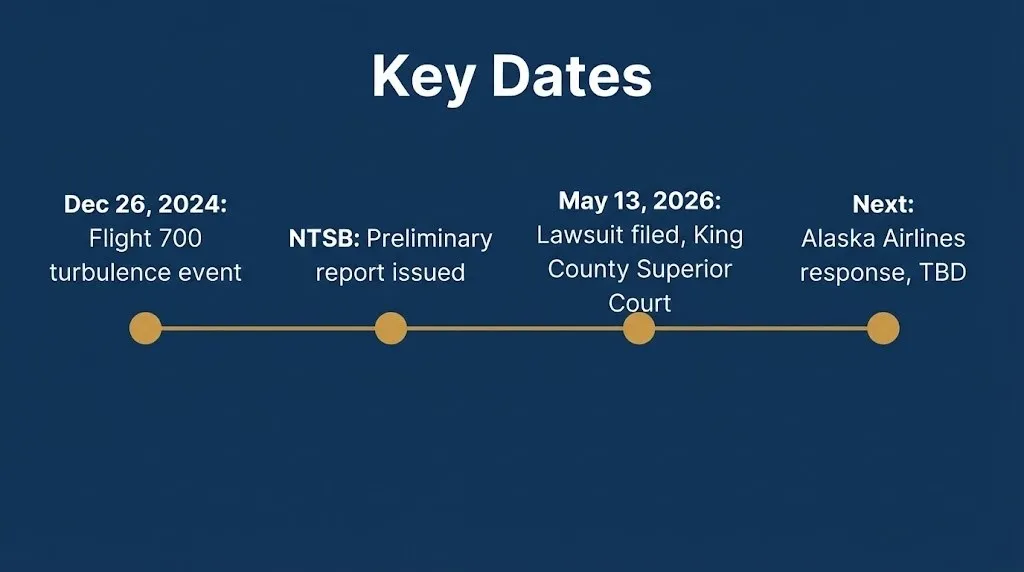
May 13, 2026: Complaint filed in King County Superior Court by Natalie Russell against Alaska Airlines.
Expected next stage: Alaska Airlines files a formal answer or motion in response to the complaint.
Expected following stage: Discovery, including cockpit, dispatch, and weather-warning records referenced in the complaint.
Expected later stage: Pretrial motions, followed by either a settlement or a scheduled trial date, neither of which has been publicly confirmed yet.
Ongoing: NTSB’s investigation into the underlying turbulence event may also continue to develop, potentially producing a final report that updates the preliminary injury findings.
Frequently Asked Questions
Is the Alaska Airlines passenger lawsuit a scam or a real case?
It’s a real, publicly filed lawsuit in King County Superior Court, not a scam or settlement notice.
There is no claims website or payout program tied to it.
Any message asking you to click a link or pay a fee to “join” this case isn’t legitimate.
How much money is the Alaska Airlines passenger seeking?
The complaint does not specify a dollar amount.
It seeks compensation for physical injuries and emotional distress, plus punitive damages.
No settlement or judgment amount has been reported as of this writing.
Can other passengers from Flight 700 join this lawsuit?
Not automatically, since this is an individual lawsuit, not a class action.
Other passengers or crew who were injured would need to file their own separate claims.
Washington’s personal injury statute of limitations would govern how long they have to do so.
What does Alaska Airlines say about the lawsuit?
Alaska Airlines says it does not comment on ongoing litigation.
The airline has stated that safety is its highest priority and that it takes turbulence incidents seriously.
It has not issued a detailed rebuttal to the specific negligence allegations.
Did the NTSB confirm passengers were injured on Flight 700?
The NTSB’s preliminary report states no passengers were injured, but the lawsuit disputes that finding.
The plaintiff says she sought urgent care for head and neck pain after the flight.
Preliminary NTSB reports can be updated as an investigation continues.
Has Alaska Airlines faced similar passenger lawsuits before?
Yes, including suits over the January 2024 Flight 1282 door plug blowout and a separate case involving an intoxicated passenger.
The same attorney representing the Flight 700 plaintiff has filed other Alaska Airlines suits in the past.
Each case has been filed and litigated separately, not as part of one combined class action.
Where can I verify updates on this case myself?
King County Superior Court’s public docket search is the most direct way to check filings and status updates.
Established aviation and regional news outlets that have covered the case are a reliable secondary source.
There is no official settlement website for this case because it isn’t a class action settlement.
There’s no claim form to fill out here and no deadline to calendar, because this is one passenger’s negligence case working through King County Superior Court, not a class settlement. If you were on Flight 700 and were injured, the appropriate next step is speaking with your own attorney, not searching for a payout portal that doesn’t exist.
Watch King County Superior Court’s docket and established aviation news coverage for the airline’s formal response, expected sometime after the May 13, 2026 filing date.