Arkansas Workers’ Compensation 2026: Rates, Deadlines and Claim Rules
Quick Answer
- Arkansas workers’ comp is a no-fault system paying medical care and wage benefits for job injuries.
- 2026 maximums are $953 weekly for total disability and $715 for permanent partial disability.
- File your claim within two years of injury, or one year after your last compensation payment.
Arkansas workers’ compensation is a no-fault system that pays medical bills and part of your lost wages after a job injury. For injuries in 2026, weekly checks max out at $953 for total disability.
It covers almost every Arkansas worker from the first day on the job. The deadline that matters most: file a claim within two years of the injury, or one year after your last compensation payment.
This guide covers pay rates, deadlines, doctors, denials, and lawyer fees. One surprise: several 2026 calculator sites still list maximums of $815 or $752, while the official state advisory says $953.
| The Facts | Details |
|---|---|
| Case | Arkansas Workers’ Compensation Law (Ark. Code Title 11, Chapter 9), enforced by the Arkansas Workers’ Compensation Commission (AWCC) |
| Status | Active state program. 2026 rates apply to injuries from January 1 to December 31, 2026 |
| Fund Size | Not applicable. Employers pay through insurance or self-insurance |
| Est. Per Person | Not yet determined for any one worker. Weekly maximums: $953 (total) and $715 (permanent partial) |
| Claim Deadline | Two years from injury or death, or one year from the last compensation payment |
| Administrator | AWCC oversees claims. Your employer’s insurer or self-insured employer pays them |
| Proof Needed | Notice of injury to your employer, medical records, and Form AR-C if you must file a claim |
What is Arkansas workers’ compensation and who does it cover?
Arkansas workers’ compensation is a no-fault law that guarantees medical care and wage benefits for injured workers. Almost every working Arkansan is covered, with a few exceptions.
The AWCC says coverage begins the first minute on the job. You don’t need a minimum tenure or wage.

Exceptions listed in the AWCC’s Questions & Answers brochure:
- Farm labor, domestic help, and some nonprofit, religious, or charitable employers fall outside the law.
- Railroad and maritime workers are covered by federal laws.
- Businesses with two or fewer employees may not be covered.
That brochure was last revised in June 2014. Any 2026 change to those exemptions is not yet confirmed, so check with the AWCC.
Which injuries and illnesses does workers’ comp cover in Arkansas?
Workers’ comp covers accidental injuries that arise out of and in the course of your job. The injury must be caused by a specific incident and be identifiable by time and place.
Three exceptions skip the “specific incident” rule:
- Rapid repetitive motion injuries, including carpal tunnel.
- Gradual-onset back injuries.
- Hearing loss.
Those three are covered only when work is the “major cause,” meaning more than 50% of the cause.
Other rules apply. A mental injury must stem from a physical injury, with disability benefits limited to 26 weeks. Crime victims are exempt from the physical injury rule. Heart attacks require unusual and extraordinary exertion. Ordinary diseases of life aren’t covered.
How much does workers’ comp pay per week in Arkansas in 2026?
The 2026 maximum is $953 a week for total disability and $715 a week for permanent partial disability. Your injury date sets the rate, not your filing date.
The state average weekly wage is $1,120.68. The cap is 85% of that figure, which is $952.58, rounded to $953. The minimum weekly rate is $20.
| Injury year | Max total disability | Max permanent partial |
|---|---|---|
| 2026 | $953 | $715 |
| 2025 | $903 | $677 |
| 2024 | $876 | $657 |
| 2023 | $835 | $626 |
| 2022 | $790 | $593 |
Some calculators show $815 or $752. Those figures don’t match the AWCC’s Advisory 2000-1, issued October 1, 2025.
Key Takeaway: For injuries in 2026, Arkansas caps weekly total disability pay at $953 and permanent partial pay at $715.
How is your Arkansas workers’ comp weekly benefit calculated?
Your total disability check is two-thirds of your average weekly wage, up to the state maximum. The AWCC says the payments are tax-free.
Your average weekly wage can’t be computed on less than a full-time workweek, per state law. That protects part-timers who normally work full weeks.
Permanent partial pay is 75% of your total disability rate, capped at $715. For amputation or permanent total loss of use of a member, it equals your total disability rate.
| Average weekly wage | Total disability | Permanent partial |
|---|---|---|
| $600 | $400 | $300 |
| $900 | $600 | $450 |
| $1,200 | $800 | $600 |
| $1,500 | $953 (capped) | $715 (capped) |
These are illustrations of the AWCC formula, not payout promises. Your rate depends on your real wage records.
How much do permanent injuries pay in Arkansas workers’ comp?
Permanent injuries pay a weekly rate for a set number of weeks. The weeks come from a body-part schedule, multiplied by your doctor’s impairment rating.
| Scheduled injury | Weeks |
|---|---|
| Arm amputated at or above the elbow | 244 |
| Arm amputated between elbow and wrist | 183 |
| Leg amputated at the knee or above | 184 |
| Leg amputated between knee and ankle | 131 |
| Hand amputated | 183 |
| Thumb amputated | 73 |
Injuries not on the schedule are valued against 450 weeks for the body as a whole. The Commission may weigh age, education, and work experience when awarding more than your impairment percentage.
Here’s a hypothetical. A 10% rating on a 131-week schedule equals 13.1 weeks. At an example $450 rate, that’s $5,895. Your case will differ, and you don’t have to accept a physician’s rating. Permanent total disability pays for life, per the AWCC.
What is the average Arkansas workers’ comp settlement?
No official average is confirmed. The AWCC pages reviewed don’t publish one, so any single figure is not yet confirmed.
One calculator site claims minor sprains settle between $10,000 and $30,000. It cites no Arkansas record. Treat that as a marketing number.
What drives a settlement is knowable: your weekly rate, your impairment rating, the weeks assigned, unpaid medical needs, and any dispute. Every final settlement must be approved by the Commission.
Think of it like paying off a car loan early. You get cash now but give up the future payments. The AWCC even publishes a calculator for the discounted lump sum of remaining liability. Ask what your future benefits are worth before signing.
Reality Check: Reasonably necessary medical care carries no deductible and no out-of-pocket cost, and benefits are automatic once your employer knows about the injury. No one can charge you to “unlock” them, and legal fees aren’t valid unless the Commission approves them. False statements to get or defeat benefits can be a Class D felony with a fine up to $10,000.
Key Takeaway: Your check is two-thirds of your average weekly wage, and permanent injuries pay for a set number of weeks.
How do you file a workers’ comp claim in Arkansas?
You start by telling your employer, not by applying to the Commission. Benefits are automatic once the employer knows.
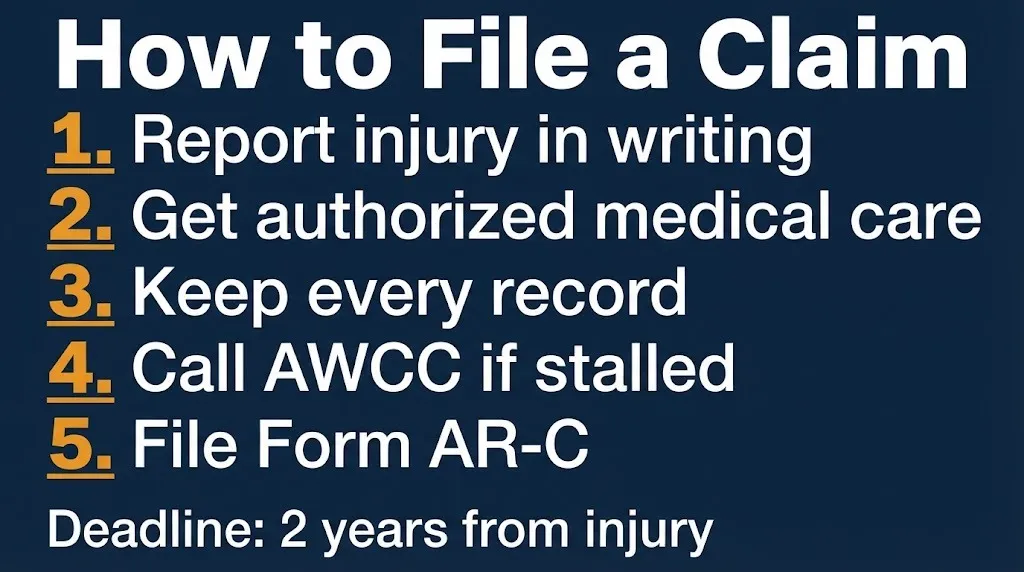
- Tell your employer or supervisor right away, in writing if you can.
- Include the time, place, and nature of the injury.
- Get care from the provider your employer or insurer designates (emergencies excepted).
- Ask for your notice of medical rights, Form AR-N.
- Keep copies of every report, bill, and work note.
- Let your employer and insurer file their reports.
- If payments stall or you’re denied, call the AWCC Legal Advisor Division.
- File Form AR-C (Claim for Compensation) if the dispute isn’t resolved.
State law gives employers 10 days to report an injury, per the AWCC forms page. Even so, your written notice is what starts the clock in practice.
What is the deadline to file a workers’ comp claim in Arkansas?
You must file within two years of the injury or death, or one year from the last compensation payment. The AWCC says the longer period applies.
| Step | Deadline |
|---|---|
| Tell your employer | Immediately, in writing (AWCC brochure) |
| Employer reports injury | Within 10 days |
| Disability waiting period | 7 days, unless disability lasts 14 days |
| First compensation check | Within 14 days if you report promptly |
| File Form AR-C | Two years from injury, or one year from last payment |
Some legal websites cite a 30-day rule for notifying your employer. The AWCC brochure says “immediately,” and a 30-day figure is not confirmed there. Report right away and avoid the question.
Think of it like a warranty claim. Register late and the calendar can beat you, even when your case is strong.
Can you choose your own doctor in Arkansas workers’ comp?
Usually not at first. An employer with a certified managed care organization can designate your initial provider.
Treatment you seek on your own may not be paid for. The employer or insurer can authorize your own doctor. In an emergency, you may seek immediate care and the employer or insurer may have to pay.
Changing doctors follows specific procedures. Requests can’t be approved over the phone by the Legal Advisor Division. Skipping the rules can mean denial of payment.
If your claim is denied, the employer may still owe treatment when four things happen: you ask in writing first, the employer doesn’t refer you within 48 hours, the injury is found compensable, and no earlier offer was made. Normal medical travel is reimbursed by mileage.
Key Takeaway: Report the injury immediately and file within two years, and use the designated doctor unless the rules say otherwise.
What does the Arkansas Workers’ Compensation Commission do?
The Arkansas Workers’ Compensation Commission administers and enforces the state’s workers’ comp law. It is not an insurance company.
The AWCC took effect on December 5, 1940. Three commissioners run it, each appointed by the governor to a six-year term. One represents labor, one management, and the chairman represents the public.
Administrative Law Judges hear disputed claims. Their decisions can be appealed to the Arkansas Court of Appeals and then the Arkansas Supreme Court. The Encyclopedia of Arkansas says a premium tax capped at three percent funds the agency.
Contacts from the AWCC’s brochure (2014, so verify):
- Little Rock main office: 324 Spring Street, 501-682-3930
- Toll-free: 1-800-622-4472
- Legal Advisor Division: 1-800-250-2511
- Springdale office: 244 South 40th, 479-751-2790
What if your Arkansas workers’ comp claim is denied?
A denial isn’t the end of the road. You can seek a preliminary conference, mediation, or a hearing.
- Call the insurance adjuster and ask what’s missing.
- Call the AWCC Legal Advisor Division.
- Request a preliminary conference or mediation.
- File Form AR-C if the problem isn’t resolved.
- Ask for assignment to an Administrative Law Judge for a hearing.
- Appeal an adverse ruling to the Court of Appeals, then the Supreme Court.
You don’t have to accept an impairment rating or a settlement offer. The AWCC says many disputes resolve at the conference or mediation stage, saving litigation costs.
Do you need a workers’ comp lawyer in Arkansas, and what do they cost?
You don’t need a lawyer to start benefits. Either side may hire one for a hearing.
Under the AWCC brochure, legal fees aren’t valid unless the Commission approves them. In contested cases, the employer or insurer pays half of the fee and you pay half out of compensation awarded.
That means you normally owe nothing unless benefits are awarded. Ask any lawyer to explain fees in writing before you sign.
The AWCC brochure is not a legal document, and this article isn’t legal advice. Your facts may change the answer.
Key Takeaway: Attorney fees need Commission approval, and in contested cases you normally owe one only if benefits are awarded.
When does the first check arrive and how long do benefits last?
Your first check should arrive within 14 days if you report the injury promptly. Checks then come every two weeks.
Temporary total disability pays during your healing period while you can’t earn wages. Permanent partial benefits begin after your doctor releases you and rates the impairment. Permanent total disability benefits last for life.
If the injury affects your pre-injury wages, you may be entitled to wage loss. Vocational rehabilitation is available for permanent impairment when the plan is reasonable. Rehabilitation pay is added on top of other compensation.
If a worker dies from a job injury, dependents may receive payments, per the AWCC. ERGO NEXT reports 50% of the average weekly wage and up to $6,000 for burial. Confirm those figures with the AWCC.
Can your employer fire you or refuse to take you back after a workplace injury?
An employer can’t discharge or discriminate against you for exercising workers’ comp rights. But the law doesn’t require it to hold your job open.
- If an employer refuses to return you to work without reasonable cause, it may owe the difference between your average weekly wage and benefits received.
- That exposure is limited to one year.
- A firing that looks like retaliation is a question for the Commission or a lawyer.
Keep a written record of your work restrictions and every return-to-work offer. Disputes often turn on dates and notes.
What if your employer has no workers’ comp insurance in Arkansas?
You may still file a claim with the Commission, or you can sue the employer in Circuit Court. That’s the AWCC’s answer for employers required to carry coverage but who didn’t.
Covered employers must display a poster of instructions, Form P. The AWCC contacts employers whose coverage it can’t verify, by letter, questionnaire, or on-site visit.
Ask your employer if you’re unsure. If the answer doesn’t satisfy you, call the AWCC.
Key Takeaway: If your employer skipped coverage, you can pursue the Commission route or a Circuit Court lawsuit.
What changed in Arkansas workers’ comp rates for 2026?
The only verified 2026 change is higher weekly maximums. The sources reviewed show no change to the benefit formula or the filing deadlines.
| Measure | 2025 | 2026 | Change |
|---|---|---|---|
| Max total disability | $903 | $953 | +$50 |
| Max permanent partial | $677 | $715 | +$38 |
| State average weekly wage | $1,061.97 | $1,120.68 | +$58.71 |
Rates reset each January 1. The average weekly wage is set each June 1 by the state’s Division of Workforce Services.
Why does Arkansas use a no-fault workers’ comp system?
Arkansas uses a no-fault system to give injured workers fast, automatic benefits without a lawsuit. Before it existed, workers sued their employers and had to prove fault.
The AWCC calls those suits costly, slow, and unfair. Voters adopted Amendment 26 in 1938. An initiated act followed in 1939, and the Commission took effect in 1940.
Act 796 of 1993 reformed the law for injuries after July 1, 1993. The AWCC’s brochure covers those injuries.
It’s a trade. You give up suing for damages, and in return you get benefits without proving fault.
What happens next for Arkansas workers’ comp?
The next stage is the 2027 rate change.
Now through December 31, 2026: Injuries are paid under the $953 and $715 maximums.
Expected fall 2026, not yet confirmed: The AWCC issues its 2027 rate advisory. The 2026 advisory was issued October 1, 2025.
January 1, 2027: New maximums apply to injuries on or after that date.
Two years from your injury: Your own filing deadline, or one year after your last payment.
Frequently Asked Questions
What is the maximum workers’ comp rate in Arkansas in 2026?
The maximum is $953 a week for total disability and $715 for permanent partial disability.
It applies to injuries from January 1 through December 31, 2026.
How long do I have to file a workers’ comp claim in Arkansas?
You must file within two years of the injury, or one year from your last compensation payment.
The AWCC says the longer period applies.
Is workers’ comp taxable in Arkansas?
The AWCC brochure says workers’ comp payments are tax-free.
Ask a tax professional about your own situation.
Does workers’ comp cover carpal tunnel in Arkansas?
It can, if work is the major cause, meaning more than 50% of the cause.
Rapid repetitive motion injuries are one of three exceptions to the specific-incident rule.
Do I pay for medical treatment?
No. Reasonably necessary care has no deductible and is paid directly to the provider.
Treatment you arrange on your own may not be covered.
Can I settle my workers’ comp case?
Yes, but every final settlement must be approved by the Commission.
Don’t sign anything until you understand what future benefits you’re giving up.
Who do I call at the AWCC?
Call 1-800-622-4472 for the Commission or 1-800-250-2511 for the Legal Advisor Division.
Those numbers come from a 2014 brochure, so confirm them on the AWCC website.
Report your injury in writing today and keep a copy. Save every medical record and work note. If payments stall, call the AWCC Legal Advisor Division.
Then calendar your deadline: two years from the injury, or one year from your last compensation payment.