Google Android User Compensation 2026: What the $135 Million Settlement Actually Pays
Quick Answer
- This is a real federal case, Taylor v. Google LLC, over Android phones using cellular data in the background without consent.
- Estimated payout is just over $1 per person before final approval, capped at $100, since roughly 100 million people qualify.
- The opt-out and objection deadline already passed on May 29, 2026. No new claim form deadline exists; enrollment is automatic.
You may have heard you’re owed money just for owning an Android phone. Here’s what’s actually confirmed.
Google agreed to pay $135 million to settle claims that Android devices transferred data over cellular networks without users’ permission, even while phones sat idle. That fund is real, and it’s sitting in federal court in California waiting on a judge’s signature.
Roughly 100 million people are covered automatically, no claim form required. The one number worth knowing now: with that many people splitting $135 million after fees, court filings estimate payments land just over $1 each, capped at $100.
This article covers who’s actually included, why California residents got carved out into a separate, much larger case, and what happens between now and when any money moves. One detail that surprises people: Google isn’t just paying cash, it also has to change how Android discloses this behavior going forward.
The Facts
| Case | Taylor, et al. v. Google LLC, Case No. 5:20-cv-07956-VKD |
| Court | U.S. District Court, Northern District of California, San Jose Division |
| Status | Final approval hearing held, ruling still pending |
| Fund Size | $135 million |
| Est. Per Person | Just over $1, capped at $100 per person |
| Claim Deadline | Not applicable; enrollment is automatic |
| Administrator | Federal Cellular Class Action Settlement Administrator |
| Proof Needed | None to qualify; Payment Election Form recommended using your Notice ID |
Is the Google Android User Compensation Settlement Real?
Yes, this is a real, court-supervised federal class action, not a scam text or phishing scheme. The case is formally called Taylor v. Google LLC, filed in the U.S. District Court for the Northern District of California.
A federal magistrate judge granted preliminary approval to the deal in early 2026, which is what triggered the wave of official notices, emails, and news coverage. If your notice included a Notice ID and confirmation code, that matches the legitimate process described on the court-authorized settlement website.
Google has not admitted any wrongdoing. The court hasn’t ruled that Google broke any law either, since both sides agreed to settle rather than go through a trial.
What confirms this is legitimate:
- Public court docket under Case No. 5:20-cv-07956-VKD
- Named class representatives: Joseph Taylor, Mick Cleary, and Jennifer Nelson
- Class counsel from Korein Tillery LLC and Bartlit Beck LLP, both named in court filings
Key Takeaway: This is a confirmed federal settlement with a real docket number and named class representatives, but the court has not yet finalized it.
Is the “Federal Cellular Class Action” the Same Thing People Are Searching For?
Yes, “federal cellular class action” is simply another name people use for this exact settlement. The official settlement website itself uses that phrase in its own branding.
If you searched “federal cellular class action” or “google class action lawsuit 2026” separately, you landed on the same underlying case. There isn’t a second, unrelated federal cellular data lawsuit running in parallel.
The one exception to keep in mind: California residents are handled separately under a related but distinct case called Csupo v. Google LLC, covered further down.
How Much Is the $135 Million Google Android Settlement Paying Per Person?
The honest estimate right now is just over $1 per person, and that’s before the court has even finalized the deal. Court documents describe an equal-split payment structure across an estimated 100 million eligible class members.
Payments will not exceed $100 per person under the settlement terms, though the realistic per-person amount is expected to land far below that cap given how many people qualify.
| Detail | Verified Figure |
|---|---|
| Total settlement fund | $135 million |
| Estimated eligible class members | Approximately 100 million |
| Estimated per-person payment | Just over $1 |
| Maximum possible payment per person | $100 |
| Leftover-fund redistribution cap | Up to $100 per previously paid member |
If money remains in the fund after the first round of payments, the administrator plans to redistribute it to people who were already paid successfully, again capped at $100 per person. Unclaimed funds go to a court-approved organization, not back to Google.
Think of this like a class-action version of a store credit refund pool: everyone gets a small, equal slice, and only leftover balance gets redistributed to people already in the system.
Are There Payout Tiers or a Cap on Google Android Compensation?
No, this settlement doesn’t use income or documented-loss tiers the way some data breach settlements do. Every eligible class member is treated the same, minus a hard $100 cap.
Reality Check: No one needs to pay a “processing fee” or hire a paid claim-filing service to receive this payment. Enrollment is automatic, and the settlement administrator sends payment attempts directly, without requiring money from you first.
If you don’t complete the optional Payment Election Form, the administrator will still attempt to send you a payment. But according to the official notice, you risk not receiving anything if that automatic attempt fails.
Key Takeaway: There’s no tiered payout structure here. It’s an equal split, capped at $100, with the completed Payment Election Form as your best way to guarantee delivery.
Do I Need to File a Claim for the Google Class Action Lawsuit 2026?
No, you do not need to file a traditional claim form for this settlement. Enrollment happens automatically if you meet the class definition and didn’t opt out by the deadline.
That said, “automatic” doesn’t mean “guaranteed to reach you” without any action.
- Check whether you received a personalized notice with a Notice ID and confirmation code
- Visit the official settlement website to locate the Payment Election Form
- Enter your Notice ID and confirmation code exactly as provided
- Choose your preferred payment method (electronic payment is expected)
- Submit the form before any posted deadline on the official site
- Save your confirmation for your records
- Watch the settlement website for updates on final approval
If you already objected to or commented on the settlement, you’re still eligible for payment. Objecting doesn’t remove you from the class, only formally opting out does that.
How Do I Complete the Payment Election Form?
The Payment Election Form is how you tell the administrator where to send your money once payments begin. You’ll need the Notice ID and confirmation code from your personalized notice to access it.
The form is available on the official settlement website. It asks for your preferred electronic payment method, since court documents indicate payments will be made electronically rather than by paper check.
If you never received a notice but believe you qualify based on the class definition, check the official settlement website’s contact information for guidance rather than guessing at eligibility.
How Do I Check My Status in the Federal Cellular Class Action?
You check your status through the official settlement website using your Notice ID and confirmation code. There is no separate claims-tracking portal with real-time payment estimates published yet.
That’s because final per-person amounts can’t be calculated until the court grants final approval and the exact administrative costs, attorneys’ fees, and class size are locked in.
If you completed a Payment Election Form and haven’t heard back, that most likely means the case is still awaiting final approval, not that anything went wrong with your submission.
When Will Google Android Settlement Payments Be Sent?
There’s no confirmed payment date yet. Payments cannot go out until the court grants final approval and any appeals are resolved.
The final approval hearing already took place on June 23, 2026. The judge took the matter under submission that day, meaning she’s still reviewing arguments rather than issuing an immediate ruling.
As of July 14, 2026, no final approval order had been entered. Once approval happens, expect an additional appeal window before the administrator can begin sending electronic payments.
Key Takeaway: No payment date exists yet, and any specific month or quarter you see quoted elsewhere is speculation, not a confirmed court schedule.
What Is the Latest Update on the Google Class Action Lawsuit 2026?
As of mid-July 2026, the case remains in the same holding pattern it entered after the June 23 hearing. The judge has not issued a ruling, and the settlement administrator has not announced a payment timeline.
Legal-press coverage of the hearing reported that the judge raised questions about the requested attorneys’ fees, the scope of the class definition, and the injunctive relief terms tied to Google’s promised Android changes. Those questions are likely part of why the ruling is taking time.
There’s no indication the settlement is at risk of collapsing. Judges commonly take weeks or months after a final approval hearing before issuing a written order in cases this large.
Why Hasn’t the Judge Ruled After the June 23 Hearing?
Judges are not required to rule from the bench, especially in cases raising fee and class-scope questions. Taking a matter “under submission” simply means the judge needs more time to review the record before deciding.
Reports from the hearing indicate the judge specifically questioned the size of the attorneys’ fee request and the terms of Google’s non-monetary commitments, like disclosure changes to Android setup screens. Those are exactly the kinds of details judges scrutinize closely before signing off on a nationwide settlement.
A multi-week gap between a final hearing and a written ruling is common, not unusual, for settlements covering an estimated 100 million people.
What Is Taylor v. Google LLC Actually About?
Taylor v. Google LLC is a class action alleging Android devices transferred data to Google’s servers over cellular networks without users’ clear permission. The lawsuit specifically claims this happened in the background, even when phones were idle and screens were off.
Plaintiffs argued this passive data transfer used up cellular data that people were paying their carriers for, without giving users a clear way to consent or decline. Some court filings describe the legal theory as a form of “conversion,” meaning Google allegedly used something belonging to users (their paid-for data) without permission.
Google denies the allegations and has not been found liable for anything. The company agreed to settle in order to avoid the cost and uncertainty of a trial, according to the settlement notice itself.
Who Qualifies for Google Android User Compensation?
You may qualify if you’re a natural person in the United States who used an Android mobile device to access the internet through a cellular data network at any point since November 12, 2017, and you’re not part of the separate California class action.
Who May Qualify:
- U.S. residents who used an Android phone on a cellular data plan since November 12, 2017
- Anyone still using an Android device on a cellular network up through the date of final approval
- Class members who did not formally exclude themselves by the May 29, 2026 deadline
- Anyone excluded from the parallel California case, Csupo v. Google LLC
You don’t need to have noticed unusual data usage or filed a complaint yourself. Simply meeting the class definition and not opting out is enough to be automatically included.
Why Are California Android Users Excluded?
California residents were carved out of this federal settlement because a separate, parallel state-court case, Csupo v. Google LLC, was already pending on nearly identical claims. Rather than let two cases resolve the same conduct twice, the federal case simply excludes anyone already covered by the California action.
That distinction matters because the two cases ended up with very different outcomes. The California case actually went to trial.
What Changes Is Google Making to Android Beyond the Payout?
Google agreed to more than just a cash payment as part of this settlement. The company committed to updating how it discloses this cellular data behavior going forward.
Confirmed non-monetary changes:
- Updates to Google Play Terms of Service disclosing the conduct at issue
- Changes to a Google Help Center page explaining background data behavior
- Updated device setup screens shown to new Android users, requesting consent
- Disabling a related setting tied to the background data transfers described in the lawsuit
These changes apply going forward and don’t affect your eligibility for the cash portion of the settlement.
How Does This Compare to the Csupo v. Google California Case?
The California case, Csupo v. Google LLC, actually went to trial and produced a much larger result for a much smaller group of people. A California state jury awarded $314.6 million on July 1, 2025, for an estimated 14 million California Android users, roughly seven times the per-capita value of the federal deal.
Rather than face an appeal of that verdict, Google and the plaintiffs later negotiated a $350 million settlement, asking the court to vacate the jury’s award in favor of the new negotiated terms. An approval hearing for that separate settlement was scheduled for February 24, 2026.
That means California residents are on a completely different, and financially larger, track than the rest of the country. If you live in California, this federal $135 million settlement does not apply to you; the Csupo case does.
Key Takeaway: California users are excluded from this federal deal because their own, larger case already produced a bigger jury verdict and a separate $350 million settlement.
What Happens Next
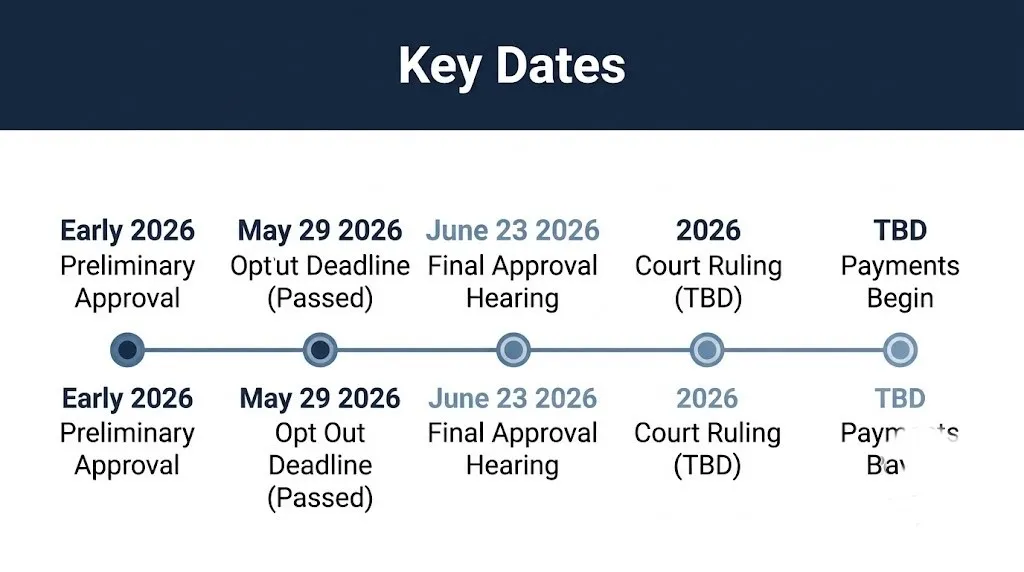
March to April 2026: Preliminary approval granted, notices go out to an estimated 100 million class members.
May 29, 2026: Deadline to opt out or object passed.
June 23, 2026: Final approval hearing held, judge takes matter under submission.
July 14, 2026 (most recent confirmed update): No final approval order entered yet.
Expected next stage: Written ruling from the court, timing unconfirmed, followed by any appeal window before payments begin.
Frequently Asked Questions
Is the Google Android settlement legit?
Yes, it’s a real federal class action settlement, Taylor v. Google LLC, Case No. 5:20-cv-07956-VKD.
It received preliminary court approval in early 2026 and held its final approval hearing on June 23, 2026.
How much money will I get from the Google Android settlement?
Court estimates put the per-person payment at just over $1, with a hard cap of $100.
The exact final figure depends on the total class size and costs deducted after final approval.
Do I need to file a claim form?
No, enrollment is automatic if you meet the class definition and didn’t opt out.
Completing the optional Payment Election Form on the official site helps ensure your payment actually reaches you.
When will payments be sent?
There’s no confirmed payment date as of mid-July 2026.
Payments can’t be sent until the court grants final approval and any appeals are resolved.
Why hasn’t the court ruled yet?
The judge took the matter under submission after the June 23, 2026 hearing rather than ruling immediately.
Reports indicate she raised questions about attorneys’ fees and the class definition that likely need more review time.
Are California residents included in this settlement?
No, California residents are excluded because of a separate, parallel case, Csupo v. Google LLC.
That case resulted in a larger $350 million negotiated settlement after an earlier jury verdict of $314.6 million.
What if I already opted out or objected?
If you formally excluded yourself by May 29, 2026, you’re not part of this settlement and won’t be paid from it.
If you only objected or commented without opting out, you remain eligible for payment.
Is this the same as the “$135 million Google Android settlement” I saw elsewhere?
Yes, that phrase and “federal cellular class action” both refer to this same Taylor v. Google LLC settlement.
Any other Google-related lawsuit you’ve seen in the news, including antitrust cases, is a separate legal matter.
Check the official settlement website directly if you’re unsure about your Notice ID or payment election status. The one date that matters most right now isn’t a payout number, it’s whether the court has ruled since the June 23, 2026 hearing.
If you received a personalized notice, keep your Notice ID and confirmation code somewhere safe. You’ll need them the moment payments are cleared to go out.