Medical Malpractice Lawsuits Naples 2026: Florida Deadlines, Damages and Steps
Quick Answer
- Naples malpractice suits follow Florida’s Chapter 766 presuit rules and are filed in Collier County.
- Payouts are not yet determined; private cases have no enforceable pain-and-suffering cap.
- Deadline: generally two years from discovery, with a four-year outer limit under Florida Statutes section 95.11.
Medical malpractice lawsuits in Naples are filed under Florida law, not city rules. You generally have two years from discovery to sue, and four years at most.
This affects patients and families treated at Collier County hospitals, clinics, and surgical centers. Before any suit, Florida requires a verified expert opinion and a 90-day presuit review.
This guide covers deadlines, damages, fees, court filing, and 2026 law changes. One surprise: Florida insurers reported 3,619 closed claims in 2025, and death was the largest category.
The Facts
| The Facts | |
|---|---|
| Case | No single case: individual claims under Florida Chapter 766 |
| Status | No class action or group settlement; each claim is separate |
| Fund Size | None; no pooled fund exists |
| Est. Per Person | Not yet determined; depends on injuries and proof |
| Claim Deadline | Generally 2 years from discovery, 4-year outer limit |
| Administrator | None; claims go through Collier County Circuit Court |
| Proof Needed | Verified written expert opinion before the notice of intent |
What counts as medical malpractice in Naples, Florida?
Medical malpractice means a provider’s care fell below accepted standards and caused you harm.
Florida handles these claims under Chapter 766, its medical negligence law. The rules are the same in Naples, Tampa, or Miami.
A claim generally rests on four pieces:
- A provider relationship: The doctor, nurse, or facility owed you care.
- A breach: The care fell below the accepted standard for that specialty.
- Causation: That breach, not your illness, caused the injury.
- Damages: You suffered measurable harm, such as bills, lost income, or pain.
A bad outcome alone isn’t malpractice. Surgery can fail without anyone being negligent.
Do I have a medical malpractice case in Naples?
You may have a case if a provider’s mistake, not your condition, caused measurable harm.
Florida won’t let you guess. Before the notice of intent, a qualified expert must give a verified written opinion. That requirement sits in section 766.203(2).
For a specialist defendant, the expert should match the defendant’s specialty under section 766.102. Florida adopted the Daubert standard for expert testimony in 2019.
Records usually decide whether a claim is viable. Your chart shows what was ordered, what was done, and when.
Ask yourself these questions first:
- Did a specific act or omission happen, and on what date?
- Did new harm follow, beyond your original illness?
- Do you have the records showing what was done?
- Can an expert in the same field explain the error?
A licensed Florida attorney and a qualified expert decide whether a claim has merit.
Is there a cap on medical malpractice damages in Florida?
No, Florida has no enforceable cap on pain and suffering in private medical malpractice cases.
In 2003, section 766.118 capped noneconomic damages. The Florida Supreme Court struck the wrongful death cap in Estate of McCall v. United States in 2014. It struck the personal injury cap in North Broward Hospital District v. Kalitan in 2017.
Both rulings rested on equal protection under the Florida Constitution. The Legislature hasn’t passed a replacement cap that survives those rulings.
| Claim type | Noneconomic damages cap status |
|---|---|
| Private provider, personal injury | No enforceable cap |
| Private provider, wrongful death | No enforceable cap (the 2014 ruling) |
| Public hospital or state employee | $200,000 per person, $300,000 per incident, unless a claims bill passes |
In 2026, Senate Bill 248 proposed a $750,000 cap. It didn’t advance.
Key Takeaway: Florida’s pain-and-suffering cap is gone for private providers, but public providers face sovereign immunity limits.
How much do medical malpractice lawsuits pay in Naples?
Payout per person: Not yet determined. Each claim depends on its injuries, proof, and defendants. No Collier County payout data has been confirmed.
Statewide numbers exist. The Florida Office of Insurance Regulation report dated October 1, 2026, covers 2025 closed claims.
| Measure (2025) | Figure |
|---|---|
| Closed claims reported by Florida insurers | 3,619 |
| Indemnity paid | $1,640,459,568 |
| Defense counsel fees paid | $249,741,384 |
| Other loss adjustment expense | $68,872,228 |
| Claims closed with no payment | About 24.7% of the time |
A separate dataset shows different numbers. A law firm research page cites National Practitioner Data Bank figures for Florida paid claims.
| Year | Paid claims | Total paid |
|---|---|---|
| 2021 | 1,053 | $310,390,000 |
| 2025 | 1,135 | $421,240,000 |
The same page puts the 2025 average at $371,137. For 2021 through 2025, it ranks Florida second nationally, with a 10.9% share of paid claims.
Don’t compare the two sets. They count different things. Averages also hide huge gaps between minor injury claims and death claims.
Defense spending adds context. Loss adjustment expense came to $318,613,612, about 19% of indemnity by our math. That’s the cost of fighting and managing claims, not money paid to patients.
How much do Naples malpractice lawyers charge?
Florida limits malpractice attorney fees to 30% of the first $250,000 and 10% above that.
Voters approved that limit as Amendment 3 in November 2004. A client can sign a waiver under Bar Rule 4-1.5(f)(4)(B)(iii). The form must state that the client gives up an important right.
The client has three days to revoke. Court approval is needed only if a waiver produces a fee above the rule’s maximums.
| Award slice | Fee limit without waiver |
|---|---|
| First $250,000 | 30% |
| Above $250,000 | 10% |
As an illustration, a $1,000,000 award would allow up to $150,000 in fees under those limits. That’s our arithmetic, before any case costs. Ask any attorney how expert fees and costs are handled.
Reality Check: No one can promise a malpractice payout by text or email. Anyone demanding an upfront fee to “release” settlement money is running a scam. Real claims leave a paper trail: a notice of intent, a written response, and a court case number.
How do I file a medical malpractice lawsuit in Naples?
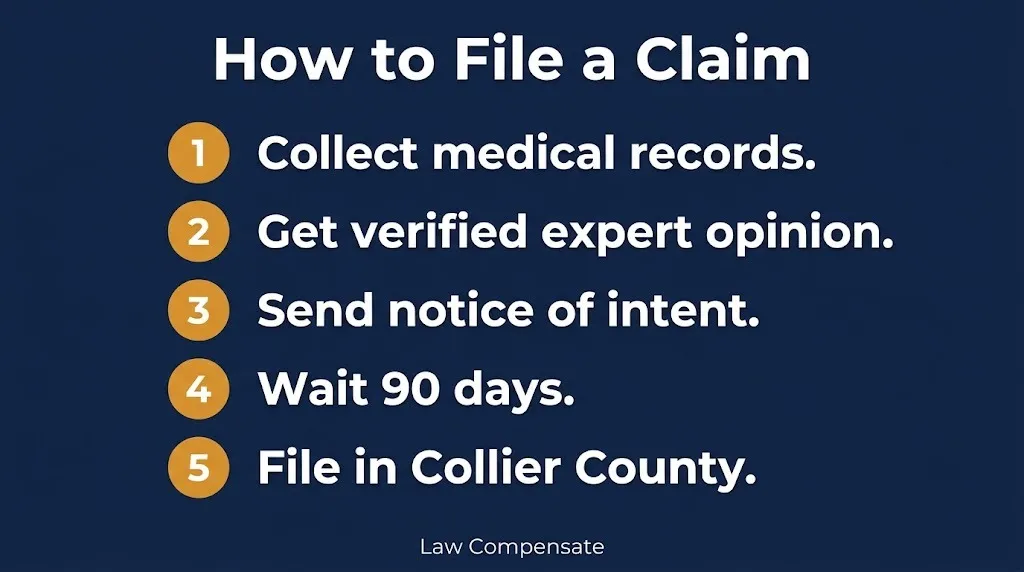
You file by completing Florida’s presuit steps first, then filing a complaint in Collier County court.
Follow these steps in order:
- Request your full medical records from every provider involved.
- Write down dates, names, and exactly what went wrong.
- Consult a licensed Florida attorney well before your deadline.
- Obtain a verified written opinion from a qualified medical expert.
- Send the notice of intent to each prospective defendant.
- Wait through the 90-day presuit investigation period.
- Review the response: rejection, settlement offer, or arbitration offer.
- File your complaint within the window the statute allows.
Skipping a step can end a case. Failure to satisfy Chapter 766 is grounds for dismissal.
Key Takeaway: The expert opinion and the 90-day presuit wait come before any lawsuit, so start early.
What should I bring to a first meeting with a malpractice attorney?
Bring every record, bill, and date you have, because the attorney starts by reconstructing what happened.
A tidy file speeds the first review. It also shows the attorney how close your deadline is.
Gather these items:
- Medical records: Charts, test results, discharge papers, and imaging reports.
- A written timeline: The date of each visit, procedure, and symptom.
- Provider names: Every doctor, nurse, and facility involved.
- Bills and receipts: Hospital charges, prescriptions, and out-of-pocket costs.
- Work records: Missed days and lost income.
- Discovery date: When you first learned something went wrong.
The discovery date matters most. Florida’s two-year clock runs from it.
Keep your own notes private and factual. Avoid posting about the case online.
What is the statute of limitations for medical malpractice in Florida?
The statute of limitations is generally two years from discovery of the injury.
Section 95.11 sets a four-year outer limit from the incident, no matter when you found out. Whichever deadline arrives first controls.
Under Tanner v. Hartog (Fla. 1993), the clock starts when you know of two things. You know of the injury, and you know of a reasonable possibility of negligence.
| Rule | Time limit |
|---|---|
| Standard filing period | 2 years from discovery |
| Outer limit (repose) | 4 years from the incident |
| Fraud or concealment | 2 years from discovery, capped at 7 years |
| Minors | Claim brought on or before the child’s 8th birthday |
You can buy time. Section 766.104(2) lets you petition the clerk and pay the filing fee before the period expires.
That gives an automatic 90-day extension. It can’t revive an expired claim.
Think of it like a warranty claim: the date on the receipt matters more than the date the part failed.
What happens during the 90-day presuit process?
During the 90-day period, nobody can file suit while the defendant investigates your claim.
Under section 766.106(3), a suit may not be filed for 90 days after notice is delivered. Delivery can be certified mail, tracked USPS mail, a commercial carrier, or a process server. It should include the records your expert used and a signed authorization under section 766.1065.
The limitations clock is tolled during this window. Under Boyle v. Samotin (Fla. 2022), tolling begins when notice is mailed. The parties can agree to extend the period.
| Defendant’s response | What it means |
|---|---|
| Rejection | The claim is denied; you may file suit |
| Settlement offer | The defendant offers money |
| Arbitration offer | Liability is admitted; arbitration decides damages only |
| Silence | After 90 days, treated as a final rejection |
After talks end, you get 60 days or the rest of the period, whichever is greater. Within 30 days of any response, your attorney must explain it in writing. That explanation covers terms, financial consequences, trial odds, and estimated costs and fees.
Key Takeaway: The 90-day window pauses your clock, but silence from a defendant counts as a rejection.
Where do you file a medical malpractice lawsuit in Naples?
Naples malpractice suits are filed with the Collier County Clerk in the Twentieth Judicial Circuit.
The Clerk’s Civil Department is at 3315 Tamiami Trail East, Suite 102, Naples, FL 34112. The Twentieth Circuit covers Collier, Lee, and surrounding counties.
Local paperwork matters. A Civil Cover Sheet (Form 1.997) must accompany your initial complaint. The winning party later files a Final Disposition Form (Form 1.998).
Civil Administrative Order No. 1.13 sets a unified system for managing circuit and county civil cases. A Civil Initial Standing Order governs procedures for every civil case filed in the circuit.
Filing fee amounts weren’t confirmed in our sources, so check the Clerk’s civil fees page. Self-represented litigants must supply an email address under Florida court rules.
Can I sue a public hospital or government doctor in Naples?
Yes, but claims against public hospitals and state-employed providers follow sovereign immunity rules in section 768.28.
Recovery is limited to $200,000 per person and $300,000 per incident. Anything higher generally needs the Legislature to pass a claims bill. That’s a political process, not a courtroom ruling.
One Florida law firm’s guide says written presentment generally must come within three years of accrual. For wrongful death, it says presentment goes to the Department of Financial Services within two years.
Check early whether your provider is a private business or a public entity. The deadline and the money limit both depend on it.
Don’t assume a nonprofit hospital is public. Nonprofit and government-owned are different things.
Can I file a complaint with the Florida Department of Health instead?
Yes, but a Florida Department of Health complaint is a licensing process, not a lawsuit.
Section 456.073 governs it. The department aims to finish its investigation within six months. A probable cause panel then decides within 30 days of the final report.
| Step | Timing |
|---|---|
| Provider’s response to complaint | Within 20 days of service |
| Investigation target | 6 months |
| Probable cause decision | 30 days after final report |
| Complaint filing window | Generally 6 years, up to 12 with fraud or concealment |
Complaint files stay confidential until 10 days after probable cause is found. A finding can lead to an Administrative Complaint. The provider may accept discipline informally or contest the facts before an administrative law judge.
Keep this track separate from your civil case. We found nothing saying a complaint pauses your lawsuit deadline.
Key Takeaway: A Health Department complaint can discipline a provider, but it doesn’t replace presuit steps.
Did Florida change its malpractice laws in 2026?
No, no change to Florida’s malpractice law has taken effect in 2026, though lawmakers tried.
On January 15, 2026, the House passed House Bill 6003 by 88 to 17. It would repeal the “free kill” law.
The Senate companion, Senate Bill 1700, never got a committee hearing. It died when the session adjourned in March.
Senate Bill 248, with a $750,000 noneconomic cap, didn’t advance either.
| Bill | What it did | Result |
|---|---|---|
| HB 6003 | Repeal “free kill” law | Passed House 88-17 on January 15, 2026 |
| SB 1700 | Senate companion | No hearing; died in March |
| SB 248 | $750,000 noneconomic cap | Did not advance |
Sponsors say they’ll refile in the 2027 session. A new governor takes office in January 2027.
What is Florida’s “free kill” law?
The “free kill” law, section 768.21(8), limits some family members in medical negligence death cases.
It bars adult children of single parents from suing. It bars parents of childless adults too.
Critics gave it the nickname. It’s like a warranty that covers some owners but not others.
In 2025, House Bill 6017 passed the House 104-6 and the Senate 33-4. The Senate rejected an amendment adding damage caps by a single vote. Governor Ron DeSantis vetoed the bill on May 29, 2025.
Florida Phoenix reported that he could consider a repeal only if lawmakers limit recoverable money. The Florida Supreme Court previously ruled such caps unconstitutional.
What does a Collier County malpractice trial look like?
A Collier County malpractice trial can last days and still end in a defense verdict.
A defense firm announced one example on September 9, 2025. The plaintiff alleged negligence by hospital employees during a total knee replacement. The case involved a left-sided component used in a right knee.
After ten days of trial, the plaintiff asked the jury for $6 million. The jury deliberated a little over four hours. It returned a complete defense verdict for the hospital system.
The court partially granted summary judgment on vicarious liability and emotional distress claims. The verdict triggered a Proposal for Settlement, and the defense planned to seek fees and costs.
The announcement doesn’t name the court, and a defense firm wrote it. One case isn’t a trend. It does show that losing can carry cost risk.
Key Takeaway: The “free kill” law still stands in 2026, and trials can end in defense verdicts.
What do Florida malpractice claims look like in 2026?
Death was the most common severity class in Florida’s 2025 closed malpractice claims.
The October 1, 2026 Office of Insurance Regulation report sorts closed claims by injury severity. Class 9, death, had 1,158 claims. That’s about 32% of the 3,619 total, by our math.
| Severity class | Closed claims (2025) |
|---|---|
| Class 9: death | 1,158 |
| Class 3: minor infections, missed fracture | 585 |
| Class 6: deafness, loss of limb or eye | 483 |
| Class 5: loss of finger, organ damage | 415 |
| Class 4: major burns, drug reaction | 382 |
| Class 7: paraplegia, blindness | 232 |
| Class 8: quadriplegia, brain damage | 141 |
| Class 2: slight lacerations | 126 |
| Class 1: emotional injury only | 97 |
Minor infections and missed fractures formed the second-largest group at 585 claims. Loss of limb, eye, or hearing followed at 483.
These are statewide insurer reports, not Naples numbers. The report doesn’t break out Collier County in the sources we reviewed.
Do birth injury claims follow different rules in Naples?
Yes, some birth-related neurological injuries fall under Florida’s NICA program instead of ordinary malpractice court.
NICA is a separate statutory track in sections 766.301 through 766.316. One firm’s guide says section 766.313 bars claims filed over five years after birth.
Whether NICA applies depends on the facts of the birth and the injury. That’s a question for an attorney early on. It can change where and how a claim proceeds.
Parents shouldn’t assume the standard two-year rule alone governs a birth injury. The minor rule and the NICA track can overlap.
Which hospital system is based in Naples?
NCH Healthcare System is a not-for-profit hospital system headquartered in Naples.
Its encyclopedia entry lists Baker Hospital downtown and a North Naples campus. It reports 713 beds across the two hospitals. The system dates to 1953, and Naples Community Hospital opened March 5, 1956, with 50 beds.
The North Naples campus opened in January 1990 on Immokalee Road. NCH runs a Marco Island facility, walk-in centers, and outpatient rehabilitation sites.
Bed counts can change, so confirm current figures with the system. This page doesn’t allege wrongdoing by any provider.
Size doesn’t change your deadline. The same Chapter 766 rules apply to a small clinic and a large hospital.
Key Takeaway: Birth injuries may follow a separate NICA track, and Naples-specific malpractice figures aren’t confirmed.
What happens next for Florida malpractice law?
What happens next is mostly legislative: Florida’s 2027 session and a new governor.
- January 2027: A new governor takes office.
- 2027 session (expected): Sponsors plan to refile the “free kill” repeal.
- Date not confirmed: Business groups want the Florida Supreme Court to reconsider the cap rulings.
- Around October 2027 (expected): Insurance regulators publish the next closed claim report.
- Your own deadline: It runs from discovery, not from any bill.
Watch the 2027 session, but don’t count on it. Lawmakers failed to pass changes in 2025 and again in 2026.
Don’t wait on Tallahassee to protect your claim. A new law wouldn’t rescue a claim after its deadline passes.
Frequently Asked Questions
How long do you have to sue for medical malpractice in Florida?
Generally two years from discovery, with a four-year outer limit.
Fraud cases can stretch to seven years.
Minors have a separate rule tied to the eighth birthday.
Is there a cap on malpractice damages in Florida?
No, there is no enforceable cap on pain and suffering in private cases.
The Florida Supreme Court struck the caps in 2014 and 2017.
Public providers face a $200,000 per person limit.
How much does a Naples malpractice lawyer cost?
Florida limits fees to 30% of the first $250,000 and 10% above that.
Clients can sign a waiver with a three-day revocation window.
Ask how case costs are handled.
Do I need an expert to file a malpractice case in Florida?
Yes, you need a verified written medical opinion before the notice of intent.
Section 766.203(2) requires it.
Missing it can lead to dismissal.
Where do I file a medical malpractice lawsuit in Naples?
You file with the Collier County Clerk of the Circuit Court.
The civil office is at 3315 Tamiami Trail East, Suite 102.
You must include Form 1.997 with your complaint.
Can I sue after a loved one dies from a medical error in Florida?
Possibly, but the “free kill” law limits some family members.
It bars certain adult children and parents from noneconomic damages.
Repeal efforts failed in 2025 and 2026.
Can I report a Naples doctor without filing a lawsuit?
Yes, you can file a complaint with the Florida Department of Health.
The department aims to investigate within six months.
It’s a licensing process and doesn’t pay you.
Is a malpractice settlement text or email real?
No, treat unsolicited payout offers as scams.
Real claims involve a notice of intent and a court case number.
Never pay an upfront fee to receive settlement money.
Closing
Gather your medical records now, and write down every date and name while memories are fresh. Then speak with a licensed Florida attorney before any deadline gets close.
The most important number is two. Florida generally gives you two years from discovery to file.