Mochi Health Lawsuit 2026: Status, Allegations, and What Patients Should Know
Quick Answer:
- No verified Mochi Health lawsuit or settlement exists in public court records as of August 2026.
- Mochi Health is a telehealth platform offering compounded GLP-1 medications for weight loss.
- Any website claiming a Mochi Health settlement is unverified and likely misleading.
If you used Mochi Health for weight loss medication and saw posts about a lawsuit, you are not alone. The telehealth company, which prescribes compounded semaglutide and tirzepatide, has been the subject of online rumors and legal speculation. But the verified reality is different. No confirmed lawsuit or settlement exists in public court records as of August 2026.
The people searching this term include patients who used Mochi Health and are worried about the safety of compounded medications, and consumers who saw a viral post claiming a payout. The single most important fact is that no verified settlement exists, no claim form is available, and no deadline applies to you.
This article covers what Mochi Health is, why rumors of a lawsuit spread, what legal risks exist in the telehealth weight loss space, and how to protect yourself from the scams already circulating. One surprising detail: the broader legal scrutiny of compounded GLP-1 drugs has created confusion that spills over onto individual telehealth companies like Mochi Health.
| The Facts | |
|---|---|
| Company | Mochi Health, telehealth provider |
| Services | Compounded GLP-1 weight loss medications |
| Verified Lawsuit | None confirmed in 2026 |
| Verified Settlement | None exists |
| Fund Size | Not applicable |
| Claim Deadline | None |
| Administrator | None appointed |
| Proof Needed | Not applicable |
Is the Mochi Health Lawsuit Real?
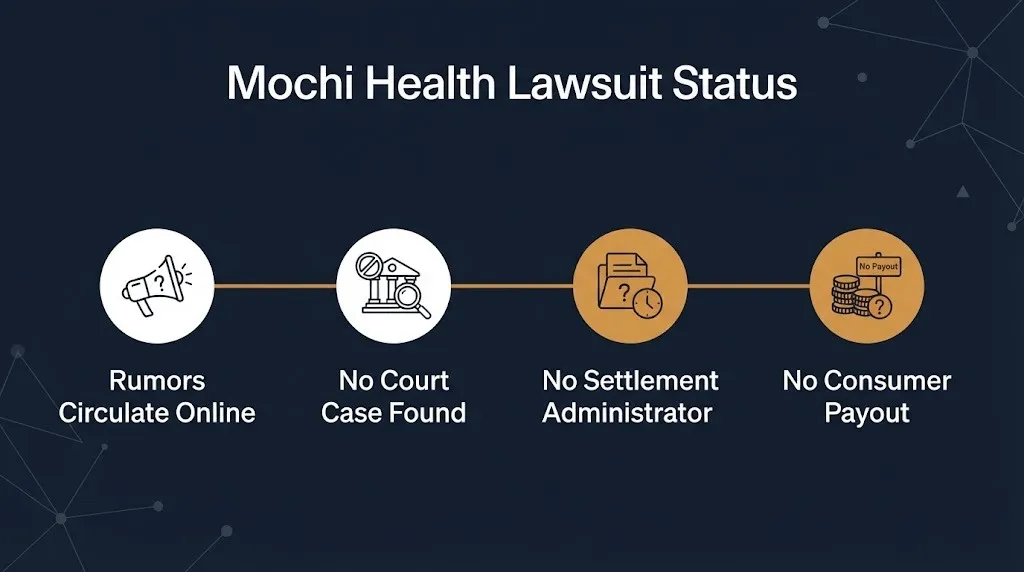
No verified Mochi Health lawsuit exists in public court records as of August 2026. The rumors circulating online are unconfirmed. The company may face legal disputes that are not public, but no consumer class action or settlement has been documented.
The confusion likely stems from the broader legal environment. Compounded GLP-1 medications have drawn regulatory scrutiny and litigation. Patients may assume that scrutiny applies to every telehealth provider, including Mochi Health.
| Claim Source | Verified Status |
|---|---|
| Social media posts | Unverified, likely false |
| Lead generation websites | Not official, often scams |
| Court records | No confirmed consumer class action |
| Mochi Health statements | No public settlement announcement |
| Legal news sites | No verified Mochi Health settlement |
The absence of evidence is not evidence of a secret settlement. If a Mochi Health lawsuit existed and produced a settlement, it would appear in court records and legitimate legal news coverage.
What Is Mochi Health?
Mochi Health is a telehealth platform that offers weight loss treatment through online consultations. The company connects patients with licensed providers who can prescribe medications, including compounded semaglutide and tirzepatide.
The business model is built on accessibility. Patients complete an online intake, have a virtual visit, and receive medication by mail. The model has grown rapidly as demand for GLP-1 weight loss drugs has surged.
| Mochi Health Feature | What It Means |
|---|---|
| Telehealth consultations | Online visits with providers |
| Compounded medications | Custom formulations, not brand-name |
| Subscription model | Monthly fees for access |
| Mail-order delivery | Medications shipped to patients |
| Weight loss focus | GLP-1 and related treatments |
The compounded medication aspect is significant. Mochi Health does not sell brand-name Ozempic, Wegovy, Mounjaro, or Zepbound. It sells compounded versions, which are mixed by compounding pharmacies. The legal and regulatory landscape for compounded GLP-1 drugs is shifting.
Why Do People Think There Is a Mochi Health Lawsuit?
People think there is a Mochi Health lawsuit because the telehealth weight loss industry is under legal and regulatory pressure. The pressure creates headlines, and headlines create confusion.
The FDA has scrutinized compounded GLP-1 medications. Lawsuits against other telehealth companies and compounding pharmacies have been filed. Patients who see those headlines may assume Mochi Health is facing the same issues.
| Confusion Source | Why It Misleads |
|---|---|
| FDA scrutiny of compounded GLP-1s | Patients assume all providers are sued |
| Lawsuits against other telehealth companies | Brands blur together |
| Social media rumors | Unverified claims spread fast |
| Lead generation ads | Fake claim sites target patients |
| Regulatory warnings | Patients fear the worst |
The telehealth weight loss space is crowded. Companies like Ro, Hers, and Mochi Health all offer similar services. A lawsuit against one can easily be misattributed to another.
Can You Get Money From a Mochi Health Lawsuit?
No, you cannot get money from a Mochi Health lawsuit because no verified lawsuit or settlement exists. Any website or social media post claiming you can file a claim is misleading.
If a legitimate settlement ever happens, the process would follow a specific path. The court would approve a settlement. A settlement administrator would be appointed. Notice would be mailed to affected patients. Only then would a claim form exist.
| Legitimate Settlement Step | Current Status |
|---|---|
| Lawsuit filed | Not confirmed |
| Class certified | Not confirmed |
| Settlement reached | Not confirmed |
| Administrator appointed | Not confirmed |
| Claim period open | Not confirmed |
None of those steps has occurred for Mochi Health in 2026.
What Legal Risks Exist for Telehealth Weight Loss Companies?
Telehealth weight loss companies face several legal risks. The most significant is regulatory scrutiny over compounded medications. The FDA has raised concerns about the safety and legality of compounded GLP-1 drugs.
The regulatory framework is complex. Compounded drugs are not FDA-approved. They are mixed by compounding pharmacies under different rules. When a brand-name drug is in shortage, compounding is allowed. When the shortage ends, the legal basis for compounding shifts.
| Legal Risk | What It Involves |
|---|---|
| FDA enforcement | Compounded drug regulations |
| Product liability | Patient injury claims |
| False advertising | Marketing claims about efficacy |
| Consumer protection | Subscription and billing practices |
| Data privacy | Patient information security |
These risks apply to the entire telehealth weight loss sector, not just Mochi Health. A lawsuit against one company does not automatically implicate another.
Key Takeaway: No verified Mochi Health lawsuit or settlement exists in public records, and the confusion stems from broader regulatory scrutiny of compounded GLP-1 medications.
What Should You Do If You Used Mochi Health?
If you used Mochi Health and are concerned about the medication or the service, the first step is to talk to your healthcare provider. Do not stop taking prescribed medication without medical advice.
The second step is to monitor for official notices. If a lawsuit or settlement ever involves Mochi Health, affected patients would receive notice by mail or email from a court-approved administrator.
Here are the practical steps to take:
- Keep records of your Mochi Health consultations and prescriptions.
- Save receipts and billing statements from the service.
- Monitor your health and report any concerns to your provider.
- Watch for official legal notices, not social media posts.
- Do not provide personal information to unknown websites.
- Report suspicious settlement ads to the Federal Trade Commission.
- Consult a healthcare lawyer if you believe you were harmed.
The records matter if litigation ever emerges. But they are also useful for your own medical care.
How Do You Verify a Real Lawsuit or Settlement?
Verifying a real lawsuit or settlement requires official sources. The court that approved the settlement will have a record. The settlement administrator will have a website. Legitimate legal news outlets will cover the settlement.
Start with the court. Federal class actions appear in PACER. State class actions appear in state court databases. If no case exists, no settlement exists.
| Verification Source | What It Shows |
|---|---|
| PACER federal court search | Federal class action filings |
| State court databases | State class action filings |
| Settlement administrator sites | Official claim forms |
| Class action news sites | Legitimate settlement coverage |
| FTC scam alerts | Known fake settlement schemes |
Do not rely on social media posts, random websites, or ads. Those sources have no verification requirement.
What Is the Regulatory Status of Compounded GLP-1 Drugs in 2026?
The regulatory status of compounded GLP-1 drugs in 2026 is in flux. The FDA has allowed compounding during drug shortages. When shortages resolve, the legal basis for compounding shifts.
The brand-name manufacturers, Novo Nordisk and Eli Lilly, have challenged compounding. They argue that compounded versions are not equivalent to their FDA-approved drugs and pose safety risks. Compounding pharmacies argue that patients need access during shortages.
| Regulatory Element | 2026 Status |
|---|---|
| Semaglutide shortage | Resolved for some doses |
| Tirzepatide shortage | Resolved for some doses |
| FDA compounding rules | Subject to ongoing litigation |
| State pharmacy boards | Varying oversight |
| Telehealth prescribing | Under regulatory review |
The regulatory uncertainty creates legal uncertainty. That uncertainty feeds rumors about lawsuits and settlements involving telehealth providers.
Reality Check: No One Is Sending You a Mochi Health Settlement Check
Reality Check: If you see a text, email, or social media post saying you qualified for a Mochi Health settlement, it is a scam. No settlement exists. No claims are being accepted. No one is mailing checks. Legitimate class actions send official notice only after a court approves the process. Any unsolicited message asking for your bank account or personal information is fraud.
How Do Fake Telehealth Settlement Scams Work?
Fake telehealth settlement scams follow a predictable pattern. The scammer creates a post or ad claiming a settlement exists. The post links to a fake claims website. The website asks for your name, address, and sometimes your bank account information.
The scammer may use the information for identity theft. Or the scammer may ask for a “processing fee” before releasing your “settlement payment.” Either way, you lose.
| Scam Step | What Happens |
|---|---|
| Fake post | Claims a settlement exists |
| Fake website | Mimics a claims portal |
| Information request | Harvests personal data |
| Fee request | Asks for money to process claim |
| Disappearance | Scammer vanishes with money and data |
The Federal Trade Commission warns about these scams regularly. Real settlements do not ask for upfront fees. Real settlements do not contact you through unsolicited text messages.
Key Takeaway: Verifying any lawsuit or settlement requires checking court records and official administrator websites, not social media posts or lead generation ads.
What Is the Difference Between a Lawsuit and a Regulatory Action?
A lawsuit is a private legal action between parties. A regulatory action is an enforcement proceeding by a government agency. Both can affect a company, but they are different processes.
A class action lawsuit seeks damages for a group of plaintiffs. A regulatory action seeks compliance and penalties for violations. The FDA may regulate compounded drugs without any private lawsuit being filed.
| Legal Process | What It Involves |
|---|---|
| Class action lawsuit | Private plaintiffs seek damages |
| Regulatory action | Government agency enforces rules |
| Product liability claim | Individual injury lawsuit |
| Settlement | Resolution of a lawsuit |
The confusion between these processes fuels settlement rumors. A regulatory action against a compounding pharmacy does not mean a consumer settlement exists.
What Happens Next With the Mochi Health Situation
| Expected Timing | Milestone |
|---|---|
| Ongoing | No verified lawsuit or settlement exists |
| Ongoing | Regulatory scrutiny of compounded GLP-1s continues |
| Unknown | Future lawsuits may be filed |
| Unknown | Future settlements may occur |
| Unknown | No consumer action required today |
The most important thing you can do is protect your health and your personal information. If a settlement ever happens, official notice will find you. Until then, ignore the rumors.
Frequently Asked Questions
Is there a Mochi Health settlement in 2026?
No verified Mochi Health settlement exists.
Social media posts claiming a settlement are unconfirmed.
No court-approved settlement has been documented.
Can I file a claim for a Mochi Health lawsuit?
No claim process exists.
There is no settlement administrator.
Any site accepting claims is a scam.
How much money can I get from the Mochi Health lawsuit?
No payout amount has been determined.
There is no settlement fund.
Any dollar figure is fabricated.
Is the Mochi Health lawsuit real or a scam?
No verified Mochi Health lawsuit exists.
The lawsuit rumors are unconfirmed.
Fake settlement posts are scams.
What should I do if I see a Mochi Health settlement ad?
Do not click the link.
Verify through court records before taking any action.
Report the ad to the Federal Trade Commission.
Has Mochi Health been sued before?
No verified consumer class action is confirmed.
The company may face private disputes that are not public.
Business disputes do not produce consumer settlements.
How do I know if a telehealth settlement is real?
Check the court docket for a filed case.
Look for a settlement administrator’s website.
Legitimate settlements produce official mailed notices.
Will Mochi Health ever have a real settlement?
It is possible but not confirmed.
No pending consumer class action is verified.
Check court records periodically for updates.
The Mochi Health lawsuit is a rumor, not a verified legal reality. No money is waiting for you. No claim form exists. No deadline applies. If you used Mochi Health and have concerns, talk to your doctor and keep your records. If you saw a post promising a payout, ignore it and warn others. August 25, 2026 is the date this information was verified. The date that matters most to you is today, because nothing about a Mochi Health settlement requires your action.