Shaklee Lawsuit 2026: Claims, Settlements and Verified Facts
Quick Answer
- Is it legit? Shaklee is a plaintiff in a September 2026 federal libel case; no consumer class action is verified.
- How much? No consumer payout exists. The 2025 lead settlement totaled $25,000: a $3,000 penalty and $22,000 in fees.
- Deadline? None. No claim form or filing deadline exists for any Shaklee matter we verified.
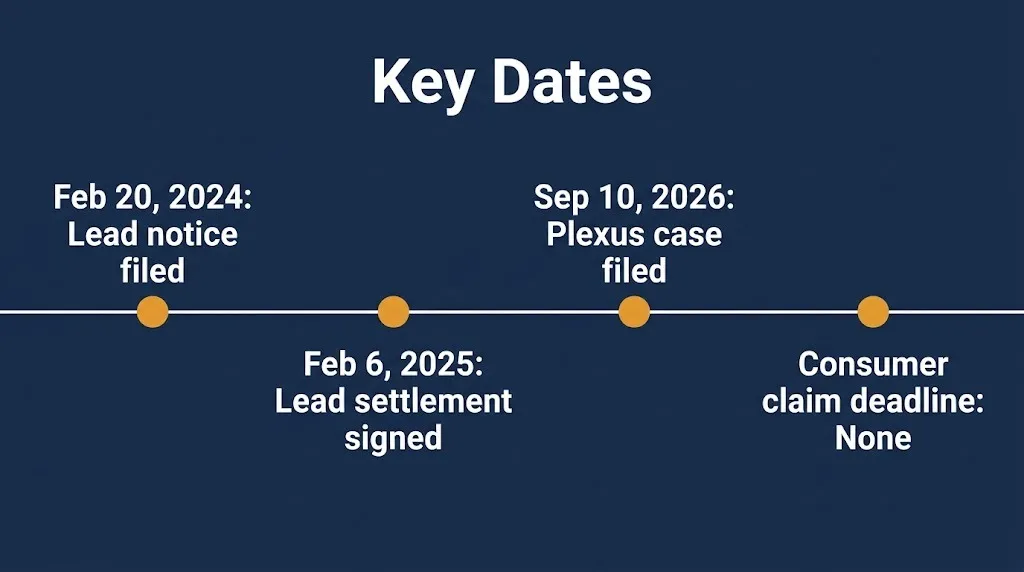
The Shaklee lawsuit that sits on a federal docket in 2026 is one Shaklee filed. Shaklee Corporation and Roger Barnett sued Plexus Worldwide, LLC on September 10, 2026, in the U.S. District Court for the District of Columbia.
That matters if a message urged you to claim Shaklee money. No consumer class action, claim form, or payout deadline has been verified.
This guide covers every verified Shaklee legal matter, from a 2025 lead settlement to self-regulatory earnings reviews. One surprising detail: the lead settlement’s total payments came to just $25,000. It paid no consumers.
The Facts
| Item | Detail |
|---|---|
| Case | No consumer class action verified. Verified matters: Shaklee Corporation and Roger Barnett v. Plexus Worldwide, LLC (D.D.C., No. 1:26-cv-03176) and KASB v. Shaklee Corporation (Prop 65 notice 2024-00694) |
| Status | Plexus case filed September 10, 2026, early stage. Prop 65 matter settled out of court February 6, 2025 |
| Fund Size | None for consumers. Prop 65 total payments: $25,000 |
| Est. Per Person | Not applicable. No class or fund exists |
| Claim Deadline | None. No claim process verified |
| Administrator | None appointed |
| Proof Needed | Not applicable. No claim form exists |
Is there a Shaklee lawsuit in 2026?
Yes, but Shaklee is the plaintiff. The docket lists the case as Shaklee Corporation and Roger Barnett against Plexus Worldwide, LLC, case number 1:2026cv03176, with a jury demanded by the plaintiffs. The Justia mirror last pulled the docket on September 11, 2026.
No lawsuit against Shaklee that pays consumers has been verified. That’s the gap between the headlines and the court record.
Here’s every Shaklee legal matter we could verify:
- 2026: Shaklee and Roger Barnett v. Plexus Worldwide, LLC (libel case)
- 2025: Proposition 65 lead settlement, signed February 6
- 2023 and 2024: Two self-regulatory earnings-claim reviews
- 2015: A trademark dispute with Mannatech
- 2002: A $30 million suit by a rival supplement maker
None of these created a claim form for customers or distributors.
Is there a Shaklee class action lawsuit?
No. We found no class action docket, settlement website, or claims administrator naming Shaklee. A class action needs a named plaintiff, a court, and a judge who certifies the class. None has surfaced.
Some pages describe a Northern District of California class action with certification pending. None gave a case number or plaintiff name. That’s the test that matters.
| Claim made online | What we could verify |
|---|---|
| Class action in N.D. California | No docket or case number found |
| Payouts of $50 to $5,000 or more | No fund exists. Ranges are borrowed from other cases |
| Class period of 2020 to 2026 | No class definition found |
| Claim window of 60 to 90 days | No notice has been issued |
A court-approved settlement always produces a public notice. Without one, estimated payouts are guesses dressed as facts.
Why do websites claim a Shaklee settlement exists?
Because “settlement” is a profitable search word, and real Shaklee filings sound like consumer cases. A Proposition 65 lead notice and a federal libel suit both carry the word “lawsuit.” Neither pays you.
Three things feed the confusion:
- Search demand: Pages get built for “lawsuit” and “settlement” whether or not a claim exists.
- Real filings: The 2025 lead settlement and the 2026 Plexus case are genuine, so rumors borrow their credibility.
- Industry suspicion: Multi-level marketing companies draw complaints, so a class action feels plausible.
It’s like mistaking a recall rumor for a recall notice. One has a docket number and an official source. The other is a post.
Key Takeaway: The verified Shaklee cases are a libel suit Shaklee filed and a $25,000 lead settlement, not consumer class actions.
Is there a Shaklee settlement payout?
No. No Shaklee settlement that pays consumers or distributors has been announced, approved, or verified. The only settlement we found is a California Proposition 65 matter that paid no one but the parties’ costs.
That matter, KASB v. Shaklee Corporation, settled on February 6, 2025, out of court. The listing says the settlement would not be submitted to a court.
| Settlement element | Status |
|---|---|
| Consumer settlement fund | None verified |
| Claims administrator | None |
| Official settlement website | None found |
| Final approval hearing | None |
| Claim form | None exists |
If you received a text or email about a Shaklee payout, treat it as a possible scam. Real notices name the case, the court, and the administrator.
How much money could you get from a Shaklee lawsuit?
Not yet determined, because no fund exists. A payout needs a settlement, a class definition, and court approval. None is verified for Shaklee.
The Proposition 65 settlement is the only verified money, and it went to costs, not people.
| Item | Amount |
|---|---|
| Non-contingent civil penalty | $3,000 |
| Attorney fees and costs | $22,000 |
| Payment in lieu of penalty | $0 |
| Total payments | $25,000 |
| Payments to consumers | None listed |
Ignore dollar ranges on other sites. They come from other supplement and MLM cases, not from a Shaklee fund.
In real class actions, the final amount depends on fund size, claim volume, administrator costs, and attorney fees. All four are blank here.
Who may qualify for a Shaklee settlement?
No one can qualify yet, because no settlement class has been defined. A class definition spells out who’s covered, usually by product, place, and date range. No such definition exists for Shaklee.
If a class action were ever filed and certified, you’d see these items in the court notice:
- A defined purchase or membership period
- The products or business program covered
- An opt-out deadline, if you’d rather sue separately
- A claim deadline and claim form
- A final approval hearing date
Any page claiming you “likely qualify” today is guessing. Qualification comes from a court order, not a blog.
Reality Check: Nobody legitimate texts you settlement money first. Filing a real claim is free, and no “claim helper” needs your bank login or a fee. If a message cites a Shaklee payout, ignore it and report it.
Key Takeaway: No fund, class, or claim form exists, so nobody can qualify and any quoted payout is invented.
How do you file a Shaklee lawsuit claim?
You can’t file a settlement claim, because no Shaklee claim process exists. If a page offers a form, test it before sharing any details.
Follow these steps:
- Look for a named case, court, and case number.
- Search that case number in the federal court records service (PACER).
- Find the settlement website named in a court notice.
- Verify the administrator’s name and phone number independently.
- Compare any deadline with the court’s order.
- File only on the official site named in the notice.
- Never pay a fee or share a bank login.
Step 3 is the dividing line. A real notice comes from a court or administrator. A fake one comes from a stranger.
If a page fails steps 1 and 2, close it. You’ve lost one minute.
How do you check a Shaklee case on the court docket?
Search the federal court records service by case number, or use free docket mirror sites for a quick look. Court records show real filings, while news articles only describe them.
| Matter | Where to look | Identifier |
|---|---|---|
| Plexus libel case | U.S. District Court for D.C., via PACER | 1:26-cv-03176 |
| Prop 65 lead matter | California Attorney General’s Prop 65 notices database | 2024-00694 |
| Self-regulatory reviews | BBB National Programs DSSRC case closures | Cases 111-2023, 172-2024 |
Checking a docket is like checking a store receipt instead of trusting someone’s memory. The record doesn’t change with the retelling.
Remember that mirror sites lag. The Justia listing was last retrieved September 11, 2026. A newer docket may exist on PACER.
How do you report misleading Shaklee earnings or health claims?
Save the evidence, then report to the FTC and your state attorney general. Many earnings claims come from independent salesforce members, not corporate ads, so note who made the claim.
Follow these steps:
- Screenshot the post, ad, or pitch, including the date.
- Copy the URL and the poster’s name.
- Note whether the claim came from the company or a distributor.
- File a report with the Federal Trade Commission.
- Send a copy to your state attorney general’s consumer unit.
- Report adverse product reactions to the FDA.
The Direct Selling Self-Regulatory Council also monitors salesforce claims. That inquiry process is run by BBB National Programs.
Keep purchase records. They help any regulator or court see your situation.
Key Takeaway: There’s no claim to file, but you can report misleading claims to the FTC and your state attorney general with saved evidence.
Is there a Shaklee lawsuit update for 2026?
Yes, one. The Plexus case was filed September 10, 2026, and the earliest public docket shows only opening paperwork. Later developments aren’t confirmed.
The September 11 entries show the complaint, a corporate disclosure, and a clerk’s notice about a filing error. The clerk said the case would not proceed until the parties’ names and residence addresses were corrected.
Here’s what would count as a real update:
- A docket entry showing Plexus was served or responded
- A motion to dismiss or an answer
- A scheduling order
- A news report quoting a court filing
Until then, “latest news” means this docket. We’ll update this page if a verified filing appears.
What is the Shaklee v. Plexus Worldwide lawsuit about?
It’s a diversity-jurisdiction case classified as libel, assault and slander, filed by Shaklee Corporation and Roger Barnett against Plexus Worldwide, LLC. The detailed allegations aren’t confirmed in the docket text we reviewed.
| Detail | Status |
|---|---|
| Parties | Shaklee Corporation and Roger Barnett v. Plexus Worldwide, LLC |
| Court | U.S. District Court for the District of Columbia |
| Case number | 1:2026cv03176 |
| Filed | September 10, 2026 |
| Nature of suit | Libel, assault and slander (diversity) |
| Jury demanded | Yes, by plaintiffs |
| Attachment | Exhibit A, a letter |
| Allegations in detail | Not yet confirmed |
| Damages sought | Not yet confirmed |
The docket doesn’t state Barnett’s role. A libel complaint contains claims, not findings. Plexus’s response isn’t confirmed.
This case doesn’t create a settlement fund for Shaklee customers. If Shaklee wins money, it goes to Shaklee.
What was the Shaklee Proposition 65 lead settlement?
It was a February 6, 2025, out-of-court settlement over lead in a Shaklee supplement called Alfalfa Complex. It required warnings or lower lead exposure for sales in California, and it paid no consumers.
The notice was filed February 20, 2024, by Keep America Safe and Beautiful, represented by KJT Law Group, LLP. Proposition 65 is California’s law requiring warnings about listed chemicals, and private groups can send these notices.
| Term | Detail |
|---|---|
| Chemical | Lead |
| Product source | Alfalfa Complex |
| Daily exposure threshold | More than 0.5 micrograms of lead per day, unless a warning is given |
| Penalty | $3,000 |
| Attorney fees and costs | $22,000 |
| Submitted to a court | No |
The listing shows a settlement, not a court finding. Rules apply to covered products sold in California.
Key Takeaway: The lead settlement required California warnings or lower lead exposure, and it paid $25,000 in penalties and fees, not consumer money.
Did regulators find that Shaklee used misleading earnings claims?
A self-regulatory body reviewed Shaklee’s salesforce earnings claims twice, in 2023 and 2024, and closed both reviews after Shaklee acted. These were advertising reviews, not court judgments.
| Case | Claims reviewed | Outcome |
|---|---|---|
| DSSRC Case 111-2023 | Six earnings claims | Administratively closed after posts were updated or removed |
| DSSRC Case 172-2024 | Ten earnings claims | Administratively closed after Shaklee removed unauthorized claims |
In the 2024 case, Shaklee pointed to two compliance training modules and said it requires its average earnings disclaimer to be read aloud at field meetings. A watchdog group, Truth in Advertising, describes the 2024 decision differently. It says DSSRC found Shaklee used atypical earnings claims.
The two accounts differ in wording. Read the DSSRC closure itself if the distinction matters to you.
Did the FTC take action against Shaklee?
No FTC enforcement action against Shaklee is verified. The FTC sent notices to hundreds of supplement marketers in 2023, but we couldn’t confirm from the FTC release that Shaklee received one.
On April 13, 2023, the FTC issued a Notice of Penalty Offenses on substantiating product claims to 670 companies. Receiving one doesn’t indicate unlawful conduct. The notices warn of civil penalties of up to $50,120 per violation.
Truth in Advertising says it sent the FTC a list of more than 660 direct selling companies that included Shaklee. That’s a watchdog’s letter, not an FTC finding.
A notice is like a speeding warning. It puts you on record, but it isn’t a ticket.
Has Shaklee been sued before?
Yes, in older matters where Shaklee was the defendant or the opposing party. We could not confirm outcomes for either.
| Matter | What happened | Outcome |
|---|---|---|
| Tishcon Corp. (2002) | Tishcon sued Shaklee and Nature’s Way, seeking $30 million, alleging false patent and bioavailability claims for CoQHeart | Not confirmed |
| Mannatech (2015) | Shaklee filed a Notice of Opposition to Mannatech’s UTH trademark application at the USPTO | Proceedings continued at the Trademark Trial and Appeal Board; final result not confirmed |
In 2002, Shaklee’s counsel said the company changed its materials to “patent pending.” Shaklee denied punitive damages were warranted.
Old cases don’t create current claims. Class settlements have set deadlines, and these are long past.
Key Takeaway: Shaklee’s older legal disputes were business and trademark fights, and none has a verified consumer payout.
Is Shaklee a pyramid scheme?
No court or FTC finding that Shaklee is a pyramid scheme has been verified. What exists are advertising reviews of salesforce earnings claims, which are a different matter.
Shaklee describes itself as a direct-selling company founded in 1956 and based in Pleasanton, California. FTC multi-level marketing guidance says any earnings claim must reflect what the typical participant can expect to earn.
Before joining any MLM, ask these questions:
- Does the company publish an income disclosure statement?
- What’s the refund or buy-back policy for unsold inventory?
- Do most earnings come from retail customers or from recruits?
- What are the monthly purchase requirements?
A legal conclusion belongs to a court or regulator. Everything else is opinion, including ours.
What happens next in the Shaklee lawsuit?
Nothing consumer-related is scheduled. The Plexus case is the only active federal filing, and its next steps depend on service and the court’s rules.
Today (October 25, 2026): No consumer class action, fund, or claim form is verified.
Expected next in the Plexus case: Plexus is served and responds, with dates not yet confirmed.
Expected after that: Motions, a scheduling order, and discovery follow.
If a consumer class action were ever filed: The complaint appears on a docket with a case number.
Expected after any settlement: A court notice names a claims administrator, claim deadline, and final approval hearing.
Frequently Asked Questions
Is there a Shaklee class action lawsuit?
No Shaklee class action has been verified.
No docket, case number, or settlement website exists.
Who is Shaklee suing in 2026?
Shaklee Corporation and Roger Barnett sued Plexus Worldwide, LLC on September 10, 2026.
The case is in federal court in Washington, D.C., number 1:26-cv-03176.
Is there a Shaklee settlement I can claim?
No consumer settlement exists.
The only verified settlement paid $25,000 in penalties and fees.
What was the Shaklee lead lawsuit?
It was a California Proposition 65 matter over lead in Alfalfa Complex, settled February 6, 2025.
It paid no consumers.
Is Shaklee a scam or pyramid scheme?
No court or FTC finding says so.
Self-regulatory reviews in 2023 and 2024 looked at salesforce earnings claims.
Did the FTC sue Shaklee?
No FTC lawsuit against Shaklee is verified.
The FTC’s 2023 notices went to 670 companies and aren’t findings of violations.
How do I report misleading Shaklee claims?
Save screenshots and report to the FTC and your state attorney general.
Note whether a distributor or the company made the claim.
Before you file anything, find a case number and a court. For Shaklee in 2026, the only live federal case is the one Shaklee filed against Plexus Worldwide.
No consumer claim form exists. Check the docket, not a headline, and ignore any message demanding a fee. The date to remember: September 10, 2026, when the Plexus case was filed.