Lawyer for Malpractice Lawsuit 2026: Costs, Fees, Deadlines, and How to Choose
Quick Answer
- Is it free to hire one? Medical malpractice lawyers usually work on contingency. California caps fees at 25% before filing and 33% after.
- How much could you get? Not determined. NPDB-based averages run high, but typical (median) payments run far lower.
- What’s the deadline? It varies by state. Nevada, for example, allows two years from discovery and three from the act.
A lawyer for a malpractice lawsuit is an attorney who sues on your behalf when a doctor, hospital, or another lawyer harmed you through substandard work. Medical malpractice cases are almost always handled on contingency, so the lawyer is paid only if you recover money.
This affects patients with a missed diagnosis, surgical error, or birth injury. It also affects clients whose own attorney missed a deadline. The number that matters most is your state’s filing deadline. In Nevada, for example, it’s two years from discovery.
Below you’ll find fees, costs, payouts, screening, and how to sue your own lawyer. One surprising detail: a New York attorney once reported rejecting 95 to 98 percent of malpractice inquiries.
The Facts
| Item | Detail |
|---|---|
| Case | Not a single case. Guide to hiring a lawyer for medical or legal malpractice |
| Status | Ongoing area of law. Rules vary by state |
| Fund Size | Not applicable |
| Est. Per Person | Not yet determined. Depends on injury, state caps, and proof |
| Claim Deadline | Varies by state. Nevada example: two years from discovery, three from the act |
| Administrator | Not applicable. You hire your own lawyer |
| Proof Needed | Medical or case records, expert opinion, and an affidavit of merit in many states |
Do you need a lawyer for a malpractice lawsuit?
In practice, yes, because malpractice cases depend on expert proof and strict procedure. A medical expert must testify that care fell short and caused the harm. Without that testimony, most cases stall.
One New Mexico firm says a claim there won’t get past summary judgment without an expert opinion. The lawyer presents the records to an expert before deciding whether to pursue the case. That step alone separates malpractice from most injury claims.

Here’s what your lawyer actually does:
- Screens your medical or case records
- Hires and manages expert witnesses
- Files within your state’s deadline
- Negotiates with insurers and defense counsel
- Tries the case if talks fail
You can legally represent yourself. But the defense will have experienced counsel and its own experts. That imbalance is why most people hire help.
How do contingency fees work for a malpractice lawyer?
A contingency fee means the lawyer takes a percentage of what you recover and nothing if you recover nothing. Malpractice cases are almost always handled this way, with the lawyer advancing the expenses.
Fees and costs are different things. The fee pays for the lawyer’s work. Costs cover experts, records, and filings. The client ultimately pays costs out of any recovery, and the attorney decides whether to advance them.
Think of a real estate agent’s commission. No sale, no commission. But listing costs still exist, and someone has to cover them.
Ask these questions before you sign:
- What percentage applies before filing, and after?
- Are costs deducted before or after the fee?
- Who pays if the case loses?
California adds a protection. Costs of medical care and the attorney’s office overhead can’t be deducted as case costs.
What’s the difference between medical malpractice and legal malpractice?
Medical malpractice is a claim against a health care provider. Legal malpractice is a claim against a lawyer. Both need duty, breach, causation, and damages, but the proof is different.
| Medical malpractice | Legal malpractice | |
|---|---|---|
| Who you sue | Doctor, hospital, nurse, clinic | Your own attorney |
| Core proof | Care fell below the standard and caused injury | Lawyer’s error cost you a better result |
| Special test | Expert testimony on standard of care | “Case within a case” |
| Typical error | Missed diagnosis, surgical mistake | Missed filing deadline |
The “case within a case” is the hard part of legal malpractice. You must show that, but for the attorney’s negligence, the underlying matter would have been won.
Our category covers both, but this guide leads with medical claims. Sections 11 and 12 cover suing a lawyer.
Key Takeaway: A malpractice lawyer is paid by percentage of recovery, but the type of malpractice decides which expert, deadline, and rules apply.
How much does a lawyer for a malpractice lawsuit cost?
It depends on your state’s fee rules and your contract. Percentages are often capped by statute, and case expenses are separate from the fee.
| State | Fee rule |
|---|---|
| California | 25% if settled before a complaint or arbitration demand, 33% after |
| Nevada | 35% cap for cases accruing on or after October 1, 2023 |
| New York | Statutory schedule. Reform bills introduced, final status not confirmed |
| New Jersey | A 2022 bill proposed 25% and 33%. Enactment not confirmed |
California also allows a higher fee after trial. The lawyer must file a motion showing good cause, and the court decides.
Expenses can be heavy. One veteran attorney writes that advanced costs often reach $30,000 or more in settled cases, and twice that at trial. That’s one lawyer’s experience, not a national figure.
How much can you get from a malpractice lawsuit?
Not yet determined, because every case turns on injury severity, state damage caps, and proof. Anyone quoting a number before reviewing your records is guessing.
National data shows how wide the spread runs. The federal government publishes no official average, according to one analysis of National Practitioner Data Bank (NPDB) reports.
| Source | Figure |
|---|---|
| One 2025 NPDB-based analysis | Average of about $463,000 per paid claim |
| Another NPDB analysis, 2000 to 2025 | Average of $257,531, median of $97,500 |
| Peer-reviewed study of surgical “never events” | Pooled median payment of $75,220 |
Notice the gap between averages and medians. A few large awards pull averages up. The median is closer to a typical case.
Don’t plan around the average. Plan around your records and an expert’s opinion.
Who may qualify to sue for medical or legal malpractice?
You may qualify if a professional owed you a duty, fell below the standard, and that failure caused measurable harm. Most states also require you to act within a strict deadline.
Four questions a lawyer will test:
- Did a provider-patient or attorney-client relationship exist?
- Did the care or work fall below accepted standards?
- Did that failure cause your injury or loss?
- Are your damages large enough to justify the cost?
That last point surprises people. One firm says it rejects cases for thin evidence, and also for clear malpractice with insufficient losses. A real mistake doesn’t guarantee a viable lawsuit.
Families can sometimes bring wrongful death claims. Minors face different timing. In Nevada, the clock for a minor starts at age 18.
Reality Check: No lawyer can promise a result, and none should guarantee a payout. Be wary of anyone who pressures you to sign the same day or claims they’ll win before seeing your records.
Key Takeaway: Qualifying depends on proof of breach, causation, and meaningful damages, not just a bad outcome.
How do you find a lawyer for a malpractice lawsuit?
Start with your records and your state bar’s referral service, then compare two or three firms that focus on malpractice. A general practice lawyer rarely has the expert network these cases need.
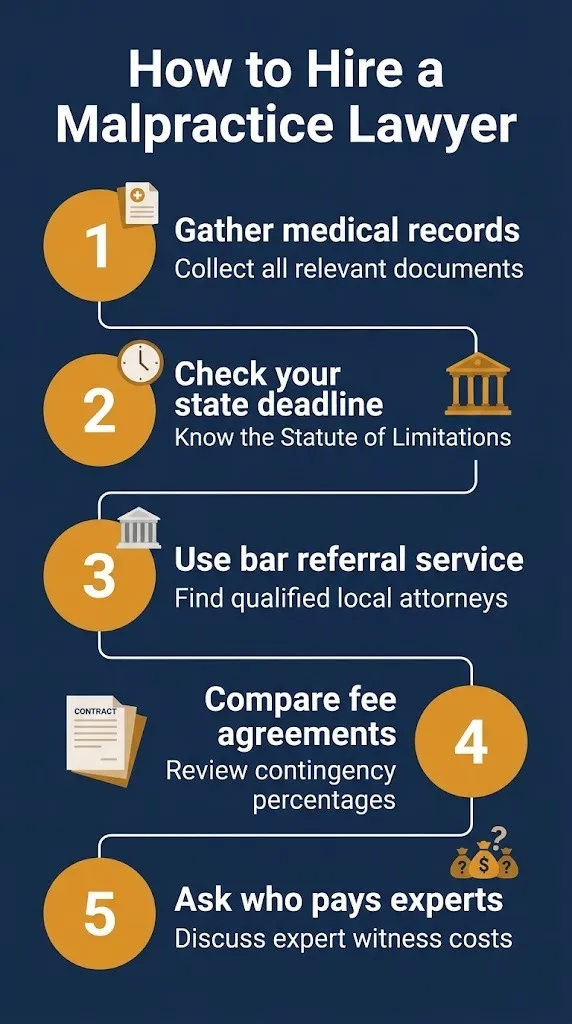
Follow these steps:
- Request your complete medical records in writing.
- Look up your state’s filing deadline.
- Use your state bar’s lawyer referral service.
- Check each lawyer’s discipline record with the state bar.
- Contact two or three firms that handle malpractice regularly.
- Compare fee agreements in writing.
- Ask who advances expert costs.
Step 4 is quick and often skipped. A clean record doesn’t prove skill, but a troubled one is a warning.
Don’t wait for the perfect match. The deadline keeps running while you compare.
What questions should you ask a malpractice lawyer before hiring?
Ask about experience, expert access, fees, and costs, and get the answers in writing. A confident lawyer won’t mind.
Use this checklist:
- How many malpractice cases like mine have you handled?
- Which experts will review my records, and who pays?
- What percentage do you take before and after filing?
- Are costs deducted before or after your fee?
- Do I owe anything if we lose?
- How long will this likely take?
On timing, expect patience. In one peer-reviewed analysis of surgical never events, the median gap from the act to the payment report was three years. That covers a narrow case type, but it shows these cases don’t resolve fast.
Bring your timeline, records, bills, and a list of every provider involved. Organized files save billable hours and help the lawyer screen faster.
Why do lawyers turn down malpractice cases?
Lawyers decline because malpractice is expensive, risky, and hard to win. The most common reason is insufficient evidence to justify the first expert review. The second is damages too small to justify the risk.
Claims about win rates conflict, and we couldn’t verify an official figure. One Chicago firm says defendants prevail in nearly 80% of malpractice trials. A New York attorney wrote that about 70% of malpractice cases are lost at trial. Treat both as attorney estimates.
The economics push lawyers toward large cases. One attorney argued that small cases rarely pay for themselves after expert costs.
If one firm says no, ask why. Then try another, because screening standards differ. A rejection isn’t a ruling that you were not harmed. It often means the math doesn’t work for that firm.
Key Takeaway: A rejection usually reflects cost and risk, so ask why and get a second opinion before giving up.
What’s the deadline to file a malpractice lawsuit?
Your deadline is set by your state, and it can be short. In Nevada, a medical malpractice suit must be filed within two years of discovering the injury, or three years of the act, whichever comes first.
| Rule | Nevada example |
|---|---|
| Discovery deadline | Two years |
| Outer deadline | Three years from the act |
| Wrongful death | Two years from date of death |
| Minors | Clock starts at age 18 |
| Affidavit of merit | Generally required |
Legal malpractice has its own clock. In Maryland, a three-year statute of limitations applies to most legal malpractice actions, with exceptions.
Treat the shorter date as your real deadline. A missed statute of limitations can end a claim permanently, no matter how strong it was.
Many states also require an affidavit or certificate of merit. That’s a sworn statement from a qualified expert that your claim has substance. Ask your lawyer how it works where you live.
What is a legal malpractice lawsuit?
A legal malpractice lawsuit is a claim that your own lawyer’s mistakes cost you money. The classic example is an attorney who lets a filing deadline expire on your injury case.
Courts apply four elements: duty, breach, causation, and damages. A source on New York practice calls them the four foundational elements. You must prove each one.
Causation is the hard part. You must show you would have prevailed in the original case. That means essentially retrying the original dispute inside the malpractice case.
Common errors include:
- Missing a filing deadline
- Failing to know the law
- Ignoring a conflict of interest
- Botching settlement or contract work
Lawyers also face a judgment-call defense. Reasonable strategic choices that didn’t work out usually aren’t malpractice.
How do you sue a lawyer for legal malpractice?
You sue by proving your lawyer’s mistake cost you a better outcome, usually with a new attorney and expert testimony. Start by preserving everything.
Follow these steps:
- Request your complete file from the lawyer.
- Write a dated timeline of the errors.
- Calculate what you lost from the original matter.
- Check your state’s legal malpractice deadline.
- Hire a different lawyer who handles these claims.
- Expect a demand letter before any filing.
- Prepare to prove the original case was winnable.
On step 6, one source recommends a demand letter documenting errors and damages before filing. It isn’t always required.
Don’t delay filing to chase mediation. If your deadline is approaching, a source on New York practice advises against waiting. You’ll likely need a qualified attorney to testify to the standard of care.
Key Takeaway: Suing your lawyer means proving the original case was winnable, so a second attorney and an expert are usually essential.
Are malpractice fee rules changing in 2026?
Several states have proposals pending, but we couldn’t confirm any final change as of October 25, 2026. Check your state’s current statute before relying on a percentage.
| Proposal | What it would do | Status |
|---|---|---|
| New York S6269 | Updates contingent fee rules; introduced March 7, 2025 | Final status not confirmed |
| New York A7448 | Similar reform | Dead as of December 31, 2024 |
| New Jersey S3343 | Would cap fees at 25% and 33%, with noneconomic caps | Enactment not confirmed |
The New Jersey bill would also set noneconomic damage caps. Those would be $250,000, or $500,000 for wrongful death.
Nevada’s 35% fee cap is already in effect for cases accruing on or after October 1, 2023.
Rules that apply to you depend on when your injury occurred. Ask your lawyer which version of the statute governs your claim.
How common are medical malpractice lawsuits?
They’re less common than medical errors, but far from rare. One analysis citing AMA data says about 29% of physicians have been sued during their careers. It also estimates about 17,000 malpractice lawsuits are filed yearly.
Payment counts vary by analysis. Reports of 2025 NPDB data range from roughly 9,900 to 11,600 payment reports. The differences likely reflect filtering choices, so treat any single count as approximate.
Some error types appear to be declining. In a peer-reviewed study of surgical never events, the share of eligible reports with a qualifying code fell from 3.98% to 3.05%.
Location matters. One 2025 analysis put New York’s total payouts at $730 million across 1,269 cases. The same analysis showed average payouts ranging from about $207,000 in Indiana to over $1 million in some states.
Why are malpractice cases so expensive to bring?
Malpractice cases cost more because they need multiple medical experts, deep record review, and years of work. One New York attorney lists experts on negligence, causation, and lost earnings.
| Cost driver | Why it matters |
|---|---|
| Negligence expert | Proves the standard of care was breached |
| Causation expert | Links the error to your injury |
| Economist | Values lost wages or household services |
| Depositions | Doctors, nurses, and other witnesses |
| Court conferences | Often five to ten before trial |
It’s like hiring a surveyor and an inspector before you can even make an offer. You pay for proof before you know whether the deal works.
That’s why firms screen hard. It’s also why settling can make sense. Costs can eat a large part of a recovery if a case drags on.
Key Takeaway: Experts and time drive malpractice costs, which is why lawyers screen cases carefully and why you should ask about expenses upfront.
What happens next after you hire a malpractice lawyer?
Cases follow a predictable path, but timing depends on your state, court, and facts. None of these stages has a guaranteed date.
Expected first: Your lawyer reviews your records and decides whether to continue.
Expected next: Experts review the care and causation, and a certificate or affidavit of merit is prepared where required.
Expected before your deadline: Your lawyer sends a demand or files the complaint in court.
Expected after filing: Both sides exchange evidence and take depositions.
Expected last: The case settles, goes to arbitration, or goes to trial.
Frequently Asked Questions
How do I find a lawyer for a malpractice lawsuit?
Start with your state bar’s referral service and firms that focus on malpractice.
Check discipline records and compare written fee agreements.
How much does a medical malpractice lawyer take?
Often a percentage of your recovery, set by your contract and state rules.
California caps it at 25% before filing and 33% after.
Can I sue my lawyer for malpractice?
Yes, if your lawyer’s mistake caused measurable loss.
You must show you would have won the original case.
How long do I have to file a malpractice lawsuit?
It depends on your state.
Nevada allows two years from discovery and three from the act.
Why will no lawyer take my medical malpractice case?
Cases are costly and risky to bring.
Lawyers often decline for thin evidence or damages too small to justify costs.
Do I need an expert to file a malpractice lawsuit?
Usually, yes.
Many states require a sworn expert statement, often called an affidavit of merit.
What is the average medical malpractice settlement?
It depends on the data source.
One 2025 analysis shows about $463,000, while another shows a median near $97,500.
Start with your records and your state’s deadline. Both are quick to look up.
Then ask two or three firms the fee and expense questions above, in writing. Confirm your state’s filing deadline first.