Shareholder Derivative Lawsuit 2026: What It Is, Recent Settlements, and How It Affects You
Quick Answer
- A shareholder derivative lawsuit is filed by a shareholder on behalf of a corporation against directors or officers who allegedly harmed the company .
- Recent 2026 settlements include Virgin Galactic ($2.75 million), Boeing ($237.5 million), and several smaller cases involving corporate governance reforms .
- You do not receive a direct payout from these settlements. Any recovery goes to the company, not individual shareholders .
What Is a Shareholder Derivative Lawsuit?
A shareholder derivative lawsuit is a legal action filed by a shareholder on behalf of the corporation itself. The claim belongs to the company, not to you. The shareholder steps into the corporation’s shoes to sue directors, officers, or third parties who allegedly breached fiduciary duties or harmed the business .
The distinction matters. In a class action, you sue for your own damages. In a derivative suit, you sue for the company’s damages. Any money recovered goes into the company’s treasury, not your pocket.
The right to bring a derivative claim belongs to the corporation. The shareholder merely “steps into the shoes” of the corporation to assert it . This is why the case is named something like In re Tesla, Inc. Derivative Litigation rather than Your Name v. Directors.
How Much Are Shareholder Derivative Settlements Worth in 2026?
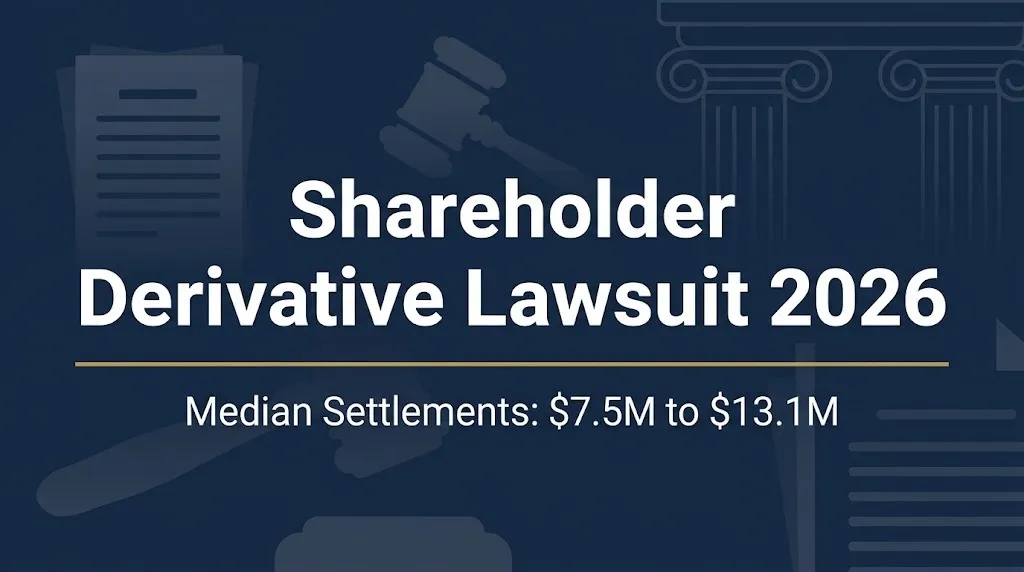
Shareholder derivative settlements vary widely, but median monetary settlements are $7.5 million outside Delaware and $13.1 million in Delaware Chancery Court, according to Cornerstone Research’s 2026 midyear analysis .
Here is the breakdown from the 2026 data:
| Venue | Median Monetary Settlement | Median Derivative / Class Action Ratio |
|---|---|---|
| Delaware Chancery | $13.1 million | 17.1% |
| Non-Delaware | $7.5 million | 25.5% |
Derivative settlements with a monetary component tend to correlate with larger securities class action settlements, suggesting they reflect the severity of underlying allegations .
The ratio matters because it shows how derivative recoveries compare to parallel securities class actions. In Delaware, the derivative settlement is typically about 17% of the related class action settlement. Outside Delaware, that ratio is higher at 25.5% .
What Recent Shareholder Derivative Settlements Happened in 2026?
Several significant derivative settlements received approval or moved toward final approval in 2026. Here are the notable ones:
| Company | Settlement Amount | Status | Key Terms |
|---|---|---|---|
| Boeing | $237.5 million | Approved | Landmark settlement tied to Section 220 demand |
| Virgin Galactic | $2.75 million | Final approval August 14, 2026 | Insurers pay company; half retained by company |
| Exicure | $675,000 (attorney fees) | Notice issued April 2026 | Governance reforms only; no monetary payment to company |
| NEE (NextEra) | Not disclosed | Final approval hearing pending | Florida statutory derivative settlement |
The Boeing settlement stands out because it demonstrates how a books-and-records demand under Section 220 can lead to a substantial recovery. That settlement was approved in Delaware Chancery Court .
The Virgin Galactic settlement involved a $2.75 million payment from insurers to the company. Half was retained by Virgin Galactic, and half was paid to plaintiffs’ counsel for fees and costs. There was no finding of wrongdoing by any director or officer .
Key Takeaway: Derivative settlements in 2026 range from under $1 million in governance-only cases to $237.5 million in cases where extensive document demands built leverage.
Do You Get Money From a Shareholder Derivative Settlement?
No. You do not receive a direct payment from a shareholder derivative settlement. The recovery goes to the corporation, not to individual shareholders .
The Exicure notice states it plainly: “Because this is not a class action, except as otherwise provided for in the Stipulation with respect to the Plaintiffs, no Current Exicure Stockholder has the right to receive any individual compensation as a result of the Settlement” .
The benefit you receive is indirect. If the settlement includes corporate governance reforms, those reforms may improve how the company operates. If the settlement includes a cash payment to the company, that money strengthens the company’s balance sheet. You benefit only to the extent that your shares become more valuable over time.
How Do You File a Shareholder Derivative Lawsuit?
Filing a derivative lawsuit requires meeting specific standing and procedural requirements. You cannot simply sue because you own shares and dislike a board decision.
Here are the steps:
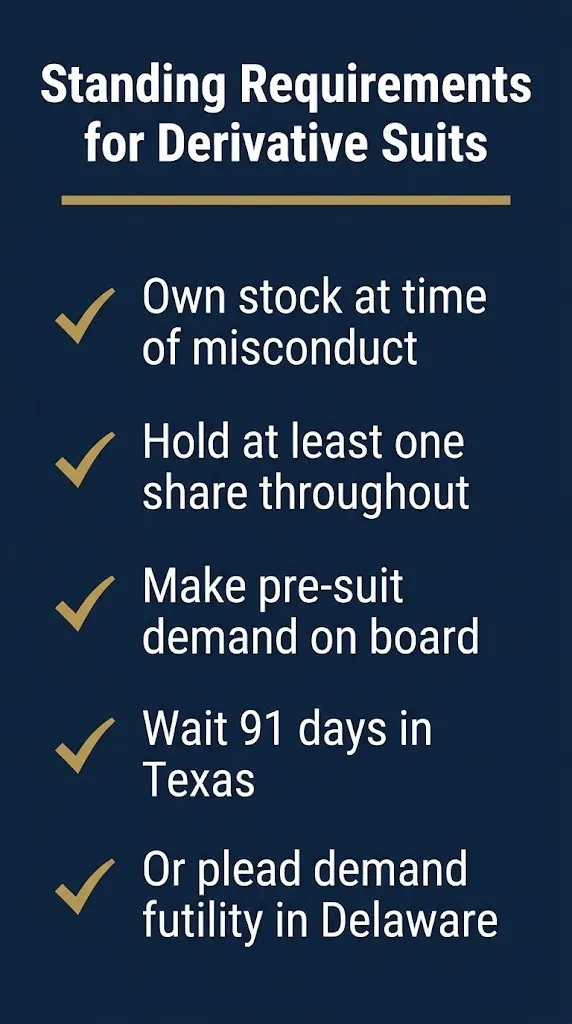
- Own stock at the time of the alleged misconduct. You must have held shares when the wrongdoing occurred .
- Continue to hold at least one share. You must maintain ownership throughout the litigation .
- Make a pre-suit demand on the board. Most jurisdictions require you to ask the board to address the issue first .
- Wait for the board to respond. In Texas, you must wait at least 91 days after making demand before filing suit .
- Show demand futility if you skip the demand. You must plead particularized facts showing the board cannot objectively evaluate the claim .
- File a books-and-records demand first. Courts strongly encourage this step to gather evidence before filing .
- File the derivative complaint. The suit is brought on behalf of the corporation, not you personally .
A Delaware court dismissed a derivative suit as premature in May 2026 because the plaintiff filed only four weeks after making a demand. The court found that four weeks was insufficient for the board to investigate claims against 15 people and consider governance reforms .
What Is the Pre-Suit Demand Requirement for Derivative Lawsuits?
The pre-suit demand requirement means you must formally ask the board of directors to take legal action before you can file a derivative lawsuit. It is a mandatory step in most jurisdictions, designed to give the board a chance to investigate and self-correct .
Delaware law allows you to skip the demand only if you can plead demand futility. That requires particularized facts showing the board is conflicted or lacks independence. It is a high bar to clear .
Texas law does not recognize demand futility at all. A shareholder must make a written demand and wait at least 91 days before filing . The Texas Business Court dismissed a Coinbase derivative suit in October 2026 because the plaintiff relied on Delaware’s futility doctrine instead of making a demand under Texas law .
The choice-of-law question matters after a company reincorporates. The Texas court held that Texas law governs standing and authority to bring derivative claims for a Texas corporation, even if the alleged misconduct occurred while the company was incorporated in Delaware .
What Is the Difference Between a Derivative Lawsuit and a Class Action?
A derivative lawsuit is filed on behalf of the corporation. A class action is filed on behalf of a group of shareholders who suffered direct harm.
| Feature | Derivative Lawsuit | Class Action |
|---|---|---|
| Who recovers | The corporation | Individual class members |
| Who is sued | Directors, officers, third parties | Company or other defendants |
| Your payout | None directly | Pro rata share of settlement |
| Claim type | Breach of fiduciary duty | Securities fraud, consumer harm |
| Notice requirement | Required, but no claim form | Required, with claim form |
If you received a notice about a derivative settlement, you are not filing a claim. The notice is to inform you of the settlement and your right to object if you choose .
Reality Check: No one texts you offering to release shareholder derivative settlement funds. These settlements do not create individual payouts. Any message asking for payment to “process” a derivative claim is a scam. The money goes to the company, not to shareholders.
What Is the Role of Books and Records Demands in Derivative Cases?
A books and records demand is a formal request under state corporate law for the company to produce internal documents. Shareholders use these demands to investigate potential wrongdoing before filing a derivative suit .
Courts strongly encourage shareholders to exhaust this step before filing. The Boeing derivative settlement, which reached $237.5 million, demonstrates how a Section 220 demand can build the evidentiary foundation for a substantial recovery .
Rhode Island enacted a law effective July 1, 2026, that allows publicly traded entities involved in derivative proceedings to deny inspection demands for certain communications, including emails and text messages. The law is designed to shield internal communications from shareholder scrutiny in active litigation .
Books and records demands are powerful tools, but they are not automatic. You must state a proper purpose for the inspection and comply with the procedural requirements of the state of incorporation.
What Happens Next for Shareholder Derivative Litigation in 2026?
Here is the expected timeline for derivative litigation trends:
Late 2026: The NEE derivative settlement final approval hearing proceeds. The settlement resolves fiduciary duty claims through Florida statutory procedures .
Ongoing 2026: Delaware Chancery Court continues to scrutinize attorney fee awards in derivative settlements. The Delaware Supreme Court reduced a fee award in a Tesla director compensation case in January 2026 .
2027: More companies may consider reincorporating outside Delaware. The Texas Business Court decision on Coinbase establishes that Texas law will govern derivative standing for Texas corporations .
Ongoing: Section 220 demands remain a critical first step for shareholders investigating potential claims .
Frequently Asked Questions
What is a shareholder derivative lawsuit?
A derivative lawsuit is filed by a shareholder on behalf of a corporation against directors or officers who allegedly harmed the company. The recovery goes to the corporation, not to the shareholder .
Do shareholders get money from derivative settlements?
No. Derivative settlements pay the corporation. Individual shareholders do not receive direct compensation .
How much are derivative settlements worth?
Median monetary settlements are $7.5 million outside Delaware and $13.1 million in Delaware Chancery Court, according to 2026 data .
What is the pre-suit demand requirement?
Most jurisdictions require shareholders to ask the board to take action before filing a derivative suit. Delaware allows demand futility, but Texas requires a written demand and a 91-day wait .
What is a books and records demand?
A formal request for corporate documents under state law. Shareholders use it to investigate wrongdoing before filing a derivative suit .
How long does a derivative lawsuit take?
Derivative lawsuits can take years. The pre-suit demand alone can require a 91-day waiting period in Texas, and the litigation itself often stretches over multiple years .
What is the difference between a derivative suit and a class action?
A derivative suit is brought on behalf of the corporation. A class action is brought on behalf of shareholders who suffered direct harm. Only class actions result in individual payouts .
What is demand futility?
A Delaware doctrine that allows shareholders to skip the pre-suit demand requirement by showing the board cannot objectively evaluate the claim. Texas does not recognize demand futility .
Know Your Role and Watch for Official Notices
If you receive a derivative settlement notice, read it carefully. You are not filing a claim. The notice informs you of the settlement terms and your right to object if you choose .
If you believe a company’s directors have breached their fiduciary duties, consult a securities attorney. A books and records demand is often the first step. The pre-suit demand requirement is the most important procedural rule in derivative litigation, and missing it can end your case before it starts .