Credit One Bank Class Action Lawsuit 2026: What’s Real and What’s Not
Quick Answer
- No open Credit One Bank settlement is paying consumer claims as of July 2026, despite viral reports of a “$14 million” payout.
- A confirmed $10.2 million judgment from California prosecutors in February 2026 pays civil penalties to the state, not checks to consumers.
- The case to watch is Mingura v. Credit One Bank, where a federal judge denied arbitration on July 10, 2026, keeping the class claims alive.
If you searched “credit one bank class action lawsuit” because a headline or a text promised you money, here is the direct answer. No settlement fund is currently accepting consumer claims. A widely shared “$14 million” TCPA settlement offering $1,000 per person has never been confirmed in any court docket.
What is real: Credit One Bank, N.A., a Las Vegas based subprime credit card issuer, is facing active federal litigation over debt collection robocalls, plus a separate $10.2 million judgment already paid to California law enforcement in February 2026. Neither of those currently sends checks to ordinary cardholders.
This article breaks down every active case, names the real court filings, and flags the one “settlement” legal reporters could not verify anywhere. One detail most competitors skip: a judge just denied Credit One’s arbitration motion this month, keeping the biggest pending case alive.
The Facts
| Category | Details |
|---|---|
| Case | Mingura v. Credit One Bank, N.A. (lead active federal case); People v. Credit One Bank, N.A. (resolved California enforcement case) |
| Status | Active, arbitration motion denied without prejudice on July 10, 2026 (Mingura); judgment entered February 19, 2026 (California case) |
| Fund Size | No consumer settlement fund currently open; $10.2 million judgment in the California case, paid as civil penalties, not consumer payouts |
| Est. Per Person | Not yet determined, no class has been certified |
| Claim Deadline | None open as of July 2026 |
| Administrator | Not yet appointed |
| Proof Needed | Not applicable, no claims process exists yet |
Is the Credit One Bank class action lawsuit legit?
Yes, the underlying litigation is real, but there is no single “the” Credit One Bank class action. Several separate cases exist at once, in different courts, at different stages.
The confusion is understandable. Credit One Bank has faced multiple Telephone Consumer Protection Act (TCPA) and debt collection lawsuits since at least 2018, and some have already settled.
Right now the two cases doing the most work are Mingura v. Credit One Bank, N.A. in federal court in California, and a resolved enforcement case brought by four California district attorneys. Neither one currently has a claims process for the general public.
Key Takeaway: There is no single active Credit One Bank class action settlement paying consumers in 2026. What exists is scattered litigation, most of it unresolved.
Is the $14 million Credit One Bank settlement real?
No court record confirms it. Legal analysts who checked federal dockets found no case matching the “$14 million TCPA settlement” figure that spread across dozens of sites in 2025 and 2026.
Attorney Eric Troutman of Troutman Amin, who tracks TCPA litigation professionally, flagged the story as a likely “phantom settlement” after multiple outlets reported it with no citation to a court or case number. Several of those articles appeared to trace back to a Reddit post rather than a filed judgment.
Here is what that means for you:
- No verified $14 million Credit One Bank TCPA settlement exists in public court records as of July 2026.
- Sites promoting a $1,000 per person payout under that name have not produced a case number.
- If a website asks for personal or banking information to “file” for that settlement, treat it as a red flag, not a payday.
Reality Check: No legitimate settlement administrator sends a text or a surprise call announcing your payout first. Filing a real claim is always free, and a genuine settlement notice always names the court and case number. If a site can’t produce both, don’t enter your information.
How much money can you get from the Credit One Bank lawsuit?
Not yet determined. No active case currently has a certified class, an approved settlement, or a claims process open to consumers.
In past resolved TCPA cases generally, payouts have ranged from roughly $40 to several hundred dollars per claimant, depending on fund size and how many people file. That range comes from historical TCPA settlement patterns industry-wide, not from a confirmed Credit One figure for 2026.
| Case | Consumer Payout Status |
|---|---|
| Mingura v. Credit One Bank (N.D. Cal.) | No settlement, no fund, case still contested |
| Snyder v. Credit One Bank (S.D. Fla.) | Early stage, filed December 31, 2025 |
| California DA judgment ($10.2 million) | Paid to state agencies, not individual consumers |
| Widely reported “$14 million” TCPA deal | Unconfirmed, no court record located |
If either federal case eventually reaches a certified settlement, per-person amounts will depend on the size of the fund and how many class members file. That has not happened yet.
Credit One Bank $10.2 million settlement: where does the money go?
It goes to California government agencies, not to individual Credit One cardholders. This is the single most misunderstood detail in every “Credit One settlement” search right now.
On February 19, 2026, a judgment was entered in Riverside County Superior Court, case number CVRI2101654, before Judge Harold Hopp. The case was brought by the California Debt Collection Task Force, a joint team from the Los Angeles, Riverside, San Diego, and Santa Clara County District Attorneys’ offices.
Credit One agreed to pay $9 million in civil penalties and $1.2 million in investigative costs, for a $10.2 million total. The Los Angeles County District Attorney’s Office alone will receive roughly $2.25 million of that in penalties.
Credit One did not admit wrongdoing. The judgment does require Credit One and its vendors to change their debt collection call practices going forward. No portion of this money is being distributed to consumers through a claim form, because this was a government enforcement action, not a class action settlement fund.
Key Takeaway: The $10.2 million figure you keep seeing is a state penalty payment, not a consumer compensation fund.
How to file a claim in the Credit One Bank lawsuit
Right now, there is nothing to file. No court has approved a settlement or opened a claims window for consumers.
That could change if Mingura v. Credit One Bank or the Snyder case eventually settles and receives court approval. If that happens, a formal claims process typically follows these steps:
- A settlement administrator gets appointed by the court.
- Class notices go out by mail, email, or text to eligible consumers.
- A dedicated settlement website and claim form go live.
- You submit the form with any required proof before the stated deadline.
- The court holds a final approval hearing.
- Approved claims get paid after the appeal period closes.
Until a step like this actually happens for a specific Credit One case, any site offering a claim form for a “credit one bank settlement” cannot be tied to a real court-approved fund.
Credit One Bank class action lawsuit status update 2026
As of July 29, 2026, the most active consumer case is Mingura v. Credit One Bank, N.A., and it just cleared a major hurdle. On July 10, 2026, U.S. District Judge Araceli Martínez-Olguín denied Credit One’s motion to compel arbitration, without prejudice.
That ruling does not end the case or guarantee a class action. It means Credit One’s attempt to force the dispute into private arbitration, which would have blocked a class-wide lawsuit, did not succeed this round.
“Without prejudice” means Credit One can raise the arbitration argument again later. No class has been certified, and no settlement talks have been publicly confirmed.
Separately, the California enforcement case (the $10.2 million judgment) is fully resolved as of February 2026. That case is closed on the government side, with no consumer component remaining.
What happened in the Mingura v. Credit One Bank case
Rebeca Mingura, a disabled senior from Alameda, California, filed her complaint on August 8, 2025, in the U.S. District Court for the Northern District of California. The case is Mingura v. Credit One Bank, N.A., Case No. 4:25-cv-06712.
Mingura alleges Credit One contacted her by phone, text, and email starting in April 2025 to collect debt on three accounts. She claims she received more than 578 calls between April and July 2025, even after her attorney sent a cease and desist letter.
Her complaint alleges violations of:
- The Telephone Consumer Protection Act (TCPA)
- The Rosenthal Fair Debt Collection Practices Act (RFDCPA)
- California’s Unfair Competition Law
She seeks statutory damages, treble damages available to senior citizens under California law, and an order requiring Credit One to stop the calls. Credit One’s motion to compel arbitration was denied without prejudice on July 10, 2026, and the case remains active before Judge Martínez-Olguín.
What is the Snyder v. Credit One Bank lawsuit about?
It is a separate TCPA case filed in a different court, alleging unsolicited telemarketing calls rather than debt collection calls specifically. Plaintiff Joseph Nicos Snyder filed the complaint on December 31, 2025.
The case is Snyder v. Credit One Bank, N.A., Case No. 1:25-cv-26172, in the U.S. District Court for the Southern District of Florida. Snyder alleges Credit One made unsolicited telemarketing calls without prior consent, in violation of the TCPA.
This case is still in its early stages. No class has been certified, and no settlement has been reported as of this writing.
Key Takeaway: Two separate federal TCPA cases against Credit One are moving through court right now, in California and Florida, and neither has reached a settlement.
What to do if Credit One Bank keeps calling you
Document everything before you do anything else. Courts in both the Mingura and California DA cases relied heavily on call logs and written cease and desist requests.
A simple comparison: treat unwanted debt collection calls the way you’d treat a billing error on a utility bill. You don’t just get annoyed, you write down the date, the amount, and every time you asked them to stop.
- Log the date, time, and number for every call.
- Save any text messages or voicemails.
- Send a written request to stop contact, by mail or email, and keep a copy.
- Note whether calls continued after that request.
- Consider filing a complaint with the Consumer Financial Protection Bureau or your state attorney general.
- Consult a consumer protection attorney if the calls continue after a formal stop request.
None of this guarantees compensation. It does build the kind of record that mattered in both cases covered above.
Why is Credit One Bank being sued?
Most active and recent litigation centers on debt collection call practices, specifically claims that Credit One or its vendors called consumers too often, too aggressively, or after being told to stop. That is the core allegation in both the Mingura case and the resolved California enforcement action.
Older cases, including a 2018 TCPA filing and a 2021 case (Jefferson v. Credit One Bank, N.A., Case No. 1:21-cv-00532, N.D. Illinois), alleged similar unwanted call conduct going back years. A federal jury also found Credit One liable for Rosenthal Act violations in 2019.
Credit One is a subprime credit card issuer, meaning it serves customers with lower credit scores. Consumer advocates have argued this customer base faces fewer alternatives and less leverage when collection practices turn aggressive.
What is the Rosenthal Fair Debt Collection Practices Act?
It is a 1977 California law that extends debt collection protections to original creditors, not just third-party collection agencies. This matters because federal law (the FDCPA) mostly covers third-party debt collectors only.
Under the Rosenthal Act, a bank collecting its own debt, like Credit One collecting on its own credit cards, can still be held liable for harassing or abusive collection tactics. That is part of why California prosecutors, not just private plaintiffs, could bring the $10.2 million case.
The California Debt Collection Task Force has now used the Rosenthal Act to win four settlements against debt collection practices statewide, according to reporting on the February 2026 judgment.
Who qualifies for the Credit One Bank lawsuit?
Right now, nobody qualifies to file a claim, because no consumer claims process exists. Eligibility only becomes relevant once a case reaches a certified class and an approved settlement.
If Mingura v. Credit One Bank eventually becomes a certified class action and settles, potential class membership would likely track the allegations: California Credit One customers who received repeated automated debt collection calls after requesting they stop.
If the Snyder case in Florida reaches that stage, eligibility would likely involve people who received unsolicited telemarketing calls from Credit One without prior consent. Both of those scenarios remain hypothetical until a court actually certifies a class.
Credit One Bank lawsuit history: past settlements and rulings
Credit One’s legal history with debt collection and robocall claims goes back to at least 2018, when a proposed TCPA class action was first filed against the bank. A separate consumer filed suit that same year over debt collection on an account Credit One had already sold.
In 2019, a federal jury found Credit One liable for violating the Rosenthal Act, an earlier warning sign of the practices California prosecutors targeted again in the 2026 judgment. Despite that verdict, the conduct allegedly continued, according to the California Debt Collection Task Force’s 2026 case.
The February 2026 judgment marks the fourth settlement won by that task force against debt collection practices statewide, and the second major legal loss for Credit One tied to Rosenthal Act conduct specifically.
Key Takeaway: This is not Credit One’s first debt collection judgment, and the pattern of allegations has repeated across a 2019 jury verdict and the 2026 case.
What Happens Next
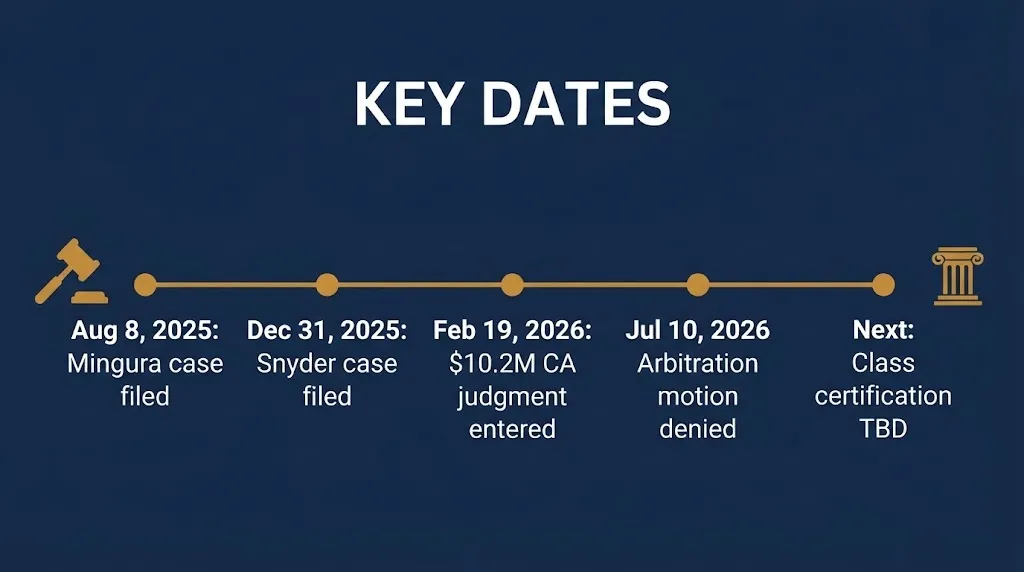
August 8, 2025: Mingura v. Credit One Bank complaint filed in federal court.
December 31, 2025: Snyder v. Credit One Bank complaint filed in Florida federal court.
February 19, 2026: $10.2 million judgment entered in the California enforcement case.
July 10, 2026: Judge denies Credit One’s motion to compel arbitration in Mingura, without prejudice.
Expected next stage: Continued pretrial proceedings in Mingura and Snyder, with class certification, if it happens, still pending and not yet scheduled.
Frequently Asked Questions
Is there a Credit One Bank settlement I can file a claim for right now?
No. As of July 2026, no court-approved settlement fund is accepting consumer claims against Credit One Bank.
Any site offering an immediate claim form for a Credit One settlement should be checked against actual court case numbers first.
Is the $14 million Credit One Bank TCPA settlement real?
No court record confirms it, and legal analysts who checked federal dockets found no matching case.
Treat any site promoting this specific figure or a “$1,000 per person” payout with caution until a case number surfaces.
Why do I keep getting robocalls from Credit One Bank?
Multiple lawsuits, past and present, allege Credit One or its vendors used automated dialing systems for debt collection and marketing calls.
Documenting the calls and sending a written stop request creates a record that could matter if litigation affecting you develops later.
Is Credit One Bank in legal trouble in 2026?
Yes, in the sense that it faces active federal litigation and just paid $10.2 million to resolve a California government case.
Neither situation currently means individual consumers are owed a payment.
What is the Mingura v. Credit One Bank case about?
It’s a federal lawsuit alleging Credit One made hundreds of unwanted debt collection calls to a disabled senior citizen after she asked the calls to stop.
The case survived Credit One’s push for arbitration on July 10, 2026, and remains active.
Does the $10.2 million California settlement pay consumers?
No. That money goes to California government agencies as civil penalties and investigative cost reimbursement, not to individual Credit One customers.
No claims process was created for consumers as part of that judgment.
How can I check if a Credit One Bank settlement is legitimate?
Look for a specific court name, case number, and a settlement administrator, and confirm those details independently before entering any personal information.
A legitimate settlement notice will never demand payment to file a claim.
Should I hire a lawyer for a Credit One Bank issue?
Since no settlement is currently open, there’s nothing to file. If you’re facing ongoing harassment from debt collection calls, a consumer protection attorney can review your specific situation.
This article reports on public litigation and doesn’t offer legal advice for individual circumstances.
If you’re dealing with unwanted Credit One Bank calls, save your documentation now, before any settlement exists. Watch the Mingura and Snyder case dockets for movement toward class certification, since that step, not a headline, is what would eventually open a real claims window.