VA Special Monthly Compensation 2026: Rates, Levels, and How to Qualify
Quick Answer
- This is a federal benefit program, not a lawsuit or settlement, run directly by the VA under federal law.
- 2026 SMC payments range from $67.00 at SMC-Q to $11,271.67 at SMC-R.2/T for a veteran with no dependents.
- There is no claim deadline. Veterans can file for SMC at any point after their disability is service-connected.
If you searched “VA special monthly compensation 2026,” you’re likely a veteran, caregiver, or family member trying to confirm this year’s payment amounts. This is not litigation and there’s no case to track.
The rates took effect December 1, 2025, reflecting a 2.8 percent cost-of-living adjustment tied to Social Security’s annual COLA. That’s the single number that changed every SMC tier this year.
This article breaks down every SMC level, what qualifies you for each one, and how dependents change your monthly total. One detail worth knowing upfront: SMC-Q hasn’t been newly awarded since 1968, yet it still appears on the VA’s current rate table.
The Facts
| Program | VA Special Monthly Compensation (SMC), not a lawsuit or settlement |
| Administered by | U.S. Department of Veterans Affairs |
| Legal Authority | 38 U.S.C. § 1114 and 38 C.F.R. § 3.350 through § 3.352 |
| Rate Effective Date | December 1, 2025 |
| 2026 COLA Increase | 2.8 percent |
| Rate Range (Veteran Alone) | $67.00 (SMC-Q) to $11,271.67 (SMC-R.2/T) |
| Filing Deadline | None, SMC has no application deadline |
| Proof Needed | Medical evidence matching a specific statutory SMC category |
Is VA Special Monthly Compensation a Lawsuit or a Benefit
VA Special Monthly Compensation is a federal disability benefit, not a lawsuit, class action, or settlement. There’s no plaintiff, no defendant, and no court involved.
Some search results and social posts use “lawsuit” language loosely when discussing VA benefits disputes, but SMC itself is a statutory payment program under Title 38 of the U.S. Code.
Veterans do sometimes appeal denied SMC claims through the VA’s Board of Veterans’ Appeals or the U.S. Court of Appeals for Veterans Claims. That’s a claims appeal process, distinct from a civil lawsuit against a company.
Key Takeaway: SMC is an entitlement you apply for directly through the VA, and no attorney or court filing is required to start a claim.
Is the 2026 SMC Rate Increase Real
Yes, the 2026 rate increase is confirmed directly on the VA’s official compensation rates page, last updated December 3, 2025. The increase applies automatically to eligible recipients.
The 2.8 percent adjustment matches the Social Security Administration’s 2026 cost-of-living adjustment, since federal law requires VA compensation to track Social Security’s COLA percentage exactly.
You don’t need to file anything to receive the increase if you already have an SMC award. The VA applies the adjustment automatically to your existing monthly payment.
How Much Is VA Special Monthly Compensation in 2026
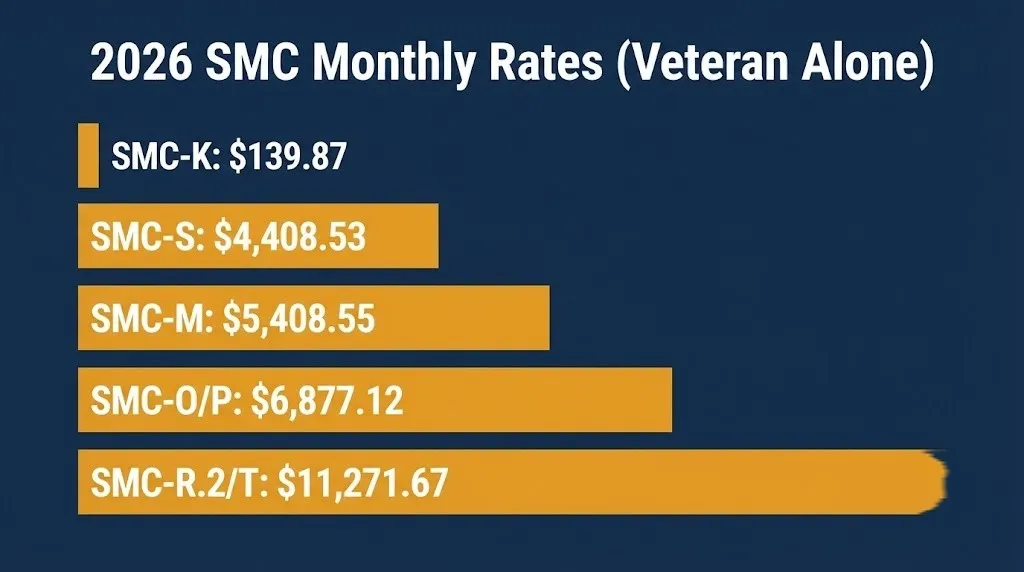
2026 SMC rates for a veteran alone, with no dependents, effective December 1, 2025:
| SMC Level | Monthly Rate |
|---|---|
| SMC-K (add-on) | $139.87 |
| SMC-Q (protected rate) | $67.00 |
| SMC-S | $4,408.53 |
| SMC-L | $4,900.83 |
| SMC-L 1/2 | $5,154.00 |
| SMC-M | $5,408.55 |
| SMC-M 1/2 | $5,780.00 |
| SMC-N | $6,152.64 |
| SMC-N 1/2 | $6,514.00 |
| SMC-O / SMC-P | $6,877.12 |
| SMC-R.1 | $9,826.88 |
| SMC-R.2 / SMC-T | $11,271.67 |
SMC-K works differently than the others. It’s an add-on rate stacked on top of your standard disability compensation, rather than a standalone monthly amount.
Reality Check: No company, agent, or text message can guarantee you a specific SMC level or speed up approval for a fee. Filing directly with the VA costs nothing, and legitimate accredited representatives don’t charge upfront fees for help preparing a claim.
What Are the 2026 SMC Rates for Veterans With Dependents
Rates increase when you have a spouse, children, or dependent parents on your award. The VA publishes separate tables for veterans with dependents.
Example, SMC-M with different dependent situations (2026):
| Dependent Status | SMC-M Rate |
|---|---|
| Veteran alone | $5,408.55 |
| With spouse | $5,628.14 |
| With spouse and 1 parent | $5,804.38 |
| With 1 child (no spouse or parents) | $5,555.40 |
| With 1 child and spouse | $5,788.96 |
The VA’s official instructions ask you to start with your basic rate from the dependent-status table, then layer on any added amounts for extra children or a spouse receiving Aid and Attendance.
How Much Extra Do Dependents Add to SMC in 2026
Added amounts apply once your basic rate already accounts for one spouse or one child, and you have additional dependents beyond that.
- Each additional child under age 18 adds $109.11 per month
- Each additional child over 18 in a qualifying school program adds $352.45 per month
- A spouse receiving Aid and Attendance adds $201.41 per month
Worked example from the VA’s own guidance: a veteran with SMC-L, a spouse, and 4 children (3 under 18, 1 over 18 in school) starts at $5,281.24, adds $109.11 twice for the second and third children, adds $352.45 for the child in school, and adds $201.41 if the spouse needs Aid and Attendance, for a total of $6,053.32 monthly.
Key Takeaway: Dependent add-ons stack on top of your basic SMC rate, so two veterans at the same SMC level can receive very different monthly totals depending on family size.
How to Apply for VA Special Monthly Compensation
SMC isn’t automatic in most cases. You generally need to file a claim and submit medical evidence matching a specific statutory category.
- Gather medical records documenting your specific loss, loss of use, or care need
- Confirm which SMC letter designation your evidence appears to match
- File a claim through VA.gov, by mail, or in person at a regional office
- Include a Statement in Support of Claim describing your daily limitations
- Consider working with an accredited Veterans Service Officer at no cost
- Respond promptly to any VA request for additional evidence
- Track your claim status through VA.gov once submitted
- Appeal through the Board of Veterans’ Appeals if your claim is denied
There’s no deadline pressure here, unlike a class action claims window. You can file whenever your medical evidence supports a claim.
How to Check Your SMC Rate and Payment Status
You can confirm your current SMC level and monthly payment amount directly through your VA.gov account. The site shows your award letter and current payment breakdown.
If your payment doesn’t match the 2026 rate table, that’s worth flagging directly with the VA, similar to noticing your bank never applied an expected interest rate change.
You can also call the VA benefits hotline to request a current payment summary if you don’t have online account access set up yet.
When Did the 2026 SMC Rates Take Effect
The 2026 rates became effective December 1, 2025, though veterans generally saw the adjusted amount reflected in their payment starting in early January 2026. VA benefits are paid in arrears, so the December rate typically shows up on the January payment date.
This mirrors how Social Security recipients see their COLA increase reflected the following January, not the same month it technically takes effect.
What Is the 2026 COLA Increase for SMC
The 2026 cost-of-living adjustment is 2.8 percent, applied uniformly across every SMC level and the standard VA disability compensation schedule.
That’s lower than some recent years’ adjustments. Federal law ties the VA’s annual increase directly to the percentage set by the Social Security Administration, so VA has no independent discretion over the number.
Key Takeaway: The 2.8 percent COLA is not unique to SMC. It applies across all VA disability compensation, and it’s set by federal statute rather than a VA policy choice.
What Is VA Special Monthly Compensation
SMC is additional tax-free monthly pay for veterans whose service-connected disabilities are severe enough that the standard 0 to 100 percent rating schedule doesn’t fully account for their impact.
It exists because losing a limb, going blind, or needing daily personal care creates costs and hardship that a percentage rating alone doesn’t capture. SMC layers extra compensation on top of, or in place of, standard disability pay.
Congress created the framework under 38 U.S.C. § 1114, and the VA implements it through detailed regulations at 38 C.F.R. § 3.350 through § 3.352.
Who Qualifies for SMC Levels L Through O
SMC levels L through O apply to specific combinations of amputation, loss of use, blindness, being permanently bedridden, or needing daily Aid and Attendance.
Each letter designation corresponds to an exact factual pattern defined in VA regulation, not a general severity judgment. For example, SMC-L can apply if you’ve lost both feet, lost the use of both feet, or need daily help with basic needs like eating and bathing.
The designations climb in severity from L toward O as combinations of losses stack together, such as blindness paired with amputation, or amputation combined with hearing loss.
What Is SMC-R and Who Qualifies
SMC-R applies when you need daily personal health care assistance from another person for needs like dressing, eating, or bathing, at a higher severity level than the L through O tiers.
There are two sub-levels: SMC-R.1 pays $9,826.88 monthly for a veteran alone, and SMC-R.2, which shares its rate with SMC-T, pays $11,271.67 monthly, the highest amount on the 2026 table.
SMC-T specifically applies to veterans with traumatic brain injury who need daily personal health care services and would otherwise require hospitalization or nursing home care.
What Is SMC-K and How Does It Work
SMC-K is different from every other SMC level because it’s an add-on, not a standalone payment. The VA adds $139.87 to your existing disability compensation rate.
You can receive SMC-K for anatomical loss or loss of use of specific body parts, including creative organs, one or both hands, or one or both feet, even at a low overall disability rating.
Veterans can potentially receive between 1 and 3 separate SMC-K awards stacked together, depending on how many qualifying losses they’ve documented.
What Is SMC-S Housebound Compensation
SMC-S applies to veterans who are essentially confined to their home because of service-connected disabilities. In 2026, it pays $4,408.53 monthly for a veteran with no dependents.
This is the lowest of the standalone SMC basic rates, sitting below SMC-L. It requires either a single disability rated 100 percent plus additional disabilities totaling 60 percent or more, or being permanently housebound due to service-connected conditions.
Why Do SMC Rates Change Every Year
SMC rates change annually because federal law requires the VA to match its compensation increases to the Social Security Administration’s cost-of-living adjustment percentage exactly.
That means the increase isn’t announced independently by the VA. It follows the SSA’s COLA announcement, which typically comes out each October for the following year.
Key Takeaway: If you want to predict next year’s SMC rates early, watch the Social Security Administration’s COLA announcement, not a VA-specific press release.
What Happens Next
October 2026 (expected): Social Security Administration announces the 2027 COLA percentage.
Expected late 2026: VA publishes updated 2027 disability compensation and SMC rate tables based on that COLA figure.
December 1, 2026 (expected): New rates take effect, consistent with past years’ pattern.
January 2027 (expected): Adjusted payments appear in veterans’ accounts, reflecting the new rate.
Frequently Asked Questions
Is VA special monthly compensation the same as regular VA disability pay?
No, SMC is an additional or separate payment layered on top of, or instead of, standard disability compensation.
It applies only when specific severe losses or care needs are documented.
Not every disabled veteran qualifies for SMC.
What is the highest SMC rate in 2026?
The highest 2026 rate is $11,271.67 monthly for a veteran alone at SMC-R.2 or SMC-T.
That amount increases further with eligible dependents.
It applies to the most severe qualifying combinations of loss and care need.
Is there a deadline to apply for SMC in 2026?
No, there is no filing deadline for Special Monthly Compensation.
Veterans can file a claim whenever their medical evidence supports a qualifying SMC category.
This differs from class action settlements, which do have strict claim windows.
Do I need a lawyer to apply for SMC?
No, you can file directly with the VA at no cost, or use a free accredited Veterans Service Officer.
Some veterans do use accredited attorneys for denied claims or appeals.
Be cautious of anyone charging upfront fees to help you file an initial claim.
How much does a spouse add to SMC payments in 2026?
A spouse without special needs adds an amount built into the basic dependent-status rate table.
If your spouse receives Aid and Attendance, that adds an extra $201.41 monthly.
Exact totals depend on your specific SMC level.
Why did my SMC payment go up in January 2026?
VA benefits are paid in arrears, so the December 1, 2025 rate increase generally first appeared in January 2026 payments.
The increase reflects the 2.8 percent COLA adjustment.
No action was required from veterans already receiving SMC.
Can I receive more than one SMC-K award?
Yes, veterans may receive between 1 and 3 separate SMC-K awards, depending on documented qualifying losses.
Each SMC-K award adds $139.87 to your monthly payment in 2026.
SMC-K stacks on top of nearly all other SMC basic rates except SMC-O, SMC-Q, and SMC-R.
What is SMC-Q and can veterans still get it?
SMC-Q is a protected legacy rate of $67.00 monthly that the VA hasn’t newly awarded since August 19, 1968.
It only appears for veterans who received that specific historical designation.
New claims cannot be awarded at the SMC-Q level today.
There’s no claim form or deadline tied to this update, only current rates worth confirming against your own VA award letter. Check your VA.gov account to see how the December 1, 2025 increase applied to your specific payment.
The single fact to remember: 2026 SMC rates run from $67.00 at the legacy SMC-Q level up to $11,271.67 at SMC-R.2/T, reflecting a 2.8 percent COLA increase.