Debt Settlement Lawyer in 2026: Costs, Scam Warnings, and How to Find One Near You
Quick Answer
- A debt settlement lawyer is a licensed attorney who negotiates with creditors and can represent you in court, unlike a debt settlement company.
- Lawyer fees commonly run $200 to $400 an hour, a $500 to $5,000 flat fee, or 15% to 30% of what you save, depending on the firm.
- Federal law bans upfront fees from for-profit debt relief telemarketers under 16 CFR Section 310.4(a)(5)(i), and that rule applies regardless of what a company calls its fee.
You’re behind on credit cards, the calls won’t stop, and you’re wondering if a lawyer is the answer. Here’s the direct answer: a debt settlement lawyer is a licensed attorney, not a salesperson, and that distinction matters the moment a creditor decides to sue you.
This matters most if you’re carrying five figures of unsecured debt, already facing a lawsuit, or getting pressured by a company that wants money before doing anything. The single fact worth remembering: it is illegal for a for-profit debt relief company to collect fees before it settles at least one of your debts.
This article breaks down what a debt settlement lawyer actually does, what it costs, how it differs from a debt settlement company, and how to spot the scams that flood this search term. One detail most sites skip: calling your fee a “retainer” doesn’t exempt anyone from the federal advance-fee ban, the FTC has said so directly.
The Facts
| Category | What’s Verified |
|---|---|
| What it is | A licensed attorney who negotiates unsecured debt and can represent you in court |
| Typical hourly rate | $200 to $400 per hour |
| Typical flat fee | $500 to $5,000 depending on complexity |
| Percentage-based fee | 15% to 30% of the amount saved or settled |
| Upfront fees | Illegal for for-profit telemarketed debt relief services under FTC rule |
| Credit score impact | Commonly a 75 to 100+ point drop, remains on report up to 7 years |
| Tax treatment of forgiven debt | Generally taxable unless you were insolvent when the debt was settled |
| Regulator | Federal Trade Commission (Telemarketing Sales Rule), plus state bar licensing for attorneys |
Not every firm marketing itself as a “settlement attorney” is actually licensed to practice law in your state. That’s the first thing worth checking before you sign anything.
What does a debt settlement lawyer actually do?
A debt settlement lawyer is a licensed attorney who negotiates with your creditors to reduce what you owe, and who can represent you if a creditor files a lawsuit. That court representation piece is the core difference from a non-attorney debt relief company.
A debt settlement lawyer typically reviews your total debt picture, contacts creditors directly, and negotiates lump-sum or structured settlements for less than the full balance. Because they’re licensed, they can also file legal responses, appear in court, and advise you on options a non-lawyer legally cannot discuss, like the interaction between debt settlement and bankruptcy.
What a debt settlement lawyer can do that a debt settlement company cannot:
- Represent you in court if you’re sued by a creditor
- Give you actual legal advice about your specific situation
- File motions or legal responses on your behalf
Neither a lawyer nor a company has special power over your creditors, though. Settlement happens because it makes financial sense for the creditor, not because a law degree is in the room.
Is a debt settlement lawyer legit, or is this a scam risk?
Hiring a licensed attorney for debt settlement is legitimate, but the industry around this search term is full of non-attorney companies using lawyer-sounding names. This is the single biggest source of confusion in this space.
Every state has a bar association where you can verify whether someone claiming to be a debt settlement attorney actually holds an active law license. This takes two minutes and it’s free.
Quick legitimacy check:
- Search the attorney’s name plus your state bar association.
- Confirm the license is active, not suspended or inactive.
- Ask directly whether they are a licensed attorney or a non-attorney “advisor.”
- Get any fee agreement in writing before paying anything.
Key Takeaway: A real debt settlement lawyer will always be verifiable through your state’s bar association, and that single check filters out most of the imitators using legal-sounding language.
Debt settlement lawyer vs debt settlement company: what’s the real difference?
The core difference is legal representation: a lawyer can appear in court for you, a debt settlement company cannot. Both may negotiate with creditors, but only one can stand next to you if a creditor sues.
| Factor | Debt Settlement Lawyer | Debt Settlement Company |
|---|---|---|
| Can represent you in court | Yes | No |
| Licensed to give legal advice | Yes | No |
| Typical fee model | Hourly, flat fee, or percentage of savings | Percentage of enrolled or settled debt, 15% to 25% |
| Upfront fees allowed | No, under FTC rule | No, under FTC rule |
| Regulation | State bar licensing | FTC Telemarketing Sales Rule, state debt relief laws |
Debt settlement companies typically instruct you to stop paying creditors and deposit money into a separate account instead. That approach often leads to increased late fees and collection activity while you wait for enough funds to accumulate.
Settlement attorney vs settlement lawyer: is there a difference?
No, “settlement attorney” and “settlement lawyer” describe the same licensed professional, the terms are used interchangeably across the legal industry. Neither term by itself guarantees a specialty in debt negotiation specifically.
Some attorneys who advertise as a “settlement attorney” focus on real estate closings, personal injury payouts, or insurance claims rather than consumer debt. When searching for help with credit card or personal loan debt, look specifically for “debt settlement attorney” or “consumer debt attorney” to narrow the field.
Key Takeaway: The words “settlement lawyer” and “settlement attorney” are identical in meaning, so the practice area, not the title, is what tells you whether they handle consumer debt.
How much does a debt settlement lawyer cost?
A debt settlement lawyer typically charges an hourly rate of $200 to $400, a flat fee of $500 to $5,000, or a percentage of the amount saved, usually 15% to 30%. There is no single standard price across the industry.
Common fee structures:
| Fee Model | Typical Range | Best Fit For |
|---|---|---|
| Hourly | $200 to $400 per hour | Cases involving lawsuits or complex negotiation |
| Flat fee | $500 to $5,000 | Straightforward settlements with fewer creditors |
| Percentage of savings | 15% to 30% | Cases where the final settlement amount is uncertain |
| Contingency (rare) | 25% to 40% of recovery | Suing a collector for FDCPA violations, not standard settlement work |
By comparison, debt settlement companies typically charge 15% to 25% of the enrolled or settled debt amount, but by law cannot collect that fee until after a settlement is reached, approved by you, and at least one payment has been made.
Reality Check: No legitimate debt settlement lawyer or company can legally demand payment before doing any work under federal law. If someone asks for money upfront before settling anything, that request itself is the red flag, not proof they’re serious.
How much debt do you need before hiring a settlement attorney?
There’s no official minimum, but attorneys generally become cost-effective once you’re carrying several thousand dollars or more in unsecured debt across multiple creditors. Below that threshold, attorney fees can eat into a large share of what you’d actually save.
People considering a debt settlement lawyer usually fall into one of these situations:
- Total unsecured debt in the tens of thousands, across several credit cards or loans
- Already facing a lawsuit or judgment from a creditor
- Dealing with aggressive collection calls or wage garnishment threats
- Weighing debt settlement against bankruptcy and needing legal guidance on both
If your total debt is small, a nonprofit credit counseling agency or a direct call to your creditor may resolve things without attorney fees at all.
Will a debt settlement lawyer hurt your credit score?
Yes, debt settlement, whether handled by a lawyer or a company, generally lowers your credit score, commonly by 75 to 100 points or more. The hit comes from the settlement process itself, not from who negotiates it.
Once an account settles for less than the full balance, it’s reported as “settled” rather than “paid in full,” a less favorable status. That notation, along with any missed payments that preceded it, can remain on your credit report for up to seven years from the original delinquency date.
What typically happens to your score:
- The steepest drop happens in the first 12 to 24 months.
- Scores often begin recovering as you rebuild positive payment history.
- The settlement notation itself stays visible for up to 7 years, even as its weight fades.
- Starting scores that were already low tend to see a smaller drop than higher starting scores.
Key Takeaway: Debt settlement is likely to hurt your credit score in the short term no matter who negotiates it, and that tradeoff should factor into your decision before you sign anything.
Is forgiven debt from a settlement taxable?
Yes, in most cases, forgiven debt over $600 is taxable income and creditors typically issue a Form 1099-C to report it to the IRS. This surprises a lot of people who assume settling debt is a clean financial win.
There is one major exception: if your total debts exceeded your total assets at the time of settlement, a condition called insolvency, you may be able to exclude some or all of the forgiven amount from taxable income. This calculation is specific to your situation and usually requires IRS Form 982.
What to do with a 1099-C:
- Save every 1099-C you receive from settled creditors.
- Calculate whether you were insolvent at the time of settlement.
- Talk to a tax professional before assuming you owe, or don’t owe, tax on the forgiven amount.
How to find debt settlement attorneys near me
Start with your state bar association’s lawyer referral service, since it only lists attorneys with active, verified licenses in your state. This avoids the flood of non-attorney companies that dominate general search results for this term.
Steps to find a legitimate debt settlement attorney near you:
- Search your state bar association’s official referral or “find a lawyer” tool.
- Filter for consumer debt, collections, or bankruptcy practice areas.
- Read any state bar disciplinary history before booking a consultation.
- Call two or three firms and compare fee structures directly.
- Ask specifically whether they are a licensed attorney handling your case personally.
- Get the fee agreement in writing before paying anything.
- Confirm they won’t request payment before any settlement work begins.
Many attorneys offer a free initial consultation, so use that call to compare fee structures before committing to anyone.
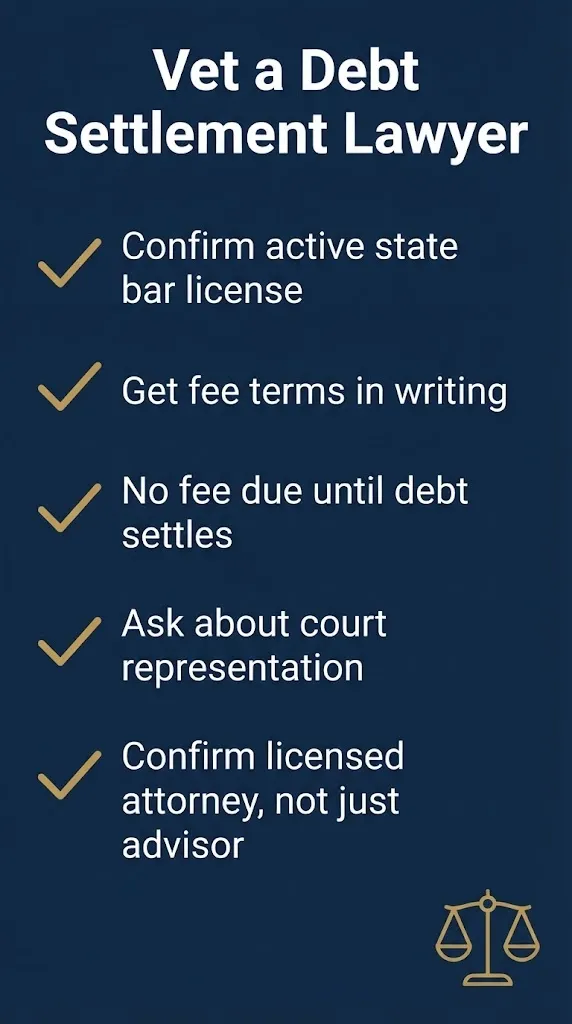
How to vet a debt settlement lawyer before you sign anything
Verify the attorney’s license through your state bar, then get a written fee agreement that spells out exactly what triggers payment. These two steps catch the majority of problems before they become expensive ones.
A short vetting checklist:
- Confirm active bar license status in your state.
- Ask how many debt settlement cases they’ve personally handled.
- Request a written explanation of the fee structure and when it’s charged.
- Confirm in writing that no fee is due until a debt is actually settled.
- Ask what happens if a creditor sues you during the process.
Think of this the way you’d treat a contractor quote before a home repair. A verbal promise means nothing once the work starts, get the terms in writing first.
What happens during the debt settlement process with a lawyer?
The typical process involves a debt review, a negotiation strategy, direct contact with creditors, and a written settlement agreement before any final payment. Timelines vary widely depending on how many creditors are involved and how willing they are to negotiate.
A general outline of the process:
- Initial consultation and full debt review.
- Attorney contacts creditors to open negotiations.
- Creditor responds with a counteroffer or rejection.
- Terms get finalized in a written settlement agreement.
- You make the agreed payment, lump sum or structured.
- The creditor updates your account status and credit report.
- You receive documentation, and possibly a 1099-C, for your tax records.
Not every negotiation succeeds. Creditors are not obligated to accept a reduced settlement, and some accounts may end up in litigation regardless of legal representation.
Can a debt settlement lawyer stop creditor calls and lawsuits?
An attorney can often reduce direct collector contact once creditors are notified you have legal representation, and can represent you if a lawsuit is already filed. This is one of the clearest practical advantages over a non-attorney debt relief company.
Debt collectors are generally required to communicate through your attorney once notified of representation, which can meaningfully reduce daily calls. If you’re already served with a lawsuit, only a licensed attorney, not a debt settlement company, can file a formal legal response and appear in court on your behalf.
Key Takeaway: Legal representation can change how creditors communicate with you and gives you courtroom protection a non-attorney company simply cannot offer.
What are the warning signs of a debt settlement scam?
The clearest warning sign is any request for payment before a debt is actually settled, which is illegal for for-profit telemarketed debt relief services under federal law. This single rule cuts through most of the confusion in this space.
Red flags to watch for:
- Upfront fees requested before any settlement is reached
- Pressure to stop communicating with your actual creditors immediately
- Guarantees of a specific reduction percentage before reviewing your debts
- Vague answers when you ask whether staff are licensed attorneys
- Refusal to put fee terms in writing
Under 16 CFR Section 310.4(a)(5)(i), a for-profit debt relief telemarketer cannot collect any fee until it has settled or resolved at least one enrolled debt, you’ve approved the deal in writing, and you’ve made at least one payment on it. Calling a fee a “retainer” does not create an exemption from this rule, according to the FTC’s own guidance to businesses.
How long does debt settlement with a lawyer take?
Debt settlement typically takes several months to a few years, depending on how many creditors are involved and how delinquent the accounts already are. There’s no fixed timeline that applies to every case.
Negotiations often move faster once an account is significantly delinquent, since creditors may prefer a reduced lump sum over the risk of getting nothing. Cases involving active lawsuits can extend the timeline further, since court schedules add their own delays outside anyone’s control.
What are the alternatives to hiring a debt settlement lawyer?
Alternatives include nonprofit credit counseling, direct negotiation with creditors, debt consolidation loans, and bankruptcy, each with different costs and credit impacts. A debt settlement lawyer is not the only path forward, and it isn’t the right fit for everyone.
| Alternative | How It Works | Best Fit For |
|---|---|---|
| Nonprofit credit counseling | Sets up a structured debt management plan, often lower fees | Manageable debt with steady income |
| Direct negotiation | You contact creditors yourself, no third-party fee | Smaller debts, comfort negotiating directly |
| Debt consolidation loan | Combines debts into one loan, often lower interest | Good credit, steady income to qualify |
| Bankruptcy | Legal process that discharges or restructures debt | Severe debt with no realistic repayment path |
A debt settlement lawyer becomes more valuable specifically when a lawsuit is involved or your total debt is high enough that court representation carries real weight.
Why are debt settlement companies restricted from charging upfront fees?
The FTC added the advance-fee ban to the Telemarketing Sales Rule in 2010 after finding widespread consumer harm from companies collecting large fees with no results. The rule, found at 16 CFR Section 310.4(a)(5)(i), took effect October 27, 2010, and remains active in 2026.
The FTC’s own guidance for businesses confirms that using an “attorney model,” calling fees a “retainer,” or hiring lawyers as part of a company’s structure does not exempt anyone from this ban. The agency evaluates actual practices, not the labels a company uses to describe itself.
This rule exists because, before 2010, some debt relief companies collected the bulk of their fees upfront and only afterward attempted (or failed) to negotiate anything. The advance-fee ban forces companies to actually deliver a settlement before getting paid.
What happens next
Before you sign anything: Verify any attorney’s license through your state bar association’s lookup tool.
During your consultation: Get the full fee structure in writing, including exactly what triggers payment.
If a creditor has already sued you: Prioritize attorneys who can represent you in court, since non-attorney companies cannot.
After any settlement: Watch for a Form 1099-C and check whether the insolvency exclusion applies to your tax situation.
Frequently Asked Questions
Is a debt settlement lawyer worth the cost?
It depends on your total debt and whether you’re facing a lawsuit.
Attorneys add clear value when court representation or complex negotiation is involved.
For smaller debts, nonprofit credit counseling may accomplish similar results for less money.
Can a debt settlement lawyer charge fees upfront?
No, federal law prohibits for-profit debt relief telemarketers from collecting fees before settling a debt.
This applies whether the fee is called a retainer or something else.
The rule is found at 16 CFR Section 310.4(a)(5)(i).
What’s the difference between a settlement attorney and a settlement lawyer?
There is no difference, the two terms describe the same licensed professional.
What matters is whether that attorney actually practices in consumer debt settlement.
Always confirm their specific practice area before hiring.
Will hiring a debt settlement attorney stop debt collector calls?
Often, yes, once creditors are notified of your legal representation.
Collectors are generally required to route communication through your attorney after that.
This does not guarantee all collection activity stops immediately.
Does debt settlement hurt your credit more than bankruptcy?
Generally no, bankruptcy tends to cause a larger score drop and stays on your report longer.
Debt settlement typically drops scores 75 to 100 points or more.
Both options carry real, lasting credit consequences worth weighing carefully.
Is forgiven debt from a lawyer-negotiated settlement taxable?
Usually yes, forgiven amounts over $600 generally count as taxable income.
An exception exists if you were insolvent, meaning your debts exceeded your assets, at settlement.
A tax professional can help determine whether that exception applies to you.
How do I know if a debt settlement lawyer is actually licensed?
Search their name through your state bar association’s official lookup tool.
Confirm the license status shows active, not suspended or inactive.
This single check is free and takes only a couple of minutes.
How much debt do I need before an attorney makes financial sense?
There’s no official minimum, but tens of thousands in unsecured debt is a common threshold.
Attorneys become more valuable specifically once a lawsuit is filed against you.
Smaller debts may be better served by nonprofit credit counseling instead.
Before you hire anyone, run the two-minute check that matters most: confirm the attorney’s license through your state bar association. No legitimate debt settlement lawyer or company can legally collect a fee before settling at least one of your debts, under federal law that has been in place since October 27, 2010.