What Is a Litigation Lawyer in 2026? The Complete Consumer Guide
Quick Answer
- A litigation lawyer is a civil trial attorney who files, manages, and argues lawsuits in court.
- Most consumer litigation lawyers charge a contingency fee, usually 33 to 40 percent of any recovery.
- Hiring one costs nothing upfront for most consumer claims, but you must sign a written fee agreement first.
If you received a notice about a class action settlement, a data breach claim, or a product defect lawsuit in 2026, you have likely encountered the work of litigation lawyers without ever stepping into a courtroom. These attorneys operate behind the scenes of nearly every major consumer settlement, employment dispute, and injury claim that makes headlines. Understanding what they do, what they charge, and whether you need one matters before you sign anything or respond to any legal notice.
A litigation lawyer is not the same as a transactional lawyer. A transactional attorney drafts contracts, forms companies, and handles paperwork. A litigation lawyer fights disputes in court. They file complaints, take depositions, negotiate settlements, and present cases to judges and juries. When a company wrongs consumers and a class action follows, a litigation lawyer is the person driving that case forward.
This guide breaks down what litigation lawyers actually do, what they cost, how they differ from trial attorneys, when you need one, and how to evaluate one before hiring. One fact surprises most people: the vast majority of civil cases never reach trial. Litigation lawyers spend most of their time preparing for trial, not performing in one.
The Facts
| Case | Civil litigation practice, general information |
| Status | No single case; ongoing legal practice area |
| Fund Size | Varies by individual case |
| Est. Per Person | Depends on case type and fee agreement |
| Claim Deadline | Statute of limitations applies, typically 1 to 4 years |
| Administrator | Not applicable |
| Proof Needed | Case-specific documents, contracts, medical records, correspondence |
What Is Litigation Lawyer Work in Practice?
A litigation lawyer handles civil disputes that end up in court or settle before trial. The work starts the moment a client walks in with a grievance and continues through investigation, filing, discovery, negotiation, trial, and sometimes appeal.
The practice includes several distinct phases. First comes case evaluation, where the attorney reviews facts and evidence to decide whether a claim has legal merit. Then comes pleading, where the lawyer files a complaint or answer with the court. Discovery follows, the longest phase, involving depositions, interrogatories, and document requests.
Most people never see these stages because roughly 95 percent of civil cases settle before trial. A litigation lawyer is often a negotiator first and a courtroom advocate second. The attorney builds leverage through discovery, then uses that leverage to extract a fair settlement.
- Case evaluation: reviewing facts, documents, and potential damages
- Pleading: filing formal complaints, answers, motions
- Discovery: gathering evidence, taking depositions, issuing subpoenas
- Settlement negotiation: mediating and bargaining with opposing counsel
- Trial: presenting evidence, examining witnesses, arguing to a jury
- Appeal: challenging or defending unfavorable rulings
Key Takeaway: Litigation lawyers do far more than argue in court; they investigate, negotiate, and manage cases from first complaint to final resolution.
What Is Litigation Lawyer Representation Worth in 2026?
The value of a litigation lawyer depends entirely on the claim. A consumer class action over a $50 defective product might yield pennies per claimant, while a personal injury lawsuit could recover six or seven figures. The attorney’s job is to maximize that recovery.
Fee structures determine what you actually keep. Most consumer litigation lawyers work on contingency, meaning they collect nothing unless they win. The standard contingency fee ranges from 33 percent to 40 percent of the gross recovery, and that percentage often increases if the case goes to trial.
Hourly litigation lawyers exist too, usually charging between $300 and $800 per hour depending on market and experience. Businesses typically hire hourly litigators. Individual consumers almost always use contingency lawyers, because paying $500 per hour is unrealistic for a claim worth $10,000.
| Fee Type | Typical Cost | Who Uses It |
|---|---|---|
| Contingency | 33 to 40 percent of recovery | Individual plaintiffs, injury victims |
| Hourly | $300 to $800 per hour | Businesses, defendants |
| Flat fee | $2,500 to $15,000 per case | Simple matters, uncontested issues |
| Retainer | $5,000 to $25,000 upfront | Complex commercial disputes |
Key Takeaway: Most consumers pay nothing upfront for a litigation lawyer; the attorney takes a percentage of what they recover.
What Is a Litigation Attorney Versus a Trial Attorney?
A litigation attorney handles the entire lawsuit process from start to finish. A trial attorney specifically focuses on courtroom advocacy. All trial attorneys are litigators, but not all litigators spend meaningful time in court.
This distinction matters because clients often ask whether they need a “trial lawyer” for their case. The honest answer: most cases settle, so what you need first is a litigation attorney who can negotiate effectively and build a strong record. If settlement fails, the same attorney can take the case to trial or bring in specialized trial counsel.
The American Bar Association does not separately license “litigation lawyers” and “trial lawyers.” Both hold standard law licenses. The difference is experience and focus. A litigation attorney who has tried 50 cases brings different value than one who has never seen a jury.
In consumer class actions, the named plaintiffs rarely interact with the litigation attorneys at all. Lead counsel handles the entire case. Class members simply receive notices and payment checks. Understanding this hierarchy helps set expectations if you join a class action.
- Litigation attorney: manages case from complaint through resolution
- Trial attorney: specializes in jury selection, opening statements, witness examination
- Class counsel: lead litigation lawyers appointed by the court in class actions
- Local counsel: attorneys licensed in the specific jurisdiction where the case is filed
What Does a Litigation Lawyer Do on a Daily Basis?
A litigation lawyer’s day rarely matches the dramatic courtroom scenes from television. Most days involve reading, writing, and talking. The attorney reads opposing filings, writes motions and briefs, and talks with clients, opposing counsel, and judges in status conferences.
Document review consumes enormous time. In a complex commercial case, discovery can produce millions of pages. Litigation lawyers use software to sort, search, and prioritize those documents. They depose witnesses, which means questioning them under oath outside of court. Depositions often prove more important than trial testimony because they lock in witness statements early.
Settlement negotiation happens throughout the case, not just at the end. Attorneys exchange demands and offers, mediate with neutral third parties, and often reach deals during late-stage discovery when both sides see the full strength of the evidence.
A typical week might include drafting a motion to compel, preparing a client for deposition, reviewing 400 pages of medical records, and attending two settlement conferences. The work is methodical, paper-heavy, and deadline-driven.
Key Takeaway: Litigation lawyers spend most of their time on investigation, paperwork, and negotiation, not courtroom arguments.
What Does a Litigation Attorney Do in a Class Action Settlement?
In a class action, a litigation attorney represents the entire group of affected consumers, called the class. The lawyer files the lawsuit, seeks class certification, negotiates the settlement, and asks the court to approve it. Individual class members usually do nothing beyond filing a claim form.
Class counsel duties are specific. The attorney must prove that common legal issues bind the class together, that the named plaintiffs adequately represent the group, and that the proposed settlement is fair. Courts scrutinize attorney fees in class actions more closely than in individual cases.
When you receive a class action notice in 2026, a litigation lawyer already negotiated the terms. The notice tells you how to claim your share, object to the settlement, or opt out to preserve your right to sue individually. The attorney who built the case never represents you personally. They represent the class as a whole.
This creates a common misunderstanding. Many consumers think the class action lawyer is “their” lawyer. In reality, the attorney’s interests generally align with the class but not perfectly. The attorney wants fees approved. You want maximum payout. Courts police this tension through fairness hearings.
- Class certification: proving the group has common legal claims
- Settlement negotiation: bargaining with the defendant over fund size and terms
- Notice distribution: ensuring class members learn about the settlement
- Fairness hearing: persuading the judge to approve the deal
- Fee petition: asking the court to approve attorney fees, usually 25 to 33 percent of the fund
Is It Worth Hiring a Litigation Lawyer for Your Claim?
Hiring a litigation lawyer makes sense when your damages exceed what you could recover without one. Small claims court handles disputes up to $10,000 in most states, and no attorney is needed there. But claims involving serious injury, employment discrimination, or significant financial loss usually warrant counsel.
The threshold question is provability. You need evidence: contracts, emails, medical records, photographs, witness statements. A litigation lawyer evaluates that evidence and tells you honestly whether a claim is worth pursuing. Good lawyers reject weak cases because contingency fees pay nothing on losses.
Timing matters too. Every state sets statutes of limitations, the deadlines for filing lawsuits. Personal injury claims often expire two to three years after the injury. Breach of written contract claims can run four to six years. Missing the deadline kills the claim forever, regardless of merit.
Reality Check: No legitimate litigation lawyer will promise a specific outcome or guarantee a settlement amount. Anyone who does is misleading you. Contingency fee agreements must be in writing, and you have the right to negotiate the percentage before signing.
- Personal injury with serious injuries: hire a litigation lawyer
- Employment discrimination or wrongful termination: hire a litigation lawyer
- Consumer claim under $10,000: consider small claims court first
- Class action where you are a member: no lawyer needed, just file a claim
How Do You Find and Vet a Litigation Lawyer in 2026?
Finding a litigation lawyer starts with the right search. State bar associations maintain attorney directories with disciplinary histories. Martindale-Hubbell and Avvo provide peer reviews and client ratings. Personal referrals from trusted sources often beat online searches.
Once you identify candidates, vet them aggressively. Ask how many cases like yours they have handled, how many went to trial, and what outcomes they achieved. Request references from past clients. Check whether they carry malpractice insurance, a sign of professionalism that some states require.
The initial consultation should feel like an interview, not a sales pitch. A good litigation lawyer asks questions about your case, explains the law plainly, and discusses both strengths and weaknesses. A bad one promises victory and pressures you to sign immediately.
Fee agreements deserve careful review. Contingency agreements must specify what happens with case expenses, which are separate from attorney fees. Expenses include filing fees, deposition costs, and expert witness charges. Some lawyers deduct expenses before calculating their percentage, which means you pay expenses even on a losing case. Others cover expenses if you lose.
- Search your state bar’s attorney directory for license status and discipline records
- Read recent client reviews on Avvo, Google, and legal forums
- Ask about trial experience, not just settlement history
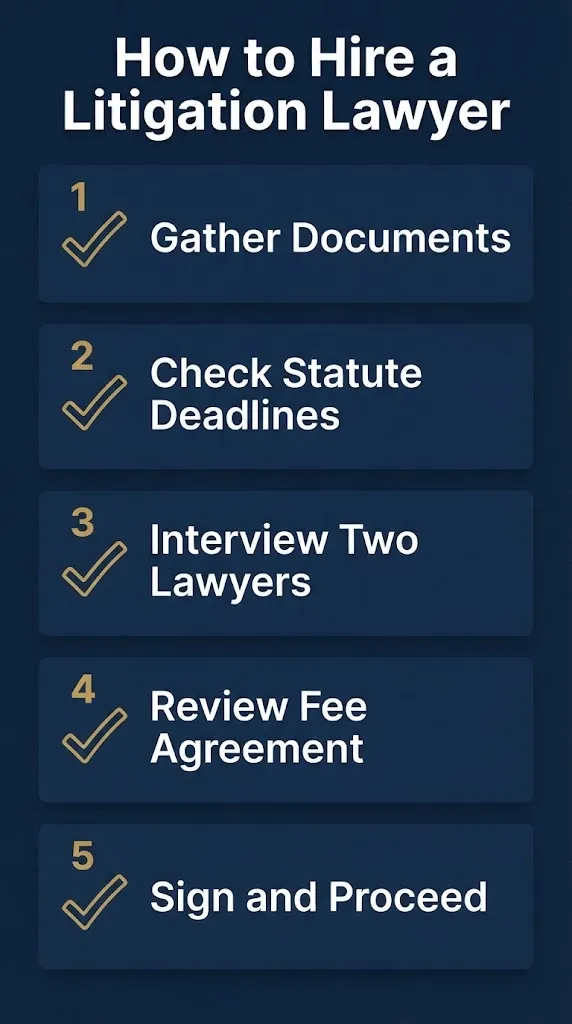
- Review the written fee agreement before signing anything
- Confirm who handles the day-to-day work, the partner or an associate
Key Takeaway: A litigation lawyer is worth hiring when damages are significant, evidence is strong, and the statute of limitations still runs.
How Much Does a Litigation Lawyer Cost in Consumer Cases?
Consumer litigation lawyers almost always work on contingency. The client pays nothing upfront. The attorney fronts all costs and collects a percentage only if the case settles or wins at trial. Standard percentages run 33 percent before trial and 40 percent if trial becomes necessary.
Costs work separately from fees. Filing fees, court reporter charges, and expert witness fees are case expenses. Many contingency agreements treat expenses as client obligations regardless of outcome. Others advance expenses and deduct them from your recovery before the fee percentage applies.
A simple example illustrates the math. You win a $100,000 settlement. Your agreement calls for a 33 percent fee and expense reimbursement. If expenses totaled $5,000, the lawyer takes $33,000 in fees plus $5,000 in expenses. You receive $62,000. Understanding this math before signing prevents surprise later.
Some consumer statutes allow courts to award attorney fees separately. The Fair Labor Standards Act, the Fair Debt Collection Practices Act, and many state consumer protection laws require losing defendants to pay the plaintiff’s attorney fees. This means the defendant pays your lawyer on top of your damages, a significant leverage point in settlement negotiations.
What Happens Next in a Typical Civil Lawsuit?
Timelines vary by case type and jurisdiction, but most civil lawsuits follow a predictable arc. The process starts with the complaint and ends with judgment or settlement, typically within 12 to 30 months.
August to October 2026: Initial consultation, case evaluation, demand letter if appropriate.
November 2026 to January 2027: Complaint filed, defendant answers or moves to dismiss.
February to December 2027: Discovery phase, including written discovery, document production, and depositions.
Early 2028: Summary judgment motions and settlement conferences.
Mid to late 2028: Trial or final settlement, followed by any appeals.
Not every case hits every stage. Most settle during discovery, when both sides see the evidence clearly. Cases that survive summary judgment usually settle before trial, because trial risk drives both parties toward compromise.
Frequently Asked Questions
What is the difference between a lawyer and a litigation lawyer?
A lawyer is any licensed attorney.
A litigation lawyer specifically handles lawsuits and court disputes.
Not all lawyers litigate; many only draft documents or advise clients.
Do litigation lawyers go to court?
Yes, litigation lawyers appear in court for hearings, motions, and trials.
Most of their work happens outside court in offices and conference rooms.
Only a small fraction of cases actually reach trial.
How much does a litigation lawyer charge per hour?
Hourly rates range from $300 to $800 for most litigation lawyers.
Elite attorneys in major cities charge $1,000 or more per hour.
Consumer clients almost never pay hourly rates.
Can a litigation lawyer settle without going to court?
Yes, the vast majority of civil cases settle before trial.
Litigation lawyers negotiate settlements throughout the case.
A strong negotiator often resolves cases without a single trial day.
What should I bring to my first meeting with a litigation lawyer?
Bring all relevant documents: contracts, emails, medical records, photographs.
Bring a written timeline of events.
Bring any correspondence from the other party or their insurer.
How long do I have to file a lawsuit?
The deadline depends on the statute of limitations for your claim.
Personal injury claims usually expire in 2 to 3 years.
Breach of contract claims often allow 4 to 6 years.
Is a litigation lawyer worth the cost for a small claim?
Probably not for claims under $10,000.
Small claims court handles those disputes without lawyers.
For larger claims, a litigation lawyer usually increases recovery enough to justify the fee.
What does class counsel mean in a settlement notice?
Class counsel is the litigation lawyer who represents the entire group.
They negotiated the settlement on behalf of all class members.
They do not represent you individually, but their work determines your payout.
Understanding what a litigation lawyer does removes the mystery from a process that touches millions of consumers each year. These attorneys carry the investigative, negotiating, and courtroom burden so ordinary people can pursue claims against corporations, employers, and wrongdoers. The key is knowing when you need one and what to ask before signing.
If you are considering a claim in 2026, check your state’s statute of limitations first. That deadline controls everything else. Then gather your documents and meet with a qualified litigation lawyer who will evaluate your case honestly, explain the costs clearly, and put your interests first.