Tylenol Lawsuit 2026: Claim Status, Settlement Amounts, and Filing Deadlines
Quick Answer:
- The Tylenol lawsuit is real, with over 500 cases consolidated in federal court alleging prenatal acetaminophen exposure caused autism or ADHD.
- No per-person payout amount has been determined because no settlement has been reached or approved.
- There is no claim deadline yet. You can still consult an attorney about filing if you believe you qualify.
If you searched “Tylenol lawsuit” after seeing a social media ad or hearing about a potential payout, you are not alone. Thousands of families have asked the same question since the litigation began gaining attention in 2022.
The cases center on one claim: that taking acetaminophen during pregnancy increased the risk of a child later being diagnosed with autism spectrum disorder or attention deficit hyperactivity disorder.
This article covers what is verified, what remains uncertain, and what you should do now. One detail most coverage misses: the litigation is still in early scientific evidence phases, not settlement negotiations.
The Facts
| Case | In re: Acetaminophen ASD/ADHD Products Liability Litigation |
| Status | Active multidistrict litigation, evidence phase |
| Fund Size | Not yet confirmed |
| Est. Per Person | Not yet determined |
| Claim Deadline | Not set |
| Administrator | Not yet appointed |
| Proof Needed | Medical records, purchase records, diagnosis documentation |
Is the Tylenol Lawsuit Legit?
The Tylenol lawsuit is legitimate and active in federal court as of January 2026. It is not a scam, but it is also not a settled case with guaranteed payouts.
The litigation is formally known as In re: Acetaminophen ASD/ADH Products Liability Litigation, centralized in the U.S. District Court for the Southern District of New York under Judge Denise Cote.
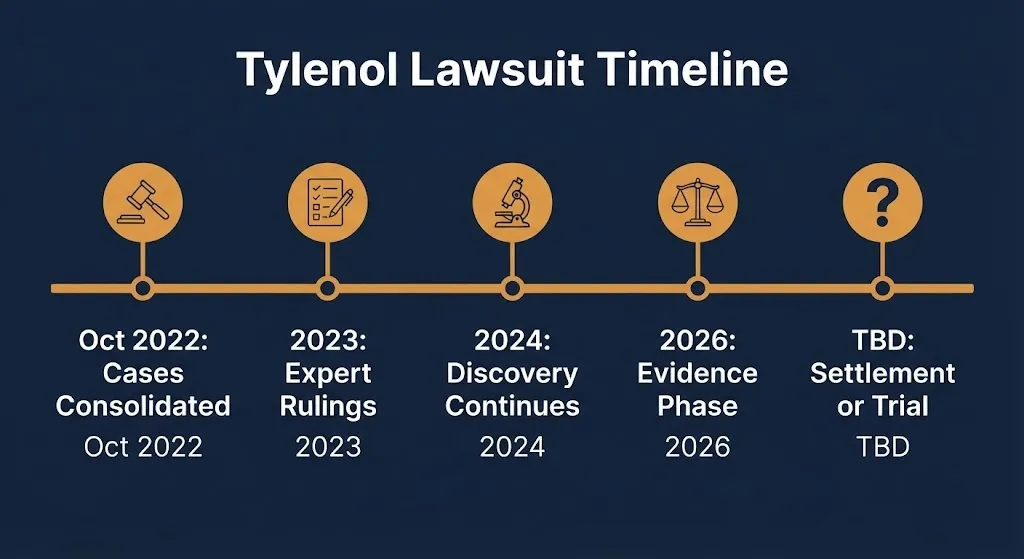
The Judicial Panel on Multidistrict Litigation consolidated cases in October 2022. Since then, the number of filed cases has grown to more than 500.
What this means for you: these are real product liability claims against major retailers and manufacturers who sold store-brand acetaminophen. The lawsuits allege those companies failed to warn pregnant consumers about potential neurodevelopmental risks.
One important distinction matters here. Most claims target generic and store-brand acetaminophen sellers, not Johnson & Johnson, which makes brand-name Tylenol. Several major retailers are defendants, including Walmart, CVS, Walgreens, and Costco.
The scientific basis remains contested. The FDA declined to change its acetaminophen pregnancy guidance after reviewing the available research. That does not mean the lawsuits fail. It does mean the outcome is far from certain.
Key Takeaway: The litigation is real and active, but no settlement exists yet, and any payout remains years away at minimum.
How Much Could the Tylenol Lawsuit Pay Per Person?
No per-person payout amount has been determined for the Tylenol lawsuit because no settlement has been reached or approved as of January 2026.
You may see ads or posts claiming specific amounts, sometimes tens of thousands of dollars. Those numbers are speculation, not court-approved figures.
Here is the reality of mass tort payouts. When cases settle or go to verdict, individual amounts depend on several factors: the severity of the diagnosed condition, the strength of medical evidence linking exposure to the diagnosis, the age of the claimant, and the total number of qualifying claimants.
Early estimates in legal marketing materials sometimes range from $50,000 to $500,000 per claim. Those figures have no basis in any court filing or settlement agreement.
If a global settlement is eventually reached, expect a tiered structure. More severe diagnoses with stronger proof of acetaminophen use during pregnancy would likely receive higher amounts. Cases with weaker documentation would receive less or nothing.
You should treat any specific dollar figure in an advertisement as unverified. The only number that will matter is the one approved by the court and published on the official settlement website if one is created.
Reality Check: No one can guarantee you a specific payout right now. Any firm or service that promises a set amount is misleading you. Filing is done through licensed attorneys, and legitimate mass tort attorneys work on contingency, meaning they only get paid if you do.
Who May Qualify for a Tylenol Autism Lawsuit Claim?
You may qualify to participate in the Tylenol lawsuit if you used acetaminophen during pregnancy and your child later received an autism spectrum disorder or ADHD diagnosis.
The core eligibility factors are straightforward. First, you must have taken acetaminophen, whether brand-name Tylenol or generic store-brand versions, while pregnant. Second, your child must have been diagnosed with autism, ADHD, or both.
Medical documentation is essential. You will need records showing the diagnosis, typically from a pediatrician, neurologist, developmental specialist, or psychiatrist. The stronger and earlier the diagnosis, the stronger the claim.
Timing also matters. The lawsuits generally involve children born after 1995, when acetaminophen use during pregnancy became widespread following aspirin safety warnings. Most cases involve children born between 2000 and the present.
Proof of purchase may help but is not always required. Pharmacy records, receipts, or even consistent testimony about the type of pain reliever used during pregnancy can support a claim. The exact proof requirements will depend on what any future settlement agreement specifies.
If you are unsure whether you used acetaminophen, check old medical records from prenatal visits. Many obstetric records note recommended or reported over-the-counter medications.
State law variations apply. The statute of limitations, or the deadline to file, differs by state and typically runs from the child’s diagnosis date, not the exposure date. This means many families still have time.
Key Takeaway: Documented prenatal acetaminophen use plus a documented autism or ADHD diagnosis in the child are the two essential qualification factors.
How to File a Tylenol Lawsuit Claim
Filing a Tylenol lawsuit claim currently means hiring an attorney to evaluate your case and file on your behalf. There is no standalone claim form or settlement website yet.
Here is the step-by-step process:
- Gather medical records showing your child’s autism or ADHD diagnosis.
- Collect any documentation of acetaminophen use during pregnancy, including pharmacy records or prenatal visit notes.
- Research and contact an attorney or law firm with experience in pharmaceutical mass tort litigation.
- Complete a free case evaluation. Most firms offer this at no cost.
- Sign a contingency fee agreement if the attorney accepts your case. You pay nothing upfront.
- Provide all requested medical records, authorizations, and other documentation.
- The attorney files your case in the appropriate court or joins the existing multidistrict litigation.
The process feels similar to filing a warranty claim for a defective product. You need proof of use and proof of the harm. Without both, the claim stalls.
Do not pay any upfront fees to anyone for Tylenol lawsuit representation. Legitimate mass tort firms work on contingency. If someone asks for a filing fee or processing fee, walk away.
Be wary of lead-generation companies that are not law firms. They may collect your information and sell it to attorneys. That is legal but not always transparent. You can contact law firms directly instead.
What Is the Latest Update on the Tylenol Lawsuit in 2026?
The latest Tylenol lawsuit update as of January 2026 is that the multidistrict litigation remains in the evidence and expert discovery phase, with bellwether trials still not scheduled.
Judge Denise Cote has been overseeing discovery since the cases were consolidated in late 2022. The current phase involves both sides exchanging expert reports on the scientific question at the heart of the case: whether prenatal acetaminophen exposure can cause autism or ADHD.
In late 2023, Judge Cote issued rulings on general causation expert testimony. She allowed some plaintiffs’ experts to testify while excluding others. The rulings were mixed, which is common in complex pharmaceutical litigation.
The defense has continued to challenge the reliability of studies cited by plaintiffs. They point to the FDA’s position that current evidence does not support changing acetaminophen recommendations.
No bellwether trial dates have been set. Bellwether trials, which test representative cases before juries, are typically the precursor to any serious settlement negotiations. Their absence signals that any resolution remains years away.
The case count has grown steadily. New filings continue as more families learn about the litigation through attorney advertising and news coverage.
Key Takeaway: The case is moving slowly through the scientific evidence phase, and no trial or settlement dates exist yet.
What Is the Acetaminophen Lawsuit About?
The acetaminophen lawsuit alleges that manufacturers and retailers failed to warn pregnant consumers about the potential link between prenatal acetaminophen use and neurodevelopmental disorders in children.
Acetaminophen is the active ingredient in Tylenol and hundreds of generic pain relievers. It is one of the most widely used medications during pregnancy. Studies suggest that over half of pregnant women in the United States use it at some point during pregnancy.
The scientific basis for the lawsuits comes from observational studies published over the past two decades. Several studies have found an association between prenatal acetaminophen exposure and increased rates of autism and ADHD diagnoses. Association, however, does not equal causation.
A 2021 consensus statement published in Nature Reviews Endocrinology, signed by 91 scientists and clinicians, called for caution and further research. The statement noted that pregnant women should use acetaminophen only when medically indicated.
The FDA reviewed the available evidence and declined to change its guidance. The agency cited limitations in the studies, including confounding factors and the lack of randomized controlled trials, which would be unethical to conduct with pregnant women.
The lawsuits target retailers who sold generic acetaminophen. The legal theory is that these companies knew or should have known about the potential risks and failed to add warning labels. Brand-name Tylenol maker Johnson & Johnson is not a primary defendant in most cases.
The litigation represents one of the largest mass tort consolidations in recent years. Its outcome could affect millions of families and reshape how over-the-counter medications are labeled during pregnancy.
Why Is Tylenol Being Sued for Autism?
Tylenol and generic acetaminophen sellers are being sued because plaintiffs claim the companies knew about studies linking prenatal use to autism and ADHD but failed to warn pregnant women.
The legal claim is not that acetaminophen definitely causes autism in every case. It is that the risk was material enough to require a warning, and the companies withheld that information from consumers.
Several epidemiological studies published since 2010 have reported associations between prenatal acetaminophen exposure and neurodevelopmental outcomes. Some studies found higher rates of autism and ADHD among children whose mothers reported using acetaminophen during pregnancy.
A 2019 study published in JAMA Psychiatry analyzed umbilical cord blood samples and found that higher acetaminophen levels correlated with higher ADHD and autism diagnosis rates. The study design strengthened the case for a biological link but still could not prove causation.
Critics of the litigation note that autism and ADHD have complex, multifactorial origins. Genetics play a significant role. Environmental factors interact with genetic susceptibility in ways researchers are still working to understand.
The lawsuits do not need to prove acetaminophen is the sole cause. Product liability law requires showing that a product carried risks that reasonable warnings would have disclosed, and that the plaintiff was harmed as a result.
The retailers facing litigation have argued that the FDA’s continued approval of acetaminophen without pregnancy warnings demonstrates that the scientific evidence does not support the claims.
Key Takeaway: The lawsuits rest on an allegation of failure to warn based on an evolving body of research, not a definitive scientific consensus.
Is There a Class Action Settlement for Tylenol and Autism?
There is no class action settlement for Tylenol and autism as of January 2026. The litigation is proceeding as a multidistrict litigation, not a class action.
This distinction matters for how any eventual resolution would work. In a class action, all class members are bound by one settlement and typically receive similar amounts. In a multidistrict litigation, each case remains individual, and any settlement must account for the specific facts of each case.
Most pharmaceutical mass torts resolve through multidistrict litigation settlements rather than class actions. This structure allows for tiered payouts based on injury severity and evidence strength.
The absence of a class action also means there is no court-appointed class representative and no class certification hearing scheduled. Those would be required steps for a class action settlement.
If a settlement is eventually reached, it would likely be a global resolution covering most or all cases in the multidistrict litigation. The settlement would create a claims process with specific eligibility criteria, documentation requirements, and payment tiers.
Until that happens, no one can file a claim for compensation. The current process is filing a lawsuit through an attorney, which preserves your right to participate in any future settlement.
The comparison is similar to a store return without a receipt. You might eventually get your money back, but you need to keep your documentation and follow the process when it opens.
What Is the Tylenol Lawsuit for Autism Deadline?
No deadline has been set for filing Tylenol autism lawsuits because there is no settlement and no claims process yet.
However, deadlines do exist in the form of statutes of limitations. These are state-specific time limits for filing a lawsuit. They vary widely, typically ranging from one to six years depending on the state and the specific legal claim.
In most states, the clock starts running when the injury is discovered, not when it occurred. For autism and ADHD claims, the discovery date is typically the diagnosis date. This means many families whose children were diagnosed in recent years may still have time to file.
Some states have statutes of repose, which cut off claims after a certain number of years regardless of discovery. These are less common but can affect older cases.
The best way to determine whether you still have time is to consult with an attorney promptly. Waiting could jeopardize your ability to participate in any future resolution.
Do not wait for a publicized deadline. By the time a settlement website appears with a claim deadline, the underlying litigation will have been resolved, and the window for filing new cases will likely have closed.
Key Takeaway: There is no settlement claim deadline, but state statutes of limitations are running. Act now if you think you have a case.
What Evidence Do You Need for a Tylenol Autism Claim?
You need evidence showing both prenatal acetaminophen exposure and a qualifying diagnosis in your child to support a Tylenol autism claim.
The specific proof requirements will depend on any future settlement agreement. But based on typical pharmaceutical mass tort settlements, here is what you should gather now:
Medical records showing the autism or ADHD diagnosis. These include evaluations from developmental pediatricians, psychologists, psychiatrists, or neurologists. School records showing special education placement or IEP documentation may supplement but not replace medical records.
Documentation of acetaminophen use during pregnancy. Pharmacy records showing purchases of Tylenol or generic acetaminophen are ideal. Prenatal medical records noting medication use are also useful. In the absence of written records, a detailed personal account of when and how often you used the medication may suffice.
The child’s birth date and general medical history. This helps establish the timeline and rule out alternative causes or contributing factors.
Your own medical records from pregnancy, if available. These help corroborate the claim that you took acetaminophen while pregnant.
Start gathering these records now, even before you contact an attorney. Having documentation ready will speed up any case evaluation and make you a more attractive client to law firms.
Think of it like preparing for a tax audit. The more organized your records, the smoother the process.
Who Are the Defendants in the Tylenol Lawsuit?
The primary defendants in the Tylenol lawsuit are major retailers that sold generic and store-brand acetaminophen products.
The named defendants include Walmart, CVS Pharmacy, Walgreens, Costco Wholesale, Target, Rite Aid, and Dollar General, among others. These companies sold their own store-brand versions of acetaminophen.
The legal claims against retailers are based on the products they sold. Retailers can be held liable for selling products that are defective due to inadequate warnings, even if they did not manufacture the products themselves.
Some manufacturers of generic acetaminophen are also named in certain cases. The exact defendant list varies by individual lawsuit and jurisdiction.
Johnson & Johnson, the maker of brand-name Tylenol, is notably absent from most cases. The brand-name product has carried similar warnings to generic versions, and plaintiffs have focused on the retailers and generic manufacturers.
The legal strategy of targeting retailers is not unusual. Retailers have deep pockets and are directly connected to the products consumers purchased. Similar approaches have been used in talcum powder, opioid, and other product liability litigations.
The defendants have consistently denied liability. They argue that acetaminophen is FDA-approved, widely recommended by medical organizations, and that the scientific evidence does not support the plaintiffs’ claims.
Key Takeaway: The case targets retailers who sold generic acetaminophen, not the makers of brand-name Tylenol.
What Happens Next in the Tylenol Litigation?
Here is the expected timeline for the Tylenol litigation based on the current posture and standard mass tort progression:
2026: Continued expert discovery and Daubert motions, which challenge the admissibility of expert testimony.
2026 to 2027: Potential selection of bellwether cases for early trials. These representative cases are chosen by both sides to test jury reactions.
2027 to 2028: Bellwether trials could begin if the court schedules them and no settlement occurs first.
2028 or later: If bellwether trials produce plaintiff verdicts, serious settlement negotiations may begin. If defense verdicts dominate, the plaintiffs’ leverage weakens substantially.
Uncertain: A global settlement could occur at any point after bellwether verdicts, or not at all.
This timeline is an estimate, not a court schedule. Mass tort litigation routinely takes five to ten years from consolidation to resolution. The acetaminophen litigation is still in its early middle stages.
The single most important thing you can do now is determine whether you have a viable claim and preserve it by filing through an attorney. Waiting for a settlement announcement means missing your window.
Frequently Asked Questions
Is the Tylenol autism lawsuit real?
Yes, the Tylenol autism lawsuit is a real, active multidistrict litigation in federal court with over 500 filed cases.
How much money can I get from the Tylenol lawsuit?
No amount has been determined because no settlement exists as of January 2026.
What is the deadline to file a Tylenol lawsuit?
There is no settlement claim deadline, but state statutes of limitations apply and vary by location.
Does Tylenol cause autism?
The scientific evidence shows an association in some studies, but causation has not been proven.
Who can join the Tylenol lawsuit?
Parents whose children have autism or ADHD and who used acetaminophen during pregnancy may be eligible to file.
Do I need proof I took Tylenol while pregnant?
Yes, documentation such as pharmacy records or medical notes strengthens your claim significantly.
Is there a class action for Tylenol and autism?
No, the litigation is a multidistrict litigation, not a class action, and each case remains individual.
Can I still file a Tylenol lawsuit in 2026?
Yes, new cases are still being filed, but you should consult an attorney soon due to state time limits.
If you believe your child’s autism or ADHD diagnosis may be connected to acetaminophen use during pregnancy, gather your medical records now. Contact a qualified mass tort attorney for a free evaluation.
The most important fact to remember: there is no settlement, no payout amount, and no claim deadline yet. The only deadline that matters is your state’s statute of limitations, and that clock is ticking.