Navy Federal Credit Union CFPB Settlement 2026: Status, Eligibility, and Consumer Impact
Quick Answer:
- Navy Federal Credit Union has faced CFPB scrutiny over lending practices, but no finalized settlement has been publicly announced.
- No consumer payout amount has been determined because no settlement order is confirmed.
- Affected members should monitor the CFPB enforcement action database for official updates.
Navy Federal Credit Union is the largest credit union in the United States, serving millions of military members, veterans, and their families. That scale means regulatory scrutiny carries significant consumer impact.
The Consumer Financial Protection Bureau has investigated lending practices at major financial institutions, including Navy Federal. Reports of potential enforcement actions have circulated, but the current status remains unconfirmed through official channels.
This article covers what is verified about the Navy Federal CFPB matter, what remains uncertain, and what consumers should do. One surprising detail: credit unions, often seen as consumer-friendly alternatives to banks, face the same CFPB oversight as large banks.
The Facts
| Case | Potential CFPB enforcement matter involving Navy Federal Credit Union |
| Status | Not confirmed, under regulatory review |
| Fund Size | Not confirmed |
| Est. Per Person | Not determined |
| Claim Deadline | Not set |
| Administrator | Not appointed |
| Proof Needed | Account records, loan documents |
Is There a Navy Federal CFPB Settlement?
No Navy Federal CFPB settlement has been publicly confirmed as of January 2026.
The Consumer Financial Protection Bureau has authority to investigate and penalize financial institutions for violations of consumer protection laws. The agency publishes enforcement actions on its official website and in its enforcement database.
Searches of the CFPB enforcement database do not show a finalized settlement order naming Navy Federal Credit Union as of the current date.
This does not mean no investigation exists. The CFPB routinely conducts non-public investigations. Settlement negotiations often occur before any public announcement.
Reports in financial news outlets have discussed CFPB scrutiny of credit union lending practices. Some reporting has specifically mentioned Navy Federal. Those reports are not official confirmations.
The absence of a public settlement means no consumer claims process exists. Any website or service claiming otherwise is inaccurate.
Key Takeaway: No confirmed settlement exists, and consumers should rely on the CFPB’s official enforcement database for accurate information.
What Is the Navy Federal Credit Union CFPB Investigation About?
The reported CFPB scrutiny of Navy Federal Credit Union centers on lending practices, specifically mortgage and auto loan origination.
Navy Federal is a dominant mortgage lender in the military community. The credit union originates more VA loans than any other lender. That volume makes its lending practices a regulatory priority.
Reports have focused on potential disparities in loan approval rates. Some analyses have suggested that minority borrowers may have faced different outcomes than white borrowers with similar qualifications.
Navy Federal has stated its commitment to fair lending. The credit union has not publicly acknowledged any wrongdoing.
The CFPB’s fair lending authority comes from the Equal Credit Opportunity Act and other consumer protection statutes. The agency can bring enforcement actions for discriminatory lending even without evidence of intentional discrimination.
The legal standard for fair lending enforcement is complex. Statistical disparities alone do not prove discrimination. The CFPB must show that the disparities result from policies or practices that are not justified by legitimate business needs.
Key Takeaway: The reported scrutiny involves fair lending concerns, but no formal findings have been made public.
How Much Could the Navy Federal Settlement Pay?
No payout amount can be estimated because no settlement exists as of January 2026.
If a settlement is eventually reached, consumer compensation would depend on the specific violations found and the number of affected consumers.
CFPB settlements typically include several components:
- Consumer restitution for harmed borrowers
- Civil penalties paid to the CFPB
- Injunctive relief requiring changed practices
- Compliance monitoring requirements
Consumer restitution amounts vary widely based on the violation. In mortgage lending cases, restitution may include refunded fees, reduced interest rates, or compensation for denied credit opportunities.
For auto loan cases, restitution may include refunded add-on product fees or overcharges.
No basis exists to estimate specific amounts for Navy Federal. Any figure circulating online is speculation.
Reality Check: No one can guarantee you a payout from a settlement that does not exist. Be wary of any service claiming to help you file a claim for a Navy Federal CFPB settlement. Official settlements are announced through the CFPB website, and filing is always free.
Who Would Qualify for a Navy Federal Settlement?
Qualification criteria for any future Navy Federal settlement would depend on the specific violations found and the settlement terms.
Typically, CFPB settlements define the affected consumer class by:
- The time period when the alleged violations occurred
- The specific products involved, such as mortgages or auto loans
- The consumer’s status during that period, such as being denied credit or charged specific fees
If the matter involves mortgage lending, affected consumers might include those who applied for Navy Federal mortgages during specific years and were denied or received less favorable terms.
If the matter involves auto lending, affected consumers might include those who financed vehicles through Navy Federal and were charged specific fees or add-on products.
No specific criteria exist because no settlement exists. The affected class would be defined in any future settlement order.
You do not need to sign up anywhere or provide information to protect your rights. If a settlement occurs, notice would be sent to affected consumers using Navy Federal’s records.
Key Takeaway: No qualification criteria exist because no settlement exists. Affected consumers would be notified through official channels if a settlement occurs.
What Is the CFPB?
The Consumer Financial Protection Bureau is a federal agency created by the Dodd-Frank Act to enforce consumer protection laws in the financial sector.
The CFPB began operations in 2011. Its authority covers banks, credit unions, mortgage lenders, payday lenders, debt collectors, and other financial services providers.
The agency has enforcement authority to investigate potential violations, bring enforcement actions, and obtain consumer restitution and civil penalties.
The CFPB maintains a public enforcement action database. Consumers can search for actions against specific companies.
The agency also operates a consumer complaint database. Consumers can file complaints about financial products and services through the CFPB’s website.
The CFPB’s budget and authority have been subject to political debate. Supreme Court decisions have addressed the agency’s funding structure and leadership. The agency continues to operate with its core enforcement authority intact.
The comparison to a financial watchdog is direct. The CFPB exists to catch problems and hold companies accountable.
Key Takeaway: The CFPB is the federal agency responsible for enforcing consumer protection laws in financial services.
What Should Navy Federal Members Do Now?
Navy Federal members who believe they experienced discriminatory lending or unfair practices should document their experiences and consider filing a complaint.
Here is what you can do:
- Gather account records, loan documents, and any communications with Navy Federal.
- Note dates, amounts, and specific incidents of concern.
- File a complaint with the CFPB through its official complaint portal.
- Consider filing a complaint with the National Credit Union Administration, which regulates credit unions.
- Monitor the CFPB enforcement database for any future action involving Navy Federal.
- Keep your contact information current with Navy Federal so you receive any future notices.
Filing a CFPB complaint does not guarantee compensation. But it creates a record and alerts regulators to potential problems.
The complaint process is free. You do not need a lawyer to file a CFPB complaint, though legal advice may help in complex situations.
If a settlement occurs, notice would likely be mailed to affected consumers. You do not need to sign up with any third-party service to receive notice.
Key Takeaway: Document your experience, file complaints through official channels, and monitor the CFPB database for updates.
What Other Enforcement Actions Has the CFPB Taken in 2026?
The CFPB has continued enforcement activity in 2026, though specific actions involving Navy Federal are not confirmed.
The agency’s enforcement priorities have included mortgage servicing, auto lending, credit reporting, and debt collection practices.
Recent years have seen CFPB actions against major banks and non-bank lenders for various violations. Settlement amounts have ranged from millions to billions of dollars depending on the scope of the violation.
Credit unions have historically received fewer CFPB enforcement actions than large banks. The credit union business model and member ownership structure often create different risk profiles. However, large credit unions like Navy Federal face similar regulatory expectations as banks.
The CFPB’s enforcement approach can shift with changes in agency leadership. Consumers should monitor the agency’s official announcements for the most current information.
Key Takeaway: The CFPB remains active in enforcement, but specific actions involving Navy Federal are not confirmed as of January 2026.
What Happens Next for the Navy Federal Matter?
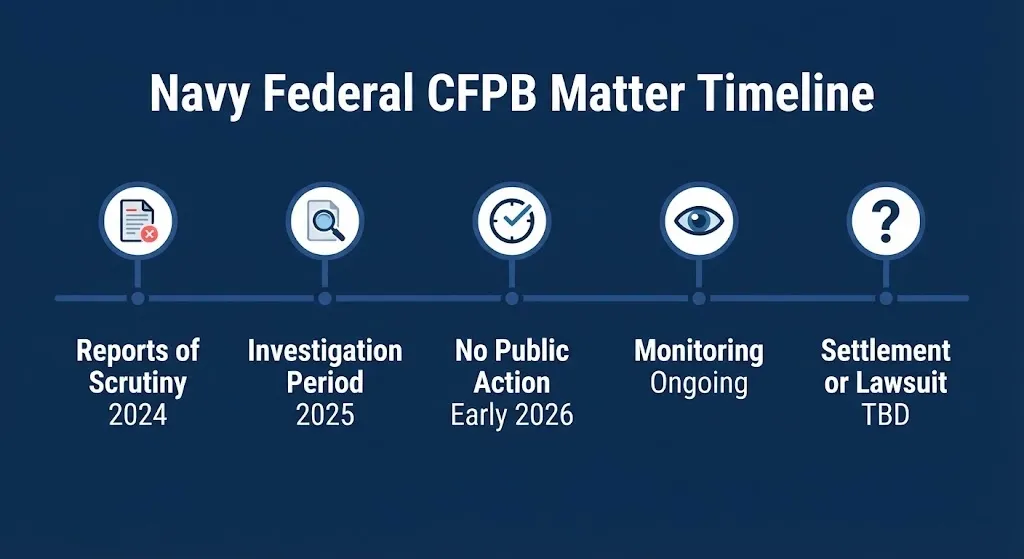
Here is the expected timeline for any potential Navy Federal CFPB matter based on standard enforcement processes:
Ongoing: The CFPB may continue any non-public investigation or review.
If a settlement is reached: The CFPB would issue a public consent order detailing findings and penalties.
If no settlement: The CFPB could file a lawsuit in federal court or close the matter without public action.
No timeline exists: Investigations can take years, and many result in no public action.
The most important action for consumers is monitoring official sources. The CFPB enforcement database and Navy Federal’s official communications are the reliable sources.
Do not rely on social media or third-party websites for information about potential settlements. Those sources often publish speculation as fact.
Frequently Asked Questions
Is there a Navy Federal CFPB settlement?
No confirmed settlement exists as of January 2026.
What is the Navy Federal lawsuit about?
Any potential matter involves lending practices, but no formal findings have been made public.
How much will I get from the Navy Federal settlement?
No amount has been determined because no settlement exists.
Do I need to file a claim for the Navy Federal settlement?
No claim process exists, and you would be notified through official channels if one opens.
Where can I check for CFPB enforcement actions?
The CFPB maintains a public enforcement action database on its official website.
Can I file a complaint against Navy Federal?
Yes, you can file a complaint with the CFPB or the National Credit Union Administration.
Is Navy Federal being sued by the CFPB?
No lawsuit has been publicly confirmed as of January 2026.
Will Navy Federal members get a payout?
No payout has been confirmed, and any future payout would depend on a settlement or court order.
Navy Federal Credit Union remains under the same regulatory oversight as any major financial institution. The CFPB has the authority to investigate and act if violations are found.
The most important action for consumers is relying on official sources. The CFPB’s enforcement database is the authoritative source for confirmed actions.