How to File a Lawsuit Against Your Employer in 2026: Step-by-Step
Quick Answer
- Yes, you can sue your employer, but most discrimination and retaliation claims must go through the EEOC first.
- Damages vary by claim type and are not a fixed dollar amount; wage claims can recover double the unpaid wages as liquidated damages.
- EEOC discrimination charges are generally due within 180 or 300 days, and FLSA wage claims within 2 or 3 years.
You want to know if you can actually sue your employer, and the honest answer is: it depends on what happened. Federal law requires most discrimination, harassment, and retaliation claims to go through the EEOC before you ever set foot in court.
Wage theft, unpaid overtime, and some contract disputes work differently. Those often let you file directly in court or through the Department of Labor’s Wage and Hour Division, with statute of limitations windows of two to three years under federal law.
This guide walks through both paths: the discrimination route through the EEOC and the direct lawsuit route for wage and contract claims. One detail most guides skip: missing your EEOC deadline by even one day can permanently bar your discrimination claim, no exceptions for good reasons.
The Facts
| Claim Type | Employment discrimination, harassment, retaliation, wage theft, wrongful termination, breach of contract |
| Filing Path | EEOC charge required first for most discrimination claims; direct lawsuit or DOL complaint for most wage claims |
| Typical Deadline | 180 or 300 days for EEOC charges; 2 or 3 years for FLSA wage claims |
| Right-to-Sue Window | 90 days from receipt of an EEOC Notice of Right to Sue |
| Potential Recovery | Varies by claim; not a fixed amount, depends on facts and proof |
| Agency Involved | EEOC for discrimination; U.S. Department of Labor Wage and Hour Division for wage claims |
| Proof Needed | Pay records, written complaints, witness statements, dates and documentation of the alleged violation |
Can You File a Lawsuit Against Your Employer?
Yes, you can file a lawsuit against your employer, but the path depends entirely on what kind of claim you’re making.
Discrimination, harassment, and retaliation claims under federal law almost always require you to file a charge with the Equal Employment Opportunity Commission (EEOC) before you can sue. Wage and hour violations under the Fair Labor Standards Act (FLSA) generally let you skip that step and go straight to court, or file with the Department of Labor first.
Breach of contract, wrongful termination outside a protected class, and some state-law claims follow their own rules entirely. The claim type determines the process, not just the fact that your employer wronged you.
Think of it like a warranty claim on a car. A recall repair goes through the manufacturer’s process first. A separate fraud claim might let you sue directly. The label on your problem decides your route.
Can You Bring a Civil Lawsuit Against Your Employer Without Going Through an Agency First?
For wage theft, unpaid overtime, and most contract claims, yes, you can often file a civil lawsuit directly without an agency step first.
For discrimination, harassment based on a protected class, or retaliation under Title VII, the Americans with Disabilities Act (ADA), or the Age Discrimination in Employment Act (ADEA), you generally cannot skip the EEOC. Federal courts will dismiss a discrimination lawsuit if you never filed a timely EEOC charge and received a Notice of Right to Sue.
There’s a narrow exception: the Equal Pay Act does not require you to file a charge with the EEOC before going to court, even though it’s often filed alongside Title VII sex discrimination claims.
Key Takeaway: Whether you can sue directly or must go through an agency first depends entirely on the specific law your claim falls under, not on how serious the harm feels to you.
How Much Can You Win in a Lawsuit Against Your Employer?
Not a fixed amount. How much you could recover depends entirely on your claim type, your documented losses, and what a court or settlement negotiation determines, so treat any flat number you see elsewhere as a guess, not a guarantee.
What is verified is how recovery is structured under different laws:
| Claim Type | What You Can Recover |
|---|---|
| FLSA wage violation | Unpaid wages plus an equal amount as liquidated damages (effectively doubling recovery), plus attorney’s fees and court costs |
| Willful FLSA violation | Same as above, with a longer 3-year lookback period instead of 2 years |
| Title VII discrimination | Back pay, reinstatement or front pay, compensatory and punitive damages depending on employer size, attorney’s fees |
| Retaliation | Similar remedies to the underlying claim, plus damages tied specifically to the retaliatory act |
Reality Check: No legitimate attorney or agency will promise you a guaranteed dollar figure before reviewing your evidence, and no one who texts you an unsolicited “you may be owed $50,000” message about a workplace claim is a real government agency. The EEOC and Department of Labor never solicit cases by cold text or demand upfront fees.
How Much Does It Cost to File a Lawsuit Against Your Employer?
Filing an EEOC charge or a Department of Labor wage complaint costs nothing. Both agencies process complaints for free, and filing a charge does not require an attorney.
If you eventually file a private lawsuit in federal court, you’ll typically owe a filing fee, though courts often let low-income filers request a fee waiver. Many employment attorneys take discrimination and wage cases on contingency, meaning you pay nothing upfront and they collect a percentage only if you win or settle.
Under the FLSA specifically, a winning employee can also recover attorney’s fees and court costs from the employer, which is part of why many employment lawyers take these cases without an upfront charge.
Key Takeaway: The government complaint process is always free; the cost question mostly comes up only if and when you move to a private lawsuit.
How to File a Lawsuit Against Your Employer Step by Step
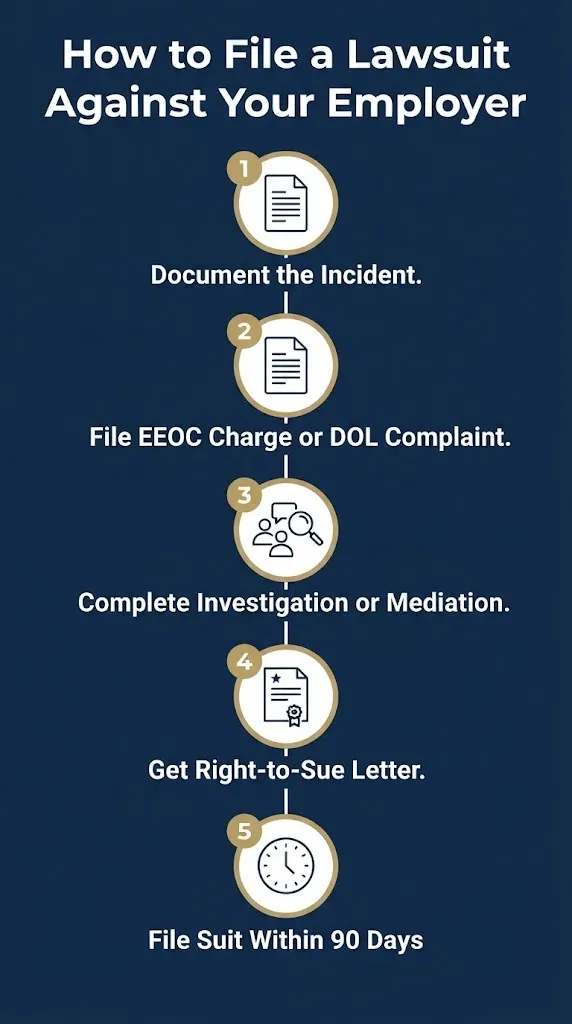
The general process for a discrimination-based claim runs through the EEOC first, then potentially into court. Here’s the sequence:
- Document the incident immediately: dates, witnesses, written communications, and your job title.
- Determine which agency has jurisdiction, usually the EEOC for discrimination or the DOL Wage and Hour Division for wage claims.
- File your charge or complaint within the applicable deadline (180/300 days for EEOC, 2/3 years for FLSA).
- Cooperate with the agency’s investigation or mediation process if offered.
- Request or wait for a Notice of Right to Sue if pursuing an EEOC discrimination claim.
- File your federal lawsuit within 90 days of receiving that notice.
- Consult an employment attorney before finalizing any lawsuit, especially for complex or high-value claims.
For wage claims, steps 2 through 5 look different: you can often file a DOL complaint or go straight to a private lawsuit within the FLSA’s 2- or 3-year window, without waiting on a right-to-sue letter.
How to File a Racial Discrimination Lawsuit Against Your Employer
A racial discrimination lawsuit under federal law starts with an EEOC charge, filed within 180 or 300 days of the discriminatory act, before you can bring a case in court.
Racial discrimination claims fall under Title VII of the Civil Rights Act, which covers most private employers with 15 or more employees. The process mirrors general EEOC filing: submit an online inquiry through the EEOC Public Portal, complete an intake interview, and have EEOC staff draft a formal Charge of Discrimination for your signature.
If the harassment or discriminatory treatment was ongoing rather than a single incident, the “continuing violation” doctrine may let the clock run from the most recent act rather than the first one. Courts apply this narrowly, so document every incident with a specific date rather than relying on a general sense that “it’s been happening for years.”
Once the EEOC completes its process or issues a Notice of Right to Sue, you have 90 days to file the federal racial discrimination lawsuit itself.
What Deadlines Apply Before You Can Sue Your Employer?
Deadlines depend entirely on your claim type, and missing one can permanently bar your case, so this is the single most important section to read carefully.
| Claim Type | Deadline |
|---|---|
| EEOC discrimination charge (most states) | 300 days from the act |
| EEOC discrimination charge (states without a Fair Employment Practices agency) | 180 days from the act |
| Federal employee EEO complaint | 45 days to contact an EEO Counselor |
| Lawsuit after EEOC Notice of Right to Sue | 90 days from receipt |
| FLSA wage claim (standard) | 2 years from the violation |
| FLSA wage claim (willful violation) | 3 years from the violation |
Age discrimination claims follow a slightly different rule: the 300-day extension only applies if a state agency actually enforces an age discrimination law, not just a general local ordinance.
Key Takeaway: The 90-day right-to-sue deadline is strictly enforced by courts, and equitable tolling exceptions are rare and hard to prove, so calendar it the day you receive the letter.
How to File an EEOC Charge Before Suing for Discrimination
You start by submitting an online inquiry through the EEOC Public Portal, which then leads to an intake interview before a formal charge is drafted.
The current process works like this:
- Go to the EEOC Public Portal and create a Login.gov account if you don’t have one.
- Click “I want to file a complaint” and answer initial screening questions.
- Submit your online inquiry with details about the adverse action you experienced.
- Schedule an intake interview, in person or by phone, with EEOC staff.
- During the interview, EEOC staff will assess your situation and determine deadlines.
- If appropriate, EEOC staff draft a formal Charge of Discrimination for you to sign.
- Once signed, the EEOC is legally required to notify your employer that a charge was filed.
If you have 60 days or fewer left before your deadline, the portal provides expedited directions so you don’t lose your claim to a processing delay.
How to File a Wage Theft Lawsuit Against Your Employer
You can file a wage theft claim either through the Department of Labor’s Wage and Hour Division or as a private lawsuit, and in most cases you don’t need to choose an agency route first.
The FLSA gives you two years to file for unpaid minimum wage or overtime, extended to three years if the violation was willful. The Wage and Hour Division recommends filing complaints as early as possible, ideally within 18 months, to preserve your full recovery window.
Steps for a wage theft claim:
- Gather pay stubs, timecards, and any records showing hours actually worked.
- File a complaint with the Wage and Hour Division, or consult an attorney about filing directly in court.
- Cooperate with any WHD investigation into your employer’s pay practices.
- If the WHD supervises a back-pay resolution, you generally cannot also file a private lawsuit over the same wages.
- If unresolved, file your own lawsuit before the 2- or 3-year deadline expires.
- Check your state’s separate wage laws, since many states allow longer filing windows than federal law.
Many states pair federal and state wage claims. California’s wage violations, for example, generally run on a three-year statute of limitations under state law, separate from the federal FLSA clock.
What Happens After You File an EEOC Charge?
After you file, the EEOC investigates your charge, may offer voluntary mediation, and eventually issues a determination before closing the case or referring it toward litigation.
The general sequence looks like this:
- EEOC staff confirm coverage and jurisdiction over your charge.
- The agency may offer mediation, a voluntary and confidential process both sides must agree to.
- If mediation doesn’t happen or fails, an investigator gathers evidence and interviews witnesses.
- The EEOC issues a determination of either “Cause” (discrimination found) or “No Cause” (insufficient evidence).
- Either way, the EEOC eventually issues a Notice of Right to Sue.
You can also request an early Notice of Right to Sue 180 days after filing, even if the investigation isn’t finished, which can be a strategic move if you’re ready to move forward faster.
What Is a Right-to-Sue Letter and How Long Do You Have After Receiving One?
A right-to-sue letter is the EEOC’s formal notice that closes the agency’s process and clears you to file a federal lawsuit, and you have exactly 90 days from receipt to file that lawsuit.
This 90-day deadline is one of the strictest in employment law. Courts apply it consistently and rarely grant extensions.
Limited exceptions exist through equitable tolling, but courts apply them sparingly:
- The employer actively concealed the discrimination from you
- You experienced a documented mental incapacity preventing timely filing
- You filed with the wrong agency in good faith within the deadline
- The employer’s conduct actively and misleadingly prevented timely filing
Do not count on any of these exceptions applying to your situation. Calendar the 90-day window the moment the letter arrives, not the moment you decide to act on it.
Can Your Employer Fire You for Filing a Lawsuit?
No, retaliating against you for filing an EEOC charge, a wage complaint, or a lawsuit is illegal under federal law, regardless of how the underlying claim turns out.
The FLSA specifically prohibits firing or discriminating against an employee for filing a wage complaint or participating in a related legal proceeding. Title VII contains similar retaliation protections tied to discrimination charges.
If your employer fires you, demotes you, or otherwise punishes you after you file, that retaliatory act can become its own separate legal claim, sometimes stronger than your original complaint. Document the timeline closely: a termination that follows quickly after you file a charge is exactly the pattern retaliation claims are built on.
Key Takeaway: Retaliation protections exist independently of whether your original claim succeeds, so a weak underlying case doesn’t excuse a retaliatory firing.
What Kind of Lawsuit Can You File Against Your Employer?
You can file several distinct types of employment lawsuits, and each one follows its own process, deadline, and agency rules.
Common categories include:
- Discrimination lawsuits based on race, sex, religion, national origin, age, or disability, generally routed through the EEOC first.
- Harassment lawsuits, including hostile work environment claims, also generally routed through the EEOC.
- Retaliation lawsuits for punishment after reporting discrimination, wage violations, or safety issues.
- Wage and hour lawsuits for unpaid minimum wage, overtime, or misclassification, filed with the DOL or directly in court.
- Wrongful termination lawsuits, which can overlap with discrimination or breach of contract depending on the facts.
- FMLA violation lawsuits for interference with protected medical or family leave.
Each category carries its own statute of limitations and its own required first steps, which is why matching the right process to your specific facts matters more than the general label “employer lawsuit.”
Do You Need a Lawyer to Sue Your Employer?
No, you are not legally required to hire an attorney to file an EEOC charge or a Department of Labor wage complaint.
That said, once a case moves toward an actual federal lawsuit, especially a discrimination or wrongful termination case, an employment attorney becomes far more valuable. Many take these cases on contingency, meaning you don’t pay unless you win or settle, and FLSA cases specifically allow winning employees to recover attorney’s fees from the employer.
Complex cases involving multiple claim types, disputed facts, or a company with in-house legal counsel are usually not worth navigating alone.
What Evidence Do You Need Before Filing a Lawsuit Against Your Employer?
You need clear, dated documentation connecting the specific act (firing, demotion, unpaid wages, harassment) to the legal violation you’re claiming.
Useful documentation includes:
- Pay stubs, timecards, and any record of hours actually worked
- Written communications: emails, texts, or performance reviews referencing the incident
- A personal timeline with specific dates, not vague recollections
- Names and contact information for any witnesses
- Copies of your employee handbook or written company policies, if relevant
- Any prior internal complaints you filed with HR, including dates and responses
Save this information as soon as an issue arises, not after you’ve already decided to file. Waiting to gather proof is like trying to prove a store purchase after you’ve thrown away the receipt.
What Happens Next
- As soon as possible after the incident: Start documenting dates, witnesses, and any written evidence.
- Within your applicable deadline (180/300 days EEOC, 2/3 years FLSA): File your charge or complaint with the correct agency.
- During the agency process: Cooperate with investigation or mediation, and keep your contact information current in the EEOC or DOL system.
- Upon receiving a Notice of Right to Sue: File your federal lawsuit within 90 days, no exceptions expected.
- Ongoing: Watch for any retaliatory action from your employer and document it separately if it occurs.
Frequently Asked Questions
Can I file a lawsuit against my employer without going to the EEOC first?
For most discrimination and retaliation claims under Title VII, the ADA, or the ADEA, no, you must file an EEOC charge first.
Wage theft and some contract claims often let you skip that step and go straight to court or the Department of Labor.
How long do I have to file an EEOC charge?
Generally 180 days from the discriminatory act, extended to 300 days if a state or local agency enforces a similar law.
Federal employees face a much shorter 45-day window to contact an EEO Counselor.
What is the deadline after receiving a right-to-sue letter?
You have exactly 90 days from receipt of the EEOC’s Notice of Right to Sue to file your federal lawsuit.
Courts enforce this deadline strictly, with only rare exceptions.
How long do I have to sue for unpaid wages?
Two years from the violation under the FLSA, extended to three years if the violation was willful.
Many states set their own, sometimes longer, wage claim deadlines separately from federal law.
Can my employer fire me for filing a complaint?
No, retaliation for filing an EEOC charge, wage complaint, or lawsuit is illegal under federal law.
A retaliatory firing can become a separate legal claim on its own.
Do I need a lawyer to file an EEOC charge?
No, filing an EEOC charge or intake questionnaire does not require an attorney and costs nothing.
An attorney becomes more valuable if your case moves toward an actual lawsuit.
How much money can I get from suing my employer?
There’s no fixed amount; recovery depends on your specific claim, documented losses, and applicable law.
FLSA wage violations can result in double damages, while discrimination cases may include back pay and other compensatory relief.
What counts as proof in an employment lawsuit?
Pay records, dated written communications, a personal incident timeline, and witness information are the core building blocks.
Internal complaints you already filed with HR, with dates and responses, also strengthen a claim significantly.
Whatever your situation, the deadline clock is already running the day the incident happens, not the day you decide to act. Start documenting now, confirm which agency has jurisdiction over your specific claim, and file before your 180/300-day or 2/3-year window closes.
The single date to remember: once you receive an EEOC Notice of Right to Sue, you have 90 days, not 90 business days, to file suit.