AT&T Customers Data Breach Settlement: 2026 Claim Deadlines and Payout Updates
Quick Answer
- Multiple proposed AT&T data breach class actions are real and pending in federal courts as of 2026.
- No settlement fund or per-person payout amount has been finalized or approved by any court.
- No claim deadline exists yet because no settlement administrator has been appointed.
If you received a notice about an AT&T data breach settlement, or you saw a headline claiming you can get money, you likely have questions about whether it is real and what to do next. This article separates verified court activity from speculation.
Several proposed class actions against AT&T are moving through federal courts. Some involve a 2023 data breach affecting millions of current and former account holders. Others involve older incidents. None have reached a final settlement.
What you need to know right now: there is no official claim form, no settlement administrator, and no deadline to file. Anyone telling you otherwise is wrong, or is trying to collect your personal information.
The Facts
| Case | Multiple proposed class actions against AT&T regarding data breaches |
| Status | Pending in federal courts; no final settlement |
| Fund Size | Not yet confirmed |
| Est. Per Person | Not yet determined |
| Claim Deadline | No deadline set; no administrator appointed |
| Administrator | Not yet appointed |
| Proof Needed | Check official court records for future updates |
Is the AT&T Customers Data Breach Settlement Real?
There is no finalized AT&T customers data breach settlement in 2026. Multiple lawsuits are pending, but no court has approved a settlement fund or authorized payments.
The confusion comes from two sources. First, AT&T has disclosed several data incidents in recent years. Second, third-party sites often write about “settlements” before one exists to capture search traffic.
A real settlement requires a specific sequence. A plaintiff files a class action. The parties negotiate or a court orders mediation. A settlement agreement is signed. A judge grants preliminary approval. A claims administrator issues notices. Claimants file forms. A final approval hearing happens. Only then do payments go out.
That sequence has not happened for the main AT&T data breach cases as of January 15, 2026. What you are seeing online are predictions, not payouts.
Key Takeaway: No AT&T data breach settlement has been approved or funded as of early 2026, and anyone claiming otherwise is not reporting verified information.
How Much Could AT&T Data Breach Victims Receive?
No one can accurately tell you a per-person payout amount because no settlement exists yet. The number will depend on several factors that courts consider in every data breach class action.
Courts typically approve settlement amounts based on the number of class members, the demonstrated harm, and the cost of credit monitoring or identity theft protection already provided. Past data breach settlements offer a rough comparison, not a guarantee.
For example, the Equifax breach settlement from 2019 eventually provided up to 20,000 dollars per person for documented identity theft losses, but most claimants received far less. The T-Mobile 2022 breach settlement allocated 350 million dollars total, with individual payments averaging under 25 dollars for basic claims.
AT&T has not agreed to any fund. No tier structure exists. No claim categories are defined. Treat any specific dollar figure you see as speculation.
| Comparison Case | Total Fund | Typical Individual Payment |
|---|---|---|
| Equifax 2019 | 425 million dollars | Up to 20,000 dollars for documented losses |
| T-Mobile 2022 | 350 million dollars | Under 25 dollars for basic claims |
| Capital One 2021 | 190 million dollars | Varies by documented loss |
| AT&T 2026 | Not yet confirmed | Not yet determined |
What AT&T Data Breach Lawsuits Are Currently Active?
Several proposed class actions name AT&T as a defendant in 2026. The most prominent case consolidates claims related to a 2023 data breach that exposed customer records.
That breach, which AT&T disclosed in early 2024, involved customer proprietary network information. The company stated that a third-party vendor was responsible for the exposure. Plaintiff attorneys allege AT&T failed to secure customer data properly.
The Judicial Panel on Multidistrict Litigation consolidated many of these cases into a single federal docket for pretrial proceedings. That docket is in the United States District Court for the Northern District of Texas.
The consolidated case is in the discovery phase. Attorneys are exchanging documents and taking depositions. No trial date has been set. No class has been certified yet.
Other AT&T data incident lawsuits involve older breaches, including a 2021 incident and a 2022 vendor compromise. Each has its own docket and timeline.
Who May Qualify for an AT&T Data Breach Settlement?
Eligibility rules cannot be confirmed until a settlement agreement exists and a judge grants preliminary approval. However, the likely class definition follows the pattern of similar data breach cases.
You may qualify if you received a notice from AT&T stating that your personal information was involved in a specific data breach. The 2023 breach affected both current and former wireless customers. Some reports estimate the number in the tens of millions.
Class definitions in data breach cases typically include anyone whose information was compromised, whether or not they experienced identity theft. Documented identity theft may qualify you for higher payment tiers.
No official class list has been published. Receiving a data breach notice does not automatically enroll you in any future settlement. You will need to file a claim form if and when one is approved.
Key Takeaway: Eligibility will depend on receiving a breach notice from AT&T, but no official class has been certified or defined yet.
How Do I File an AT&T Data Breach Claim?
You cannot file an AT&T data breach settlement claim in 2026 because no claim process exists yet. When a settlement is approved, the process will follow a standard sequence.
Here is how data breach settlement claims typically work once a court approves a settlement:
- A claims administrator is appointed and launches an official settlement website.
- You receive a notice by mail or email with a unique claim ID.
- You visit the official settlement website and enter your claim ID.
- You select a claim category: documented loss, credit monitoring, or basic payment.
- You upload supporting documents, such as receipts or police reports for identity theft.
- You submit the form before the posted deadline.
- You wait for the final approval hearing and any appeals to resolve.
- You receive payment by check, direct deposit, or prepaid card.
No official website exists for an AT&T data breach settlement yet. Do not enter personal information on any site claiming to process AT&T settlement claims.
Is My AT&T Data Breach Notice Legitimate?
A legitimate data breach notice from AT&T arrives by mail or email and identifies the specific incident, the types of information exposed, and the steps AT&T is taking. It does not ask you to pay money or provide your Social Security number upfront.
AT&T has sent real notices for multiple breaches. The notices typically offer free credit monitoring or identity protection services through a third party like Experian or Kroll.
A scam notice asks you to pay a fee, provide bank account details, or click a suspicious link to “claim your settlement.” Real settlement notices never require payment.
If you are unsure, contact AT&T directly using the number on your bill or on the official company website. Do not use the number in the notice itself.
The Federal Trade Commission maintains guidance on recognizing data breach and settlement scams. Check the FTC website for current warnings about AT&T-related fraud.
Key Takeaway: AT&T sends legitimate breach notices by mail or email, but real notices never ask for payment or bank details upfront.
What Data Was Exposed in the AT&T Breach?
The 2023 AT&T data breach, disclosed in 2024, exposed customer records that may include names, phone numbers, email addresses, and account details. In some cases, call records and text metadata were part of the exposure.
AT&T stated that the breach did not include Social Security numbers, dates of birth, or credit card numbers for the main affected group. The company attributed the exposure to a third-party cloud vendor.
Plaintiff attorneys dispute the scope and severity of the breach. They allege the exposed data allows bad actors to identify who customers called and texted, which raises privacy concerns beyond simple identity theft.
The exact number of affected customers is not yet confirmed through court filings. AT&T has stated the breach affected “nearly all” of its wireless customers, a phrase that suggests a very large class.
When Will the AT&T Settlement Be Approved?
No approval hearing date has been scheduled because no settlement agreement has been filed. The case is in discovery, and class certification has not been granted.
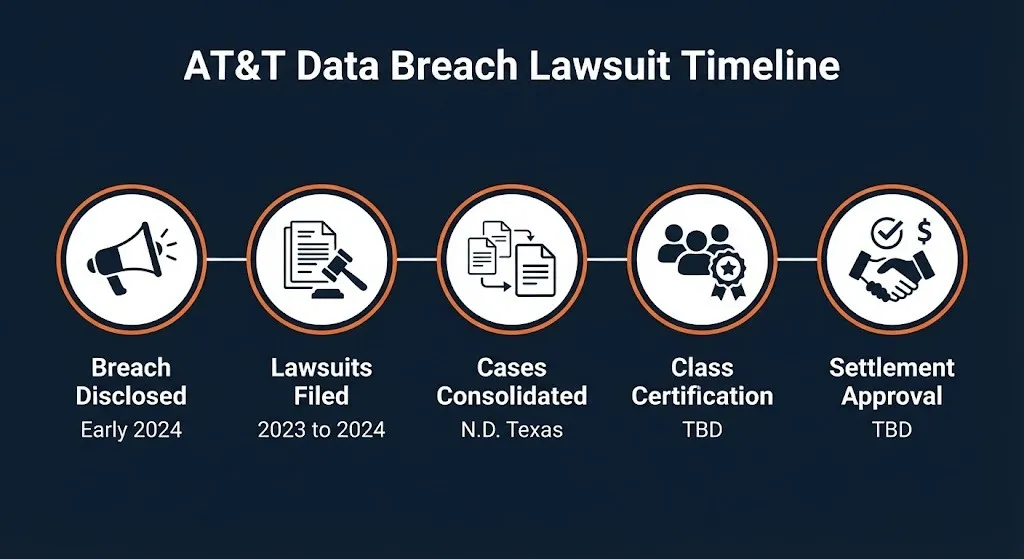
In complex data breach litigation, the path from filing to settlement approval often takes three to five years. The first AT&T breach lawsuits were filed in 2023 and 2024. A final settlement in 2026 is possible but not guaranteed.
The court’s docket will show when a motion for preliminary approval is filed. From that point, the timeline typically moves faster. Preliminary approval hearings often happen within 60 to 90 days after a settlement is announced.
Final approval comes months later, after notice is sent to class members and a fairness hearing is held. Payments follow only after appeals are exhausted, which can add another year.
What Should I Do While Waiting for an AT&T Settlement?
You do not need to do anything yet to preserve your rights in a potential AT&T data breach settlement. But you can take practical steps now that will help you if a settlement is approved.
Keep the breach notice you received from AT&T. Store it with your other important documents. The notice may include a reference number or date that confirms your eligibility later.
Check your credit reports for suspicious activity. You are entitled to free weekly credit reports from the three major bureaus through AnnualCreditReport.com.
If AT&T offered free credit monitoring, enroll. Keep records of any identity theft or fraud you experienced. Receipts, police reports, and correspondence will be your proof if documented loss claims are part of a future settlement.
Monitor official court records. The consolidated docket in the Northern District of Texas is searchable through PACER. You can also check the AT&T investor relations page for official company statements.
Reality Check
No one can get you money from an AT&T settlement that does not exist. Be highly skeptical of any website, social media post, or unsolicited message claiming you have been approved for an AT&T data breach payment. Filing a legitimate claim is always free. Third-party services that charge a fee to “help” you file are unnecessary and often scams.
What Happens Next
Expected mid-2026: Discovery continues in the consolidated AT&T data breach litigation in the Northern District of Texas.
Expected late 2026: Plaintiffs may file a motion for class certification.
TBD: Any settlement agreement, if reached, will be filed with the court and announced publicly.
TBD: A preliminary approval hearing would follow any settlement filing.
TBD: A claims administrator and official settlement website would launch after preliminary approval.
Frequently Asked Questions
Is there an AT&T data breach settlement in 2026?
No approved settlement exists as of January 15, 2026.
Multiple lawsuits are pending, but no court has approved a fund.
How do I check if I am part of the AT&T data breach?
Check whether you received a notice from AT&T about a specific data incident.
You can also contact AT&T directly using verified contact information.
Will I get money from the AT&T data breach?
It is too early to say whether any settlement will be approved or how much it would pay.
Payments depend on many factors, including documented losses and the number of claims filed.
Is the AT&T settlement email I received real?
AT&T sends legitimate breach notices by email or mail.
But real notices never ask for payment or bank account details.
What was the AT&T data breach about?
The 2023 breach involved customer records exposed through a third-party vendor.
Exposed data may include names, phone numbers, and call records.
How long do data breach settlements take?
Most data breach class actions take three to five years from filing to payment.
The AT&T cases began in 2023 and 2024, so a final result may not come until 2027 or later.
Do I need a lawyer to file an AT&T claim?
No lawyer is needed to file a claim in a class action settlement.
You can file on your own through the official administrator website when it launches.
Where can I find official AT&T settlement updates?
Check PACER for court filings in the Northern District of Texas.
Also watch AT&T’s official investor relations and news pages for company statements.
Your best move right now is to keep your breach notice, monitor your credit, and ignore anyone promising fast AT&T settlement money. The court record, not social media, is the source of truth.
When a real settlement is filed, it will be on the court docket and covered by established legal news outlets. Until then, treat every AT&T settlement website and payment claim as unverified.