Tennessee Workers’ Compensation 2026: Claims, Rates, and Legal Updates
Quick Answer:
- Tennessee workers’ compensation is a real state-mandated insurance system covering most employers with five or more employees.
- Weekly benefit amounts are capped by state law, with the 2026 maximum tied to the state’s average weekly wage.
- Injured workers must report injuries within 15 days and file claims within one year to preserve benefits.
Workers’ compensation in Tennessee is not a lawsuit settlement. It is a state-run insurance system that pays medical bills and partial lost wages when you get hurt on the job. The Tennessee Bureau of Workers’ Compensation oversees the system, and the rules changed again on July 1, 2026, when new benefit rates took effect.
The people searching this term are often injured workers who just got told their claim was denied, or employers trying to understand their insurance obligations. The single most important number for 2026 is the new maximum weekly benefit rate, which every injured worker and every employer in Tennessee should know before the year ends.
This article covers verified 2026 rates, how claims work, what to do after a denial, and the legal deadlines that can make or break a claim. One surprising detail: Tennessee caps how long most injured workers can receive temporary benefits, and that cap is shorter than many workers assume.
| The Facts | |
|---|---|
| System | Tennessee Workers’ Compensation Act, state-regulated |
| Oversight | Tennessee Bureau of Workers’ Compensation |
| 2026 Rate Update | Effective July 1, 2026 |
| Weekly Benefit Cap | Set annually by state average weekly wage |
| Reporting Deadline | 15 days from injury or discovery |
| Claim Filing Deadline | Generally one year from injury date |
| Administrator | Employer’s insurance carrier or self-insured employer |
Is Tennessee Workers’ Compensation Legitimate?
Tennessee workers’ compensation is a legitimate, mandatory insurance program created by state law. It is not a scam, not a federal program, and not optional for most employers. The system has existed in some form since 1919 and is codified in the Tennessee Workers’ Compensation Law.
Every employer in Tennessee with five or more employees must carry workers’ compensation insurance. Construction and coal mining employers must carry coverage regardless of how many workers they employ. A business that fails to carry required coverage faces fines and can be held personally liable for an injured worker’s medical bills and lost wages.

The system is no-fault. That means you do not have to prove your employer did something wrong to receive benefits. You only need to show the injury happened at work or was caused by your work duties. In exchange for this no-fault coverage, workers generally give up the right to sue their employer in civil court.
The Tennessee Bureau of Workers’ Compensation handles disputes, monitors compliance, and sets rates. The Bureau’s website is the official source for forms, deadlines, and current benefit schedules.
How Much Does Tennessee Workers’ Compensation Pay in 2026?
Tennessee workers’ compensation pays a portion of your lost wages and covers reasonable medical treatment for work injuries. For 2026, the exact weekly benefit amounts went into effect on July 1, 2026, and are based on the state’s average weekly wage.
The maximum weekly benefit for injuries occurring on or after July 1, 2026, is set by law at a percentage of the state average weekly wage. This figure is recalculated every year, so the number that applied in 2025 no longer controls new injuries in 2026.
| Benefit Type | 2026 Rule |
|---|---|
| Temporary Total Disability | Two-thirds of average weekly wage, up to state cap |
| Temporary Partial Disability | Two-thirds of wage difference, up to state cap |
| Permanent Partial Disability | Based on impairment rating and body part schedule |
| Medical Benefits | Reasonable and necessary treatment, no dollar cap |
| Mileage Reimbursement | Set rate per mile for travel to medical appointments |
Workers earning minimum wage or close to it will see their benefits calculated at the lower end of the scale. Higher-wage workers often hit the maximum cap. The exact cap amount for 2026 injuries is published by the Tennessee Bureau of Workers’ Compensation and should be verified before you settle.
Permanent disability benefits depend on a doctor’s impairment rating. Tennessee uses the American Medical Association Guides to determine that rating. A 5% whole-body impairment pays differently than a 10% arm impairment because Tennessee has a scheduled body-part system for some injuries.
What Is the Maximum Workers’ Compensation Rate in Tennessee for 2026?
The maximum weekly workers’ compensation rate in Tennessee for 2026 is set by the state and recalculated annually. The Bureau publishes this rate every year, and it takes effect for injuries occurring on or after July 1 of that year.
The cap applies to temporary total disability and temporary partial disability benefits. It does not apply to medical benefits, which have no dollar cap. Your employer’s insurance carrier must pay for all reasonable and necessary medical treatment related to the work injury, regardless of cost.
For a worker earning $1,200 per week, two-thirds of that is $800. If the 2026 weekly cap is set below $800, the worker receives the cap amount, not the full two-thirds. If the cap is above $800, the worker receives the full two-thirds. That is why the cap matters more for higher earners.
Key Takeaway: Tennessee workers’ compensation is a no-fault state system, not a lawsuit settlement, and the 2026 benefit rates took effect July 1 with new weekly caps that all workers should verify.
How Do I File a Workers’ Compensation Claim in Tennessee?
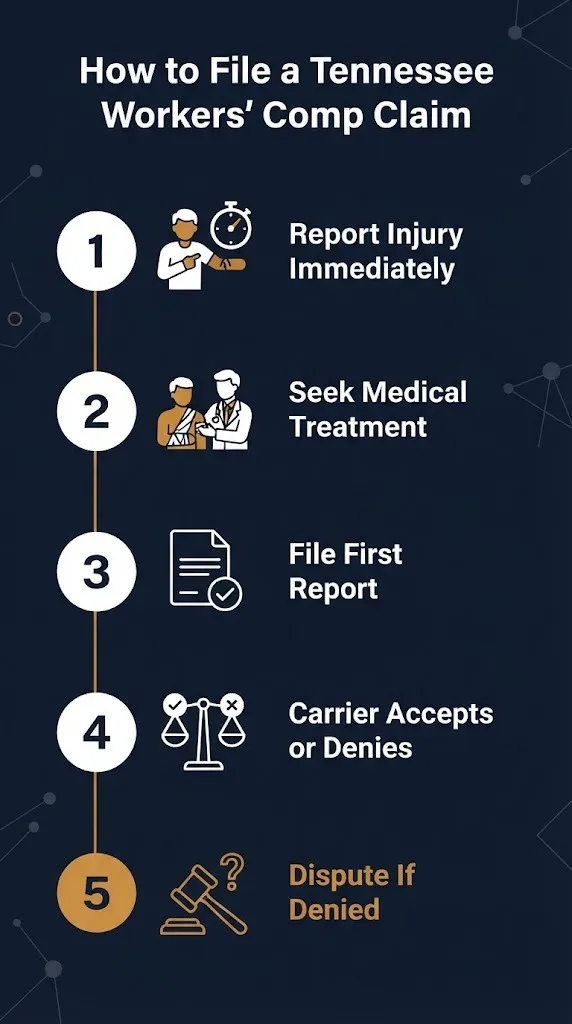
Filing a workers’ compensation claim in Tennessee follows a specific sequence. Missing a step or a deadline can sink your claim even if your injury is legitimate. Here is the verified process:
- Report the injury to your employer immediately, but no later than 15 days after the incident.
- Seek medical treatment. Your employer may direct you to an approved provider.
- Complete the employer’s first report of injury form.
- Your employer files the claim with its insurance carrier.
- The carrier investigates and accepts or denies the claim.
- If denied, you can request a benefit review conference through the Bureau.
- If the dispute remains unresolved, you may request a hearing before a workers’ compensation judge.
The report to your employer is the most critical step. Do it in writing, keep a copy, and note the date and who you told. A verbal report to a coworker does not count. A text message to your supervisor is better than silence but worse than a written report through the proper channel.
Once your claim is filed, the insurance carrier has a limited window to accept or deny. If you hear nothing, contact the Bureau. Silence is not a denial, but it is also not an approval, and you should not wait indefinitely.
What Is the Deadline to Report a Workplace Injury in Tennessee?
You must report a workplace injury in Tennessee within 15 days of the accident or of discovering the injury. The clock starts on the date you knew or should have known the injury was work-related. For cumulative injuries like carpal tunnel syndrome, the discovery date matters more than the first day you felt pain.
Failing to report within 15 days does not automatically kill your claim, but it gives the employer and insurance carrier a reason to question whether the injury happened at work. Delays often lead to denials. The safest practice is same-day reporting.
The one-year deadline to formally file a claim is separate. You may report the injury on day one and still have a year to file the official claim forms. Most workers should never wait that long. Evidence disappears, witnesses move on, and medical records become harder to link to the work event.
| Deadline Type | Time Limit |
|---|---|
| Report injury to employer | 15 days |
| File workers’ compensation claim | 1 year from injury or discovery |
| Request benefit review conference | Varies, generally within 1 year of denial |
| Appeal a Bureau decision | 30 days from decision date |
What Does Tennessee Workers’ Compensation Insurance Cover?
Tennessee workers’ compensation insurance covers medical treatment and lost wages for work-related injuries and occupational illnesses. It also pays death benefits to dependents when a worker dies from a job injury.
Medical benefits include doctor visits, surgery, hospital stays, physical therapy, prescriptions, and medical equipment. There is no deductible and no copay for the injured worker. The employer or its insurance carrier pays the providers directly.
Lost wage benefits fall into categories. Temporary total disability pays when you cannot work at all. Temporary partial pays when you return to lighter duty at lower pay. Permanent partial pays when you reach maximum medical improvement but retain a permanent impairment.
The system does not pay for pain and suffering. It does not pay punitive damages. It is a wage replacement and medical coverage system, not a personal injury lawsuit.
What Happens When a Tennessee Workers’ Compensation Claim Is Denied?
A denial means the insurance carrier or employer has refused to pay some or all of your claim. Tennessee law gives you the right to challenge that denial through the Bureau of Workers’ Compensation. A denial is not the end of the road.
The first step after a denial is to request a benefit review conference. This is an informal mediation with a Bureau specialist. Many disputes get resolved here without a formal hearing. You can represent yourself, though some workers choose to hire an attorney.
If the benefit review conference fails, you can request a hearing before a workers’ compensation judge. This is a legal proceeding with evidence, testimony, and a written decision. Either side can appeal the judge’s decision to the Workers’ Compensation Appeals Board.
The timeline matters. Do not wait months to act after a denial. Request the benefit review conference as soon as possible. The Bureau’s forms are available on its website, and filing is free.
Key Takeaway: Reporting within 15 days and filing within one year are strict rules in Tennessee, and even a denied claim can be revived through the Bureau’s free dispute process.
How Much Does Workers’ Compensation Insurance Cost Employers in Tennessee?
Employers in Tennessee pay workers’ compensation insurance based on their industry classification, payroll size, and claims history. Rates are filed with the state and vary widely by job type. A roofing company pays more per $100 of payroll than an accounting firm.
The National Council on Compensation Insurance, or NCCI, sets the base rates that most Tennessee carriers use. Each employer then receives an experience modification factor that adjusts the rate up or down based on past claims.
| Cost Factor | Effect on Premium |
|---|---|
| Industry class code | Higher hazard equals higher rate |
| Total payroll | More payroll equals higher premium |
| Claims history | More claims raises experience modification |
| Safety programs | May qualify for discounts |
| Deductible choice | Higher deductible lowers premium |
Small employers sometimes choose a professional employer organization, or PEO, to handle workers’ compensation. That can simplify compliance but does not remove the legal obligation to maintain coverage.
The Bureau conducts compliance checks. Working without required coverage can result in fines and a shutdown order. A single uninsured claim can bankrupt a small business because the employer becomes personally responsible for the injured worker’s benefits.
Reality Check: A Third Party Cannot Guarantee a Bigger Settlement
Reality Check: No lawyer or claims service can guarantee a specific workers’ compensation outcome in Tennessee. The benefit amounts are set by state formula, not negotiation. Anyone who promises to double your settlement for a fee is selling something the law already gives you. The Bureau’s dispute process is free, and most workers navigate it without paying a fee.
How Does Tennessee Workers’ Compensation Differ From a Lawsuit Settlement?
Tennessee workers’ compensation is not the same as a personal injury lawsuit. You do not sue your employer. You do not get a jury trial. You do not recover pain and suffering. You receive scheduled benefits based on state formulas.
The tradeoff is speed and certainty. A workers’ compensation claim can start paying medical bills within weeks. A personal injury lawsuit can take years. In exchange for that speed, you give up the right to seek larger damages from your own employer.
There is one exception. If a third party, not your employer, caused your injury, you may file a separate lawsuit against that third party. For example, if a defective machine injures you, the workers’ compensation system covers your medical care while a product liability lawsuit targets the machine manufacturer. These cases can coexist.
Settlement in a workers’ compensation case usually means a lump-sum buyout of future benefits. Tennessee requires court or Bureau approval for most settlements. An unapproved private deal between you and the insurance adjuster may not be enforceable.
What Are the Most Common Tennessee Workers’ Compensation Injuries?
The most common Tennessee workers’ compensation injuries mirror national workplace injury trends. Overexertion, slips and falls, and being struck by objects top the list. In Tennessee, the construction, manufacturing, and healthcare sectors file the most claims.
| Injury Type | Common Cause |
|---|---|
| Strains and sprains | Lifting, pulling, repetitive motion |
| Fractures | Falls, being struck by equipment |
| Lacerations | Cutting tools, machinery |
| Burns | Chemicals, heat sources, electrical |
| Occupational illnesses | Chemical exposure, hearing loss, respiratory conditions |
Tennessee records these injuries through first reports of injury filed by employers. The Bureau publishes annual reports showing which industries and which types of claims cost the most. Those reports guide rate-setting for future years.
For workers, the message is simple: repetitive motion injuries are covered. You do not need a single dramatic accident. If your job duties caused the condition over time, that is a workers’ compensation claim, not just an aging problem.
Key Takeaway: Tennessee workers’ compensation is not a lawsuit settlement and does not pay pain and suffering, but it covers medical bills and partial wages for both sudden accidents and repetitive motion injuries.
What Is the Tennessee Workers’ Compensation Appeals Process?
The appeals process in Tennessee workers’ compensation has multiple levels. The first level is the benefit review conference. The second is a hearing before a workers’ compensation judge. The third is the Workers’ Compensation Appeals Board. The final state-level appeal goes to the Tennessee Supreme Court in limited cases.
Each level has deadlines. Missing a deadline usually means losing the right to appeal. The clock is strict, and the Bureau does not extend deadlines for good intentions.
At the hearing level, the workers’ compensation judge reviews medical records, hears testimony, and issues a written decision. That decision can award benefits, deny them, or modify the amount. Either side can appeal to the Appeals Board.
The Appeals Board reviews the judge’s decision for legal errors, not to re-hear the facts. If the judge applied the law correctly, the decision generally stands. This is why the initial hearing matters so much.
How Do I Check the Status of My Tennessee Workers’ Compensation Claim?
You can check the status of your Tennessee workers’ compensation claim through your employer, the insurance carrier, or the Bureau. Each channel gives you different information.
Your employer’s human resources department should know whether the first report of injury was filed. The insurance carrier can tell you whether the claim was accepted or denied. The Bureau maintains records of disputes filed with the agency.
If you have a claim number, reference it in every communication. Insurance carriers handle thousands of claims. A claim number is the fastest way to get your file pulled. If you do not have a claim number, ask for one when you report the injury.
Written requests create paper trails. A phone call may be faster, but an email or letter gives you proof of when you asked and what you were told. That proof matters if a dispute later develops over whether you reported the injury on time.
What Happens Next for Injured Workers in Tennessee
| Expected Timing | Milestone |
|---|---|
| Immediately | Report injury to employer in writing |
| Within days | Employer files first report of injury |
| Within weeks | Insurance carrier accepts or denies claim |
| If denied | Request benefit review conference through the Bureau |
| If unresolved | Request hearing before workers’ compensation judge |
| After maximum medical improvement | Permanent disability evaluation and settlement discussions |
These steps are predictable. The timeline is not. Simple claims can resolve in months. Disputed claims can take a year or longer to reach a hearing. The Bureau’s caseload and the complexity of your medical evidence drive the pace.
The single most important thing you can do after an injury is report it immediately and document everything. Every medical appointment, every missed workday, every conversation with the adjuster. Build the file before you need it.
Frequently Asked Questions
Is Tennessee workers’ compensation required for all employers?
No, only employers with five or more employees must carry coverage.
Construction and coal mining employers must have coverage regardless of size.
Sole proprietors and partners are generally exempt unless they elect coverage.
Can I choose my own doctor for a Tennessee workers’ compensation injury?
Tennessee allows employers to direct injured workers to specific providers.
You may request a change of physician if you are dissatisfied with the care.
Emergency treatment is always covered regardless of where you go.
How long can I receive Tennessee workers’ compensation benefits?
Temporary total disability benefits generally last until you reach maximum medical improvement.
The law imposes a maximum duration that varies by injury type.
Permanent partial disability benefits follow a scheduled formula based on impairment.
Do I have to pay taxes on Tennessee workers’ compensation benefits?
No, workers’ compensation benefits are generally not taxable income.
This applies to both weekly wage replacement and lump-sum settlements.
Consult a tax professional for your specific situation.
Can I be fired for filing a Tennessee workers’ compensation claim?
Tennessee law prohibits retaliation for filing a workers’ compensation claim.
If you are fired after filing, you may have a separate retaliation claim.
Document any change in treatment after you report an injury.
What if my employer does not have workers’ compensation insurance?
You may still receive benefits through the Tennessee Uninsured Employers Fund.
The Bureau can also pursue penalties against the uninsured employer.
Report the injury immediately and contact the Bureau for help.
Can I settle my Tennessee workers’ compensation case for a lump sum?
Yes, lump-sum settlements are allowed for most claims.
The settlement requires approval from the Bureau or a workers’ compensation judge.
Once approved, the settlement is final and cannot be reopened.
How long does a Tennessee workers’ compensation settlement take?
Simple settlements can finalize within weeks of maximum medical improvement.
Disputed claims can take months or longer to reach settlement.
The process depends on medical evidence and carrier cooperation.
Tennessee workers’ compensation is a state system with fixed rules, annual rate changes, and strict deadlines. The 2026 rates took effect July 1, 2026, and every injured worker should know their weekly benefit cap before accepting any settlement. Report your injury within 15 days. File your claim within one year. Use the Bureau’s free dispute process if your claim is denied. The system works best for workers who act fast and keep records. August 25, 2026 is the date this information was verified. The date that matters most to you is the one you report your injury, and that should be today.