Structured Settlement Buyer 2026: How Selling Works, Discount Rates, and Scam Risks
Quick Answer:
- A structured settlement buyer is a company that pays you cash now for your future periodic payments.
- Buyers discount your payments, often paying 30% to 60% of the total future value.
- Court approval is required in most states, and the process takes 45 to 90 days.
If you receive structured settlement payments and a company is offering you a lump sum, you are dealing with a structured settlement buyer. The industry is real, legal, and regulated, but the discounts are steep. You are not getting a settlement payout. You are selling an asset, your future payment stream, for less than its face value.
The people searching this term include injury victims who need cash for medical bills, home repairs, or debt, and beneficiaries who inherited a payment stream they do not want. The single most important number is the discount rate, which determines how much of your future money you actually receive.
This article covers how structured settlement buyers work, what your payments are worth, how the court approval process functions, and how to avoid the scams that plague this industry. One surprising detail: in most states, you cannot sell your payments without a judge finding the sale in your best interest.
| The Facts | |
|---|---|
| Industry | Structured settlement factoring |
| Key Regulation | State Structured Settlement Protection Acts |
| Court Approval | Required in most states |
| Typical Discount Rate | 10% to 20% per year |
| Cash Received | Often 30% to 60% of future value |
| Process Timeline | 45 to 90 days on average |
| Scam Risk | High, unlicensed buyers and advance-fee schemes |
Is a Structured Settlement Buyer Legitimate?
Yes, structured settlement buyers are legitimate financial companies. The industry is not a scam in itself. Factoring companies, as they are called, buy future payment streams from settlement recipients in exchange for a lump sum.
The legitimacy comes from regulation. Nearly every state has a Structured Settlement Protection Act. These laws require court approval for most transfers. A judge must find that the sale is in your best interest before the buyer can take your payments.
The industry exists because structured settlements are designed to prevent lump-sum spending. If you need cash sooner than the payment schedule allows, selling is an option. But the option comes at a cost.
Legitimate buyers are licensed, registered, and willing to go through the court process. A buyer who offers to pay you without court approval is either operating illegally or trying to structure the deal to evade regulation.
How Much Will a Structured Settlement Buyer Pay?
A structured settlement buyer pays a lump sum that is less than the total value of your future payments. The gap between the future value and the cash offer is the discount. The discount compensates the buyer for waiting and for taking the risk that the insurance company backing the payments fails.
The discount rate varies. Most structured settlement sales apply an annual discount rate between 10% and 20%. That means future payments are reduced by that percentage for each year they are in the future.
| Future Payment Stream | Typical Cash Offer Range |
|---|---|
| $10,000 over 5 years | $6,000 to $8,000 |
| $25,000 over 10 years | $12,000 to $18,000 |
| $50,000 over 20 years | $20,000 to $35,000 |
| $100,000 over 30 years | $35,000 to $60,000 |
These ranges are illustrative, not guaranteed. The actual offer depends on the buyer, the payment schedule, the insurance company, and your state’s legal environment.
The longer the payment stream, the deeper the discount. A payment due next year is worth more than a payment due in 20 years. Buyers apply that time-value calculation to every payment in your schedule.
Why Do Structured Settlement Buyers Pay Less Than Face Value?
Structured settlement buyers pay less than face value because of the time value of money. A dollar received today is worth more than a dollar received in ten years. The buyer is giving you money now and waiting years to recover it.
The buyer also bears risk. The annuity payments are backed by an insurance company, but the buyer still faces transaction costs, legal fees, and the possibility that the court rejects the transfer. Those costs get built into the discount.
Inflation reduces the purchasing power of future payments. A $1,000 payment in 2040 will buy less than $1,000 buys today. The discount rate accounts for that erosion.
| Discount Factor | Why It Matters |
|---|---|
| Time value of money | Cash now is worth more than cash later |
| Risk of non-payment | Insurance company could fail |
| Transaction costs | Legal fees, court costs, administrative work |
| Inflation | Future dollars lose purchasing power |
| Buyer profit | The buyer is running a business |
This is not a government program or a charity. It is a business. The buyer expects to profit from the transaction. Your job is to understand the discount and decide whether the cash now is worth giving up more money later.
How Does the Court Approval Process Work?
Court approval is the centerpiece of the structured settlement sale process. In most states, the transfer is not valid until a judge approves it. The judge reviews the deal to determine whether it is in your best interest.
The process starts when you sign a transfer agreement with the buyer. The buyer then files a petition with the court. The petition includes the payment schedule, the lump-sum offer, and the discount rate.
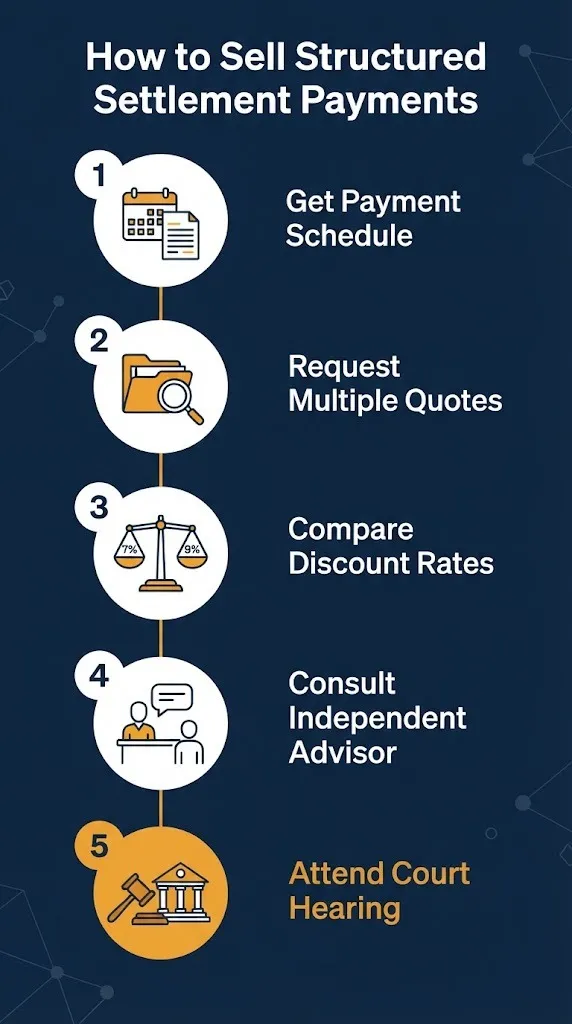
You attend a hearing, either in person or by phone. The judge asks whether you understand the transaction and whether you have independent legal advice. Some states require you to consult an independent lawyer before the hearing.
| Court Process Step | What Happens |
|---|---|
| Transfer agreement signed | You agree to sell specific payments |
| Petition filed | Buyer asks court to approve |
| Disclosure provided | You receive written terms and discount rate |
| Hearing held | Judge reviews best interest factors |
| Order issued | Court approves or denies the transfer |
The court is not a rubber stamp. Judges deny transfers when the discount is excessive or the seller appears coerced. That protection is why the process takes 45 to 90 days.
What Should You Do Before Selling Structured Settlement Payments?
Before selling your structured settlement payments, you should gather information, get independent advice, and compare offers. This is not a transaction to rush.
Here are the verified steps to take:
- Obtain your current payment schedule from the annuity issuer.
- Calculate the total future value of the payments you want to sell.
- Request quotes from at least three licensed structured settlement buyers.
- Compare the discount rates, not just the lump-sum amounts.
- Consult an independent financial advisor or lawyer, not one the buyer recommends.
- Ask the buyer for the disclosure statement showing the discount rate.
- Consider alternatives like borrowing or partial sale before committing.
The disclosure statement is critical. State laws require buyers to show you the discount rate and the total cost of the transaction. If a buyer refuses to provide it, that is a red flag.
Think of this like selling a house. You would not accept the first offer without knowing the market value. You should not accept the first structured settlement buyout without comparing quotes.
What Is the Discount Rate and Why Does It Matter?
The discount rate is the annual percentage by which your future payments are reduced to calculate the present value. It is the most important number in a structured settlement sale.
A 10% discount rate means a $10,000 payment due in one year is worth about $9,091 today. A 20% discount rate means the same payment is worth about $8,333 today. Over many years, the difference compounds dramatically.
| Discount Rate | $50,000 Over 20 Years |
|---|---|
| 8% | Approximately $23,000 present value |
| 12% | Approximately $15,000 present value |
| 16% | Approximately $10,000 present value |
| 20% | Approximately $7,000 present value |
These are rough calculations for illustration. The actual present value depends on the timing of each payment.
Buyers use the discount rate to justify their offer. A higher discount rate means a lower offer. You should know the rate before you agree to anything.
Key Takeaway: Structured settlement buyers are legitimate but heavily discount your future payments, and court approval is required in most states to protect you from bad deals.
How Do You Compare Structured Settlement Buyers?
Comparing structured settlement buyers is not about the brand name. It is about the numbers. The same payment stream can produce wildly different offers from different buyers.
Start by requesting the same quote from multiple buyers. Give each buyer the identical payment schedule and ask for the lump-sum offer and the discount rate. Do not tell them what the other buyers offered until after you have their numbers.
| Comparison Factor | What to Look For |
|---|---|
| Lump-sum offer | Highest cash amount |
| Discount rate | Lowest annual rate |
| Fees deducted | Fewer fees means more cash |
| Reputation | Licensed, no disciplinary actions |
| Disclosure | Provides required statements |
| Timeline | Reasonable processing window |
Do not compare only the lump sum. A buyer may offer more cash but charge higher fees, reducing your net. Ask for the net amount you will receive after all deductions.
Check the buyer’s license. State insurance departments and attorneys general often register structured settlement buyers. Unlicensed buyers may still operate, but they cannot get court approval.
What Are the Risks of Selling to a Structured Settlement Buyer?
The biggest risk is selling for too little. The discount rate eats into your future security. What feels like a large check today may look small when you realize the future payments you gave up.
The second risk is using an unlicensed buyer. Without court approval, the transfer may not be legally valid. You could lose your payments and have no legal recourse if the buyer stops paying or disappears.
| Risk | Consequence |
|---|---|
| Excessive discount | You lose future value |
| Unlicensed buyer | Transfer may be invalid |
| Advance-fee scam | You pay money and get nothing |
| Coercion | Court may reject the deal |
| Tax consequences | Selling may trigger tax liability |
Structured settlement payments are generally tax-free. Selling them for a lump sum does not change the tax character of the underlying payments, but the transaction may have tax implications. Consult a tax professional.
The scam risk is real. Advance-fee schemes ask you to pay a fee before receiving your lump sum. Legitimate buyers do not charge upfront fees. They deduct costs from the proceeds at closing.
What Is the Best Structured Settlement Company?
There is no single best structured settlement company for everyone. The right buyer depends on your payment schedule, your state, and the specific offer you receive.
The largest buyers include J.G. Wentworth, Peachtree Settlement Funding, and Oasis Financial. These companies advertise heavily and process thousands of transactions. Their size gives them resources but does not guarantee the best offer.
| Company Type | Examples |
|---|---|
| National buyers | J.G. Wentworth, Peachtree, Oasis |
| Regional buyers | State-licensed local factoring companies |
| Brokers | Shop your deal to multiple buyers |
| Insurance company direct | Some annuity issuers offer commutation |
A broker can shop your payment stream to multiple buyers. That can increase competition and improve your offer. But brokers also charge fees, which reduce your net.
The best approach is to get multiple quotes yourself. Do not rely on one company’s advertising. The same payment stream can produce offers that differ by thousands of dollars.
Reality Check: No Legitimate Buyer Charges Upfront Fees
Reality Check: A legitimate structured settlement buyer never asks for money before closing. If someone demands an application fee, a processing fee, or a good-faith deposit, it is a scam. Legitimate buyers deduct their costs from the lump sum at closing. You never pay out of pocket to sell your own payments.
How Do Structured Settlement Sales Affect Your Taxes?
Structured settlement payments are generally tax-free when they arise from a personal injury settlement. Selling those payments for a lump sum does not change the underlying tax character, but the transaction itself may have implications.
The lump sum you receive is generally not taxable income, just as the periodic payments were not taxable. However, the discount you take is not a deductible loss. You simply receive less than the face value.
| Tax Question | Answer |
|---|---|
| Are structured settlement payments taxable? | Generally no, for personal injury cases |
| Is the lump sum from selling taxable? | Generally no |
| Is the discount deductible? | No |
| Should you consult a tax professional? | Yes |
The tax rules for structured settlements arising from non-personal-injury cases may differ. Workers’ compensation settlements, lottery winnings, and other structured payments have their own tax treatment.
This is not tax advice. The IRS rules are complex, and your specific situation may vary. A tax professional can give you a definitive answer.
What Are the Alternatives to Selling Structured Settlement Payments?
Selling is not your only option. Before you accept a discounted lump sum, consider the alternatives. You may be able to solve your cash need without giving up future payments.
A personal loan or a home equity line may be cheaper than the discount rate a buyer offers. If you need $10,000 for a medical bill, a loan at 8% interest costs less than selling future payments at a 15% discount.
| Alternative | When It Works |
|---|---|
| Personal loan | You have good credit and can repay |
| Home equity loan | You own a home with equity |
| Borrow from family | You have willing relatives |
| Partial sale | You only sell some payments |
| Payment acceleration | The annuity issuer offers commutation |
A partial sale is underused. You do not have to sell all your payments. Selling just the next few years of payments can meet a short-term need while preserving your long-term security.
Key Takeaway: Comparing multiple offers and checking licenses is essential, and the discount rate, not the brand name, determines whether a structured settlement sale is a good deal.
What Happens Next If You Decide to Sell
| Expected Timing | Milestone |
|---|---|
| Immediately | Gather your payment schedule and calculate future value |
| This week | Request quotes from multiple licensed buyers |
| After comparing | Choose an offer and sign a transfer agreement |
| Within weeks | Buyer files a petition with the court |
| 45 to 90 days | Court hearing and approval |
| After approval | You receive your lump sum |
The timeline is predictable, but the outcome depends on the judge. If the court finds the discount too high or the sale not in your best interest, the transfer is denied. That protection exists specifically because sellers often act under financial pressure.
The best move is to slow down. Request quotes. Read the disclosure statement. Talk to a lawyer. The structured settlement was designed to protect you from a bad decision. Selling it should be a decision made with the same care.
Frequently Asked Questions
Is selling a structured settlement a good idea?
It depends on your financial situation and the discount rate.
Selling may make sense for a genuine emergency.
It is usually a poor choice for optional spending.
How long does it take to sell structured settlement payments?
Most sales take 45 to 90 days.
The court approval process drives the timeline.
Some states are faster than others.
Can I sell only part of my structured settlement?
Yes, partial sales are common.
You can sell specific future payments and keep the rest.
A partial sale preserves some of your future income.
Do I need a lawyer to sell my structured settlement?
You may need one in states that require independent professional advice.
A lawyer can review the discount rate and disclosure statement.
Do not use a lawyer recommended by the buyer without independent review.
What is the maximum amount a buyer will pay?
There is no fixed maximum.
Buyers pay a percentage of the future value.
The percentage depends on the discount rate and payment schedule.
Can a structured settlement buyer take all my payments?
Yes, if you agree to sell the entire payment stream.
The court must approve the full sale.
The judge considers whether the full sale serves your interest.
What happens if the court denies my structured settlement sale?
The transfer does not happen.
You keep your future payments.
You can reapply later with a better offer.
How do I know if a structured settlement buyer is licensed?
Check with your state insurance department.
Ask for the buyer’s license number.
Verify the license before signing anything.
Structured settlement buyers offer a real service, but the price is steep. Your future payments are discounted, sometimes by half or more. The court approval process exists to protect you from your own urgency. Use it. Get multiple quotes. Compare discount rates. Talk to an independent advisor. August 25, 2026 is the date this information was verified. The date that matters most to you is the day you sign the transfer agreement, and that day should come only after you understand exactly what you are giving up.