Settlement and Health: How a Lawsuit Settlement Affects Your Insurance, Medicare and Medicaid in 2026
Quick Answer
- Yes, Medicare, Medicaid, and private health plans can legally claim part of your settlement to recover medical costs already paid.
- The amount taken depends on your specific lien, and there is no single flat percentage that applies to every case.
- Medicare generally requires its lien to be resolved before final settlement funds are released to you.
If you just settled a case, or you’re weighing one, and someone mentioned Medicare, Medicaid, or your health insurer wants a cut, that concern is valid. Federal law gives Medicare a legal right to be paid back for medical care it covered related to your injury.
This affects almost anyone who used Medicare, Medicaid, or private health insurance for treatment tied to an accident, injury, or health-related class action. The number that matters most isn’t a settlement date, it’s whether a lien exists at all, since that determines how much of your payout you actually keep.
This article covers how these liens work, how to resolve them, and which real health-related settlements made news in 2026. One detail surprises a lot of people: Medicare can seek double the amount it paid if its lien isn’t handled correctly.
The Facts
| Case | General legal process, not a single lawsuit; applies to most injury and health-related settlements |
| Status | Federal Medicare Secondary Payer Act and state Medicaid lien laws remain in force in 2026 |
| Fund Size | Not applicable, this is a repayment process, not a shared settlement fund |
| Est. Per Person | Varies by lien type; based on actual medical costs paid, not a fixed formula |
| Claim Deadline | Medicare liens generally must be resolved before final settlement funds are released |
| Administrator | Medicare’s Benefits Coordination and Recovery Center (BCRC); state Medicaid agencies for Medicaid liens |
| Proof Needed | Conditional Payment Letter, Final Demand Letter, and settlement documentation |
Does a Lawsuit Settlement Really Affect Your Health Insurance?
Yes, a settlement can trigger real repayment obligations to Medicare, Medicaid, or your private health plan if they paid for injury-related treatment.
This isn’t a rumor or a scare tactic used by claims companies. It’s built into federal and state law through what are known as liens or subrogation rights. If a government program or insurer covered your medical bills, they generally have a legal claim to be reimbursed once you receive money for the same injury.
Think of it like a store issuing a refund after your bank already covered a fraudulent charge. Someone already paid the cost, so that party expects to be made whole once new money shows up.
Key detail: the settlement doesn’t have to be from a lawsuit specifically. Insurance claims and out-of-court settlements can trigger the same lien rights.
Can Medicare or Medicaid Actually Take Money From Your Settlement?
Yes, both Medicare and Medicaid have statutory rights to recover money they paid for your injury-related medical care directly from a settlement.
Medicare’s authority comes from the Medicare Secondary Payer Act, a federal law. Medicaid’s recovery rights come from a mix of federal mandates and state-specific lien statutes, since Medicaid programs are run at the state level.
These aren’t informal requests. According to legal sources tracking Medicare lien resolution, Medicare liens are considered a “super lien” and are usually non-negotiable in the way a private medical bill might be.
- Medicare: federal right, generally non-negotiable in amount
- Medicaid: state-administered right, procedures vary by state
- Private insurers: contractual or statutory rights, vary widely by plan and state
How Much of Your Settlement Can Medicare or Medicaid Take?
Not a fixed amount. Medicare and Medicaid can only recover what they actually paid for treatment tied to your specific injury, not a flat percentage of your settlement.
Medicare calculates its lien based on actual conditional payments made on your behalf. You can request an interim estimate, called a Conditional Payment Letter (CPL), from Medicare’s Benefits Coordination and Recovery Center while your case is ongoing.
| Payer Type | How the Amount Is Set | Negotiable? |
|---|---|---|
| Medicare | Actual conditional payments made for the injury | Rarely, limited exceptions |
| Medicaid | Amount paid under state Medicaid program rules | Sometimes, varies by state |
| Private health insurer | Contract terms or state subrogation law | Often, case by case |
| Hospital lien | State lien law, tied to billed charges | Often negotiable |
Once your case resolves, Medicare requires proof of the final settlement, including the total amount and a breakdown of attorney’s fees and costs. The Benefits Coordination and Recovery Center then issues a Final Demand Letter within 30 days, and payment is generally due within 60 days of that letter.
How Much Does a Private Health Insurance Lien Take From a Settlement?
Private health insurance liens vary widely and depend heavily on your plan type and your state’s laws.
Self-funded employer plans governed by ERISA often have stronger reimbursement rights than fully insured plans, since ERISA can override certain state protections. In New York, for example, ordinary private health insurers face specific statutory limits on recovery under New York General Obligations Law Section 5-335.
- ERISA self-funded plans: often broad reimbursement rights under federal law
- Fully insured private plans: subject to state subrogation and anti-lien laws
- State-by-state variation: recovery rights differ significantly depending on where you live
Key Takeaway: There is no single national rule for private insurance liens, so the same injury and the same settlement amount can produce very different repayment obligations depending on your plan type and state.
What Does a Medicare Set-Aside Cost in a Settlement?
Not yet standardized. A Medicare Set-Aside (MSA) cost depends entirely on your projected future medical needs, and there is no fixed dollar figure that applies broadly.
An MSA is different from a Medicare lien. A lien reimburses Medicare for care it already paid for. An MSA sets aside a portion of your settlement to cover care Medicare would otherwise pay for in the future, related to the same injury.
- Lien: repays past medical costs Medicare already covered
- MSA: sets aside settlement funds for anticipated future treatment
- Purpose: prevents Medicare from paying for care your settlement was meant to cover
Reality Check: No legitimate government agency or insurer contacts you out of the blue demanding instant payment through a gift card, wire transfer, or unfamiliar payment app to “release” your settlement. Real lien resolution happens through formal letters, documented demand amounts, and your attorney or settlement administrator, never a rushed phone call.
How Do You Resolve a Medicare Lien on a Settlement?
You resolve a Medicare lien by requesting payment information from Medicare’s Benefits Coordination and Recovery Center and paying the confirmed amount after your case settles.
Medicare lien resolution follows a defined process, and skipping steps can delay your final payout or expose you to penalties.
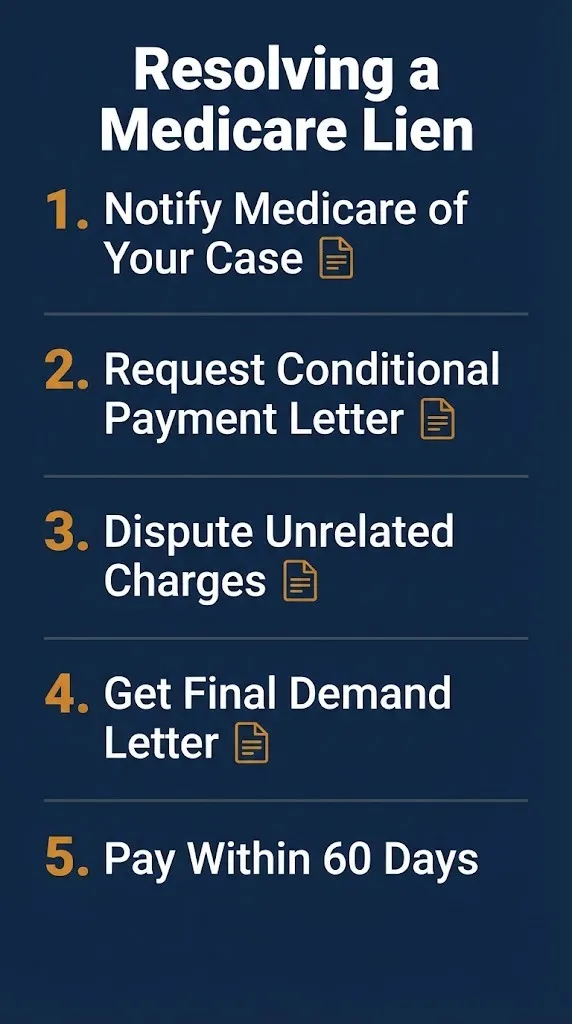
- Notify Medicare’s Benefits Coordination and Recovery Center (BCRC) of your case.
- Request a Conditional Payment Letter for an interim lien estimate.
- Review the letter for charges unrelated to your actual injury.
- Dispute any inaccurate items with supporting documentation.
- Provide final settlement details once your case resolves.
- Wait for Medicare’s Final Demand Letter, generally issued within 30 days.
- Pay the confirmed lien amount within 60 days of that letter.
- Keep records of payment to prevent future collection issues.
Missing this window matters. Sources tracking Medicare lien practice describe potential penalties, including recovery of up to double the amount Medicare paid, plus interest, if the lien isn’t resolved on time.
How Do You Negotiate a Hospital or Provider Lien After a Settlement?
You can often negotiate a hospital or medical provider lien, since these liens are typically governed by state law rather than the stricter federal Medicare framework.
Hospital liens are usually tied to your state’s specific lien statute. In New York, for instance, hospital liens fall under New York Lien Law Section 189, which sets procedural requirements hospitals must follow to enforce the lien.
- Request an itemized bill showing exactly what the lien covers.
- Confirm the lien was properly filed under your state’s law.
- Compare billed charges to what your insurance would have paid.
- Ask the provider or a lien resolution specialist about a reduction.
- Get any negotiated reduction confirmed in writing before final settlement.
This step often works like negotiating a bill after a hospital stay without insurance, providers frequently accept less than the sticker price when facing a lump-sum payment.
How Do You Check for a Medicaid Lien on Your Case?
You check for a Medicaid lien by contacting your state’s Medicaid agency directly and asking whether they have paid for treatment related to your injury.
Medicaid liens are established under state law, so the exact process for checking and resolving them differs depending on where you live. Some states, like New York, allow Medicaid agencies to file a lien directly against personal injury proceeds rather than filing a separate lawsuit.
- Contact your state Medicaid office and reference your case or claim number.
- Ask whether Medicaid paid injury-related medical bills during your treatment period.
- Request written confirmation of any lien amount before finalizing your settlement.
- Loop in your attorney or settlement administrator to handle formal lien resolution.
Key Takeaway: Medicaid liens can attach to settlement proceeds without a separate court case, so checking early protects you from an unexpected reduction to your final payout.
What Health-Related Settlements Made News in 2026?
Several health-sector settlements made headlines in 2026, most tied to data privacy rather than personal injury.
Cone Health reached a $1,765,000 class action settlement over its MyChart patient portal, covering people who used the portal or a website form between September 1, 2016, and November 3, 2022. That settlement received preliminary court approval on July 7, 2026, with a final approval hearing scheduled for November 5, 2026.
Northwell Health and Catholic Health System settled separate pixel-tracking lawsuits alleging unauthorized data sharing with companies like Meta and Google. Their claim filing deadline was set at April 20, 2026, with a final fairness hearing on April 21, 2026.
Separately, the U.S. Department of Labor announced a settlement with Kaiser Foundation Health Plan on February 10, 2026, resolving investigations into the insurer’s handling of mental health and substance use disorder care access.
- Cone Health: $1,765,000 fund, no proof required, preliminary approval July 7, 2026
- Northwell and Catholic Health: pixel tracking claims, deadline April 20, 2026
- Kaiser and DOL: regulatory settlement on mental health care access, announced February 10, 2026
Are There Proposed Changes to Medicare and Medicaid Settlement Recovery Rules?
Not yet confirmed. Lawmakers have introduced bills aimed at limiting Medicaid’s ability to recover future medical expenses from settlements, but no major federal law has passed as of this writing.
This reform push follows criticism of a legal standard allowing Medicaid to recover from portions of a settlement earmarked for future medical care, not just past bills already paid. Advocates argue this practice can leave injury victims with far less money for ongoing needs than expected.
Until any such bill becomes law, the current recovery framework for both Medicare and Medicaid remains fully in effect.
Why Does Medicare Get Repaid From Your Settlement?
Medicare gets repaid because federal law treats it as a “secondary payer,” meaning other sources, including settlements, are supposed to cover injury costs first.
When Medicare pays medical bills related to an accident before a settlement is reached, it does so as a conditional payment, expecting reimbursement once a primary payer, like an at-fault party’s insurer, becomes available. Your settlement counts as that primary source once it’s finalized.
This structure exists to prevent taxpayer-funded programs from permanently absorbing costs that a private settlement was meant to cover.
What Is the Medicare Secondary Payer Act?
The Medicare Secondary Payer Act is the federal law that makes Medicare a secondary payer behind settlements, judgments, and other primary insurance sources for injury-related care.
Under this law, settlement funds are treated as primary to Medicare even when liability in the underlying case was denied by the defendant. That means a lien can apply even in cases that settled without any formal admission of fault.
- Establishes Medicare’s right to reimbursement from settlements
- Applies even when the settling party denies liability
- Backs Medicare’s “super lien” status described by legal sources
- Allows recovery from multiple parties in the payment chain, including attorneys
Key Takeaway: The Medicare Secondary Payer Act means a lien can attach to your settlement even if the case never went to trial and no one admitted wrongdoing.
Do ERISA Health Plans Have Rights to Your Settlement?
Yes, self-funded ERISA health plans often have strong reimbursement rights to your settlement, sometimes stronger than state-regulated private insurance.
ERISA is a federal law governing many employer-sponsored health plans, and self-funded plans under ERISA can sometimes override state anti-subrogation protections that would otherwise limit an insurer’s recovery. Whether this applies depends on the specific plan’s language.
- Self-funded ERISA plans: governed by federal law, often broader recovery rights
- Fully insured employer plans: generally subject to state insurance law instead
- Plan documents matter: the specific reimbursement clause controls the outcome
What Happens if You Don’t Pay a Medicare Lien?
If a Medicare lien goes unpaid, Medicare can pursue collection action against you, your attorney, or other parties in the settlement chain.
Federal law allows Medicare to recover from multiple parties under what’s sometimes called a “received payment” provision. That means Medicare isn’t limited to collecting only from the injured person if the lien isn’t resolved properly.
Reported consequences for unresolved Medicare liens can include recovery of double the amount originally paid, plus interest, according to legal sources tracking lien enforcement.
Does a Settlement Affect Your Health Insurance or Medicaid Eligibility Going Forward?
A large settlement can affect ongoing Medicaid eligibility, since Medicaid uses income and asset limits that a lump-sum payment may temporarily exceed.
This is separate from the lien process described above. A lien repays past medical costs, while eligibility rules determine whether you can keep receiving Medicaid benefits after the settlement lands in your account.
Structured settlements or special needs trusts are commonly used tools to help manage this issue, though whether either fits your situation depends on your specific state’s Medicaid rules and your own circumstances.
Key Takeaway: Settlement money can create two separate health-related headaches, a lien for past costs and a possible disruption to ongoing Medicaid eligibility, and the two require different planning strategies.
What Happens Next
- Ongoing in 2026: Medicare and Medicaid lien rules remain fully active, with no confirmed federal change to recovery limits.
- November 5, 2026: Final approval hearing scheduled in the Cone Health MyChart settlement.
- Expected: Continued congressional discussion of bills limiting Medicaid’s future-care recovery rights, with no confirmed passage yet.
- Ongoing: State-by-state variation in Medicaid and private insurer lien rules continues, so check your specific state’s process.
Frequently Asked Questions
Does a settlement really affect your health insurance?
Yes, if Medicare, Medicaid, or your health insurer paid for injury-related treatment, they generally have a legal right to be repaid from your settlement.
This is a standard part of most personal injury and health-related settlement processes.
How much will Medicare take from my settlement?
Medicare can only recover the actual amount it paid for care tied to your specific injury, not a flat percentage of your settlement.
You can request a Conditional Payment Letter for an estimate before your case resolves.
Can I negotiate a Medicare lien?
Medicare liens are generally described as non-negotiable, though limited exceptions like financial hardship waivers may apply.
Hospital and private insurer liens are often more negotiable than Medicare’s.
What is a Medicare Set-Aside?
A Medicare Set-Aside is money from your settlement reserved for future medical care Medicare would otherwise cover.
It is separate from a lien, which repays medical costs already paid.
Do I have to pay back Medicaid after a settlement?
Yes, if Medicaid paid for treatment related to your injury, state law generally gives it a right to recover that amount from your settlement.
Rules and procedures vary depending on which state’s Medicaid program covered your care.
What happens if I ignore a Medicare lien?
Ignoring a Medicare lien can lead to collection action and, in some cases, recovery of double the amount paid plus interest.
Medicare can pursue multiple parties in the payment chain, not just the injured person.
Can a settlement affect my Medicaid eligibility later?
Yes, a lump-sum settlement can temporarily push you over Medicaid’s income or asset limits in some states.
Tools like special needs trusts are sometimes used to help manage this issue.
Are there recent health-related class action settlements to know about?
Yes, 2026 saw settlements involving Cone Health, Northwell Health, Catholic Health, and a Department of Labor action against Kaiser.
Details and deadlines vary by case, so check each settlement’s official website directly.
The Bottom Line
If you’re expecting a settlement and used Medicare, Medicaid, or private health insurance for related treatment, start the lien resolution process early rather than waiting until the money arrives.
Request a Conditional Payment Letter from Medicare’s Benefits Coordination and Recovery Center as soon as your case is underway, and confirm any Medicaid or private insurer claims before your settlement finalizes.