Always Pads Lawsuit 2026: What the Case Actually Alleges
Quick Answer
- Real but narrow: Yuryeva v. Procter & Gamble, filed May 29, 2026, challenges “leak-free” advertising claims only.
- Payout: not yet determined, no settlement fund exists and no class has been certified.
- Deadline: no claim deadline exists, since no settlement or claim form has been announced.
If you’re searching “Always pads lawsuit” expecting a PFAS injury payout, here’s the correction you actually need: the confirmed 2026 case against Always is about advertising language, not toxic chemicals.
That distinction matters. It affects millions of Always customers who may be seeing headlines that blend several unrelated cases into one scary story. The real, currently active case is Yuryeva v. Procter & Gamble, Case No. 2:26-cv-05821, filed in the U.S. District Court for the Central District of California.
This article separates what’s actually verified from what other sites are guessing at. One detail worth knowing upfront: a completely different lawsuit, filed by seven women in California, does name Always among several brands in a PFAS-related health claim, and we cover that separately below.
The Facts
| Case | Yuryeva v. Procter & Gamble Company, No. 2:26-cv-05821 (C.D. Cal.) |
| Status | Active, filed May 29, 2026, no class certification confirmed |
| Fund Size | Not applicable, no settlement exists |
| Est. Per Person | Not yet determined |
| Claim Deadline | None open, no claim form exists |
| Administrator | Not yet appointed |
| Proof Needed | Not applicable yet, check for updates before assuming a process exists |
Is there a real Always pads lawsuit in 2026?
Yes. A proposed class action against Procter & Gamble over Always pad advertising is active in federal court as of 2026.
Ruffina Yuryeva filed the case on May 29, 2026, in the U.S. District Court for the Central District of California. The case number is 2:26-cv-05821, and it’s publicly searchable on federal court records.
What’s not confirmed is anything close to a nationwide settlement or a proven safety defect. No court has ruled that Always pads are unsafe, and no settlement has been approved.
Key confirmed facts:
- Filed May 29, 2026
- Court: U.S. District Court, Central District of California
- Case number: 2:26-cv-05821
- Defendant: The Procter & Gamble Company
Is the Always pads lawsuit about PFAS and cancer, or something else?
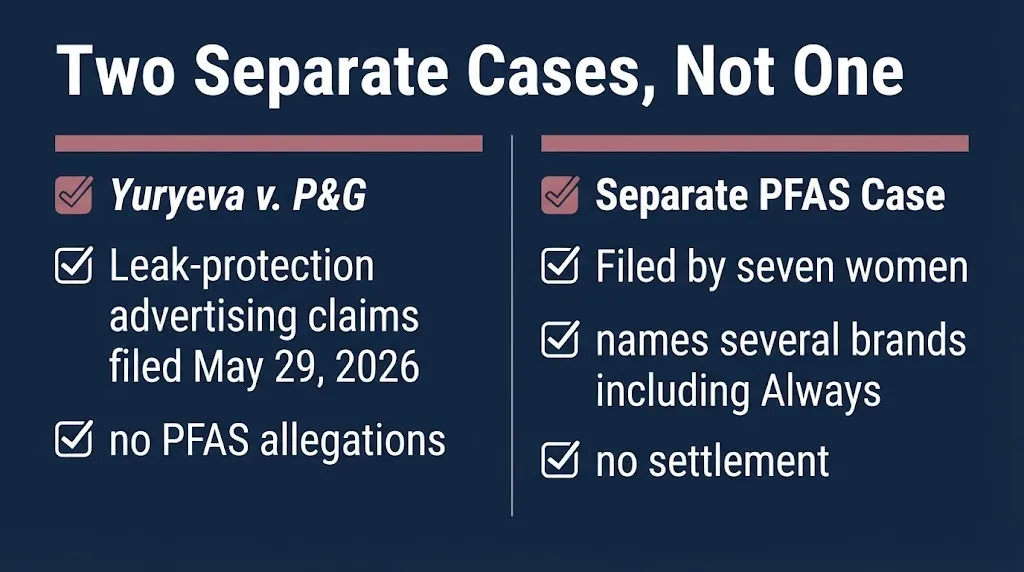
The confirmed Always pads lawsuit is about advertising language, specifically leak-protection claims, not PFAS exposure or cancer.
This is the single biggest point of confusion online right now. Several sites describe an Always PFAS settlement with “millions of women eligible,” but we could not verify any court filing, case number, or settlement notice supporting that claim for Always specifically.
The actual complaint alleges that phrases like “100% leak-free” or promises of zero leaks may mislead shoppers about how the pads perform during normal use, given that flow, body shape, movement, and wear time affect real-world results.
What this case is NOT confirmed to be:
- Not a confirmed PFAS injury class action
- Not a ruling that Always pads cause cancer
- Not a nationwide health harm settlement
- Not the same case as the Carefree or Tampax lawsuits
Key Takeaway: The verified 2026 Always pads lawsuit concerns leak-protection advertising claims only, and no PFAS or cancer settlement involving Always has been confirmed.
How much could you get from the Always pads lawsuit?
Not yet determined. No settlement fund exists in the Yuryeva case, so no per-person payout figure can be honestly reported.
Any specific dollar amount you see quoted for an “Always pads settlement” right now is not sourced from a court filing, since the case remains in early proceedings with no class certified.
| Stage | Status |
|---|---|
| Class certified | Not yet |
| Settlement negotiated | Not started |
| Settlement fund approved | Does not exist |
| Claim form released | Does not exist |
Advertising-claim class actions like this one, if they eventually settle, often result in smaller per-person amounts than personal injury cases, since damages relate to product cost rather than physical harm.
Do you qualify for the Always pads advertising lawsuit?
You may potentially be part of the proposed class if you purchased Always pads marketed with leak-protection claims like “100% leak-free” and experienced leaks despite that marketing.
Eligibility rules haven’t been finalized, since no class has been certified yet. The complaint centers on California consumer protection law, so location and purchase history will likely matter if the case moves forward.
Reality Check: No text message, email, or phone call is currently a legitimate way to “sign up” for an Always pads payout, because no settlement or claim process exists yet. Filing a legitimate class action claim, if one eventually opens, is always free, and paying a third party now to “register early” is not necessary.
Are Always pads part of the separate PFAS feminine hygiene lawsuit?
Yes, but only as one of several named brands in a completely different lawsuit, not the same case as the advertising claim.
Seven women filed a separate California lawsuit alleging that feminine hygiene products, including Tampax, Always, Always Discreet, and L. Organic, contained PFAS, endocrine disruptors, carcinogens, and heavy metals. That case names six corporate defendants: Procter & Gamble, Kimberly-Clark, Edgewell Personal Care, Essity, Prestige Consumer Healthcare, and The Honey Pot Company.
Plaintiffs in that case allege harms including miscarriages, a condition described as polyendocrine metabolic ovarian syndrome, chronic heavy bleeding, and pelvic pain. No settlement, class certification, or payout figure has been confirmed for this case either.
What’s confirmed about the PFAS case:
- Filed by seven women in California
- Names Always and Always Discreet among several brands
- Filed against six companies, including Procter & Gamble
- No settlement or class certification confirmed as of this writing
How to file a claim or join the Always pads lawsuit
There’s no public claim form yet for either the advertising case or the separate PFAS case, since neither has reached a settlement stage.
- Save receipts or order history for Always pad purchases.
- Screenshot any “leak-free” or “zero leaks” marketing you relied on.
- If pursuing the PFAS matter, save product packaging and purchase dates.
- Watch official federal court records for case number 2:26-cv-05821.
- Consult an attorney if you believe you experienced a specific harm.
- Avoid any site or caller charging a fee to “register” your claim.
- Confirm any settlement news against an actual case number before acting.
What proof do you need if a settlement happens
You would likely need proof of purchase and, depending on the case, some documentation connecting the product to your specific claim.
For the advertising case, this would likely mean receipts, loyalty program records, or credit card statements showing Always pad purchases during the relevant period. For the PFAS case, proof of use alongside any related medical documentation would likely matter more.
Documentation worth saving now:
- Store or online purchase receipts
- Product packaging or lot numbers if available
- Screenshots of specific marketing claims you saw
- Any relevant medical records, if pursuing a health-related claim
Key Takeaway: Neither the advertising lawsuit nor the separate PFAS case has a claim process yet, so the only useful action right now is saving your purchase records.
What is the latest update on the Always pads lawsuit?
The latest confirmed update is the May 29, 2026 filing of Yuryeva v. Procter & Gamble in the Central District of California.
As of late July 2026, court records show no class certification ruling and no settlement announcement. Procter & Gamble has not been found liable, and the company’s detailed public response was not included in available court reporting we reviewed.
Confirmed timeline:
- May 29, 2026: Case filed by Ruffina Yuryeva
- June 2026: Media coverage of the filing begins
- Late July 2026: No class certification or settlement confirmed
What is happening with the separate PFAS lawsuit naming Always?
The PFAS-related lawsuit naming Always among several brands became public around July 2026 and remains in early litigation, with no settlement confirmed.
News coverage of the seven-women lawsuit emerged in late July 2026. The complaint draws on independent testing referenced by advocacy groups showing PFAS detected in a portion of tested pads, tampons, and period underwear across the broader market, not Always exclusively.
Because menstrual products are generally classified by the FDA as medical devices, ingredient disclosure requirements differ from cosmetics, which is part of what plaintiffs argue left consumers uninformed.
Key Takeaway: A second, separate lawsuit filed around July 2026 names Always among several brands over PFAS allegations, but it’s a distinct case from the May 2026 advertising lawsuit, and neither has settled.
Is the Carefree pads lawsuit the same as the Always pads lawsuit?
No, the Carefree pads lawsuit is a separate 2024 California case against a different manufacturer, Edgewell Personal Care.
That case centers on PFOA, a specific PFAS compound, allegedly found in Carefree liners at levels the complaint compares to EPA safety concerns. It does not involve Procter & Gamble or Always products as named defendants.
Coverage that blends the Carefree case into “the Always pads lawsuit” is combining two separate legal actions against two separate companies.
Is the Tampax lawsuit the same as the Always pads lawsuit?
No, the main Tampax lawsuit involves different allegations and was reportedly dismissed in July 2025.
That case alleged Tampax Pure Cotton tampons contained unsafe lead levels. It’s a separate product, a separate legal theory, and according to available reporting, it did not survive to a settlement.
Treat any article that merges Tampax lead claims, Carefree PFOA claims, and Always advertising claims into one unified “settlement” with real skepticism, since these are three distinct legal matters.
Why was Procter & Gamble sued over Always pads advertising?
Procter & Gamble was sued because a California shopper alleges the company’s leak-protection marketing set an unrealistic standard that ordinary use couldn’t consistently meet.
The complaint focuses on phrases suggesting complete or guaranteed leak protection. Plaintiffs argue that flow level, pad size, body shape, movement, sleep position, placement, and wear time all affect real performance, making an absolute “leak-free” claim potentially misleading.
Think of it like a mattress advertised as “guaranteed to eliminate all back pain.” Even a good product depends on individual circumstances, and marketing that promises a perfect outcome can draw legal scrutiny.
What chemicals have been found in menstrual pads, and does that apply to Always?
Independent testing has found PFAS and other chemicals in a portion of tested menstrual pads across the market, and some reporting has referenced Always specifically, though this is separate from the confirmed advertising lawsuit.
One frequently cited advocacy testing effort reported PFAS in roughly 48% of tested pads, 22% of tampons, and 65% of period underwear across various brands. Older testing from 2014, cited in multiple secondary reports, found volatile organic compounds like styrene, chloroform, and chloromethane in several Always pad varieties, though that testing predates the current lawsuits by over a decade.
Not yet confirmed: whether current Always products contain PFAS at levels tied to any specific health outcome, since that causal link has not been established in court.
Who are the parties in the Always pads lawsuit?
In the confirmed advertising case, the plaintiff is Ruffina Yuryeva and the defendant is The Procter & Gamble Company, maker of the Always brand.
In the separate PFAS case, the plaintiffs are seven unnamed or individually named women in California, and the defendants include Procter & Gamble, Kimberly-Clark, Edgewell Personal Care, Essity, Prestige Consumer Healthcare, and The Honey Pot Company.
Procter & Gamble has owned the Always brand since introducing it in the United States in 1983, making it one of the longest-running names in the American feminine hygiene market.
What happens next
May 29, 2026: Yuryeva v. Procter & Gamble filed in the Central District of California.
Around July 2026: Separate seven-women PFAS lawsuit naming Always becomes public.
Expected late 2026: Possible motions to dismiss or class certification proceedings in the advertising case, timing unconfirmed.
TBD: Any settlement, claim form, or payout structure in either case.
Frequently Asked Questions
Is the Always pads lawsuit real?
Yes, Yuryeva v. Procter & Gamble is an active federal case filed May 29, 2026.
It concerns leak-protection advertising claims, not chemical safety.
Case number 2:26-cv-05821 is publicly searchable in federal court records.
Is the Always pads lawsuit about PFAS?
The confirmed advertising case is not about PFAS.
A separate lawsuit filed around July 2026 does name Always among several brands over PFAS allegations.
Neither case has settled or reached class certification.
How much is the Always pads settlement worth?
No settlement exists in either case, so no confirmed payout figure exists.
Numbers cited elsewhere are not sourced from any court filing we could verify.
Real figures would only emerge after a settlement or court judgment.
Do I qualify for the Always pads lawsuit?
Possible eligibility depends on which case, and neither has a confirmed claim process.
The advertising case may eventually cover buyers who relied on leak-free marketing.
The PFAS case eligibility rules have not been established yet.
Is the Carefree pads lawsuit part of the Always pads lawsuit?
No, Carefree is a separate 2024 case against Edgewell Personal Care.
It does not name Procter & Gamble or Always as defendants.
Treat combined coverage of both cases with caution.
Is the Tampax lawsuit part of the Always pads lawsuit?
No, the main Tampax lead lawsuit is a separate case, reportedly dismissed in July 2025.
It involves different allegations and a different product entirely.
It should not be treated as evidence in the Always advertising case.
What proof would I need if a settlement happens?
Purchase receipts or order history would likely be required.
Screenshots of specific marketing claims may help support an advertising-based claim.
No proof requirements are confirmed yet, since no settlement exists.
Save your Always pad receipts and any marketing screenshots now, in case a real settlement process opens later. Watch federal court records under case number 2:26-cv-05821 rather than relying on secondhand payout claims.
The fact to remember: as of August 30, 2026, no Always pads settlement, payout, or claim form exists in either the advertising case or the separate PFAS lawsuit.