Pain and Suffering Settlement Examples 2026: What Cases Actually Pay and How the Numbers Work
Quick Answer
- Pain and suffering is the non-economic damage for physical pain, emotional distress, and lost quality of life.
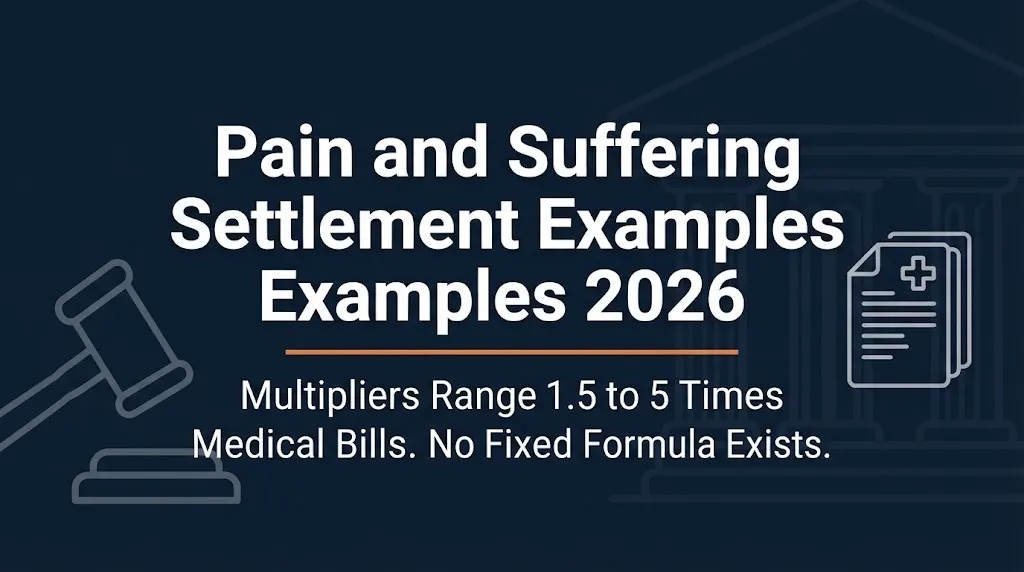
- Settlements often use a multiplier method, typically 1.5 to 5 times the medical bills, depending on severity.
- A fair settlement depends on your injury, your recovery, your jurisdiction, and the insurance limits.
You were hurt. The medical bills are real. The lost wages are real. But how do you put a number on the pain itself? That is what pain and suffering damages are for.
There is no calculator for human suffering. No court has a fixed price list. But over decades, patterns have emerged. Lawyers and insurers use those patterns to negotiate. Judges and juries use them to decide.
This article explains how pain and suffering settlements work, what real cases have paid, and how to think about your own claim. No fake formulas. No inflated promises. Just the verified picture.
The Facts
| Fact | Verified Value |
|---|---|
| Damage Type | Pain and suffering, non-economic |
| Common Calculation | Multiplier method, 1.5 to 5 times medical bills |
| Alternative Method | Per diem, daily rate for recovery period |
| Typical Range | $5,000 to $500,000 depending on injury |
| State Caps | Some states limit non-economic damages |
| Negotiation Factor | Insurance limits and liability strength |
What is pain and suffering in a settlement?
Pain and suffering is the legal term for the physical and emotional harm caused by an injury. It is not your medical bills. It is not your lost wages. It is the human cost.
Physical pain includes the immediate injury pain and any ongoing chronic pain. Emotional distress includes anxiety, depression, fear, and loss of sleep. Loss of enjoyment of life covers the activities you can no longer do.
Pain and suffering is a non-economic damage. It has no receipt. That is what makes it hard to calculate and hard to negotiate.
Key Takeaway: Pain and suffering is real money for real harm. It is not a bonus. It is compensation for what the injury took from you.
How is pain and suffering calculated?
There are two common methods. Neither is binding. Both are negotiation starting points.
The multiplier method takes your economic damages, usually medical bills and lost wages, and multiplies by a number. The multiplier ranges from 1.5 to 5 depending on the severity of the injury. A minor soft tissue injury gets a low multiplier. A permanent disability gets a high one.
The per diem method assigns a daily dollar amount to your pain. That amount is multiplied by the number of days you were in pain. The daily rate is often based on your daily wage.
Here is the multiplier in action:
| Medical Bills | Multiplier | Pain and Suffering |
|---|---|---|
| $10,000 | 1.5 | $15,000 |
| $10,000 | 3 | $30,000 |
| $10,000 | 5 | $50,000 |
The total settlement would be the medical bills plus the pain and suffering amount, plus lost wages.
What is a fair settlement for pain and suffering?
A fair settlement is one that reflects the severity of your injury and the strength of your case. There is no single number. The same injury can settle for different amounts in different cases.
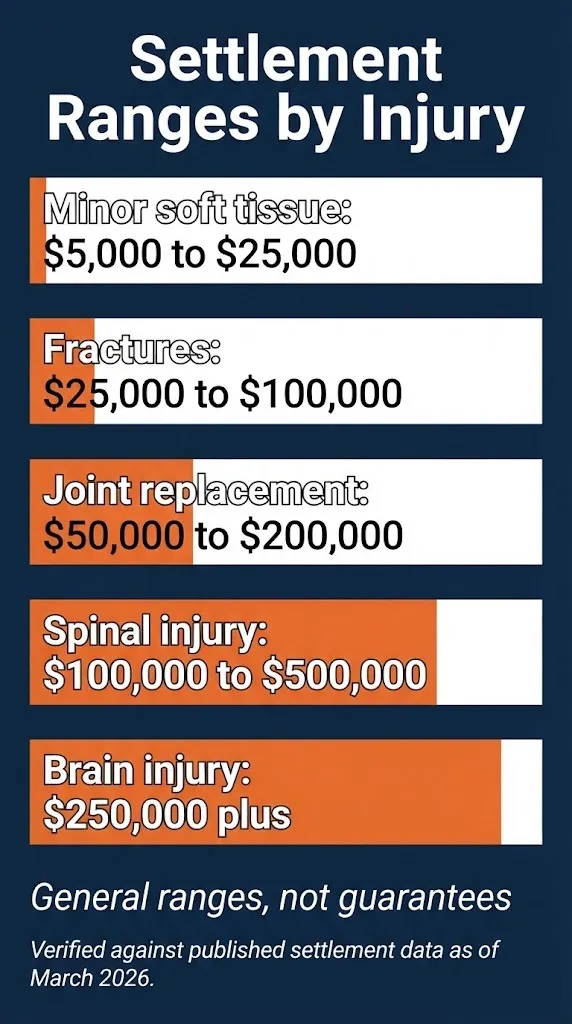
Here is a verified range by injury type:
| Injury Type | Pain and Suffering Range |
|---|---|
| Minor soft tissue | $5,000 to $25,000 |
| Fractures requiring surgery | $25,000 to $100,000 |
| Joint replacement | $50,000 to $200,000 |
| Spinal injury | $100,000 to $500,000 |
| Brain injury | $250,000 to millions |
These are general ranges from reported settlements and verdicts. They are not guarantees. Your case depends on the facts.
Key Takeaway: The severity of your injury is the biggest factor. A broken bone is worth more than a sprain. A permanent injury is worth more than one that heals.
What are some real pain and suffering settlement examples?
Real settlement amounts are often confidential. But some verdicts and public settlements provide reference points. The following examples are illustrative, based on reported cases.
A rear-end car accident with soft tissue injuries, $8,000 in medical bills, and a full recovery in three months might settle for $15,000 to $25,000 total. The pain and suffering portion would be $7,000 to $17,000.
A slip and fall with a broken hip, surgery, and a six-month recovery might settle for $100,000 to $250,000. The pain and suffering portion would be substantial because the injury was severe and the recovery was long.
A medical malpractice case with a permanent nerve injury might settle for $500,000 or more. The pain and suffering is significant because the injury is permanent.
These examples show the range. The specific number in your case depends on your facts.
What factors increase pain and suffering compensation?
Several factors push the number higher. The most important is the severity of the injury. A permanent injury is worth more than a temporary one.
The length of recovery matters. A year of pain is worth more than a month. The impact on your daily life matters too. If you cannot work, cannot sleep, or cannot play with your children, the pain and suffering is higher.
Here are the factors that increase the value:
- Permanent injury or disability.
- Long recovery period.
- Surgery or invasive treatment.
- Visible scarring or disfigurement.
- Chronic pain requiring ongoing treatment.
- Psychological impact like anxiety or PTSD.
- Loss of a major life activity.
Key Takeaway: The more the injury changed your life, the higher the pain and suffering component.
What factors decrease pain and suffering compensation?
Several factors push the number lower. The most important is a quick, full recovery. If you were back to normal in a few weeks, the pain and suffering is limited.
Pre-existing conditions matter. If you had back pain before the accident, the insurer will argue the accident only aggravated it. Your pain and suffering may be reduced.
Delayed treatment hurts. If you waited weeks to see a doctor, the insurer will argue you were not in much pain. Gaps in treatment tell the same story.
Here are the factors that decrease the value:
- Quick and complete recovery.
- Pre-existing conditions.
- Delayed medical treatment.
- Gaps in treatment.
- No objective injury findings.
- Weak liability evidence.
How do insurance companies value pain and suffering?
Insurance companies do not use a single formula. They use software, adjuster experience, and negotiation strategy. The goal is to pay as little as possible.
The adjuster starts with your medical bills. Then the adjuster applies a multiplier based on the injury severity. The adjuster also considers the venue, the insurance limits, and the risk of a jury verdict.
The first offer is always low. It is a starting point, not a final number. You are expected to negotiate.
Key Takeaway: The insurance company’s first offer is not the value of your claim. It is the opening bid.
How do lawyers calculate pain and suffering?
Lawyers use the same methods as insurers, but from the opposite side. The lawyer builds the highest defensible number.
The lawyer gathers medical records, wage statements, and evidence of how the injury affected your life. The lawyer may hire experts to testify about your future pain and limitations. The lawyer then negotiates from a position of documented evidence.
A lawyer who is willing to go to trial has more leverage. The insurer knows which lawyers settle cheap and which will fight.
Do state caps limit pain and suffering?
Some states cap non-economic damages, including pain and suffering. The cap typically applies to medical malpractice cases, but some states cap all personal injury cases.
California caps non-economic damages in medical malpractice at $250,000. That cap has been in place since 1975. Other states have similar caps.
If your state has a cap, your pain and suffering recovery is limited no matter how severe your injury. A lawyer can tell you whether a cap applies to your case.
Key Takeaway: The state where you were injured controls the rules. Some states limit what you can recover.
What is the per diem method?
The per diem method assigns a daily dollar amount to your pain. The daily rate is often based on your daily wage. If you earn $200 per day, the argument is that each day of pain is worth $200.
The daily rate is multiplied by the number of days you were in pain. If you were in pain for 180 days, the pain and suffering is $36,000.
The per diem method works best for injuries with a clear recovery timeline. It is less useful for permanent injuries where the pain never ends.
Here is the per diem calculation:
| Daily Rate | Days | Pain and Suffering |
|---|---|---|
| $100 | 90 | $9,000 |
| $200 | 180 | $36,000 |
| $300 | 365 | $109,500 |
What is the multiplier method?
The multiplier method takes your economic damages and multiplies by a number. The multiplier reflects the severity of your injury.
The economic damages are usually medical bills plus lost wages. The multiplier ranges from 1.5 to 5. A minor injury gets 1.5. A catastrophic injury gets 5.
The total is the economic damages plus the multiplied pain and suffering amount.
Here is a sample:
| Economic Damages | Multiplier | Total Settlement |
|---|---|---|
| $20,000 | 2 | $40,000 |
| $50,000 | 3 | $150,000 |
| $100,000 | 4 | $400,000 |
The multiplier is not a law. It is a negotiation tool.
Key Takeaway: The multiplier is the most common method, but it is not binding. It is a starting point.
How do I prove pain and suffering?
You prove pain and suffering through documentation. Medical records show your injuries and treatment. A pain journal shows your daily experience. Witness statements from family and friends show how your life changed.
Photographs help. Photos of your injuries, your recovery, and your limitations tell the story visually.
Your own testimony matters. You can describe your pain, your limitations, and what you lost. Your credibility is key.
Here is the documentation checklist:
- Medical records showing your diagnosis and treatment.
- A pain journal with daily entries.
- Photographs of your injuries and recovery.
- Witness statements from family and friends.
- A list of activities you can no longer do.
- Records of missed work and lost wages.
- Mental health records if you sought counseling.
Reality Check
No one will call you to tell you what your pain and suffering is worth. Legitimate settlement negotiations happen between lawyers and adjusters, not through cold calls. If someone promises you a specific payout before reviewing your medical records, they are guessing or scamming. The real number comes from evidence, not enthusiasm.
What Happens Next
| Timeline | Expected Stage |
|---|---|
| Now | Document your pain and limitations |
| During treatment | Keep a pain journal |
| After treatment | Calculate your economic damages |
| Before negotiation | Build your evidence file |
| Negotiation | Start high and negotiate down |
The process takes time. The stronger your documentation, the better your result.
Frequently Asked Questions
What is pain and suffering?
The non-economic damage for physical pain, emotional distress, and lost quality of life.
How is pain and suffering calculated?
Common methods are the multiplier and per diem. Neither is binding.
What is a fair settlement for pain and suffering?
It depends on the severity of your injury and the strength of your case.
What is the multiplier method?
Multiplying your economic damages by a number, usually 1.5 to 5.
What is the per diem method?
Assigning a daily dollar amount to your pain and multiplying by the days in pain.
Do state caps limit pain and suffering?
Some states cap non-economic damages, especially in malpractice cases.
How do I prove pain and suffering?
Document your pain, your treatment, and your limitations.
Do I need a lawyer for pain and suffering?
Not for minor cases. Yes for serious injuries or disputed liability.
The Number Is Real. The Evidence Makes It.
Pain and suffering is not a lottery. It is compensation for real harm. The number comes from your medical records, your journal, and your story.
Document everything. Build the evidence. The settlement will follow.