Asbestos Settlement Payouts and Compensation Claims: 2026 Guide
Quick Answer
- Asbestos compensation is real and comes from trust funds, lawsuits, or veterans benefits.
- Average settlements range from $10,000 to $50,000 for non-malignant claims, with mesothelioma cases far higher.
- Statutes of limitations apply per state, often one to three years from diagnosis.
You worked around asbestos decades ago. Now you have a diagnosis, or you’ve lost someone who did. The search for compensation starts with confusion: trust funds, lawsuits, settlements, VA claims. Which one applies to you?
Here’s what the verified data shows. More than 60 active asbestos bankruptcy trusts still hold billions in assets for current and future claimants. Mesothelioma claims typically receive the largest payouts. Non-malignant claims, like asbestosis or pleural plaques, receive smaller amounts.
This article covers the real settlement ranges, how trust fund payouts actually work, what proof you need, and the deadlines that can kill a valid claim. One surprising fact: many claimants miss compensation because they don’t know their state’s statute of limitations starts at diagnosis, not at exposure.
The Facts
| Case | Individual claims against asbestos trusts and defendants, not a class action |
| Status | Active; trusts continue accepting claims in 2026 |
| Fund Size | Over $30 billion across major asbestos bankruptcy trusts |
| Est. Per Person | $10,000 to $50,000 for non-malignant; mesothelioma often $1 million+ |
| Claim Deadline | State-specific, typically one to three years from diagnosis |
| Administrator | Individual trust administrators vary by trust |
| Proof Needed | Medical records, employment history, exposure documentation |
Is Asbestos Compensation Real in 2026?
Yes. Asbestos compensation is one of the longest-running and most established mass tort systems in U.S. legal history. Trust funds, lawsuits, and veterans benefits continue to pay qualified claimants in 2026.
The system works differently from class action settlements. There’s no single fund, no single claim form, and no single deadline. Instead, dozens of asbestos bankruptcy trusts operate independently, each with their own claim requirements and payment percentages.
The RAND Institute for Civil Justice has documented over $30 billion in remaining trust assets. Those trusts were created by bankrupt asbestos companies, including Johns Manville, Owens Corning, and W.R. Grace, to pay current and future claimants. The money is real. The process is not simple.
If you were exposed to asbestos and have a diagnosis, multiple compensation sources may apply to you. The challenge is identifying which trusts your work history matches.
What Is the Average Asbestos Settlement?
No single verified average exists across all asbestos settlements because payouts vary enormously by diagnosis, exposure type, and trust payment percentage. But published data shows clear ranges.
Non-malignant asbestos claims, such as asbestosis, typically settle for $10,000 to $50,000 per claim across major trusts. Pleural plaques, a less severe condition, often settle for less. Mesothelioma claims routinely exceed $1 million when combining trust payouts and lawsuit settlements.
The confusion comes from mixing these categories. A law firm ad claiming “average asbestos settlement of $1 million” is talking about mesothelioma claims, not all asbestos claims. If you have asbestosis, your realistic range is much lower.
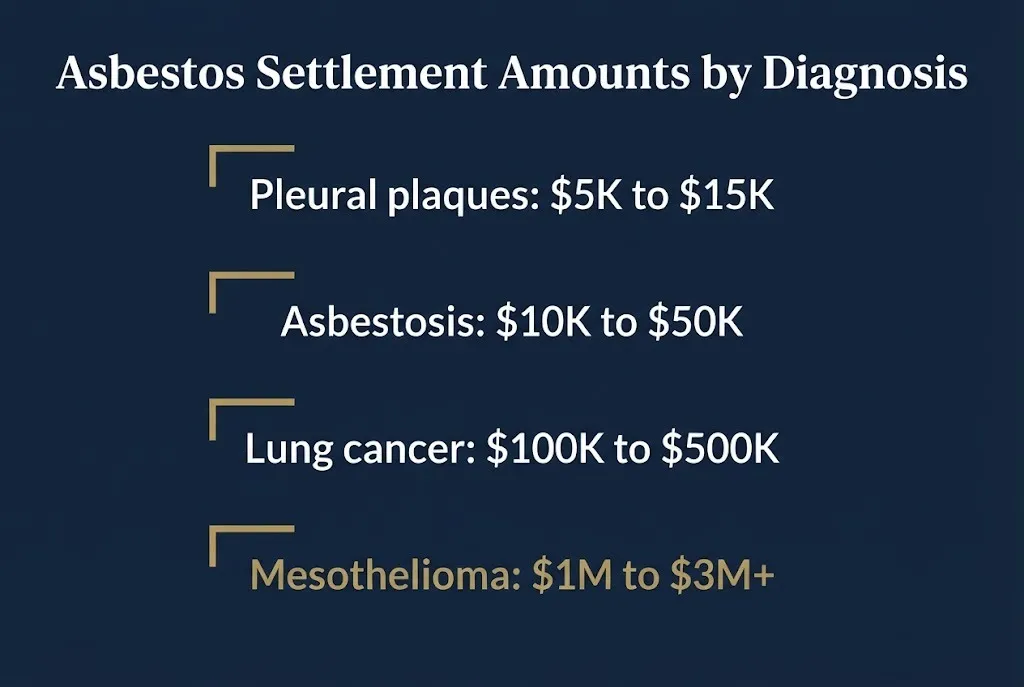
| Diagnosis | Typical Compensation Range |
|---|---|
| Pleural plaques | $5,000 to $15,000 |
| Asbestosis | $10,000 to $50,000 |
| Lung cancer with asbestos exposure | $100,000 to $500,000 |
| Mesothelioma | $1 million to $3 million+ |
These ranges reflect reported trust payment patterns, not guaranteed amounts.
What Are Asbestos Settlement Amounts by Disease Type?
Asbestos settlement amounts vary dramatically based on your specific diagnosis. The disease determines the value, not just the exposure.
Mesothelioma is the most valuable claim because it is almost exclusively caused by asbestos and is always terminal. Juries and trusts assign the highest values to mesothelioma claims. Lung cancer claims with documented asbestos exposure are the next tier, followed by non-malignant conditions.
The reason is straightforward. Trusts use payment percentage schedules and disease categories. A mesothelioma claim receives the full scheduled value. An asbestosis claim may receive 10 to 20 percent of that value. Pleural plaques receive even less.
Your medical records are the single most important factor. A clear, recent diagnosis from a qualified pulmonologist or oncologist opens the door. Without a confirmed diagnosis, no trust will pay.
Key Takeaway: Your disease diagnosis, not your years of exposure, determines which compensation tier your claim falls into.
How Does Asbestos Trust Fund Compensation Work?
Asbestos trust fund compensation works through a multi-step process that starts with matching your exposure history to specific bankruptcy trusts. It’s not a lawsuit in the traditional sense.
Each asbestos trust sets a payment percentage, which is the fraction of the claim’s scheduled value that the trust actually pays. For example, if a trust has a 25 percent payment percentage and your claim’s scheduled value is $40,000, you receive $10,000.
The payment percentage exists because trusts have limited funds and millions of potential claimants. Paying full value to every claimant would exhaust the trust quickly. The percentage adjusts over time based on claims volume and remaining assets.
You can file with multiple trusts if your work history matches multiple bankrupt companies. Many tradespeople, such as insulators, pipefitters, and shipyard workers, file against several trusts in one claims process.
What Proof Do You Need for an Asbestos Claim?
Filing an asbestos claim requires specific proof of exposure and diagnosis. The documentation burden is higher than most other injury claims.
Here’s what you’ll need.
- Medical records confirming an asbestos-related diagnosis.
- Pathology reports if cancer is involved.
- Work history records showing where and when you worked.
- Military service records if you served in the Navy or other branches.
- Witness affidavits from coworkers who can verify exposure.
- Product identification showing which asbestos-containing materials you handled.
- Smoking history, which affects lung cancer claim evaluation.
Gathering this proof takes time. Start with your medical records and then reconstruct your work history. Your attorney or claims preparer will help match that history to specific trusts.
Think of it like a store return without a receipt. You need to prove you were there and what you purchased. The more documentation you have, the smoother the claim goes.
How Do I File an Asbestos Trust Fund Claim?
Filing an asbestos trust fund claim follows a defined sequence. Most people work with an attorney or specialized claims preparer because the process is detailed.
- Obtain a confirmed asbestos-related diagnosis from your doctor.
- Compile your complete work history with dates and locations.
- Identify which asbestos trusts match your exposure history.
- Gather medical records, pathology reports, and employment records.
- Complete the trust claim forms, often with attorney assistance.
- Submit the claim package to each applicable trust.
- Respond to any deficiency notices from the trust.
- Receive the trust’s payment decision and timeline.
The process typically takes three to twelve months per trust, depending on the trust’s backlog and whether your claim has deficiencies. Expedited review exists for severe diagnoses like mesothelioma.
What Is the Deadline to File an Asbestos Claim?
The deadline to file an asbestos claim is governed by your state’s statute of limitations, which typically runs one to three years from the date of diagnosis, not from the date of exposure.
This distinction matters. Many people assume the clock started when they were exposed decades ago. It didn’t. Most states apply a discovery rule that starts the deadline when you knew or should have known you had an asbestos-related disease.
| State Example | Statute of Limitations |
|---|---|
| California | One year from diagnosis |
| New York | Three years from diagnosis |
| Texas | Two years from diagnosis |
| Florida | Four years from diagnosis |
| Pennsylvania | Two years from diagnosis |
If a loved one died from an asbestos disease, a wrongful death claim has its own deadline, often one to two years from the date of death. Check your state’s specific rules immediately.
Key Takeaway: The clock starts at diagnosis, not exposure, but in some states you have only one year to act after you learn you’re sick.
Can Family Members File Asbestos Claims?
Yes. Family members can file asbestos claims in two situations: wrongful death claims when a loved one has died from an asbestos disease, and secondary exposure claims in limited circumstances.
Wrongful death claims are the most common family filing. If your spouse or parent died from mesothelioma, lung cancer, or another asbestos-related disease, you may file on their behalf. The deadline is typically one to two years from the date of death.
Secondary exposure claims involve family members who were exposed through asbestos fibers brought home on a worker’s clothing. Wives who washed contaminated work clothes have successfully filed claims after developing mesothelioma.
These claims are fact-specific. Your attorney will need to establish that the secondary exposure was a substantial factor in the disease.
Is There an Asbestos Class Action Settlement in 2026?
No. There is no single asbestos class action settlement in 2026. Asbestos compensation operates through individual claims against bankruptcy trusts and individual lawsuits against solvent defendants.
The asbestos litigation system is unique. Instead of a class action with one settlement fund and one claim form, it’s a patchwork of dozens of trusts and thousands of individual cases. Each trust has its own rules. Each lawsuit has its own facts.
This structure actually benefits claimants with serious diagnoses because their cases can be valued individually. A class action would likely flatten payouts, reducing what mesothelioma victims receive.
If you see an ad for an “asbestos class action settlement,” it’s misleading. The real system is trust funds and individual claims, not a single class proceeding.
Reality Check: No one calls, texts, or emails you out of the blue about asbestos settlement money. Legitimate claims start when you contact an attorney or claims service, never with unsolicited contact.
What Is the Average Asbestos Settlement for Mesothelioma?
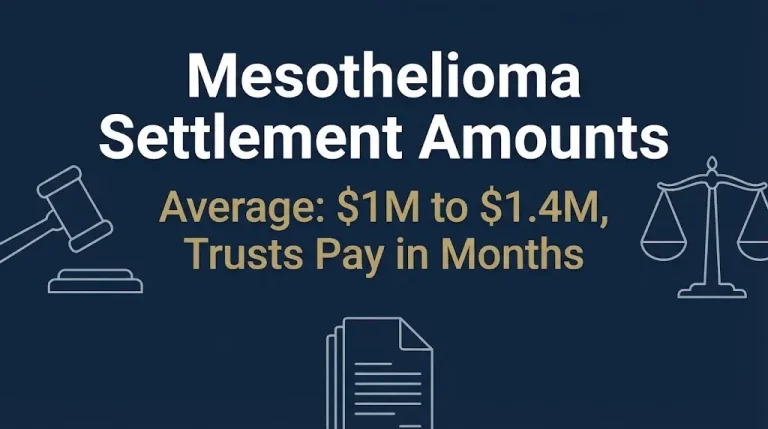
Mesothelioma settlements average substantially higher than other asbestos claims, typically ranging from $1 million to $1.4 million when combining multiple trust payouts and lawsuit settlements. Some cases exceed $3 million.
The reason is the disease itself. Mesothelioma is a terminal cancer almost exclusively caused by asbestos. Juries respond strongly to mesothelioma cases because the causal link is clear and the damages are catastrophic.
But that average doesn’t mean every mesothelioma claim pays seven figures. Cases with weaker exposure evidence, shorter work histories, or lower-value trusts may pay less. Cases involving multiple bankrupt companies and strong product identification pay more.
If you have a mesothelioma diagnosis, you likely have claims against multiple trusts and potentially solvent defendants. An experienced asbestos attorney can identify every available source.
What Is the Average Asbestos Settlement for Asbestosis?
Asbestosis claims settle for far less than mesothelioma claims, typically $10,000 to $50,000 per trust, with total combined recoveries sometimes higher if multiple trusts apply.
Asbestosis is a non-malignant scarring of the lungs caused by asbestos exposure. It’s a serious disease that causes breathing problems and increases cancer risk. But it’s not cancer, and it’s not terminal. Trusts value it accordingly.
The payment percentage also reduces the actual payout. If a trust’s scheduled value for asbestosis is $30,000 and the payment percentage is 25 percent, you receive $7,500 from that trust.
Many asbestosis claimants file against multiple trusts. A career insulator might match five or six trusts, producing a total recovery of $50,000 to $100,000. But each trust payment is modest.
Key Takeaway: Asbestosis claims are real but modest. Expect $10,000 to $50,000 total from most trust combinations, not millions.
What Does Asbestos Compensation Cover?
Asbestos compensation covers both economic and non-economic damages, though trust fund claims are typically more limited than lawsuit verdicts.
Trust fund payouts are based on scheduled disease values, not your actual medical bills. The amount is fixed by the trust’s rules, not by what you spent. That’s different from a lawsuit, where a jury might award your full medical costs, lost wages, and pain and suffering.
For most claimants, trust fund compensation is partial. It helps with medical expenses and provides some recognition of harm. It rarely makes anyone whole. A delayed tax refund comes to mind: you get something back, but it’s not the full amount you lost.
If you also have a viable lawsuit against a solvent company, that claim may provide additional compensation above trust payouts. Your attorney will evaluate both paths.
Can Veterans File Asbestos Claims?
Yes. Veterans, especially Navy veterans, have some of the strongest asbestos claims because military service involved heavy asbestos exposure on ships, in shipyards, and in military facilities.
Veterans have access to three compensation sources. First, VA disability benefits for asbestos-related diseases. Second, asbestos trust fund claims based on service-related exposure. Third, lawsuits against asbestos product manufacturers who supplied the military.
Navy veterans who served between 1940 and 1980 have the highest exposure rates. Asbestos was used extensively in ships for insulation, fireproofing, and engine room applications. Boiler tenders, pipefitters, and machinist’s mates have particularly strong claims.
VA benefits and trust claims are not mutually exclusive. You can receive both. An attorney experienced in military asbestos claims can help you navigate both systems.
What Happens Next in an Asbestos Claim?
Month 1: Gather medical records and confirm your diagnosis.
Month 2: Compile work history and identify matching trusts.
Month 3: File initial trust claims with attorney assistance.
Month 6: Respond to trust deficiency notices if any.
Month 9: Receive payment decisions from most trusts.
Month 12: Combined payments issued from multiple trusts.
These timelines are typical for straightforward trust claims. Mesothelioma expedited claims can move faster. Deficient claims take longer.
Frequently Asked Questions
Is asbestos compensation taxable?
No. Compensation for personal physical injuries, including asbestos settlements, is generally not taxable.
The IRS excludes damages received for physical injury or illness.
Can I file an asbestos claim if I smoked?
Yes, but smoking affects lung cancer claims, not mesothelioma claims.
Mesothelioma is not caused by smoking, so smoking history is irrelevant to those claims.
How long does an asbestos claim take?
Most trust fund claims take six to twelve months from filing to payment.
Mesothelioma claims with expedited review can complete in three to six months.
Do I need a lawyer for an asbestos claim?
No, but the process is complex and most people use an attorney or claims service.
Attorneys work on contingency, so there’s no upfront fee.
Can I file with multiple asbestos trusts?
Yes. You can file against every trust that matches your work history.
Each trust evaluates your claim independently under its own rules.
What if the company I worked for is still operating?
You may file a lawsuit against the company in addition to any trust claims.
An attorney can evaluate whether a lawsuit adds value to your case.
Is there a deadline for asbestos claims after death?
Yes. Wrongful death claims have their own deadlines, often one to two years from death.
Check your state’s rules immediately if you’re filing for a deceased loved one.
How much does an asbestos attorney cost?
Nothing upfront. Asbestos attorneys work on contingency, typically 33 to 40 percent.
They’re paid only if you recover compensation.
If you have an asbestos-related diagnosis, the most urgent number is your state’s statute of limitations. That deadline, not the trust fund process, is what can permanently bar your claim.
Gather your medical records and work history. Then contact an experienced asbestos attorney to identify your trust matches. The money is there. But it only pays those who file.