Settlement Options for Life Insurance Policies in 2026: What Policyholders and Beneficiaries Must Know
Quick Answer
- Life insurance settlement options include lump sum, installment payments, interest income, and life income plans.
- Your choice affects taxes, long-term security, and how much beneficiaries ultimately receive.
- No class action settlement exists, so no claim deadline applies to these standard policy elections.
If you inherited a life insurance policy or your own policy is maturing, the insurer will ask you to choose a settlement option. That choice determines how you receive the death benefit and how much tax you may owe.
The verified fact is this: life insurance settlement options are contractual, not a lawsuit. They are the payout methods written into your policy. One surprising detail from consumer complaint data: many beneficiaries choose a lump sum by default and later regret losing the guaranteed income stream that other options provide.
The Facts
| Fact | Details |
|---|---|
| Case | No lawsuit, standard life insurance policy elections |
| Status | Ongoing, governed by state insurance law |
| Fund Size | Depends on individual policy face value |
| Est. Per Person | Varies by policy and settlement choice |
| Claim Deadline | No deadline, but policy terms apply |
| Administrator | Insurer or state insurance department |
| Proof Needed | Death certificate, policy documents, beneficiary forms |
What Are Settlement Options for Life Insurance Policies?
Settlement options for life insurance policies are the ways an insurer pays out a death benefit or policy proceeds. You choose the method when you buy a policy, name a beneficiary, or file a claim.
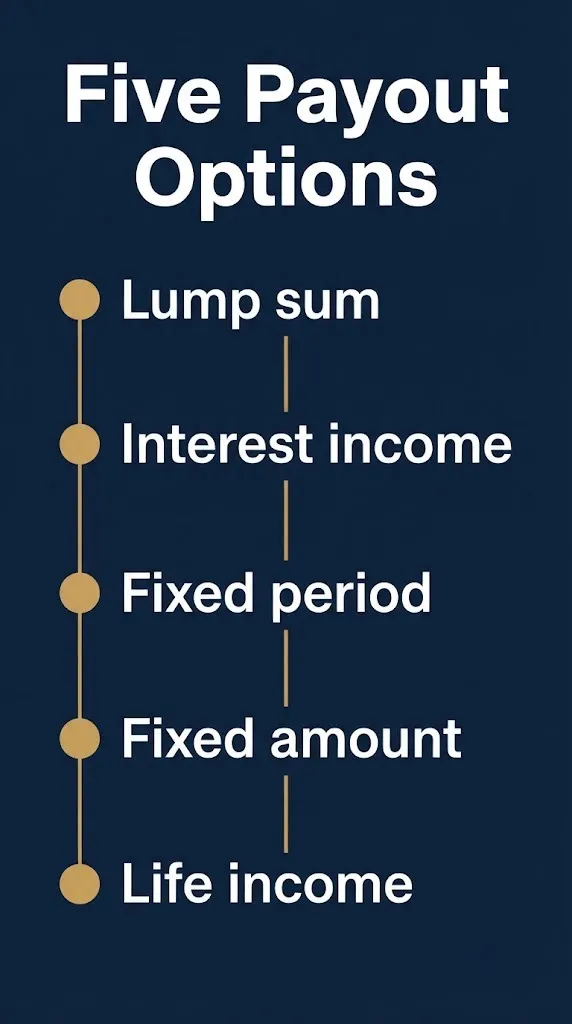
The five standard options are lump sum, interest income, fixed period installments, fixed amount installments, and life income. Each has different tax, flexibility, and risk implications.
These options are not the same as a life settlement, which is selling your policy to a third party while you are still alive. The term “settlement option” here means payout method, not lawsuit resolution.
Key Takeaway: Settlement options are payout choices written into your policy, not litigation.
What Are the Main Life Insurance Settlement Options?
The main life insurance settlement options are five standard payout methods offered by most insurers.
| Option | How It Works |
|---|---|
| Lump sum | Entire death benefit paid at once |
| Interest income | Insurer holds principal and pays interest |
| Fixed period | Equal payments over a set number of years |
| Fixed amount | Equal payments until the fund runs out |
| Life income | Payments guaranteed for the beneficiary’s lifetime |
Each option fits a different need. A lump sum works for paying off a mortgage or covering immediate expenses. Life income works for someone who needs guaranteed monthly income for decades.
What Is the Lump Sum Settlement Option?
The lump sum settlement option pays the entire death benefit in one payment. It is the default choice for most beneficiaries because it offers maximum flexibility.
The advantage is control. You can invest, spend, or save the money however you want. The disadvantage is risk. A large sum can be spent too quickly or mismanaged.
Tax treatment is generally favorable. Life insurance death benefits are usually not subject to income tax when paid as a lump sum to a named beneficiary.
Key Takeaway: Lump sum means full control now, which is also the biggest risk if spending discipline is weak.
What Is the Interest Income Settlement Option?
The interest income option leaves the death benefit with the insurer, which pays you interest on the balance. You can withdraw principal later or leave it intact.
This option protects the principal while providing income. It works well for beneficiaries who do not need the full amount immediately.
The interest rate is set by the insurer and may be lower than what you could earn elsewhere. Some policies guarantee a minimum rate.
What Is the Fixed Period Settlement Option?
The fixed period option pays equal installments over a set number of years, such as 10 or 20. The insurer calculates payments based on the total benefit and the period length.
This option provides predictable income for a defined time. It helps bridge a gap, like supporting children until they finish college or covering a surviving spouse until Social Security begins.
Here is an example using a $100,000 death benefit at a 3 percent assumed interest rate:
| Period | Approximate Annual Payment |
|---|---|
| 10 years | $11,700 |
| 20 years | $6,700 |
| 30 years | $5,100 |
These are illustrative figures, not guarantees. Your insurer uses its own rate assumptions.
Key Takeaway: Fixed period means predictable payments for a set time, then the money stops.
What Is the Life Income Settlement Option?
The life income option pays a guaranteed income for the beneficiary’s lifetime. Payments stop at death, regardless of how much has been paid out.
This option protects against outliving the death benefit. A young beneficiary who needs lifelong support may benefit most.
The tradeoff is loss of principal. If the beneficiary dies early, the remaining benefit typically stays with the insurer unless a guaranteed period is added.
Some policies offer life income with a guaranteed period, such as 10 or 20 years. That means payments continue to a secondary beneficiary if the primary beneficiary dies during the guarantee window.
What Is a Life Settlement Option Versus a Life Insurance Settlement?
A life settlement option is a payout method. A life settlement is selling your policy to a third party for cash while you are still alive.
These are different products with different consequences.
| Feature | Settlement Option | Life Settlement |
|---|---|---|
| Who chooses | Beneficiary or policyholder | Policyholder |
| When | After death or policy maturity | While alive |
| Purpose | Distribute death benefit | Access cash early |
| Tax treatment | Death benefits usually tax-free | May be taxable |
Key Takeaway: Do not confuse payout elections with selling your policy, they are separate transactions.
How Do You Choose the Right Life Insurance Settlement Option?
You choose the right settlement option by matching the payout method to your actual needs, not to the insurer’s default.
Here are five steps:
- List your immediate expenses: funeral, debts, mortgage, education.
- Calculate how much monthly income you need if the primary earner is gone.
- Compare the insurer’s payment illustrations for each option.
- Consider your age, health, and spending discipline.
- Ask a tax professional how each option affects your tax bill.
Take your time. You are not required to make an instant decision. Insurers typically hold the benefit and pay interest during the decision window.
What Are the Tax Consequences of Life Insurance Settlement Options?
Life insurance death benefits are generally income tax free to named beneficiaries. That rule applies to lump sum payments.
Interest earned on installments or interest income options is taxable. The principal portion is not taxed, but the interest portion is ordinary income.
A life settlement sale, by contrast, may create taxable gain. The tax treatment depends on your basis in the policy and the sale price.
Reality Check: No legitimate insurer charges a fee to choose a settlement option. If someone asks for money to “process” your life insurance payout or to switch your payment method, that is a scam. Contact your insurer directly using the number on your policy.
Can You Change Your Life Insurance Settlement Option?
You can change your settlement option before payments begin, depending on policy terms. Most insurers allow the policyholder to change the election during their lifetime.
After death, beneficiaries may have limited flexibility. Some policies allow a beneficiary to change from installments to lump sum, but not the reverse.
Read the policy and ask the insurer for a written explanation of any change rights. Get it in writing. Oral promises from a call center agent are not binding.
What Happens If No Settlement Option Is Chosen?
If no settlement option is chosen, the insurer typically pays the death benefit as a lump sum or holds the funds in an interest-bearing account.
State insurance laws require insurers to notify beneficiaries of their options. Many states also require insurers to pay interest while the beneficiary decides.
The money is yours to claim. Failing to choose does not mean losing it. It means the insurer may hold it and earn interest on your benefit.
What Is the Role of State Insurance Departments in Settlement Options?
State insurance departments regulate life insurance settlement options. They enforce prompt payment laws and review insurer conduct.
If an insurer delays payment or misleads you about options, you can file a complaint with your state insurance department. That complaint is free and often prompts faster resolution.
State unclaimed property laws also apply. If a beneficiary cannot be located, the death benefit may eventually escheat to the state.
Key Takeaway: State regulators are your enforcement mechanism if the insurer stalls or misbehaves.
What Are the Common Mistakes With Life Insurance Settlement Options?
The most common mistake is choosing a lump sum by default without considering the alternatives. A second mistake is choosing installments without understanding the interest assumption.
Other mistakes include:
- Not updating beneficiary designations after divorce or death.
- Ignoring tax consequences of interest income options.
- Failing to compare the insurer’s rate with market alternatives.
- Choosing life income without a guaranteed period when dependents rely on the payments.
Each mistake is avoidable with a written comparison and time to think.
What Is the Life Income Settlement Option Guaranteed Period?
A life income settlement option guaranteed period means payments continue to a secondary beneficiary if the primary beneficiary dies within a set number of years.
For example, a life income with a 20-year guaranteed period pays the primary beneficiary for life. If that person dies in year 10, the remaining 10 years of payments go to a named secondary beneficiary.
This structure protects against early death. It costs slightly more, meaning the monthly payment is lower than a pure life income option.
How Do Life Insurance Settlement Options Compare to Annuity Options?
Life insurance settlement options function like annuities. Both convert a lump sum into a stream of payments.
The difference is the source. Settlement options come from a life insurance death benefit. Annuities are purchased with cash.
Annuities may offer more flexibility and higher rates because the annuity market is competitive. But settlement options are often simpler and inherit the tax treatment of the death benefit.
What Happens Next
If you are choosing a life insurance settlement option, your timeline is self-directed. No court deadline applies.
- Immediately: Contact the insurer and request written payment illustrations for each option.
- Within 30 days: Compare the options and consult a tax professional if the benefit is large.
- Within 60 days: Make your election in writing and confirm the first payment date.
- If delayed: File a complaint with your state insurance department.
The single most important fact is your choice. It determines how long the money lasts and who benefits after you.
Frequently Asked Questions
What are the settlement options for life insurance policies?
The settlement options are lump sum, interest income, fixed period, fixed amount, and life income.
Each option distributes the death benefit differently.
Your choice affects taxes and long-term income security.
What is the best life insurance settlement option?
The best option depends on your financial needs and discipline.
A lump sum works for immediate large expenses.
Life income works for guaranteed lifelong income.
Are life insurance settlements taxable?
Death benefits paid to named beneficiaries are generally income tax free.
Interest earned on installments is taxable.
A life settlement sale may create taxable gain.
Can I sell my life insurance policy instead of choosing a settlement option?
Yes, a life settlement allows you to sell your policy for cash while alive.
It is different from choosing a payout method after death.
Life settlements may be taxable and reduce what beneficiaries receive.
What is the life income settlement option?
The life income option pays a guaranteed income for the beneficiary’s lifetime.
Payments stop at death unless a guaranteed period applies.
It protects against outliving the benefit.
How long do I have to choose a life insurance settlement option?
There is no fixed deadline, but insurers may hold funds and pay interest during the decision window.
State laws require insurers to notify you of your options.
Delaying too long could trigger unclaimed property rules in some states.
What is the difference between fixed period and fixed amount options?
Fixed period pays equal installments over a set number of years.
Fixed amount pays equal installments until the fund runs out.
The period option has a definite end date.
Who regulates life insurance settlement options?
State insurance departments regulate life insurance payout practices.
They enforce prompt payment laws and review complaints.
You can file a free complaint if the insurer delays or misleads you.