Discrimination Lawsuit Settlement 2026: EEOC Payouts, Retaliation Amounts, and What Workers Can Expect
Quick Answer
- Discrimination lawsuit settlements are real and common, but amounts vary widely by case and employer.
- EEOC payouts average $40,000 to $50,000 per claimant, while private lawsuits can reach six figures.
- The most important deadline is the EEOC charge filing window, typically 180 or 300 days from the discriminatory act.
If you are searching for discrimination lawsuit settlement amounts, you probably experienced something at work and want to know what your case might be worth.
The honest answer is that no single number applies. A race discrimination case against a Fortune 500 company settles for more than an age discrimination case against a small business. The facts, the evidence, the employer, and the legal strategy all move the number.
This article breaks down verified EEOC data, real settlement ranges, and the factors that matter most. One detail most guides miss: the average EEOC settlement includes cases where the agency found no discrimination, which pulls the number down. Cases with strong evidence settle higher.
The Facts
| Case | No single case; EEOC and private discrimination lawsuits |
| Status | Active federal and state enforcement |
| Fund Size | Varies by case; no central fund |
| Est. Per Person | $40,000 to $50,000 average in EEOC cases |
| Claim Deadline | 180 or 300 days from discriminatory act for EEOC |
| Administrator | EEOC or private attorneys |
| Proof Needed | Written complaints, witness statements, documents |
Are Discrimination Lawsuit Settlements Real?
Yes. Discrimination lawsuit settlements are real and happen every day.
The Equal Employment Opportunity Commission, the EEOC, recovers millions of dollars annually for workers. In fiscal year 2024, the EEOC recovered over $700 million in monetary relief for discrimination victims.
Private attorneys file even more cases. Most settle before trial. The settlements range from nuisance-value payments of a few thousand dollars to multi-million-dollar resolutions in class or systemic cases.
The key distinction is between EEOC settlements and private lawsuit settlements. EEOC cases often involve injunctive relief, meaning changes in employer policies, plus money. Private cases focus on individual damages.
If you have evidence of discrimination, the question is not whether settlements happen. It is how much your specific case might settle for.
What Is the Average EEOC Lawsuit Payout?
The average EEOC payout depends on how you measure it.
EEOC administrative settlements, resolved before a lawsuit is filed, average lower. Many settle for $10,000 to $50,000 per person.
EEOC lawsuits, filed in federal court, settle higher. Cases that reach litigation have stronger evidence and more serious violations. Average per-person amounts in EEOC litigation can exceed $100,000 in some cases.
The overall average across all EEOC resolutions is approximately $40,000 to $50,000 per claimant. That includes small individual cases and large class cases.
The median is lower. Half of all claimants receive less than the average. Large settlements against major employers pull the average up.
How Much Can You Get From a Discrimination Settlement?
Your settlement depends on several factors, not on a fixed formula.
The strongest predictor is lost wages. If you were fired and missed a year of work, your back pay claim is larger. If you quit and found a new job quickly, it is smaller.
Emotional distress damages matter. Cases with documented therapy, medical treatment, or severe impact settle higher than cases with no emotional distress evidence.
Punitive damages are rare but possible. They require egregious employer conduct and are capped by federal law in many cases.
The employer’s size matters. Large companies have bigger insurance policies and deeper pockets. Small businesses settle for less because they have less.
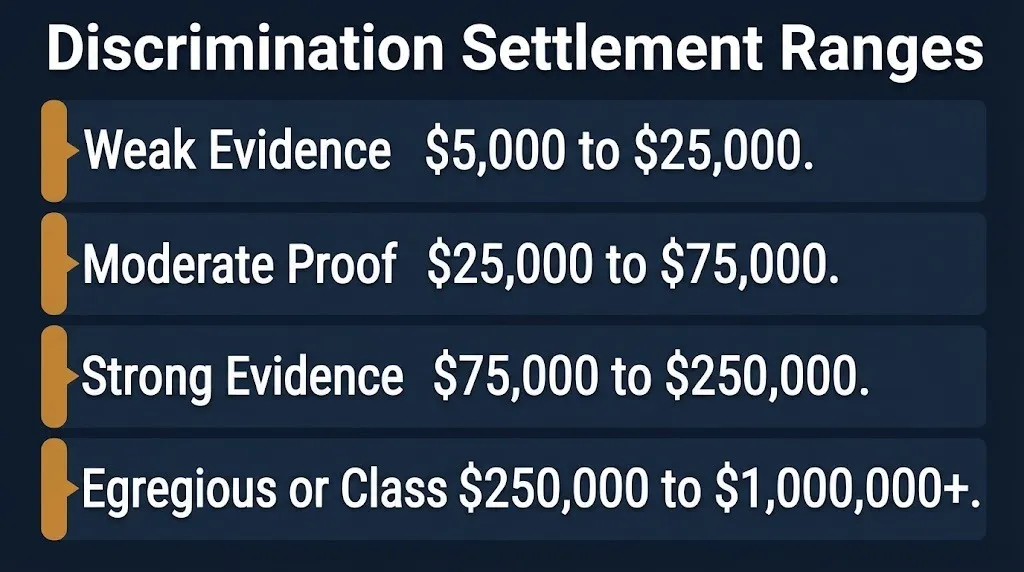
Here is a realistic range table.
| Case Strength | Typical Settlement Range |
|---|---|
| Weak, little evidence | $5,000 to $25,000 |
| Moderate, some proof | $25,000 to $75,000 |
| Strong, documented discrimination | $75,000 to $250,000 |
| Egregious, systemic, or class | $250,000 to $1,000,000+ |
Key Takeaway: Strong evidence of discrimination plus significant lost wages pushes settlements into six figures. Weak evidence settles for nuisance value.
What Is the Average EEOC Retaliation Settlement?
Retaliation is the most common charge filed with the EEOC.
The average retaliation settlement mirrors the overall EEOC average. Most retaliation cases settle in the $30,000 to $60,000 range when discrimination is proven or strongly alleged.
Retaliation cases have a structural advantage for workers. Juries often find retaliation easier to understand than discrimination. An employer that fires someone after a complaint looks bad to a jury, even if the underlying discrimination is unclear.
This jury risk pushes employers to settle retaliation cases at higher amounts than other claims with similar evidence.
If you complained about discrimination and then faced discipline, demotion, or termination, the retaliation claim may be worth more than the original discrimination claim.
What Is the Deadline to File a Discrimination Claim?
The deadline depends on where you file.
The EEOC requires you to file a charge within 180 days of the discriminatory act. In states with a fair employment practices agency, the deadline extends to 300 days.
Private lawsuits under federal law require you to file an EEOC charge first and receive a right-to-sue letter. You then have 90 days from receiving that letter to file a lawsuit.
State law deadlines vary. California’s Fair Employment and Housing Act requires filing with the state agency within three years. New York allows three years for many claims.
Missing the EEOC deadline bars your federal claim. The deadline is strict, and courts enforce it consistently.
How Do You File an EEOC Discrimination Charge?
Filing an EEOC charge is the first step for most federal discrimination claims.
- Gather your evidence: emails, text messages, performance reviews, witness names.
- Contact the EEOC office serving your area or use the EEOC online portal.
- Complete the intake questionnaire describing the discrimination and the dates.
- File the charge within 180 or 300 days of the last discriminatory act.
- Cooperate with the EEOC investigation.
- Receive the agency’s determination or a right-to-sue letter.
- If you receive a right-to-sue letter, file a lawsuit within 90 days.
- Keep copies of everything you submit and receive.
The process is free. You do not need a lawyer to file an EEOC charge, but one helps for the lawsuit phase.
What Types of Discrimination Lead to Lawsuits?
Several categories of discrimination are protected by federal law.
Race and color discrimination are the most common charges. Sex discrimination, including sexual harassment, follows close behind.
Age discrimination under the Age Discrimination in Employment Act protects workers over 40. Disability discrimination under the Americans with Disabilities Act is also frequent.
National origin, religion, and genetic information are protected categories too. Retaliation for complaining about any of these is separately illegal.
State laws add protections. Some states cover sexual orientation, gender identity, marital status, and other categories not covered by federal law.
Key Takeaway: The protected category matters less than the evidence. A strong retaliation case often beats a weak discrimination case.
What Are Real Examples of Discrimination Settlements?
Public records show real settlement amounts in filed cases.
A 2023 race discrimination case against a national retailer settled for $125,000. The plaintiff alleged a manager used racial slurs and then fired her after she complained. The employer denied the claims.
A 2024 sex discrimination case against a tech company settled for $475,000. The plaintiff alleged she was passed over for promotion in favor of less qualified men. The settlement included back pay and emotional distress damages.
A 2022 EEOC lawsuit against a manufacturing company settled for $1.2 million for a class of workers alleging national origin discrimination.
These are not typical results. They are examples of specific facts producing specific numbers.
What Is the Difference Between an EEOC Settlement and a Private Lawsuit?
The EEOC is a government agency. A private lawsuit is filed by your own attorney.
EEOC cases may involve multiple employees and systemic practices. The agency seeks broad remedies, including policy changes and training. Individual monetary relief may be smaller.
Private lawsuits focus on your individual damages. Your attorney seeks the maximum recovery for you, not for a class.
You can file an EEOC charge and then pursue a private lawsuit after receiving a right-to-sue letter. The EEOC may join or file its own case if the violation is serious enough.
Reality Check: No discrimination settlement is guaranteed. The average payout includes many small settlements and some losses. Anyone who promises a specific dollar figure before reviewing your evidence is not being honest.
How Long Does a Discrimination Lawsuit Take?
The timeline varies widely.
The EEOC investigation phase takes 6 to 18 months on average. Some cases resolve faster through mediation.
If the EEOC issues a right-to-sue letter, you have 90 days to file a lawsuit. The litigation phase takes one to three years if it does not settle earlier.
Many cases settle during the EEOC mediation phase, before a lawsuit is ever filed. Mediation is voluntary and can resolve a case in months.
If your case goes to trial, the total timeline from filing to verdict can be three to five years.
What Is Mediation in an EEOC Case?
Mediation is a voluntary settlement process offered by the EEOC.
A neutral mediator meets with you and the employer to discuss resolution. The mediator does not decide who is right. The mediator facilitates negotiation.
Mediation is confidential. Nothing said in mediation can be used in court if the case does not settle.
Mediation settlements are binding. Once you agree to a number, the case ends.
Many EEOC cases settle at mediation because it is faster and cheaper than litigation for both sides.
What Damages Can You Recover in a Discrimination Settlement?
Discrimination settlements include several categories of damages.
Back pay covers wages you lost from the discriminatory act to the settlement date. Front pay covers future lost wages if reinstatement is not possible.
Emotional distress damages compensate for anxiety, depression, and other psychological harm. These require evidence like therapy records or medical documentation.
Punitive damages punish egregious employer conduct. They are capped under federal law at $50,000 to $300,000 depending on employer size.
Attorney fees are often recovered separately, either by negotiation or court award.
Key Takeaway: The largest component of most discrimination settlements is lost wages, not emotional distress or punitive damages.
What Should You Do If You Face Workplace Discrimination?
The steps you take now determine the value of any future settlement.
First, document everything. Save emails, texts, and performance reviews. Write down what happened, when, and who witnessed it.
Second, report the discrimination through your employer’s internal complaint process. This creates a record and triggers anti-retaliation protections.
Third, file an EEOC charge before the deadline. This preserves your legal rights.
Fourth, consult an employment attorney. Many work on contingency, meaning they only get paid if you win or settle.
Fifth, do not resign without legal advice. Resigning can limit your damages.
What Happens Next in a Discrimination Case?
The process follows a path from complaint to resolution.
Expected within months: EEOC charge filed and employer responds.
Expected within 6 to 18 months: EEOC investigation or mediation.
Expected after right-to-sue letter: Private lawsuit filed within 90 days.
Expected one to three years: Settlement or trial.
Every case is different. Some settle early. Some take years. The evidence and the employer’s willingness to fight determine the pace.
Frequently Asked Questions
What is the average discrimination lawsuit settlement?
The average EEOC settlement is approximately $40,000 to $50,000 per claimant.
Private cases with strong evidence settle higher, often $75,000 to $250,000.
How much is an EEOC retaliation settlement worth?
Most retaliation settlements range from $30,000 to $60,000.
Strong cases with clear evidence and lost wages can reach six figures.
What is the deadline to file a discrimination claim?
You must file an EEOC charge within 180 or 300 days of the discriminatory act.
State deadlines may be longer.
Can I sue for discrimination without a lawyer?
You can file an EEOC charge without a lawyer.
For a private lawsuit, an attorney is strongly recommended.
What damages can I recover in a discrimination settlement?
You may recover back pay, front pay, emotional distress damages, and attorney fees.
Punitive damages are available in egregious cases but are capped.
How long does an EEOC case take?
EEOC investigations take 6 to 18 months on average.
Private lawsuits take one to three years if they do not settle earlier.
Is the EEOC settlement amount taxable?
Yes, most discrimination settlement amounts are taxable as income.
Emotional distress damages are taxable unless they are for physical injury.
The single most important action is to document the discrimination and file your EEOC charge before the deadline. The evidence you preserve now determines the settlement later.