Best Lawyer for Roundup Lawsuit 2026: How to Choose Qualified Counsel and What to Expect
Quick Answer
- Roundup lawsuits are real mass tort claims, not a class action with one settlement fund.
- Payouts vary by injury type and settlement tier, with many past settlements in the billions total.
- You need a qualified mass tort lawyer, not a general practitioner, before filing deadlines pass.
You are searching for the best lawyer for a Roundup lawsuit because you or someone you know used the weed killer and got sick.
The legal claims against Monsanto and Bayer over Roundup are real. Billions in settlements have already been paid, but the path to compensation runs through a lawyer who handles mass tort cases, not a settlement website.
This article explains how to choose the right Roundup lawyer, what the current litigation looks like in 2026, and what questions to ask before you sign anything.
| The Facts | |
|---|---|
| Case Type | Mass tort, not class action |
| Status | Ongoing settlements and trials |
| Fund Size | No single fund, multiple programs |
| Est. Per Person | Varies by injury and tier |
| Claim Deadline | Set by individual firm and state law |
| Administrator | Multiple, by settlement tranche |
| Proof Needed | Diagnosis, exposure history, product use |
Are Roundup Lawsuit Attorneys Legitimate or Is This a Scam?
Roundup lawsuit attorneys are legitimate, but the field attracts aggressive marketers and some bad actors who want your signature more than your best interest.
The underlying litigation is real. Bayer announced a settlement framework in 2020 covering tens of thousands of claims, and additional settlements have followed. Courts in multiple states and federal multidistrict litigation have overseen these cases.
The problem is not the lawsuits. The problem is the marketing. Some law firms and lead generators spend heavily on ads that promise “cash now” or “free claim check.” Those are red flags.
A legitimate Roundup lawyer will review your medical records, ask about your exposure history, and give you an honest assessment. A bad one will rush you to sign without reviewing anything.
You are not hiring a website. You are hiring a person who will represent you in complex litigation.
How Much Are Roundup Lawsuit Payouts Per Person in 2026?
No single payout amount applies to every Roundup plaintiff because settlements are structured in tiers based on injury severity, exposure, and timing.
Past settlement programs have allocated different amounts for different diagnoses. The largest published settlement framework from 2020 totaled about $10 billion to resolve a large portion of existing claims.
Here is how payouts generally break down across reported programs:
| Injury Category | Reported Settlement Range |
|---|---|
| Non-Hodgkin lymphoma, resolved | Lower six figures, case-dependent |
| Non-Hodgkin lymphoma, ongoing | Mid to high six figures, varies |
| Death claims | Higher amounts, often seven figures |
| Multiple injuries or extended exposure | Case-specific, may exceed baseline |
These are not guaranteed numbers. Your case depends on medical records, proof of Roundup use, and the specific settlement or trial track your lawyer pursues.
Attorney fees, usually 33 to 40 percent, come out of any recovery.
How Do You Choose the Best Law Firm for a Roundup Lawsuit?
The best law firm for a Roundup lawsuit has mass tort experience, trial capability, and a track record in toxic exposure cases.
Here is a checklist to evaluate any firm:
- Ask how many Roundup cases the firm has handled.
- Ask if the firm has taken a Roundup case to trial.
- Ask who will actually work on your case, not just sign you up.
- Ask about the fee agreement and what happens if you lose.
- Check state bar records for disciplinary actions.
- Ask how the firm communicates updates.
- Get the answers in writing before you sign.
A firm with a big ad budget is not automatically a good firm. A smaller firm with trial experience may serve you better than a national settlement mill.
What Is the Difference Between a Roundup Class Action and a Mass Tort?
A Roundup lawsuit is a mass tort, not a class action, which means each plaintiff has an individual case with individual damages.
In a class action, one or a few plaintiffs represent a large group with similar claims. In a mass tort, each person files separately but the cases are consolidated for pretrial efficiency.
The federal Roundup litigation was centralized in the U.S. District Court for the Northern District of California as multidistrict litigation, or MDL. State court cases proceeded separately.
This distinction matters because mass tort payouts are individual, not divided from one fund. Your lawyer negotiates your settlement or takes your case to trial.
Key Takeaway: Roundup cases are individual mass tort claims, not class actions, and payouts depend on your specific injury and proof.
Who Qualifies for a Roundup Lawsuit in 2026?
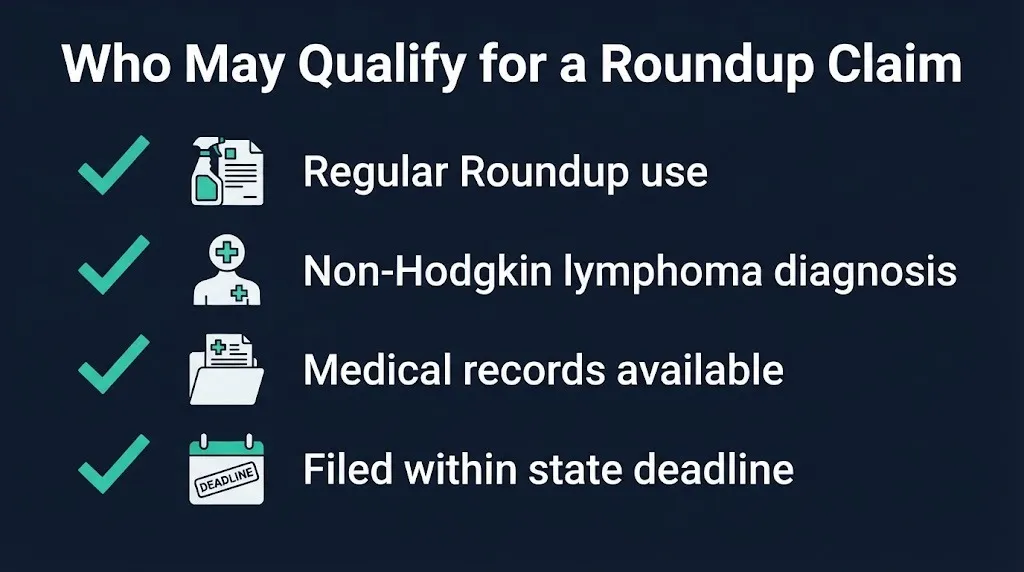
You may qualify for a Roundup lawsuit if you used the product regularly, have a qualifying diagnosis, and can prove the connection through medical and exposure records.
The most common qualifying diagnosis is non-Hodgkin lymphoma. Other cancers and injuries have been alleged, but non-Hodgkin lymphoma is the backbone of the litigation.
Here are the factors that matter most:
| Factor | Why It Matters |
|---|---|
| Diagnosis | Must match a claimed injury, usually NHL |
| Exposure duration | Longer use strengthens causation |
| Product type | Roundup branded products used by consumers |
| Latency period | Time between exposure and diagnosis |
| Medical records | Must show diagnosis and treatment |
If you used Roundup once years ago and have no cancer diagnosis, you likely do not have a claim. If you used it for years and have a qualifying lymphoma, you may.
A lawyer must review your records before you know if you have a case.
What Proof Do You Need to File a Roundup Claim?
You need medical records showing a qualifying diagnosis, plus evidence of Roundup use over a meaningful period.
Here is what to gather before you contact a lawyer:
- Complete medical records with the diagnosis and date.
- Pathology reports confirming the cancer type.
- Treatment records and prescription history.
- Receipts or purchase records for Roundup, if available.
- Employment records if you used Roundup at work.
- Witness statements from people who saw you use it.
- Photographs showing the product on your property, if possible.
You do not need perfect proof of every purchase. Many plaintiffs prove use through consistent testimony and circumstantial evidence.
The medical diagnosis is the non-negotiable part. No qualifying diagnosis, no case.
How Long Do You Have to File a Roundup Lawsuit?
The filing deadline for a Roundup lawsuit is governed by the statute of limitations in your state, usually two to three years from diagnosis or discovery.
The clock typically starts when you knew or should have known that Roundup may have caused your cancer, not when you first used the product.
Here is a general guide, not legal advice:
| State Category | Typical Filing Window |
|---|---|
| Two-year states | Texas, California, Pennsylvania |
| Three-year states | New York, Florida, Michigan |
| Discovery rule states | Clock starts at diagnosis or link discovery |
Some states have longer windows. Some have shorter. Do not wait because a website says there is still time.
The single biggest mistake people make is assuming they have missed their window and doing nothing. Let a lawyer check the date.
Key Takeaway: Your diagnosis and exposure history control eligibility, and your state’s deadline controls whether you can still file.
Reality Check: No legitimate law firm asks for upfront fees in a Roundup case. These are contingency fee cases. If someone asks for money to “process” your claim, walk away.
What Is the Current Status of Roundup Litigation in 2026?
Roundup litigation remains active in 2026, with settlements continuing and some trials still proceeding in state courts.
Bayer has resolved most of the older claims through settlement programs, but new claims continue to be filed. The company has also pursued legal defenses around preemption and labeling.
Here is a summary of the current landscape:
| Track | Status |
|---|---|
| Federal MDL | Largely resolved through settlements |
| State courts | Active trials in some jurisdictions |
| New claims | Still being filed by new plaintiffs |
| Settlement programs | Multiple, with different deadlines |
The litigation is not over. But the easy money phase, if it ever existed, is done. New claims must be thoroughly documented and timely filed.
What Should You Expect When You Contact a Roundup Lawyer?
When you contact a Roundup lawyer, expect a screening process before anyone agrees to represent you.
Here is what usually happens:
- You call or fill out a form.
- A case manager asks about diagnosis, exposure, and medical history.
- You sign a medical records release.
- A lawyer reviews the records.
- The firm accepts or declines the case.
- If accepted, you sign a retainer agreement.
- The firm files your case or adds you to a settlement program.
This is like applying for a mortgage. The lender checks your documents before approving anything. A good law firm does the same.
If a firm accepts you without seeing medical records, that is a warning sign.
What Questions Should You Ask a Roundup Attorney Before Signing?
Ask about experience, fees, communication, and trial history before you sign any retainer agreement.
Here are the essential questions:
- How many Roundup cases has your firm filed?
- Has your firm taken any Roundup case to verdict?
- What percentage of my recovery will you take?
- Who is my day-to-day contact?
- How long will my case take?
- What happens if my case loses?
- Do you advance case costs?
- Will you keep me updated, or will I chase you?
Write down the answers. A lawyer who will not answer these questions is not the best lawyer for your Roundup lawsuit.
What Are Common Mistakes People Make When Hiring a Roundup Lawyer?
The most common mistakes are rushing to sign, choosing the biggest advertiser, and not reading the fee agreement.
Here are mistakes to avoid:
| Mistake | Why It Hurts |
|---|---|
| Signing with the first firm you call | You miss better representation |
| Choosing by ad size | Ad spend does not equal skill |
| Ignoring the fee agreement | Costs can surprise you later |
| Lying about exposure | Weakens your credibility |
| Missing your state deadline | Kills your claim forever |
Take a week to compare firms. The litigation will still be there.
Key Takeaway: Screening works both ways. You are evaluating the lawyer as much as the lawyer is evaluating you.
How Do Roundup Attorney Fees Work?
Roundup attorney fees are contingency fees, meaning the lawyer gets paid only if you recover money.
The standard fee range is 33 to 40 percent of the gross recovery, before costs. Costs are separate and include filing fees, expert witnesses, and depositions.
Here is how a typical recovery breaks down:
| Item | Amount |
|---|---|
| Gross settlement | $200,000 example |
| Attorney fee, 33% | $66,000 |
| Case costs | $15,000 example |
| Net to client | $119,000 |
The percentages and costs vary by firm and case. Get the fee agreement in writing before signing.
Some firms negotiate lower fees for strong cases. Others charge more for cases that go to trial.
Can You Switch Roundup Lawyers If You Are Unhappy?
You can switch Roundup lawyers, but the old firm may have a lien on the case for work already performed.
This is common in mass tort cases. If you signed with a firm that is not communicating, you have the right to seek better representation.
The practical steps:
- Review your retainer agreement for termination clauses.
- Interview replacement lawyers before firing the current one.
- Ask how the new firm will handle the old firm’s lien.
- Get everything in writing from both firms.
- Make the switch only if the benefit outweighs the delay.
Switching lawyers slows your case, but staying with a bad lawyer is worse.
What Is the Long-Term Outlook for Roundup Litigation?
The long-term outlook for Roundup litigation depends on new claims, regulatory actions, and Bayer’s legal strategy.
The Environmental Protection Agency has maintained that glyphosate, the active ingredient in Roundup, is not likely to be carcinogenic. The International Agency for Research on Cancer classified it as probably carcinogenic.
That split keeps the litigation alive. Juries in some states have sided with plaintiffs. Others have sided with Bayer.
Here is what to watch in 2026 and beyond:
| Factor | Impact |
|---|---|
| New diagnoses | Continue to drive new claims |
| Regulatory shifts | Could strengthen or weaken causation |
| Trial outcomes | Set settlement benchmarks |
| Bayer’s financial position | Affects settlement willingness |
If you have a qualifying diagnosis, the safest move is to explore your legal options now, not wait for the litigation to end.
What Happens Next If You Pursue a Roundup Claim?
- Month 1: Gather medical records and contact qualified law firms.
- Month 1 to 3: Lawyer review and case acceptance.
- Month 3 to 6: Case filed or added to settlement program.
- Month 6 to 24: Discovery, settlement negotiation, or trial preparation.
- Final stage: Settlement payment or trial verdict, minus fees and costs.
Each case moves at its own pace. Some settle quickly through established programs. Others take years.
Frequently Asked Questions
What is the best law firm for a Roundup lawsuit?
The best firm is one with mass tort experience, trial history, and clear communication.
No single firm is best for every plaintiff.
How much does a Roundup lawyer cost?
A Roundup lawyer costs nothing upfront because fees are contingency based.
You pay only if you win, usually 33 to 40 percent.
How long does a Roundup lawsuit take?
A Roundup lawsuit can take six months to several years depending on the track.
Settlement program cases move faster than trial cases.
Can I still file a Roundup lawsuit in 2026?
You may still file if your diagnosis is recent and your state deadline has not passed.
A lawyer must check your specific filing window.
What cancers qualify for a Roundup lawsuit?
Non-Hodgkin lymphoma is the most common qualifying diagnosis.
Other cancers have been alleged but are less established in the litigation.
Do I need proof I bought Roundup?
Receipts help but are not required if you can prove use through testimony and records.
Your medical diagnosis is the critical proof.
How much will I actually receive from a Roundup settlement?
Your net recovery depends on your injury tier, settlement amount, fees, and costs.
No one can promise a specific number before reviewing your case.
Is Roundup still being sold?
Yes, Roundup remains on the market in most places.
The litigation does not stop sales, and the EPA has not banned glyphosate.
The best lawyer for your Roundup lawsuit is the one who reviews your records honestly, explains your options clearly, and has real experience in toxic exposure litigation.
Do not let an ad make the decision for you. Gather your medical records, interview at least two firms, and ask the hard questions before you sign.
Your filing deadline is the one thing you cannot recover. Start the process now.