Divorce Settlement 2026: How Negotiations Work, What You May Receive, and How to Protect Your Share
Quick Answer
- A divorce settlement is a private agreement dividing assets, debts, and support between spouses.
- There is no standard payout; amounts depend on state law, marriage length, income, and assets.
- Deadlines vary by state, but your divorce must be finalized before any settlement takes effect.
You searched for “divorce settlement” because you are either going through a divorce, thinking about one, or trying to understand what you might receive or owe.
A divorce settlement is not a class action. There is no settlement administrator, no claim form, and no fund you join. It is a private legal agreement between two people ending a marriage.
This article explains how divorce settlements actually work in 2026, what factors control the outcome, and how to avoid the most expensive mistakes people make.
| The Facts | |
|---|---|
| Case Type | Private marital dissolution |
| Status | Governed by state law, no national process |
| Fund Size | No fund, assets divided per state rules |
| Est. Per Person | Case-specific, no standard amount |
| Claim Deadline | State filing requirements apply |
| Administrator | None, negotiated or court-ordered |
| Proof Needed | Financial records, income, asset documentation |
Is a Divorce Settlement Legally Binding?
A divorce settlement is legally binding once a judge approves it and incorporates it into a final divorce decree.
Until the judge signs, the agreement is just a proposal. Either side can back out, change their mind, or ask for different terms.

The settlement becomes enforceable only after the court reviews it for fairness, especially when children are involved. A judge can reject a settlement that appears one-sided or fails to meet state legal standards.
This is different from a consumer class action settlement, where a settlement administrator handles claims. In divorce, the court itself is the authority.
If your ex violates the final agreement, you can return to court to enforce it through contempt proceedings or wage garnishment.
How Much Is the Average Divorce Settlement?
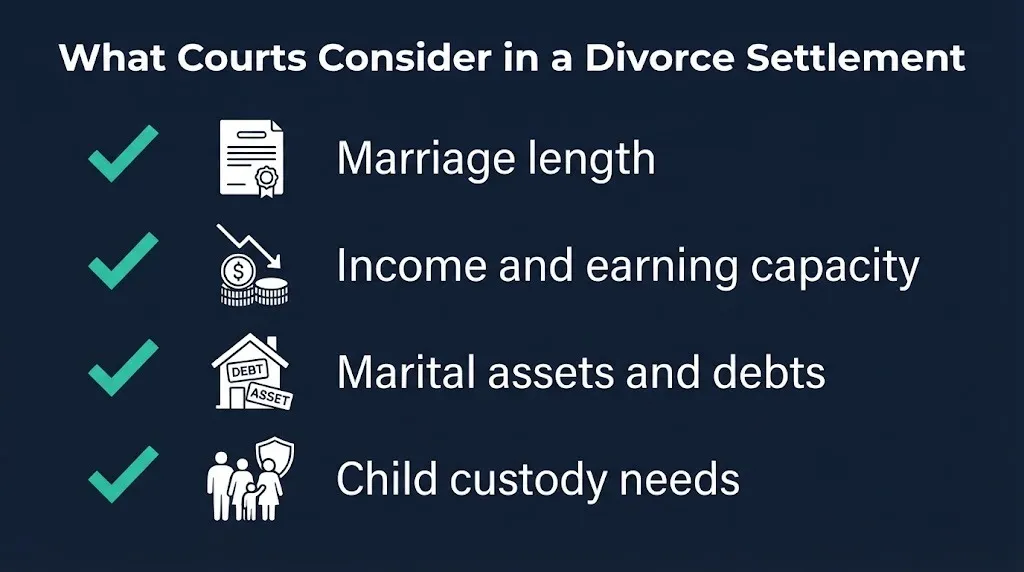
No single average divorce settlement amount exists because every marriage has different assets, debts, incomes, and state laws.
Some divorces settle for the division of modest bank accounts and a car. Others involve millions in property, retirement accounts, and business interests.
Here is how the financial picture typically breaks down:
| Factor | What It Affects |
|---|---|
| Marital assets | Property, savings, investments, retirement accounts |
| Marital debts | Mortgages, credit cards, loans |
| Income difference | Alimony or spousal support amounts |
| Marriage length | Duration of support and asset division approach |
| Child custody | Child support and parenting plans |
| State law | Community property or equitable distribution |
States divide property in one of two ways. Community property states split marital assets roughly equally. Equitable distribution states divide assets fairly, which does not always mean equally.
You cannot look up a standard “divorce settlement amount” because none exists.
How Is Property Divided in a Divorce Settlement?
Property division depends on whether your state uses community property or equitable distribution rules.
In community property states, like California and Texas, most assets acquired during the marriage are split 50/50. In equitable distribution states, like New York and Florida, the court divides assets based on fairness factors.
Here is the breakdown:
| State Type | Rule | States Include |
|---|---|---|
| Community property | Marital assets split equally | California, Texas, Arizona, Nevada |
| Equitable distribution | Assets divided fairly, not always equally | New York, Florida, Illinois, Ohio |
Assets you owned before the marriage usually stay separate. Gifts and inheritances received by one spouse usually stay separate too.
The problem is when separate and marital assets get mixed together. A house bought before marriage but paid for with joint funds can become partly marital property.
What Is Alimony and How Is It Calculated in 2026?
Alimony, also called spousal support or maintenance, is money one spouse pays the other after divorce.
Not every divorce includes alimony. Courts award it when one spouse earns significantly less or sacrificed career opportunities during the marriage.
Here are the factors courts consider:
| Factor | Why It Matters |
|---|---|
| Marriage length | Longer marriages often mean longer support |
| Income difference | Bigger gaps support larger payments |
| Health and age | Affects earning capacity |
| Standard of living | Courts try to avoid drastic drops |
| Contributions | Stay-at-home parenting counts |
The 2017 Tax Cuts and Jobs Act changed alimony tax treatment for divorces finalized after 2018. The payer can no longer deduct alimony, and the recipient no longer reports it as income.
That change remains in effect in 2026.
Key Takeaway: Property division, alimony, and child support are separate issues, each with its own legal rules.
How Does Child Support Fit Into a Divorce Settlement?
Child support is a separate obligation from alimony and property division, calculated by state guidelines based on income and parenting time.
Most states use a formula that considers both parents’ incomes, the number of children, and how much time each parent spends with them.
Here is what child support covers:
| Expense | Typically Covered |
|---|---|
| Housing and food | Yes |
| Clothing | Yes |
| Medical costs | Often shared separately |
| Education | May be additional |
| Extracurriculars | Sometimes included or shared |
Judges can deviate from guidelines in special cases, but the formula is the starting point. Parents cannot waive child support entirely because it belongs to the child, not the parent.
What Is the Difference Between a Contested and Uncontested Divorce Settlement?
An uncontested divorce settlement means both spouses agree on all terms. A contested divorce means they do not, and the court must decide.
Uncontested divorces are faster and cheaper. You negotiate the terms, write them up, and submit them for approval.
Contested divorces can drag on for a year or more, with discovery, depositions, and trial.
Here is the comparison:
| Factor | Uncontested | Contested |
|---|---|---|
| Cost | Lower, often under $5,000 total | Can exceed $30,000 per side |
| Time | 1 to 6 months | 1 to 3 years |
| Control | Spouses decide | Judge decides |
| Stress | Lower | Much higher |
Most divorces eventually settle before trial. Only a small percentage go all the way to a judge’s ruling.
Key Takeaway: The more you and your spouse can agree on, the faster and cheaper your settlement will be.
Reality Check: No government program or settlement website sends you a “divorce settlement check.” Your divorce is a private legal matter between you, your spouse, and the court. Anyone offering to process a divorce payout for a fee is running a scam.
How Do You Negotiate a Divorce Settlement?
You negotiate a divorce settlement by exchanging financial information, identifying your priorities, and working toward compromise.
Here are the steps:
- Gather complete financial records for both spouses.
- List all marital assets and debts with current values.
- Identify your non-negotiable priorities.
- Identify areas where you can compromise.
- Consider mediation before litigation.
- Put every agreement in writing.
- Have a lawyer review before you sign.
Mediation is often cheaper than court. A neutral mediator helps both sides reach agreement without a judge.
The negotiation is not about winning everything. It is about getting a settlement you can live with.
What Are the Most Common Divorce Settlement Mistakes?
The most common mistakes are hiding assets, ignoring tax consequences, and letting emotion drive decisions.
Here are the mistakes that cost people the most:
| Mistake | Consequence |
|---|---|
| Hiding assets | Court sanctions, lost credibility |
| Forgetting retirement accounts | Lose your share of the largest asset |
| Ignoring tax basis | Pay more tax later |
| Letting anger decide | Overspend on legal fees |
| Not updating beneficiaries | Ex gets assets after your death |
| Signing under pressure | Unfair settlement you regret |
The goal is not to punish your ex. The goal is to end the marriage with a settlement that lets both of you move forward.
What Is a Gray Divorce Settlement?
A gray divorce settlement is a divorce involving couples over 50, and it often focuses on retirement accounts, Social Security, and healthcare.
Gray divorce rates have risen for decades. Older couples face unique issues that younger couples do not.
Here is what matters most in gray divorce:
| Issue | Why It Matters |
|---|---|
| Retirement accounts | Often the largest asset to divide |
| Social Security | Spousal benefits may apply after 10-year marriage |
| Healthcare | Losing a spouse’s plan changes costs |
| Limited earning years | Harder to recover financially |
A Qualified Domestic Relations Order, or QDRO, is often needed to divide 401(k) and pension accounts without tax penalties.
Key Takeaway: The biggest mistakes are emotional decisions, hidden assets, and ignoring tax consequences.
Can You Modify a Divorce Settlement After It Is Final?
You can modify some parts of a divorce settlement, like child support and sometimes alimony, but property division is usually final.
Courts allow modification of child support when circumstances change significantly, such as job loss or a major income shift. Alimony may be modifiable depending on the agreement and state law.
Property division is almost never modified. Once the judge approves the asset split, it is done.
Here is the general rule:
| Issue | Modifiable? |
|---|---|
| Child support | Yes, with changed circumstances |
| Child custody | Yes, based on child’s best interest |
| Alimony | Sometimes, depends on terms |
| Property division | Rarely, usually final |
If you want to change something, file a modification motion. Do not stop paying without court approval.
How Does a Business Get Valued in a Divorce Settlement?
A business owned during the marriage is a marital asset in most states, and its value must be determined before division.
Business valuation is complex. Experts are often hired to determine what the business is worth.
Here are the common methods:
| Method | How It Works |
|---|---|
| Income approach | Value based on earnings and projections |
| Market approach | Compare to similar business sales |
| Asset approach | Value of assets minus liabilities |
One spouse may keep the business and buy out the other’s share with other assets. Or the business may be sold and the proceeds split.
If you or your spouse owns a business, do not try to value it yourselves. Hire a neutral expert.
What Happens to Debt in a Divorce Settlement?
Debt accumulated during the marriage is divided like assets, but creditors do not care what your divorce decree says.
In community property states, marital debt is generally split equally. In equitable distribution states, debt is divided fairly based on who incurred it and why.
The problem is that divorce decrees only bind you and your ex. Creditors are not parties to your divorce.
If your ex stops paying a joint credit card, the creditor can still come after you. Your remedy is to return to court for enforcement, not to argue with the bank.
Here is the practical rule:
| Debt Type | What Happens |
|---|---|
| Joint credit cards | Both remain liable to creditor |
| Mortgage | Both liable unless refinanced |
| Student loans | Usually separate, incurred before marriage |
| Medical debt | Divided by state rules |
Get your name off joint accounts during the divorce process, not after.
Key Takeaway: Property division is usually final, but child support and sometimes alimony can be modified later.
What Is a Qualified Domestic Relations Order?
A Qualified Domestic Relations Order, or QDRO, is a court order that divides retirement accounts without tax penalties.
Most retirement plans require a QDRO before they will pay a portion to an ex-spouse. Without it, the account owner keeps everything.
Here is what a QDRO does:
| Function | Why It Matters |
|---|---|
| Splits 401(k) and pensions | Transfers your share directly |
| Avoids early withdrawal penalties | Not treated as taxable distribution |
| Names the alternate payee | You receive your portion directly |
The QDRO must be prepared after the divorce decree and approved by the plan administrator. This step is often forgotten, and it costs people their retirement share.
How Long Does a Divorce Settlement Take?
A divorce settlement takes one to six months in uncontested cases and one to three years in contested cases.
The timeline depends on complexity, cooperation, and court backlogs. Here is a general schedule:
| Stage | Typical Timing |
|---|---|
| Filing and financial disclosure | 1 to 3 months |
| Negotiation or mediation | 1 to 6 months |
| Discovery, if contested | 6 to 18 months |
| Trial, if no settlement | 12 to 36 months |
| Final decree | After settlement or trial |
Your state’s waiting periods also matter. Some states require a minimum separation period before divorce can be finalized.
What Happens Next After You Reach a Divorce Settlement?
- Settlement agreed: Both spouses sign the written agreement.
- Court review: A judge reviews for fairness and legal compliance.
- Final decree issued: The divorce becomes official.
- QDRO prepared: Retirement accounts are divided.
- Account transfers: Assets and debts are moved per the decree.
Each step requires paperwork and follow-through. A signed settlement is not the end. It is the beginning of implementation.
Frequently Asked Questions
What is a divorce settlement?
A divorce settlement is a written agreement dividing assets, debts, and support between spouses.
It becomes binding when a judge approves it.
How much does a divorce settlement cost?
An uncontested divorce can cost a few thousand dollars or less.
A contested divorce can cost tens of thousands per spouse.
Can I get alimony in my divorce settlement?
You may get alimony if your income is much lower or you sacrificed career opportunities.
Courts weigh marriage length, health, and earning capacity.
How is child support calculated in a divorce settlement?
Child support is calculated using state guidelines based on income and parenting time.
Judges can deviate in special cases.
What happens if my ex violates the divorce settlement?
You can return to court for enforcement through contempt proceedings or wage garnishment.
Do not stop paying your own obligations without court approval.
Can I change my divorce settlement later?
Child support and sometimes alimony can be modified with changed circumstances.
Property division is usually final.
Do I need a lawyer for a divorce settlement?
You are not required to have a lawyer, but divorce law is complex and unforgiving.
Most people benefit from at least a lawyer review before signing.
What is a gray divorce settlement?
A gray divorce involves couples over 50 and focuses on retirement, Social Security, and healthcare.
These cases require special attention to retirement accounts and QDROs.
The single most important thing to know about divorce settlements is that they are private, state-specific, and final once approved.
Gather your financial records, know your state’s property rules, and get professional help before you sign anything.
The settlement you accept today determines your financial life for years. Treat it with the seriousness it deserves.