Variable Compensation 2026: Plan Structures, Legal Protections, and What Employees Should Know
Quick Answer
- Variable compensation is real and includes bonuses, commissions, and profit sharing.
- No national settlement exists; disputes are handled case by case under state wage laws.
- Deadlines for unpaid wage claims vary by state, typically two to four years.
If you earn a bonus, commission, or profit share, you have variable compensation. That money is not guaranteed the way base salary is, and that distinction is exactly where legal disputes arise.
Variable compensation plans are governed by employment contracts, offer letters, and state wage laws. When employers change the plan or refuse to pay, workers often have legal claims for unpaid wages.
This article explains how variable compensation works, what the law requires, and what to do if your employer owes you money. One surprising detail: in many states, earned commissions and bonuses are considered wages, which means employers who fail to pay them can face penalties far beyond the amount owed.
The Facts
| Topic | Verified Detail |
|---|---|
| Variable compensation types | Bonuses, commissions, profit sharing |
| Legal classification | Often treated as wages under state law |
| Unpaid wage deadlines | 2 to 4 years depending on state |
| Common disputes | Plan changes, clawbacks, unpaid final bonuses |
| Governing laws | State wage laws, FLSA, employment contracts |
What Is Variable Compensation?
Variable compensation is pay that depends on performance, results, or company profitability. Unlike base salary, it is not fixed and can vary from year to year.
The most common forms are bonuses, commissions, profit sharing, and incentive pay. Sales professionals often rely on commissions. Executives often receive performance bonuses. Some workers receive profit sharing tied to company earnings.
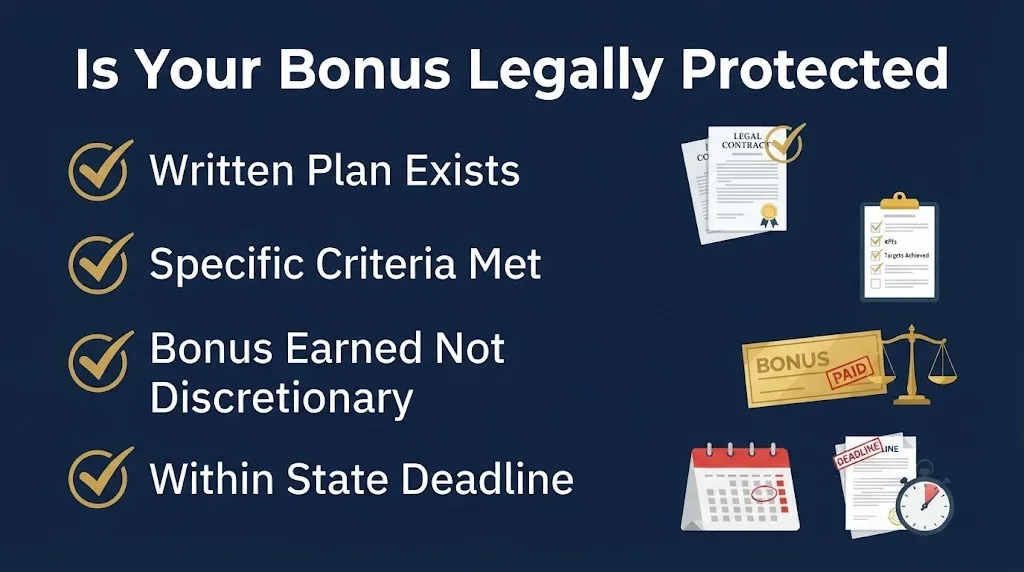
The key legal question is whether the money is discretionary or earned. If it is earned, the law may treat it as wages. If it is discretionary, the employer has more freedom.
Key Takeaway: The difference between discretionary and earned compensation is the single most important legal distinction in these disputes.
What Are Common Variable Compensation Plan Examples?
Variable compensation plans come in many forms. Here are the most common examples.
| Plan Type | How It Works |
|---|---|
| Sales commission | Percentage of sales revenue paid to the seller |
| Annual bonus | Lump sum based on company or individual performance |
| Profit sharing | Portion of company profits distributed to employees |
| Stock options | Right to buy company stock at a set price |
| Retention bonus | Payment for staying with the company a set period |
Each plan has its own terms, and those terms control whether the money is earned or discretionary.
Is Variable Compensation Legally Protected?
Variable compensation is legally protected when it is earned. Many state laws treat earned commissions and bonuses as wages that must be paid.
The federal Fair Labor Standards Act, known as the FLSA, sets minimum wage and overtime rules. It does not require bonuses, but if a bonus is promised and earned, state law often steps in.
California, New York, and many other states have strong wage laws that classify earned bonuses and commissions as wages. That classification gives workers powerful tools to recover unpaid amounts.
Key Takeaway: If your variable compensation is earned, it is likely protected by wage laws. If it is discretionary, your protection is weaker.
Can an Employer Refuse to Pay a Bonus?
An employer can refuse to pay a bonus only if the bonus is truly discretionary. A discretionary bonus is one where the employer has full freedom to decide whether to pay and how much.
If the bonus is tied to specific criteria, such as hitting a sales target, and you hit the target, the bonus is probably earned. Refusing to pay an earned bonus can violate wage laws.
The plan document or offer letter is the controlling document. It should state whether the bonus is discretionary or earned.
What Is the Difference Between Discretionary and Earned Bonuses?
A discretionary bonus is one where the employer decides after the fact whether to pay. There is no formula, no target, and no promise.
An earned bonus is one where the employee meets defined criteria and the bonus becomes due. The criteria might be individual performance, company revenue, or specific goals.
The difference matters because earned bonuses are usually wages under state law. Discretionary bonuses are not.
Reality Check: No national settlement or class action fund exists for variable compensation disputes. Each case is handled individually under state law. If someone tells you a “bonus settlement” check is coming, verify it against court records before believing anything.
What Are Variable Incentive Compensation Plans?
Variable incentive compensation plans are structured programs that tie pay to performance metrics. They are common in sales, finance, and executive roles.
These plans define the metrics, the payout formula, and the timing. A well-drafted plan leaves little room for dispute because the terms are clear.
A poorly drafted plan creates legal risk. Ambiguous language about whether pay is earned or discretionary is a common source of litigation.
What Happens If My Employer Changes the Plan?
Your employer can change a variable compensation plan for future periods, but not retroactively. Changing the plan after you have already earned money is usually illegal.
For example, if you earned a commission in March, the employer cannot change the plan in April and refuse to pay the March commission. That money is already earned.
Changes that apply only to future periods are generally allowed. The employer must give notice, and you may have the right to accept or reject the change depending on your contract.
What Is a Clawback and Is It Legal?
A clawback is a demand that you repay compensation already received. Clawbacks are legal if they are part of your compensation agreement and triggered by specific events.
Common clawback triggers include financial restatements, misconduct, or leaving the company before a certain date. The terms must be in writing and clear.
If the clawback is not in your agreement, the employer may struggle to enforce it. State wage laws often protect earned compensation from clawback.
Key Takeaway: Clawbacks are only enforceable if they are clearly spelled out in writing. Verbal clawback threats are often empty.
What Should I Do If My Employer Owes Me a Bonus or Commission?
If your employer owes you variable compensation, act quickly. Here is a checklist.
- Review your offer letter and plan documents.
- Document the criteria you met and the amount owed.
- Send a written demand to the employer.
- File a wage claim with your state labor agency.
- Consult an employment attorney if the amount is substantial.
State wage claims are free to file and can be effective for smaller amounts. Larger disputes often require a lawyer.
What Is the Deadline to File an Unpaid Wage Claim?
The deadline to file an unpaid wage claim depends on your state. Most states allow two to four years from the date the wage was due.
Some states have shorter deadlines for certain claims. Administrative wage claims may have different deadlines than court cases.
Do not wait. The clock starts when the money was due, not when you discovered the problem. Every month of delay weakens your claim.
How Are Variable Compensation Disputes Resolved?
Variable compensation disputes are resolved through negotiation, administrative wage claims, or litigation. Most settle before trial.
Administrative wage claims are the fastest path for smaller amounts. Your state labor commissioner can investigate and order payment.
Litigation is slower but can recover more, including penalties and attorney fees in some states. California, for example, allows recovery of waiting time penalties on top of unpaid wages.
What States Have the Strongest Wage Protection Laws?
California, New York, Massachusetts, and Illinois have strong wage protection laws for variable compensation. Those states classify earned bonuses and commissions as wages.
Other states have weaker protections. In those states, the language of your contract matters even more.
If you work remotely or across state lines, the applicable law may be complex. An employment attorney can help you determine which state’s law applies.
Key Takeaway: Your legal protection depends heavily on where you work and what your contract says.
What Happens Next If You File a Wage Claim?
If you file a wage claim, the state labor agency will investigate. The employer will be asked to respond with its side of the story.
Many claims settle during the investigation. If not, the agency may hold a hearing and issue a decision.
If the decision is in your favor, the employer is ordered to pay. If the employer refuses, the agency can pursue enforcement.
Expected weeks 1 to 4: Agency reviews your claim and contacts employer.
Expected months 1 to 6: Investigation and possible settlement.
Expected months 6 to 12: Hearing and decision if not settled.
If appealed: Court review adds another year or more.
Frequently Asked Questions
Is variable compensation the same as salary?
No, salary is fixed pay. Variable compensation depends on performance or results.
Can my employer withhold my bonus if I quit?
If the bonus is earned, the employer generally must pay it even if you quit.
Are commissions considered wages?
In many states, earned commissions are wages and are protected by wage laws.
What is a discretionary bonus?
A bonus the employer decides to pay without any pre-set criteria.
How long do I have to file a wage claim?
Most states allow two to four years from the date the wage was due.
Can my employer claw back my bonus?
Only if the clawback is clearly stated in your written agreement.
Do I need a lawyer for a wage claim?
For small claims, the state labor agency may be enough. For large claims, a lawyer helps.
Where can I file a wage claim?
File with your state labor commissioner or department of labor.
Your next step is to review your compensation plan and document everything. If you believe you are owed money, file a wage claim or consult an employment attorney. The deadlines are running, and the law rewards those who act quickly.
The single most important fact: earned variable compensation is often legally protected as wages. Do not let an employer convince you otherwise without checking your state’s laws.