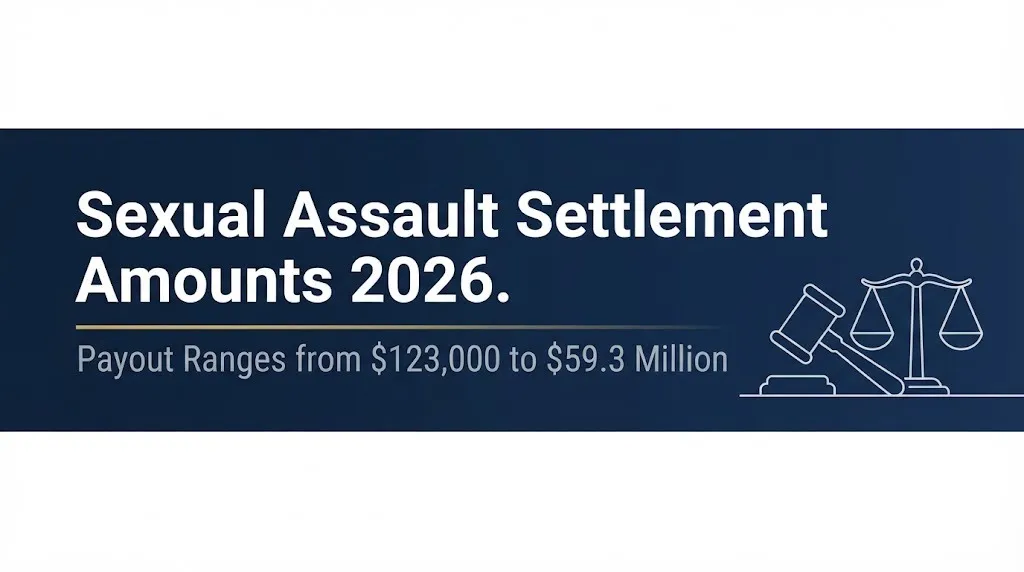
Sexual Assault Settlement Amounts 2026: Real Payout Ranges and Compensation Factors
Quick Answer
- Is it legit? Yes. Survivors can pursue civil damages through lawsuits, bankruptcy trusts, and victim compensation programs.
- How much? No fixed average exists. Settlements range from six figures to tens of millions based on case strength.
- Key deadline: California’s AB 250 lookback window runs through December 31, 2027 for entity cover-up claims.
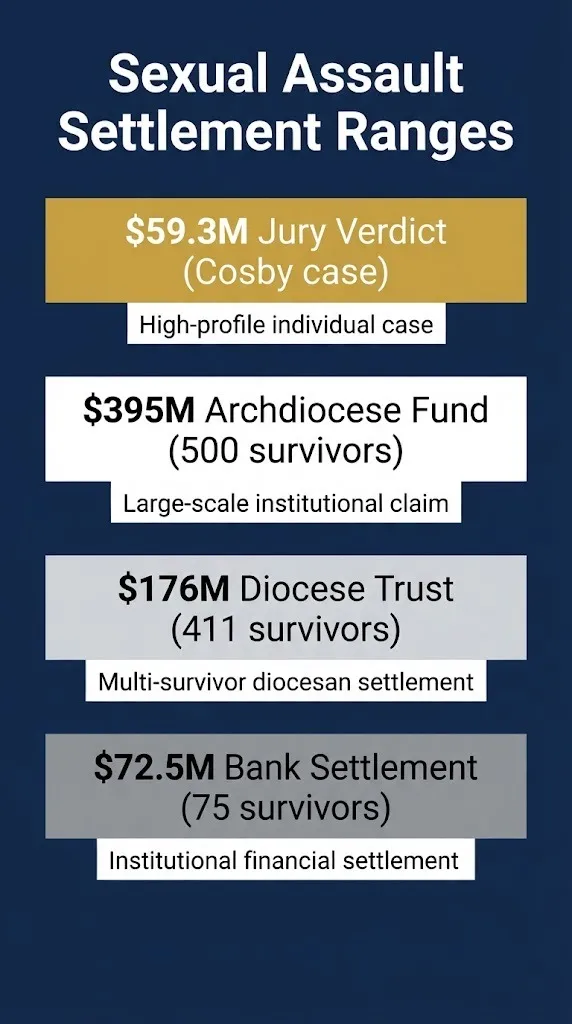
When you search for “sexual assault settlement amounts,” you are asking a question with no single answer. The range is enormous. A single survivor suing an individual perpetrator might recover $100,000. A group of 500 survivors suing an institution can split a $395 million fund .
What determines the number? Evidence, the defendant’s wealth, whether an organization covered up the abuse, and the jurisdiction where you file. A jury in California awarded $59.3 million to one woman in March 2026 . A bankruptcy trust in New York distributed $176.1 million among 411 survivors, averaging roughly $428,000 each .
This guide breaks down verified settlement amounts from 2026 cases, the factors that drive payouts up or down, and the deadlines you cannot afford to miss.
The Facts
| Topic | What You Need to Know |
|---|---|
| Typical Settlement Range | $100,000 to $1 million for individual claims against institutions |
| Jury Verdict Range (2026) | $19.3 million to $59.3 million in California cases |
| Bankruptcy Trust Average | $428,000 per survivor in Syracuse Diocese case |
| Epstein Estate Settlement | $25 million to $35 million total for 40+ survivors |
| Bank of America Settlement | $72.5 million for up to 75 Epstein survivors |
| Minimum Statutory Award | $123,000 under proposed federal Survivors’ Rights Act |
| California Lookback Deadline | December 31, 2027 under AB 250 |
What Is the Average Sexual Assault Settlement Amount in 2026?
There is no reliable national average, but most institutional settlements range from $100,000 to $1 million per survivor. The variation is too wide for a single number to mean anything.
Consider the verified data points from 2026. The Syracuse Diocese funded a $176.1 million trust for 411 survivors, which works out to roughly $428,000 per claimant if distributed equally . The San Francisco Archdiocese agreed to a $395 million settlement for over 500 survivors, averaging approximately $790,000 each .
Individual jury verdicts run higher. A California jury awarded $59.3 million to Donna Motsinger, who was assaulted by Bill Cosby in 1972, including $40 million in punitive damages . Another Cosby accuser received $19.3 million in a separate civil case .
The Epstein estate settlement offered $25 million to $35 million total for approximately 40 survivors, which averages $625,000 to $875,000 per person if all claims are approved .
These numbers illustrate the range. Your case value depends on facts unique to your situation.
Sexual Assault Settlement Amounts by Case Type
Settlement values track closely with the defendant type and evidence strength. Here is how the ranges break down based on 2026 data:
| Case Type | Typical Range | Key Factors |
|---|---|---|
| Individual perpetrator, limited assets | $50,000 to $250,000 | Insurance coverage, ability to collect |
| Institutional defendant (church, school) | $200,000 to $1 million+ | Number of survivors, organizational wealth |
| Corporate defendant with cover-up evidence | $500,000 to $5 million+ | Punitive damages potential |
| Bankruptcy trust distribution | $100,000 to $500,000 | Total fund divided among claimants |
| Epstein-related settlements | $500,000 to $1 million+ | Estate assets, bank liability |
A plain-life comparison: think of it like buying a house. The listing price gets your attention, but the condition, location, and seller’s motivation determine what you actually pay. In sexual assault cases, the defendant’s assets and insurance coverage are the “location.” The evidence is the “condition.”
Key Takeaway: No single average settlement exists. Institutional cases against churches and corporations produce the largest payouts, while claims against individuals with limited assets often settle for less than $250,000.
How Much Compensation Can Sexually Abused Victims Get?
Victims can recover economic damages, non-economic damages, and in some cases punitive damages. The total depends on what you can prove.
Economic damages cover quantifiable losses. That includes medical expenses, therapy costs, lost wages, and reduced earning capacity. These are documented with receipts and records.
Non-economic damages compensate for pain, suffering, emotional distress, and loss of enjoyment of life. The Cosby jury awarded $17.5 million in past damages and $1.75 million for future damages, including mental suffering, grief, anxiety, and humiliation .
Punitive damages punish the defendant and deter future conduct. The same Cosby jury added $40 million in punitive damages in a second phase of trial . Punitive damages require proof of malice, oppression, or fraud.
Some jurisdictions allow claims against organizations that enabled the abuse. California’s AB 218, passed in 2020, expanded the statute of limitations and allowed triple damages against institutions that covered up abuse . That law enabled the San Francisco Archdiocese settlement.
What Factors Determine Sexual Assault Settlement Amounts?
Evidence quality, the defendant’s wealth, the number of survivors, and jurisdiction are the four biggest drivers. Each factor can move a settlement by hundreds of thousands of dollars.
Evidence quality is paramount. Contemporaneous records, witness testimony, police reports, and documentation of the assault strengthen your case. In the Syracuse Diocese bankruptcy, the trust fund was distributed by an independent arbiter based on claim evaluation .
Defendant’s wealth determines collectability. A judgment against an individual with no assets is worth little. A claim against a diocese, a corporation, or an insured professional has a deeper pool. Bank of America agreed to a $72.5 million settlement for Epstein survivors because it had the resources to pay .
Number of survivors affects the per-person payout in group settlements. A larger class divides the same fund more ways. But larger classes also increase pressure on defendants to settle.
Jurisdiction matters enormously. California has some of the most survivor-friendly laws in the country. AB 250, which took effect January 1, 2026, created a new two-year window for claims against entities that covered up abuse . The deadline is December 31, 2027.
Reality Check: No legitimate attorney or settlement administrator will text you asking for a fee to “release” your sexual assault settlement. Filing claims is always free. Anyone demanding payment upfront is preying on survivors. Report them.
How to File a Sexual Assault Civil Claim
Filing a civil claim requires meeting your state’s statute of limitations, gathering evidence, and often finding an attorney who handles survivor cases. Here is the process:
- Check your state’s deadline before anything else. Some states have eliminated civil statutes of limitations entirely for sexual assault .
- Preserve all evidence: Texts, emails, medical records, therapy notes, and any documentation of the assault.
- Consult a survivor-focused attorney. Most work on contingency and offer free initial reviews.
- File the civil complaint in the appropriate court.
- Participate in discovery and any court-ordered mediation.
- Attend trial if settlement talks fail.
- Receive your award after judgment or settlement approval.
California’s current law allows filing within 10 years of the assault or 3 years from discovering that an injury resulted from the assault . The state also has a revival window through December 31, 2026 for certain claims .
What Is the California Sexual Assault Lookback Window?
California’s AB 250 created a new two-year lookback window from January 1, 2026 through December 31, 2027. This law revives claims against entities that covered up sexual assault .
The original lookback window under AB 2777 gave survivors until December 31, 2026 to file for assaults occurring on or after January 1, 2009 . AB 250 extended that deadline to December 31, 2027 and expanded it to cover claims against entities that engaged in cover-ups.
To qualify under AB 250, you must show that you were assaulted, that an entity is legally responsible for your injury, and that the entity engaged in a “concerted effort to hide evidence” or used nondisclosure agreements to keep you silent .
The law exempts public entities, including the State of California and the University of California system . Claims against private organizations, churches, corporations, and individuals are covered.
If your assault occurred in California and involved an institutional cover-up, December 31, 2027 is the date that matters.
Frequently Asked Questions
What is the average sexual assault settlement amount?
No single average exists. Institutional settlements range from $100,000 to $1 million per survivor, while jury verdicts can exceed $50 million for egregious cases .
How much compensation can sexually abused victims get?
Victims can recover economic damages, emotional distress damages, and punitive damages. The total depends on your losses, the defendant’s assets, and the evidence you can prove.
How long do you have to file a sexual assault lawsuit?
It varies by state. Some states have eliminated civil statutes of limitations entirely. California allows 10 years from the assault or 3 years from discovery of injury .
What is the Epstein survivors settlement amount?
The Epstein estate agreed to pay $25 million to $35 million total to roughly 40 survivors. Bank of America separately settled for $72.5 million for up to 75 survivors .
Can you sue an organization for sexual assault?
Yes, if the organization enabled the abuse or covered it up. California’s AB 250 creates a specific cause of action against entities that concealed abuse .
What is the California AB 250 lookback window?
It runs from January 1, 2026 through December 31, 2027. The law revives time-barred claims against entities that covered up sexual assault .
Do you need a lawyer to file a sexual assault claim?
You can file on your own, but the process is complex. Most survivor attorneys work on contingency, meaning you pay nothing unless you recover.
How long does a sexual assault settlement take?
Most cases settle within 1 to 3 years of filing. Bankruptcy trust distributions can take longer because of the number of claimants involved.
What Happens Next for Survivors
If your assault occurred in California with an entity cover-up: File before December 31, 2027 under AB 250.
If you are considering a civil claim: Consult a survivor-focused attorney immediately. Deadlines are strict and vary by state.
If you are part of a bankruptcy trust: Watch for notice from the independent arbiter. Claims are evaluated on a rolling basis.
If you are unsure about your options: RAINN recommends that states eliminate civil statutes of limitations entirely for sex crimes . Several states have already done so.
The single most important thing is this: your deadline is the number that matters. Evidence can wait. Gathering documentation can wait. But the statute of limitations will not. Check your state’s rules today. If you are in California and have an entity cover-up claim, December 31, 2027 is your date.