Chemo Port and PowerPort Lawsuits in 2026: Claims, Injuries, and What Patients Should Know
Quick Answer
- Chemo port lawsuits allege that implanted port devices fractured, migrated, or caused infections, blood clots, and other serious injuries.
- The Bard PowerPort litigation is the largest, with thousands of cases consolidated in a federal multidistrict litigation in Arizona.
- No global settlement or claims process exists in 2026; individual cases continue moving through the MDL and state courts.
If you typed “chemo port lawsuit,” “PowerPort lawsuit,” or “port lawsuit” into a search bar, you probably have a port implanted, know someone who does, or saw an attorney advertisement and want to know whether the litigation is real and whether you might qualify. This article gives you the verified facts using court records, FDA filings, and MDL dockets, not law firm marketing pages.
The litigation is real. It has been running for years. The core allegation is that certain implantable port devices, especially the Bard PowerPort, were defectively designed or manufactured, leading to fractures, infections, and other complications.
The surprising verified detail: the FDA cleared the Bard PowerPort through the 510(k) process, which means it was approved based on similarity to an existing device, not through new clinical trials. That regulatory path is now central to the litigation.
The Facts
| Fact | Detail |
|---|---|
| Primary device | Bard PowerPort and related implantable port devices |
| Manufacturer | Becton Dickinson, which acquired C.R. Bard |
| Injury allegations | Catheter fracture, migration, infection, thrombosis, organ damage |
| MDL court | U.S. District Court, District of Arizona |
| MDL number | 3081 |
| Case count | Thousands of cases pending |
| Global settlement | None confirmed as of September 2026 |
| Claims administrator | None for a class-wide payout |
Is the Chemo Port Lawsuit Real and Active in 2026?
The chemo port litigation is real and remains active in 2026. The Judicial Panel on Multidistrict Litigation consolidated federal Bard PowerPort cases into MDL 3081 in the District of Arizona. That MDL is still open.
Thousands of cases have been filed. Some allege the catheter fractured and pieces migrated to the heart or lungs. Others allege infections, thrombosis, or device malfunction requiring surgical removal.
No global settlement has been announced. This is a mass tort, not a class action. Each plaintiff’s case proceeds individually, even though pretrial proceedings are consolidated.
If you see an advertisement claiming a chemo port class action settlement is paying out, that claim is not verified. Check the MDL docket or a legitimate legal news source before relying on it.
Key Takeaway: The litigation is active and real, but there is no class-wide settlement. Each case stands or falls on its own facts.
What Is the Bard PowerPort and Why Is It the Subject of Lawsuits?
The Bard PowerPort is an implantable vascular access device. Doctors implant it under the skin, usually in the chest or arm, to deliver chemotherapy, fluids, blood draws, or other intravenous treatments without repeated needle sticks.
The device has a catheter that runs from the port into a large vein. The lawsuits allege that the catheter can fracture, crack, or break over time. When that happens, pieces can migrate through the bloodstream to the heart or lungs.
Other alleged problems include the port reservoir separating from the catheter, infection at the implant site, blood clots around the device, and the device shifting or eroding through the skin.
Becton Dickinson, the current manufacturer after acquiring C.R. Bard, has denied the allegations. The company says the device is safe when used properly and that complications are rare.
Key Takeaway: The PowerPort is a widely used device, but thousands of patients say it fractured or failed in ways that caused serious harm.
What Injuries Are Alleged in the PowerPort Lawsuits?
The injuries alleged in the PowerPort lawsuits are serious and sometimes life-threatening. The table below shows the most common injury categories and what they mean for patients.
| Injury Type | Description | Typical Claim |
|---|---|---|
| Catheter fracture | The catheter breaks or cracks while implanted | Migration, surgical removal, organ damage |
| Catheter migration | Pieces of the catheter travel through the bloodstream | Heart or lung damage, emergency surgery |
| Infection | Bacterial infection at the implant site or in the bloodstream | Hospitalization, port removal, sepsis |
| Thrombosis | Blood clots form around the catheter or port | Anticoagulation therapy, stroke risk |
| Port failure | Device stops working or cannot be accessed | Replacement surgery, treatment delays |
Each injury type requires different medical evidence. The strongest cases have imaging showing the fracture or migration, surgical records documenting removal, and a clear timeline connecting the device to the injury.
Key Takeaway: The injuries alleged are not cosmetic. They involve emergency surgery, organ damage, and lasting harm.
Has the FDA Recalled the Bard PowerPort?
The FDA has not issued a full recall of the Bard PowerPort as of September 2026. The device remains on the market.
However, the FDA has issued safety communications about implantable ports, including a 2020 letter to healthcare providers warning about the risk of catheter fracture and migration. The agency has also received thousands of adverse event reports related to port devices.
Becton Dickinson has issued some field safety notices and updated labeling in certain regions, but a full market recall has not occurred. The absence of a recall is a point of contention in the litigation.
Plaintiffs argue that the company should have recalled the device earlier. The company argues that the device is safe and that no recall is warranted.
Reality Check: No legitimate settlement administrator is sending text messages about a PowerPort payout. No one from the MDL court will call you. If someone offers to file your claim for a fee, that fee is unnecessary. Mass tort cases require a lawyer, not a claims form.
Who Qualifies to File a Chemo Port Lawsuit in 2026?
Qualification depends on several factors, and no single rule applies to everyone. You may have a claim if you received a Bard PowerPort or another alleged defective port, experienced a complication such as fracture, migration, infection, or thrombosis, and required medical treatment for the injury.
The strongest cases share certain features. The patient had a documented PowerPort implant. The device failed or was removed due to complications. Imaging or surgical records document the failure. The patient suffered lasting harm or required additional surgery.
Time matters. Each state has a statute of limitations for personal injury and product liability claims. In some states, that window is as short as one or two years from discovery. If too much time has passed, a lawyer may decline your case.
If you are not sure whether your port was a Bard PowerPort, check your medical records. The device manufacturer and model should be listed in your surgical notes or implant card.
Key Takeaway: The strongest cases involve a documented PowerPort implant, a device failure, and lasting harm, filed within the state’s time limit.
How Much Could a PowerPort Lawsuit Pay?
There is no fixed payout schedule, and no jury has awarded a standard amount. Settlement values in mass tort litigation depend on the strength of individual cases, the number of claims, and the defendant’s willingness to resolve them.
In similar medical device litigations, settlements have ranged widely. Some mass tort cases settle for a few thousand dollars per plaintiff. Others settle for six or seven figures for the most serious injuries.
The table below shows illustrative ranges based on comparable medical device mass tort settlements, not specific PowerPort offers.
| Settlement Tier | Typical Characteristics | Illustrative Range |
|---|---|---|
| Low | Device removed, limited complications | $10,000 to $75,000 |
| Medium | Fracture or migration, surgical removal, ongoing symptoms | $75,000 to $250,000 |
| High | Organ damage, emergency surgery, permanent harm | $250,000 to $1 million+ |
| Trial verdict | Jury award, rare | Varies widely |
These are not promises. No PowerPort global settlement exists, so these figures are comparisons from other device litigations, not verified PowerPort payout amounts.
Attorney fees typically range from 33 to 40 percent of any recovery, plus litigation costs. That is standard for mass tort cases and should be spelled out in a written fee agreement.
Key Takeaway: Payouts in medical device litigation vary widely. No PowerPort settlement exists yet, so any specific figure is speculation.
How Do I Find a Chemo Port Lawyer in 2026?
Finding a qualified chemo port lawyer takes research, not just clicking the first ad you see. The right lawyer has mass tort experience, medical device litigation experience, and the resources to handle a case against a large manufacturer.
Start with these steps.
- Search the MDL docket to identify law firms actively filing PowerPort cases.
- Check each firm’s track record in other medical device mass torts.
- Read the firm’s bar record and disciplinary history in every state where it practices.
- Ask whether the firm handles the case itself or refers it to another firm for a fee.
- Ask how many PowerPort cases the firm has filed, not just how many clients it has signed.
- Get the fee agreement in writing before signing anything.
- Ask who your main contact will be and how often you will get case updates.
Many firms advertise PowerPort cases but refer them to other firms. That is legal and common, but you should know who actually handles your case.
Key Takeaway: The right lawyer has real mass tort experience, files cases in the MDL, and answers your questions directly.
What Evidence Do I Need for a Chemo Port Case?
Documentation makes or breaks a chemo port case. The essential evidence includes medical records showing the PowerPort implant, records showing the complication, and documentation of the treatment you received for the injury.
Imaging is critical. X-rays, CT scans, or echocardiograms that show a fractured or migrated catheter are powerful evidence. Surgical records documenting removal of the device or fragments are equally important.
Photographs help. If you have photos of the implant site, the removed device, or visible complications, keep them.
The device itself matters. If the explanted port was preserved, it can be tested. Not all hospitals preserve explanted devices, but if yours did, that evidence is invaluable.
Gather these records before you contact a lawyer. You can request them from hospitals, clinics, and surgical centers.
Key Takeaway: Medical records, imaging, surgical notes, and the explanted device itself are the core evidence in a chemo port case.
What Is the Current Status of the PowerPort MDL in 2026?
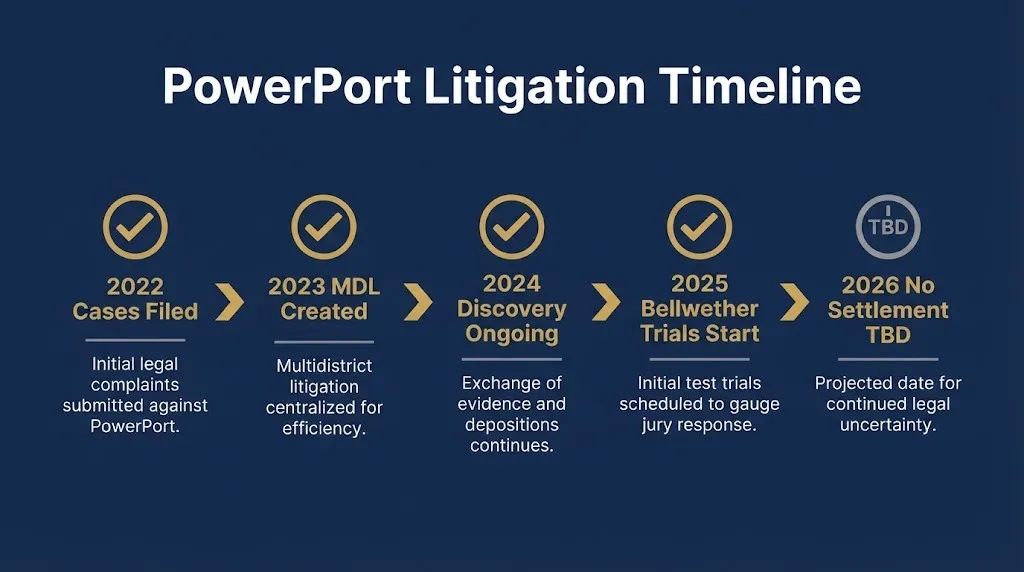
The PowerPort MDL in the District of Arizona remains open in 2026. Judge David G. Campbell oversees the litigation and has issued rulings on discovery, expert testimony, and bellwether selection.
Bellwether trials, which are test cases designed to show how juries might rule, are being scheduled or have begun in some instances. The outcomes will shape settlement negotiations.
No global settlement has been announced. The litigation continues to handle new filings and discovery.
The pace of the litigation is typical for medical device MDLs. These cases often take years to resolve, with settlement discussions intensifying after bellwether trials.
Key Takeaway: The MDL is active and moving through bellwether stages. No global resolution appears imminent as of September 2026.
What Is the Difference Between a Class Action and a Mass Tort?
A class action and a mass tort are different legal structures, and the distinction matters for your case.
In a class action, one or a few plaintiffs represent a large group of similarly situated people. If the class is certified, all class members are bound by the outcome unless they opt out. A settlement creates a claims process, and eligible class members file claims through an administrator.
In a mass tort, each plaintiff files an individual lawsuit. The cases are consolidated for pretrial proceedings, but each case remains separate. A settlement in a mass tort typically involves tiered payouts based on injury severity, and each plaintiff must prove their own injuries.
The PowerPort litigation is a mass tort, not a class action. There is no class claims form. You need a lawyer to file an individual case.
Key Takeaway: The PowerPort litigation is a mass tort, meaning individual lawsuits, not a class action with a claims form.
What Should I Do If I Have a Bard PowerPort and I Am Worried?
If you have a Bard PowerPort implanted and you are worried, the first step is to talk to your doctor. Do not remove the device on your own. Do not skip treatments.
Your doctor can order imaging to check the device for signs of fracture, migration, or other problems. If the device is functioning normally and you have no symptoms, the risk may be low.
If you experienced a complication, gather your medical records and contact a qualified lawyer. The consultation is free, and the lawyer can evaluate whether you have a viable claim.
Do not rely on online ads or social media posts for medical or legal advice. The decision to remove a functioning port is a medical one, not a legal one.
Key Takeaway: Talk to your doctor first about any medical concerns. Then gather records and contact a lawyer if you experienced a complication.
What Happens Next in the PowerPort Litigation?
The next stages are predictable in shape. Bellwether trials will continue. The outcomes will shape settlement negotiations.
If bellwether trials favor plaintiffs, a global settlement becomes more likely. If they favor the defense, some plaintiffs may drop their cases, and the litigation may narrow.
A global settlement would likely involve a tiered payout structure based on injury severity, a claims administrator, and a claim deadline. None of that exists yet.
For now, watch the MDL docket and legal news for bellwether trial outcomes. Those rulings will tell you more about the litigation’s direction than any attorney advertisement.
Frequently Asked Questions
What is the Bard PowerPort lawsuit about?
The lawsuits allege that the PowerPort catheter can fracture, migrate, or cause infections and other serious injuries.
Is there a PowerPort class action settlement?
No. The PowerPort litigation is a mass tort, not a class action, and no global settlement exists in 2026.
Has the Bard PowerPort been recalled?
No full recall has been issued. The FDA has issued safety communications, but the device remains on the market.
How do I know if I have a Bard PowerPort?
Check your medical records or your implant card. The device manufacturer and model should be listed.
What injuries qualify for a PowerPort lawsuit?
Catheter fracture, migration, infection, thrombosis, and port failure requiring removal are the most common injuries.
How much does a chemo port lawyer cost?
Most mass tort lawyers work on contingency, typically charging 33 to 40 percent of any recovery plus costs.
How long do I have to file a PowerPort lawsuit?
The statute of limitations varies by state. Contact a lawyer as soon as possible to evaluate your deadline.
Can I file a PowerPort claim without a lawyer?
No. The PowerPort litigation is a mass tort. You need a lawyer to file an individual lawsuit.
If you have a Bard PowerPort and experienced a complication, your next step is not a claim form. It is a conversation with a qualified mass tort attorney who can evaluate your medical records, your state’s deadline, and the strength of your case. That conversation is free.
The clock is running. Statutes of limitations do not pause because the MDL is slow or because no global settlement has been announced. The best time to act was when you first learned about the link between your port and your injury. The second best time is now.