What Does Class Action Lawsuit Mean in 2026: A Plain-English Guide
Quick Answer
- A class action lawsuit is a single case where one or a few people sue on behalf of a larger group who share the same claim against the same defendant.
- You typically don’t pay anything to be part of a class action, and any payout amount depends entirely on the specific case’s settlement or verdict.
- There’s no universal deadline; each class action has its own claim filing deadline set by that case’s court-approved settlement notice.
If you’re asking what a class action lawsuit actually means, here’s the direct answer. It’s a legal process that lets a small number of people, called class representatives, sue on behalf of everyone who was harmed the same way by the same company or entity.
This matters to you if you’ve ever gotten a notice in the mail or email saying you “may be a class member” in a lawsuit you never filed yourself. It also matters if you’re wondering whether you should join one, opt out, or ignore it entirely.
This article breaks down exactly how class actions work, from filing to certification to payout, using plain terms instead of legal jargon. One detail people often miss: you can be part of a class action and receive money from it without ever having to hire a lawyer or go to court yourself.
The Facts
| Legal Basis | Federal Rule of Civil Procedure 23 (federal cases); each state has its own parallel class action rule for state court cases |
| Who Can Sue | One or more “class representatives” suing on behalf of a larger group with the same type of claim |
| Cost to Join | Generally free; class members typically do not pay attorney fees directly out of pocket |
| Payout Amount | Not universal; determined case by case through settlement negotiation or trial verdict |
| Claim Deadline | Not universal; set individually by each case’s official settlement notice |
| Who Decides Payouts | The presiding court, based on a proposed settlement or, less commonly, a jury verdict |
| Proof Needed | Varies by case; some require documentation of loss, others require only a valid claim form |
What does class action lawsuit mean?
A class action lawsuit is a single legal case where one or more people, called class representatives, sue on behalf of a larger group of people who all suffered a similar harm from the same defendant.
Instead of thousands of people each filing their own individual lawsuit over the same product defect, data breach, or deceptive practice, a class action combines those claims into one case. That case proceeds through the court system on behalf of the entire “class,” which can range from a few hundred people to millions.
The core idea is efficiency and access. Many individual claims are too small on their own to justify hiring a lawyer, but combined into a class action, they become worth litigating, and the court handles it as one case rather than thousands of separate ones.
Key Takeaway: A class action lawsuit exists so that many people with the same small claim against the same defendant can get relief through one combined case instead of filing individually.
How do class action lawsuits work?
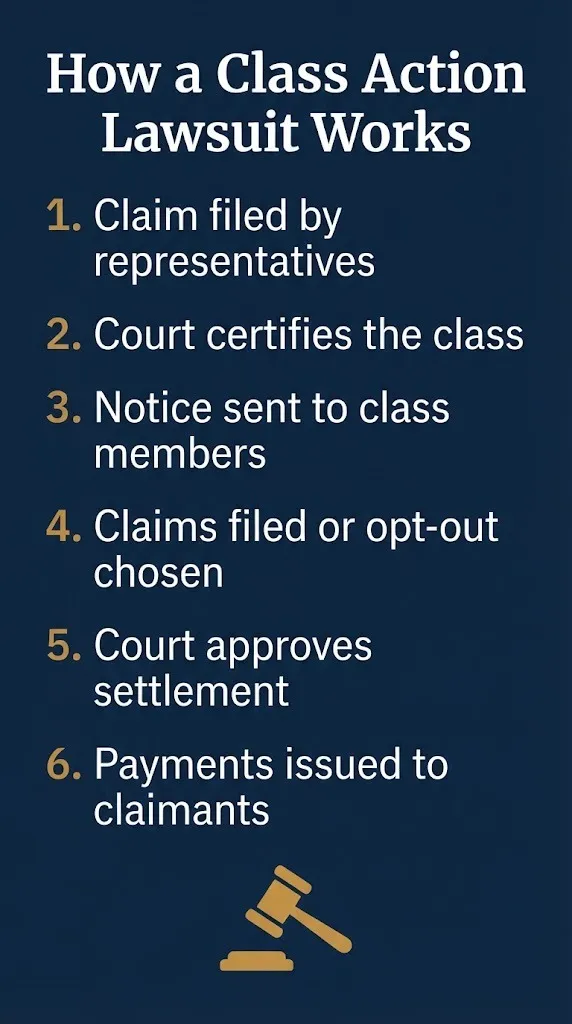
Class action lawsuits work through several distinct stages, starting with a complaint filed by class representatives and ending with either a settlement or a trial verdict.
The typical stages, in order:
- A person or small group with a claim, called class representatives or named plaintiffs, files a complaint against the defendant.
- Their attorney requests that the court certify the case as a class action, meaning the court agrees the claims are similar enough to proceed as one case.
- If certified, the court defines the “class,” meaning exactly who is included based on specific criteria like dates, purchases, or notifications received.
- The case proceeds through discovery, where both sides gather evidence, which can take months to years.
- Most class actions settle before trial, with both sides negotiating a proposed settlement that the court must approve.
- The court holds a preliminary approval hearing, then requires notice to be sent to all class members.
- Class members can file claims, opt out, or object during a specific window set by the settlement.
- The court holds a final approval hearing, and if approved, the settlement administrator begins processing and paying claims.
This process can take anywhere from several months to several years from filing to final payout, depending on the case’s complexity and how many appeals or objections arise.
How does a class action lawsuit work if you never filed anything yourself?
You can become a class member automatically, without ever filing a lawsuit, simply by falling within the group the court defines as the “class.”
Most class actions use what’s called an “opt-out” structure. This means if you fit the class definition, such as anyone who purchased a specific product during a specific date range, you’re automatically included unless you actively choose to exclude yourself.
What this means practically:
- You typically learn about your inclusion through an official notice, either by mail, email, or a court-approved publication notice.
- You don’t need to hire an attorney or take any action to remain a class member.
- If you want to preserve your right to sue the defendant separately on your own, you generally must formally opt out by a specific deadline stated in the notice.
- If you do nothing and don’t opt out, you’re typically bound by the settlement’s terms, including its release of claims, even if you never filed a claim form for payment.
What is a “class action suit” and how is it different from an individual lawsuit?
A class action suit is a lawsuit brought on behalf of a group rather than a single individual, which is the main distinction from an ordinary individual lawsuit.
Key differences, side by side:
| Feature | Individual Lawsuit | Class Action Lawsuit |
|---|---|---|
| Who files | One plaintiff, for their own claim | One or more class representatives, for a defined group |
| Who benefits from the outcome | Only the person who filed | Everyone in the certified class |
| Attorney cost structure | Client typically pays hourly or contingency fees directly | Attorneys typically paid from the settlement fund, approved by the court |
| Individual control | Full control over your own case | Limited individual control once a class is certified |
| Typical use case | Unique, high-value, or highly individualized claims | Widespread, similar harm affecting many people |
Class actions make sense when the harm to each individual person is relatively small, but the collective harm across a large group is significant enough to justify litigation.
Reality Check: What class action myths should you ignore?
Reality Check: No legitimate settlement administrator or court will ever contact you demanding a fee to “activate” your class action payment, and filing a claim in a real class action is always free. If you’re asked to pay money upfront to join or receive money from a class action, that’s a scam layered on top of a real legal process, not part of how class actions actually work.
Key Takeaway: Being part of a class action never requires you to pay a fee, hire your own lawyer, or take any action beyond filing a claim form if you want a payout.
How much money can you get from a class action lawsuit?
Not universal. The amount you could receive from any specific class action depends entirely on that case’s settlement fund size, how many people file valid claims, and what type of harm the settlement covers.
Common payout structures across different class actions:
| Structure | How it works |
|---|---|
| Fixed cash payment | Every valid claimant receives the same flat amount, common in smaller consumer settlements |
| Documented loss reimbursement | Payment amount depends on proof of actual financial loss, often capped at a maximum figure |
| Pro rata distribution | The total fund is divided among all valid claimants, so your amount depends on how many others also filed |
| Tiered payments | Different categories of harm receive different set amounts, common in personal injury or data breach cases |
| Non-monetary relief | Some settlements offer services like credit monitoring instead of, or in addition to, cash |
Because payout structures vary so widely, there is no single dollar figure that applies to “class action lawsuits” as a category. Each individual case’s official settlement notice is the only reliable source for what you might actually receive.
How do you file a claim in a class action lawsuit?
You generally file a claim by completing the official claim form provided in the settlement notice, either online through the case’s official settlement website or by mail.
Typical steps to file a claim:
- Read the official notice you received carefully to confirm you fit the class definition.
- Locate the official settlement website named in that notice, not a third-party site.
- Gather any required documentation, such as receipts, account numbers, or proof of purchase.
- Complete the claim form with accurate information, since false claims can be rejected or investigated.
- Submit the claim before the stated deadline, since late claims are typically not accepted.
- Keep a copy or confirmation number of your submitted claim for your records.
- Watch for updates from the settlement administrator about approval status and expected payment timing.
What does it mean to “opt out” of a class action?
Opting out means formally excluding yourself from the class, which removes you from the settlement but preserves your right to pursue your own individual lawsuit against the defendant.
Most people don’t opt out, since remaining in the class is usually the simpler path if the settlement terms seem fair for your situation. People typically opt out when they believe their individual damages are significantly higher than what the class settlement would provide, and they want to pursue a separate, individual case instead.
When opting out might make sense:
- Your losses from the underlying issue are substantially larger than the typical class member’s.
- You have unique facts about your situation that a generalized class settlement wouldn’t fairly address.
- You’ve already consulted an attorney about pursuing an individual claim and been advised it’s a stronger path for your specific circumstances.
If you opt out, you generally cannot later change your mind and rejoin the class settlement once the opt-out deadline has passed.
What does “class certification” mean?
Class certification is the court’s formal decision that a case can proceed as a class action, based on the case meeting specific legal requirements under Rule 23 or the equivalent state rule.
Courts generally require the class to be large enough that individual lawsuits would be impractical, that class members share common legal or factual questions, that the named plaintiffs’ claims are typical of the class, and that the case can be fairly and efficiently managed as one proceeding.
Not every proposed class action gets certified. If a court denies certification, the case can still proceed, but only as an individual lawsuit for the original named plaintiffs, not on behalf of a broader group.
What happens at a final approval hearing?
A final approval hearing is where a judge decides whether to formally approve a proposed class action settlement, based on whether it’s fair, reasonable, and adequate for the class.
By this stage, the class has typically already received notice of the settlement, and the window for filing claims, opting out, or objecting has usually closed or is closing. The judge reviews the settlement terms, considers any objections raised by class members, and hears from both sides’ attorneys before deciding whether to grant final approval.
If approved, the settlement becomes final, and the settlement administrator moves forward with processing and distributing payments to approved claimants. If a judge denies approval, the parties typically must renegotiate the settlement terms and go through the process again.
What Happens Next
- Ongoing: Federal Rule of Civil Procedure 23 continues to govern class action practice at the federal level, with courts applying stricter certification scrutiny in some circuits following recent Supreme Court decisions on uninjured class members.
- Case by case: Each active class action moves through its own individual timeline of certification, notice, claims filing, and final approval, entirely independent from other cases.
- Ongoing trend: Courts have shown increased willingness to scrutinize attorney fee awards in class action settlements, a trend legal analysts expect to continue.
- Recommended for consumers: If you receive any class action notice, check the specific case’s official settlement website directly rather than relying on secondhand summaries, since terms and deadlines vary case by case.
Frequently Asked Questions
What does class action lawsuit mean in simple terms?
It means one lawsuit filed on behalf of a large group of people who were all harmed in a similar way by the same defendant.
Instead of everyone filing separately, the group’s claims are combined into a single case.
How do I know if I’m part of a class action?
You’ll typically receive an official notice by mail or email if you fall within the group the court has defined as the class.
That notice will explain your options, including filing a claim, opting out, or doing nothing.
Do I have to pay to join a class action lawsuit?
No, joining a class action and filing a claim is typically free.
Attorney fees are usually paid out of the settlement fund itself, approved by the court, not charged directly to class members.
How much money do you get from a class action lawsuit?
There’s no set amount; it depends entirely on that specific case’s settlement fund, the type of harm covered, and how many people file valid claims.
Check the official settlement notice for your specific case to see the actual payout structure.
What’s the difference between a class action and a mass tort?
A class action treats the group as one unified case with one outcome applying to everyone, while a mass tort keeps each person’s case somewhat individual even though they’re grouped together for efficiency.
Mass torts are more common in personal injury and product liability cases where individual damages vary significantly.
Should I opt out of a class action lawsuit?
That depends on your specific situation and is a decision this article can’t make for you, since it involves weighing your individual damages against the proposed settlement terms.
Consulting an attorney can help you understand whether your specific circumstances might justify pursuing an individual claim instead.
How long does a class action lawsuit take?
There’s no fixed timeline; class actions can take anywhere from several months to several years from filing to final payout.
Complex cases with multiple appeals or numerous objections generally take longer than straightforward settlements.
What happens if I ignore a class action notice?
If you do nothing and don’t opt out, you typically remain part of the class and are usually bound by the settlement’s terms, even without filing a claim for payment.
This means you may lose the ability to sue the defendant separately later, so reading the notice carefully matters even if you decide not to file a claim.
Understanding how class actions work helps you make an informed choice the next time you receive a settlement notice. Read the specific case’s official notice carefully, note its claim deadline, and decide whether filing a claim or opting out fits your situation.