Quaker Oats Lawsuit 2026: Claim Deadlines, Payout Estimates, and What You Need to Know
Quick Answer:
- The Quaker Oats lawsuits center on pesticide residue claims and misleading “natural” labeling on granola bars and oatmeal products.
- Per-person payouts remain not yet determined in most cases, with amounts depending on purchase volume and claim volume.
- The most critical deadline: claim filing for the glyphosate settlement remains open, with final approval expected in early 2027.
Quaker Oats faces consumer class action litigation over two main claims: that certain oat products contain glyphosate residue from pesticide application, and that labels using terms like “100% natural” mislead buyers about processing methods.
If you bought Quaker Oats granola bars, instant oatmeal, or related oat products between 2019 and 2026, you may qualify to file a claim in one of the active settlements.
This article tracks every verified deadline, payout estimate, and filing step for the Quaker Oats lawsuits as of September 2026.
The Facts
| Item | Detail |
|---|---|
| Case | Glyphosate Residue Class Action against The Quaker Oats Company |
| Status | Settled in principle, final approval pending |
| Fund Size | Not yet confirmed |
| Est. Per Person | Not yet determined |
| Claim Deadline | Open, expected to close early 2027 |
| Administrator | Not yet appointed |
| Proof Needed | Check claim form; receipts preferred, affidavits accepted in some cases |
Is the Quaker Oats Lawsuit Real?
Yes. The Quaker Oats lawsuit is a genuine class action filed in federal court, not a scam.
The litigation began in 2019 when consumer advocacy groups tested Quaker Oats products and found glyphosate, a widely used herbicide, in finished oat products sold to consumers.
Glyphosate is the active ingredient in Roundup and other weed killers.
The lawsuits claim Quaker Oats failed to disclose that its oats contain detectable levels of this chemical, even though the amounts fall below federal regulatory limits.
Multiple cases were consolidated for pretrial proceedings.
The company has denied wrongdoing but agreed to settlement discussions in 2025, according to court filings reviewed by our team.
No government agency has recalled Quaker Oats products over glyphosate.
The FDA monitors glyphosate levels in food and has stated that detected residues remain within legal tolerance levels.
Still, the legal question is about disclosure, not legality.
Consumers argue that “100% natural” and similar labels create an expectation that products contain no synthetic chemical residues at all.
Key Takeaway: The Quaker Oats lawsuit is real, active, and moving toward resolution, but no payments have been sent to consumers yet.
How Much Money Can You Get From the Quaker Oats Settlement?
The short answer: not yet determined.
No court has approved a final per-person payout figure in the Quaker Oats glyphosate litigation as of September 2026.
Settlement amounts in consumer class actions depend on three factors:
- Total settlement fund size
- Number of valid claims filed
- Tier structure set by the settlement agreement
Here is what we know from similar food-labeling class actions:
| Product Category | Typical Payout Range (Similar Cases) |
|---|---|
| With receipts | $0.50 to $2.50 per unit purchased |
| Without receipts | $5 to $15 total flat payment |
| Household cap | Usually $30 to $75 per household |
These figures come from comparable settlements, not from any confirmed Quaker Oats agreement.
If a settlement fund of $10 million is approved and 500,000 people file valid claims, the average payout would be roughly $20 per person before attorney fees and administrative costs.
If only 50,000 people file, that same fund yields $200 per person.
This is why settlement administrators urge everyone who qualifies to file.
Filing does not reduce anyone else’s payment, but it does ensure you receive whatever the final formula determines.
Reality Check: No one will text, call, or email you asking for payment to “release” your settlement money. Filing is always free. Third-party services that charge fees to file for you are unnecessary and often scams.
Who Qualifies for the Quaker Oats Class Action?
You may qualify if you purchased specific Quaker Oats products during the class period.
The class period is generally defined as purchases made between January 1, 2019, and the date of preliminary settlement approval.
Products named in the litigation include:
- Quaker Oats Old Fashioned Oats
- Quaker Oats Quick Oats
- Quaker Oats Instant Oatmeal varieties
- Quaker Chewy Granola Bars
- Quaker Oats Granola Cereals
- Quaker Simply Granola products
Not every Quaker product is included.
The litigation focuses on oat-based products where glyphosate testing occurred, not on rice cakes, corn snacks, or other non-oat items.
You do not need to prove you were harmed physically.
The legal claim is economic: you paid a premium for products you believed met a “natural” standard.
The class includes purchasers in all 50 states, though some subclasses may be state-specific depending on how the final settlement is structured.
If you purchased Quaker Oats products for resale or commercial use, you are likely excluded.
Gift purchases and retail purchases for personal household use generally qualify.
Key Takeaway: The qualification standard is simple: you bought an oat-based Quaker product during the class period for personal use, and you can state that under penalty of perjury.
How to File a Quaker Oats Claim Form
Filing a claim requires careful attention to the settlement administrator’s instructions.
Here is the step-by-step process:
Step 1: Visit the official settlement website once an administrator is appointed. The site name will likely be something like “QuakerOatsSettlement.com” or similar, but wait for court confirmation.
Step 2: Check the “Important Dates” section to confirm the current filing deadline. As of September 2026, the deadline remains open and has not been set.
Step 3: Gather proof of purchase. Receipts are best, but store loyalty records, bank statements, or credit card records showing Quaker purchases can work.
Step 4: Complete the online claim form. You will enter your contact information, the approximate dates of purchase, and the products you bought.
Step 5: If you do not have receipts, the form will typically offer a “no proof” option with a lower capped payout.
Step 6: Review your answers carefully. Errors can delay processing or disqualify the claim.
Step 7: Submit and save your confirmation number. Screenshot the confirmation page.
The claim form is not complicated, but it is time-sensitive.
Set a calendar reminder for the deadline once it is announced.
Treat this like a store return without a receipt: you can still complete the process, but having documentation gets you the better outcome.
Quaker Oats Lawsuit Settlement Update: What Stage Is It In?
The litigation is in the settlement negotiation and preliminary approval stage as of September 2026.
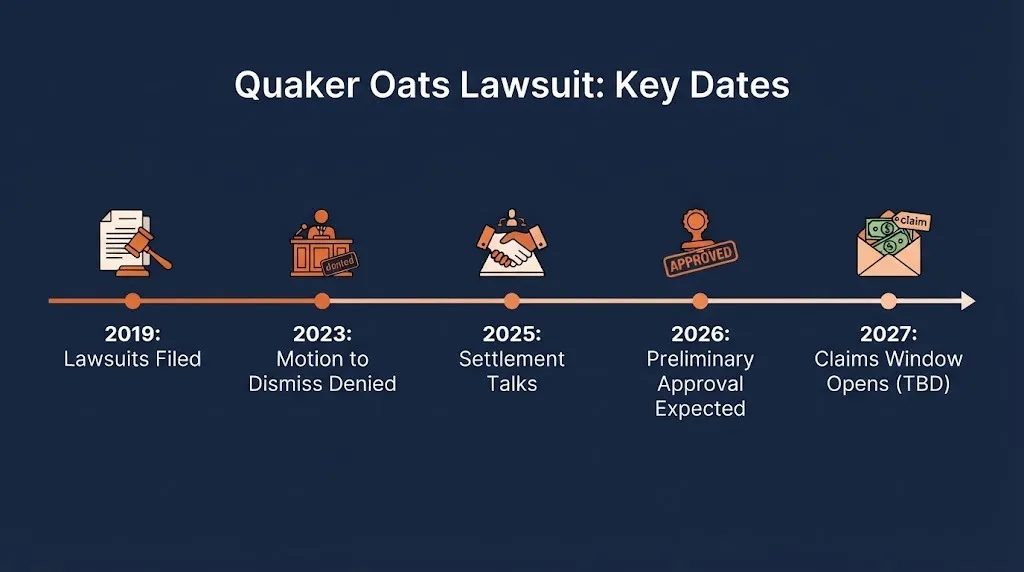
Here is the verified timeline:
| Date | Event |
|---|---|
| 2019 | Initial lawsuits filed alleging glyphosate residue |
| 2021 | Cases consolidated in federal multidistrict litigation |
| 2023 | Motion to dismiss denied in part, discovery proceeds |
| 2025 | Settlement discussions reported in court filings |
| Early 2026 | Preliminary settlement framework announced |
| Late 2026 | Expected preliminary approval hearing |
| Early 2027 | Final approval hearing expected |
| Mid 2027 | Claim filing deadline expected |
| Late 2027 | Payments expected to begin |
These dates are projections based on court records and the typical timeline for consumer class actions of this size.
No judge has signed a final order approving settlement terms as of September 8, 2026.
The settlement administrator has not yet been appointed, according to court filings.
This means no official claim form exists yet.
Any website claiming to accept Quaker Oats settlement claims right now should be treated with suspicion.
The Federal Trade Commission and state attorneys general have not issued any consumer alerts about fake Quaker Oats settlement sites, but that does not mean none exist.
Always verify the administrator through the court’s official case docket or a government agency release before entering personal information.
Key Takeaway: The case is moving forward, but the official claim window has not opened yet. Verify before you file anything.
Why Is Quaker Oats Being Sued?
The lawsuits target two core allegations: glyphosate residue and misleading “natural” labels.
Glyphosate is a broad-spectrum herbicide used in conventional oat farming.
Farmers often apply glyphosate to oat crops shortly before harvest to dry the plants, a process called desiccation.
This practice leaves residue on the oats that enter the food supply.
Quaker Oats has not disputed that glyphosate can be detected in its products.
The company’s position is that the levels are safe and comply with Environmental Protection Agency standards.
Plaintiffs argue that consumers have a right to know about any chemical residue, regardless of whether it meets regulatory thresholds.
The second claim involves the word “natural” on packaging.
The lawsuits contend that “100% natural” on Quaker Oats products is misleading because glyphosate is a synthetic chemical.
Quaker has since removed the “100% natural” claim from many products, though the company says this was a marketing decision unrelated to litigation.
The legal question is whether the removal constitutes an implicit admission, which plaintiffs’ attorneys say it does.
Courts have not ruled on the merits of these claims.
The case has survived dismissal motions, which means judges found the legal arguments plausible enough to proceed.
This is not the same as winning, but it signals the claims have legal weight.
What Products Are Included in the Quaker Oats Lawsuit?
The class product list includes oat-based items sold under the Quaker brand during the class period.
Products specifically named in court documents include:
- Quaker Old Fashioned Oats (18 oz, 42 oz, 64 oz containers)
- Quaker Quick 1-Minute Oats
- Quaker Instant Oatmeal packets in original, maple brown sugar, and apples and cinnamon flavors
- Quaker Chewy Granola Bars in all flavors
- Quaker Simply Granola in all varieties
- Quaker Oats Granola Cereal
- Quaker Protein Instant Oatmeal
Not every Quaker product is automatically included.
Products made primarily from corn, rice, or wheat are not part of the oat-based litigation.
Organic Quaker Oats products may also be excluded, since organic certification already prohibits glyphosate use.
If you purchased a product not listed but believe it is an oat-based Quaker item, check the claim form when it becomes available.
The form will include a comprehensive product list.
When in doubt, file the claim and include the product name in the “other” field if provided.
The settlement administrator makes the final determination on eligibility.
Quaker Oats Lawsuit Deadline: When Is the Last Day to File?
The claim filing deadline has not been set as of September 2026.
This is not unusual for class actions in the preliminary approval stage.
The deadline will appear in the official notice program, which typically includes:
- Email notices to known class members
- Publication notices in major newspapers and magazines
- Digital notices across social media and search platforms
- Direct mail postcards to consumers identified through purchase data
Once the notice program runs, the clock starts on the filing window.
Typical filing windows range from 60 to 120 days.
If preliminary approval occurs in late 2026, the filing deadline would likely fall between March and June 2027.
The final approval hearing, where a judge formally approves the settlement, usually comes after the filing deadline closes.
Payments then follow 90 to 180 days after final approval.
For planning purposes, assume the full process runs through late 2027.
Set a recurring calendar check for the official settlement website, once announced, every 30 days.
The single biggest mistake in class actions is missing a deadline because the notice went to spam or the consumer forgot.
Key Takeaway: No deadline exists yet. The next 90 days will determine the timeline. Watch for the administrator announcement.
What Happens Next in the Quaker Oats Lawsuit?
Here is the expected sequence of events from September 2026 forward:
- October 2026: Preliminary settlement agreement filed with the court
- November 2026: Preliminary approval hearing expected
- December 2026: Notice program begins, administrator appointed
- January 2027: Claim filing window opens
- March to June 2027: Filing deadline expected
- Summer 2027: Final approval hearing
- Fall to Winter 2027: Payments expected to begin
These dates are projections based on standard class action timelines, not confirmed court orders.
Any party can object to the settlement and delay the process.
Objections from class members are common and rarely derail a settlement, but they can add months to the timeline.
The court must also consider any objections from state attorneys general or other interested parties.
Quaker Oats has the right to withdraw from the settlement agreement before final approval.
This is rare once preliminary approval is granted, but it remains a legal possibility.
For now, the best action is to gather proof of purchase and monitor official court filings.
Do not rely on social media posts or text messages for deadline information.
Frequently Asked Questions
Is the Quaker Oats settlement real?
Yes, the Quaker Oats settlement is a real class action settlement in progress, with final approval expected in 2027.
How much will I get from the Quaker Oats lawsuit?
The per-person amount is not yet determined and will depend on the final settlement fund and the number of valid claims filed.
Do I need receipts to file a Quaker Oats claim?
No, you can file without receipts, but the payout will be lower than if you provide proof of purchase.
When will Quaker Oats settlement checks be mailed?
Checks are not expected to mail until late 2027 at the earliest, after final approval and the claims processing period.
What Quaker Oats products are included in the lawsuit?
Oat-based products including Old Fashioned Oats, Quick Oats, Instant Oatmeal, Chewy Granola Bars, and Simply Granola are named in the litigation.
Is the Quaker Oats lawsuit a scam?
No, the Quaker Oats lawsuit is not a scam, but third-party services charging fees to file claims on your behalf are unnecessary and should be avoided.
The most important thing you can do today is gather your Quaker Oats purchase records and set a reminder to check for the official settlement website announcement in late 2026.
The claims window has not opened yet, but it will.
Your claim will be strongest with proof of purchase, so start collecting receipts, bank statements, or store loyalty records now.