Partition Lawsuit 2026: How Property Division Claims Work, What to Expect, and When Courts Step In
Quick Answer:
- A partition lawsuit is a legal action to force the sale or division of jointly owned real estate when co-owners cannot agree.
- The “payout” is your share of the property’s net sale proceeds, determined by ownership percentage and court orders.
- There is no claim form or settlement administrator. The timeline is set by your local court, not a national process.
A partition lawsuit is not a mass tort or consumer class action. It is a civil lawsuit one co-owner files against another co-owner to divide real property.
If you own a house, land, or commercial building with someone else and you cannot agree on what to do with it, a partition action may be the legal tool that breaks the deadlock.
The most important number in any partition case is the ownership percentage, because that determines how much of the sale proceeds each co-owner receives after court costs, realtor fees, and any offsets are subtracted.
The Facts
| Item | Detail |
|---|---|
| Case Type | Civil partition action, not a class action |
| Status | Varies by individual case, no central docket |
| Fund Size | No settlement fund; property value sets the stakes |
| Est. Per Person | Share of net sale proceeds, case-specific |
| Claim Deadline | None; court schedule controls timing |
| Administrator | None; court-appointed referee or commissioner in some states |
| Proof Needed | Deed, ownership records, mortgage statements, tax records |
Is a Partition Lawsuit a Real Legal Process?
Yes. A partition lawsuit is a long-established legal procedure available in every U.S. state.
Partition actions date back to English common law and remain codified in state statutes across the country.
When two or more people own real estate together as tenants in common or joint tenants, any co-owner has the right to ask a court to divide the property.
The court can divide the property physically if it is large enough, such as splitting acreage into separate parcels.
For houses, condos, and most residential property, physical division is impossible, so the court orders a sale instead.
The sale can happen through a private listing, a public auction, or a court-supervised process depending on your state’s laws.
Judges do not like ordering the sale of someone’s home, but they will do it when co-owners cannot reach any other agreement.
The alternative, letting one co-owner block a sale forever, would trap every other owner in a property they cannot use, sell, or borrow against.
That is the legal logic behind partition: ownership rights include the right to exit the ownership arrangement.
Key Takeaway: Partition lawsuits are real, common, and available to any co-owner of real estate who wants out of a shared ownership situation.
How Much Money Do You Get From a Partition Lawsuit?
Your payout in a partition lawsuit equals your ownership share of the net sale proceeds.
The formula works like this: the property sells for a price, then closing costs, realtor commissions, unpaid property taxes, mortgage payoff, and court costs are subtracted.
What remains is divided according to ownership percentages.
Here is a simple example:
| Item | Amount |
|---|---|
| Sale price | $400,000 |
| Mortgage payoff | $180,000 |
| Realtor commission and closing costs | $28,000 |
| Unpaid property taxes | $6,000 |
| Court costs and referee fees | $12,000 |
| Net proceeds | $174,000 |
| 50% ownership share | $87,000 |
If one co-owner paid more than their share of the mortgage, property taxes, or necessary repairs, the court may award them an offset before dividing the remainder.
This is called an accounting, and it can shift the final numbers significantly.
For example, if your co-owner lived in the house rent-free for three years while you paid half the mortgage, the court may credit you for their half of the rental value.
The exact calculation depends on evidence presented at trial or in settlement negotiations.
No two partition cases produce identical payouts because no two properties and ownership histories are alike.
Reality Check: No one sends you a settlement check in a partition case. You get paid when the property sells, the mortgage is paid off, and the court approves the final accounting. That can take six months to two years from filing, depending on your state and whether the case settles.
Who Can File a Partition Lawsuit?
Any co-owner of real estate can file a partition lawsuit.
You must have an ownership interest, meaning your name appears on the deed or you inherited an interest through a will, trust, or intestate succession.
Common situations that lead to partition actions include:
- Siblings who inherit a family home together and disagree about selling
- Unmarried couples who bought a house together and later separated
- Business partners who own commercial property and want to dissolve the venture
- Divorcing spouses whose property was not divided in the divorce decree
- Friends or relatives who co-signed a mortgage and now want out
You do not need the other co-owner’s permission to file.
You do not need a reason beyond wanting to end the co-ownership.
The right to partition is considered absolute in most states, meaning a court will grant it unless a valid legal defense exists.
Defenses are rare and usually involve a prior agreement not to partition, such as a written contract that waives the right for a specific period.
If you inherited property through a trust, check the trust document first. Some trusts include no-partition clauses.
Key Takeaway: If your name is on the deed or you have a documented ownership interest, you likely have the right to file a partition action regardless of what the other owners want.
How to File a Partition Lawsuit Step by Step
Filing a partition lawsuit involves more than filling out a form. You must follow your state’s civil procedure rules.
Here are the general steps, though specifics vary by state:
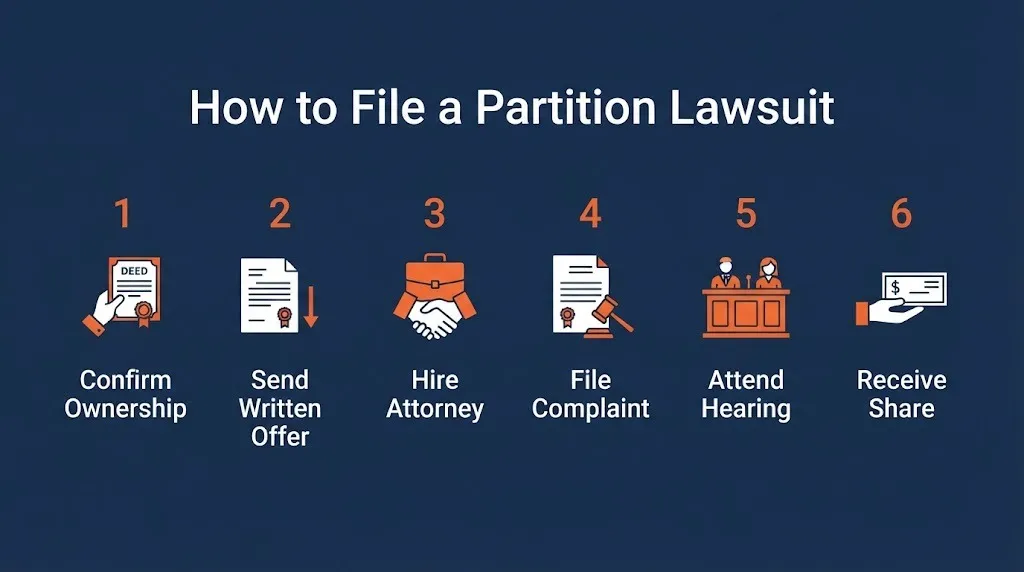
Step 1: Confirm your ownership interest. Obtain a copy of the deed, title report, or probate order showing your name.
Step 2: Attempt resolution in writing. Send a formal letter to the other owners offering to buy them out or sell the property. Courts prefer this.
Step 3: Hire an attorney. Partition law is complex, and most courts require legal representation for property division cases.
Step 4: File a complaint for partition in the county where the property is located. The complaint names all co-owners as defendants.
Step 5: Serve the other owners. They get a chance to respond and may contest the partition or request their own accounting.
Step 6: Attend the preliminary hearing. The court may order mediation, appoint a referee, or schedule a trial.
Step 7: Proceed to sale. If the court orders a sale, a referee or commissioner manages the process, lists the property, and reports back to the judge.
Step 8: Receive your share. After the sale closes and all costs are paid, the court orders distribution of the remaining funds.
This process is more like a store return without a receipt than a simple claim form: you can do it, but documentation and patience determine how smoothly it goes.
How Long Does a Partition Lawsuit Take?
Most partition lawsuits take between six months and two years from filing to final distribution of sale proceeds.
The timeline depends on several factors:
- Whether the co-owners settle or fight the case
- How quickly the property sells
- Court congestion in your county
- Whether any co-owner files for bankruptcy or appeals the ruling
- Whether the property has title defects, liens, or other complications
If all parties agree to sell early in the case, the process can move faster than a standard real estate listing because the court can order the sale without waiting for a trial.
If one co-owner contests every motion, refuses to cooperate with the referee, or files objections to the sale price, the case can drag on for years.
Appeals add another six to eighteen months.
Some states have expedited partition procedures for simple cases with clear ownership records and no disputes.
Others require a full civil trial even when the facts are uncontested.
Your attorney can give you a realistic estimate based on local practice and the specific judge assigned to your case.
Key Takeaway: Partition lawsuits are not quick fixes. Expect a minimum of six months, and plan for two years if the other owner fights the sale.
Partition Lawsuit Update: What Is the Current Legal Landscape in 2026?
Partition law did not change dramatically in 2026, but a few states have refined their procedures.
The biggest legislative trend is the push toward mandatory mediation before a court will order a sale.
Courts in California, New York, and Florida now routinely order co-owners to attempt mediation before proceeding to trial.
Mediation is a structured negotiation with a neutral third party who helps the owners reach a buyout or sale agreement.
If mediation fails, the case moves to the judge for a partition order.
Some states have also updated their rules to require earlier disclosure of financial records.
This prevents a co-owner from hiding rental income, refinance proceeds, or other property-related money.
The Uniform Partition of Heirs Property Act remains the most significant legal development for families with inherited property.
This law gives heirs a chance to buy out the other co-owners before the property goes to public auction.
It has now been adopted in 22 states as of September 2026, according to legislative tracking by the Uniform Law Commission.
If you inherited property through family lines, check whether your state has adopted this act. It can change your rights significantly.
What Is a Partition by Sale Versus a Partition in Kind?
A partition lawsuit can end two ways: a physical division of the property or a sale.
Partition in kind means the court physically divides the land into separate parcels.
This works for large acreage where each owner can receive a usable piece.
A 200-acre farm with two owners can often be split into two 100-acre parcels.
Partition by sale means the court orders the property sold and the proceeds divided.
This is the outcome for houses, condos, duplexes, and most urban or suburban property.
Physical division of a single-family home is impossible without destroying its value.
Here is the comparison:
| Factor | Partition in Kind | Partition by Sale |
|---|---|---|
| Best for | Large land parcels | Houses, condos, buildings |
| Outcome | Each owner gets land | Each owner gets cash |
| Court preference | Used when practical | Default for residential |
| Timeline | Faster, no listing needed | Depends on market and buyer |
Courts prefer partition in kind when it is feasible because it preserves each owner’s property rights without forcing a sale.
Courts order partition by sale when division would materially reduce the property’s value or when the parties agree a sale is the only sensible outcome.
Key Takeaway: If you own a house with someone, expect a sale. If you own land, physical division may be possible depending on size, zoning, and local rules.
Who Pays the Costs in a Partition Lawsuit?
The costs of a partition lawsuit are typically paid from the sale proceeds before any money is distributed to the owners.
This means both owners share the costs proportionally to their ownership interest.
Common costs include:
- Attorney fees for both sides, if the court orders reimbursement
- Realtor commissions for the property sale
- Court filing fees and service costs
- Referee or commissioner fees
- Appraisal costs
- Title search and title insurance fees
- Unpaid property taxes and mortgage payoff
- Necessary repairs to make the property marketable
If one co-owner forces the sale over the other’s objection, courts sometimes order the objecting owner to pay their own attorney fees.
In other cases, the court awards attorney fees to both sides from the sale proceeds.
This is a critical point: you may spend $10,000 to $30,000 on legal fees before you see any money.
The fees are usually recoverable from the sale, but you may need to pay your attorney upfront and wait for reimbursement.
Your attorney can file a lien against the property to secure payment, which is standard practice in partition cases.
Key Takeaway: Partition lawsuits are not free. Costs come out of the sale proceeds, reducing every owner’s payout, but you may need cash upfront to hire an attorney.
Can You Stop a Partition Lawsuit?
Yes, in limited circumstances.
The most common way to stop a partition lawsuit is to reach a buyout agreement before the court orders a sale.
If you want to keep the property, you can offer to buy out the other co-owner’s interest at fair market value.
The other co-owner may accept, especially if they want the cash more than they want a long court battle.
You can also stop a partition by agreeing to sell the property voluntarily instead of through a court-ordered sale.
This gives both owners more control over the listing price, timing, and sale terms.
Legal defenses to partition are rare but include:
- A written agreement waiving the right to partition for a specific period
- A trust document that prohibits partition
- A pending divorce or probate proceeding that already addresses the property
- A pending bankruptcy that freezes property transfers
If you are the defendant in a partition case, you have the right to file an answer, contest the ownership percentages, request an accounting, or propose a buyout.
You cannot stop a partition simply by refusing to cooperate.
The court will proceed without your consent if the plaintiff proves ownership and the absence of a valid defense.
Key Takeaway: The best way to stop a partition lawsuit is to negotiate a buyout or agree to a voluntary sale before the court takes control of the property.
What Happens Next in a Partition Lawsuit?
Here is a typical timeline once a partition lawsuit is filed:
- Month 1: Complaint filed, defendants served
- Months 2 to 3: Defendants answer, preliminary hearing held
- Months 3 to 6: Mediation ordered or settlement negotiations occur
- Months 6 to 12: Trial or summary judgment if no settlement
- Months 12 to 18: Property listed and sold
- Months 18 to 24: Final accounting, distribution of proceeds
These are estimates, not guarantees.
Your case may move faster if the owners cooperate or slower if the property sits on the market.
Court-ordered sales sometimes involve price reductions if the property does not attract buyers at the initial listing price.
The referee or commissioner reports back to the judge on all offers, and the court must approve the final sale.
Only after the sale closes, all liens are paid, and the accounting is approved do the owners receive their checks.
Frequently Asked Questions
What is a partition lawsuit?
A partition lawsuit is a court case filed by one co-owner to force the division or sale of jointly owned real estate.
How much does a partition lawsuit cost?
Legal fees for a partition lawsuit typically range from $10,000 to $30,000, paid from sale proceeds or upfront depending on the arrangement.
Can I file a partition lawsuit without a lawyer?
Most courts require an attorney for partition cases because they involve complex property law, title issues, and civil procedure rules.
What if the other owner refuses to sell?
If the other owner refuses to sell, the court can order the sale and appoint a referee to handle the listing and closing process.
How is money divided in a partition lawsuit?
Money is divided according to ownership percentages after subtracting mortgage payoff, taxes, closing costs, legal fees, and any court-ordered offsets.
How long does a partition lawsuit take?
A partition lawsuit typically takes six months to two years from filing to final distribution, depending on cooperation and court schedules.
If you are considering a partition lawsuit, gather your deed, mortgage statements, tax records, and any written agreements between co-owners now.
The strength of your case depends on documenting your ownership percentage and any money you have contributed beyond your share.
Partition is a court process with real costs and real delays, but it remains the most reliable legal tool for ending a co-ownership stalemate.