Vaginal Mesh Lawsuit Update 2026: Claim Deadlines, Payout Status, and Who May Qualify
Quick Answer
- Most transvaginal mesh class actions and MDLs are closed to new claims, but some state court lawsuits still accept filings.
- Past settlements paid between $40,000 and $60,000 per claimant on average, though individual amounts varied widely.
- The most important deadline now is the statute of limitations in your state, not a single national claim deadline.
If you or someone close to you had pelvic mesh surgery and are only now learning about complications, you are not alone. Lawsuits over these devices have been resolving for over a decade, but pockets of active litigation remain.
This article covers the current status of transvaginal mesh lawsuits in 2026, what the Johnson & Johnson and bladder sling cases look like now, whether any money is still available, and what to do if you think you have a claim.
The Facts
| Case | Multiple MDLs and state court actions against Boston Scientific, Johnson & Johnson, Bard, Coloplast, and others |
| Status | Mostly settled or closed to new filings; some state cases still active |
| Fund Size | Multiple funds totaling over $8 billion across all manufacturers |
| Est. Per Person | $40,000 to $60,000 average in prior settled MDLs |
| Claim Deadline | No single national deadline; state statutes of limitations apply |
| Administrator | Various, including ARCHER Systems and Epiq, by specific settlement |
| Proof Needed | Medical records showing implant and revision or removal surgery, plus proof of complications |
Is the vaginal mesh lawsuit still open in 2026?
The short answer: most of the big multidistrict litigations are closed, but not every door is shut. If you had surgery recently or were diagnosed with complications only recently, you may still have time depending on your state.
The large federal MDLs against Boston Scientific, Ethicon, Bard, and American Medical Systems settled years ago. Those settlement funds have paid out. The claims filing windows for those specific deals have passed.
However, state court lawsuits remain possible in several jurisdictions. Some plaintiffs are still filing individual cases where the device was implanted more recently or where the injury did not become apparent until later. In 2026, the critical question is not whether the nationwide litigation is open. It is whether your state’s deadline for filing a personal injury lawsuit has passed.
Is the transvaginal mesh lawsuit legitimate?
Yes, the transvaginal mesh litigation is real and has produced billions in settlements. It is not a scam, though there are plenty of third-party lead generators and “claim helpers” that operate in the gray zone around it.
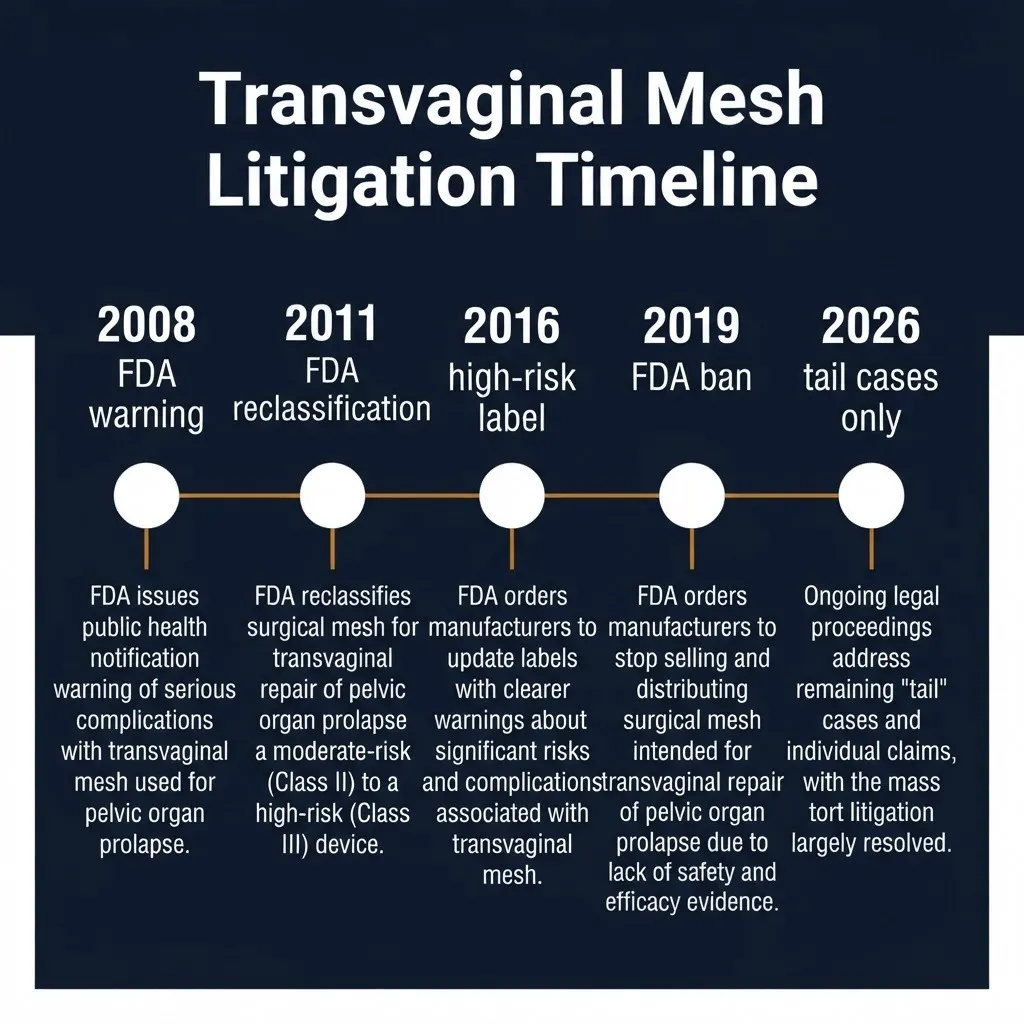
The litigation began in earnest around 2008 and grew into one of the largest mass torts in U.S. history. The FDA issued public health warnings in 2008 and again in 2011. In 2016, the FDA reclassified transvaginal mesh for pelvic organ prolapse as a high-risk device. In 2019, the FDA ordered manufacturers to stop selling transvaginal mesh for prolapse repair entirely.
Courts have awarded millions in individual verdicts. Settlements have covered tens of thousands of claimants. The total across all manufacturers exceeds $8 billion, according to public company filings and settlement administrator reports.
How much money did people get from the mesh lawsuits?
Payouts have varied by manufacturer and by the severity of the injury. Some claimants received less than $20,000. Some received more than $100,000.
The largest settlement pools involved Boston Scientific, which reported a $119 million settlement for about 2,970 claims in one tranche, and later a larger agreement. Ethicon, a Johnson & Johnson subsidiary, settled a substantial portion of its docket for an undisclosed total but with average payments reported in the $40,000 to $50,000 range. Bard settled its MDL with average gross payments near $60,000 before fees and liens.
| Manufacturer | Approx. Average Gross Payout | Notes |
|---|---|---|
| Bard | $55,000 to $65,000 | Based on settlement trust reports |
| Ethicon / J&J | $40,000 to $50,000 | Varied by injury tier |
| Boston Scientific | $40,000 to $55,000 | Multiple tranches |
| American Medical Systems | $40,000 to $50,000 | Resolved earlier |
| Coloplast | $30,000 to $45,000 | Lower injury severity on average |
These are gross amounts. Attorney fees, medical liens, and settlement administrator deductions reduced net payments. Individual net checks often landed in the $20,000 to $35,000 range.
Key Takeaway: Verdicts and settlements in the mesh litigation have paid real money to real claimants, but the average net check was smaller than many people expected after fees and liens.
Is there any money left in the mesh settlement funds?
This is the question most people actually ask once they find an old Facebook post or text about mesh payouts. The honest answer: most old settlement funds are closed and depleted.
When a settlement fund pays out, the administrator distributes the money, files a final report with the court, and closes the fund. That has happened for most of the major mesh MDL funds. There is no unclaimed pile of money sitting in a vault waiting for late claimants.
That said, some newer state court settlements or smaller manufacturer agreements may still have active funds. Also, if you filed a claim in a prior settlement but never cashed a check, you should check with the administrator. Uncashed checks may eventually escheat to the state.
Can you still file a transvaginal mesh lawsuit in 2026?
You may still file if your case falls into one of three categories.
First, if you were implanted recently, meaning within the last few years and within the manufacturer’s sale window, you may have time. Second, if you were diagnosed with a mesh complication for the first time only recently, the clock on your claim may start from the date of diagnosis in some states. Third, if you are in a state with a longer statute of limitations or a discovery rule that tolls the deadline.
Filing now is harder than it was ten years ago. Most law firms that handled thousands of these cases have moved on. But some firms still evaluate new inquiries, especially for bladder sling and stress urinary incontinence mesh products that were sold after the prolapse mesh ban.
Reality Check: No one from a government agency or a court will call, text, or email you to say you have mesh settlement money waiting. Filing a claim is free. Anyone charging an upfront fee to “process” your mesh claim is running a lead-gen scheme. Walk away.
What is the transvaginal mesh lawsuit update for 2026?
The most current update as of early 2026 is that the center of gravity has shifted from federal MDLs to state court litigation and to ongoing monitoring of previously settled cases.
The major MDLs are closed. The appeals have run their course. What remains is a tail of individual lawsuits, some class actions in state courts, and secondary litigation over whether certain liens and deductions were properly applied.
The Judicial Panel on Multidistrict Litigation has not created any new mesh MDL since the original tranche. No new national settlement class has been certified. That is the honest state of play in 2026.
What is the bladder mesh lawsuit status?
Bladder mesh, also called bladder sling or mid-urethral sling, is a separate product category from prolapse mesh. The FDA did not ban bladder slings. They remain on the market.
This matters legally. The prolapse mesh cases had a stronger regulatory history because the FDA banned the product. Bladder sling cases are harder to win because the device is still approved, and manufacturers argue the risk profile is different.
Still, bladder sling lawsuits have been filed and settled. Some are part of the older MDLs. Some are state court cases. If your bladder sling failed, eroded, or caused chronic pain or infection, and you had revision surgery, you may have a claim. The statute of limitations in your state will govern.
What happened with the mesh bladder sling lawsuit?
Mesh bladder sling lawsuits followed a similar path to the prolapse mesh cases, with one big difference: the device is still legal.
Thousands of bladder sling cases were consolidated with prolapse mesh claims in the early MDLs. Others proceeded as individual state court actions. Settlements were reached with several manufacturers, but the average payout for bladder sling cases was often lower than for prolapse mesh cases, because the injury profile and regulatory history were less favorable.
The key legal issue in bladder sling cases is whether the manufacturer adequately warned about erosion, dyspareunia, chronic pain, and the difficulty of removing the mesh. Trial outcomes have been mixed. Some juries awarded substantial sums. Some found for the defense.
Is the Johnson and Johnson mesh lawsuit update for 2022 still relevant in 2026?
The 2022 update is old news now, but it explains why you may be reading about J&J mesh cases in 2026.
In 2022, Johnson & Johnson and its Ethicon subsidiary had largely resolved the federal MDL claims. The remaining disputes involved state court cases, appeals, and a small number of claims that disputed their settlement tier. J&J had also announced an effort to resolve remaining mesh claims through a bankruptcy-adjacent structure, but that did not wipe out claims the way some feared.
By 2026, the J&J mesh situation is essentially: settled, paid, and closed for the vast majority of claimants. If you had a J&J or Ethicon mesh product and never filed a claim, you are unlikely to find an open J&J-specific settlement fund. Your only option is an individual lawsuit, and only if your state deadline has not passed.
Who can still file a mesh lawsuit in 2026?
You may still file in 2026 if you meet each of these conditions.
Your mesh product was implanted after about 2012 or your state has a discovery rule that starts the clock from the date you first learned the mesh caused your injury. You have medical records showing a mesh implant, a complication, and a revision or removal surgery. You have not already signed a release in a prior settlement. And your state’s statute of limitations has not expired.
Here is a quick checklist.
| Criterion | What You Need |
|---|---|
| Implant date | Within the last 10 to 12 years, or later |
| Medical records | Proof of mesh implant and complications |
| Revision surgery | Usually required, not always |
| No prior release | You never settled or opted into a class |
| Statute of limitations | Not expired in your state |
If you check all five boxes, contact a law firm that still handles mesh cases and ask for an evaluation. Do not pay upfront.
What were the Johnson and Johnson mesh lawsuit settlement amounts?
Johnson & Johnson has never disclosed a single total settlement number for its Ethicon mesh cases. Public filings, analyst reports, and settlement administrator data suggest the company paid several billion dollars across all mesh claims.
The average per-claimant payment in the Ethicon MDL settlement was reported by legal news outlets as roughly $40,000 to $50,000 gross. Some claims settled for less. Some trials produced verdicts of $3 million or more, though those were often reduced on appeal.
If you are looking for an exact J&J mesh payout number, you will not find it. The company has kept the total confidential, and individual claimant amounts are private.
How do you check the status of a mesh lawsuit claim?
If you filed a claim in a prior settlement, do not sit around hoping for news. Check it directly.
Here are the steps.
- Find your settlement administrator notice or check the official settlement website.
- Look up your claim number and the last status update.
- Call the administrator’s toll-free number if your status is unclear.
- Ask your attorney for a written update if you had one.
- Check your state’s unclaimed property database if you moved.
- Confirm your banking details are still valid if you chose electronic payment.
The process is like tracking a delayed tax refund. You can usually find the status if you have the right number and go to the right place.
What are the current mesh lawsuit deadlines in 2026?
There is no single national deadline. There never was, even at the height of the litigation. Each settlement had its own claim window, and each state has its own statute of limitations for filing a new lawsuit.
For most states, the personal injury statute of limitations is two or three years from the date of injury or discovery. Some states allow four years. A few allow longer.
The practical deadline for most people in 2026 is the filing deadline in their home state, not a settlement administrator’s cutoff. If you are serious about pursuing a claim, find out your state’s rule this week.
Key Takeaway: The real deadline for a mesh lawsuit in 2026 is your state’s statute of limitations, and that clock may have already run out if your injury was diagnosed years ago.
What is the statute of limitations for transvaginal mesh lawsuits?
The statute of limitations is the legal deadline for filing a lawsuit. For transvaginal mesh, it usually starts running on the date you discovered, or reasonably should have discovered, that the mesh caused your injury.
Every state is different. Some states start the clock on the surgery date, not the discovery date. That is a critical distinction. If you were implanted in 2010 and diagnosed with erosion in 2012, your clock may have expired in 2014 or 2015 in a two-year state.
If you were implanted in 2018 and only learned the mesh caused your chronic pain in 2024, some states would allow you until 2026 or 2027 to file. The analysis is highly fact-specific and state-specific.
What documents do you need to file a mesh lawsuit?
You need proof of three things: the implant, the complication, and the medical treatment you received as a result.
Specifically, gather these items if you are considering a claim.
- Operative report from the original mesh implant surgery
- Medical records showing mesh erosion, infection, or other complications
- Records of any revision surgery or mesh removal
- Prescriptions and pain management records
- A list of all doctors who treated you
- Any correspondence or warnings from the manufacturer
- Proof of lost wages if you missed work
The more complete your file, the faster a law firm can evaluate your case. Missing the operative report is the most common reason cases stall.
What happens next in the transvaginal mesh litigation?
The big litigation is over. What remains is the long tail of individual cases and administrative cleanup.
Here is the expected path for the remaining activity in 2026 and beyond.
| Timing | Expected Stage |
|---|---|
| 2026 | Individual state court cases continue to be filed where deadlines allow |
| 2026 | Remaining settlement funds complete final distributions |
| 2026 to 2027 | Some appeals in older cases may still resolve |
| 2027 and later | Mesh litigation winds down to isolated cases only |
| Ongoing | Bladder sling litigation continues as long as the product is marketed |
No new national MDL is expected. No new FDA ban is pending. The story of transvaginal mesh litigation is entering its final chapter.
Frequently Asked Questions
Is there a transvaginal mesh lawsuit settlement in 2026?
No new national settlement has been announced in 2026.
Prior settlements are closed or distributing final payments.
New individual lawsuits may still settle privately.
Can I still join the mesh class action?
No.
The major class actions and MDLs are closed to new claimants.
You may still file an individual lawsuit if your state deadline has not passed.
How do I know if I qualify for a mesh lawsuit?
You may qualify if you had a mesh implant, suffered complications, and had revision surgery.
Your medical records must support each element.
An attorney can evaluate whether your state deadline has passed.
What was the average payout for the vaginal mesh lawsuit?
The average gross payout was between $40,000 and $60,000 in most settled cases.
Net amounts after fees and liens were lower.
Individual amounts varied by injury tier and manufacturer.
What is the deadline to file a mesh lawsuit?
There is no single national deadline.
Your state’s personal injury statute of limitations controls.
For many claimants, that deadline has already passed.
Is the mesh settlement real or a scam?
The original settlements were real and paid billions.
Current unsolicited messages about unclaimed mesh money are often scams.
Never pay an upfront fee to someone who contacts you about a settlement.
What if my mesh was removed years ago but I still have pain?
You may still have a claim if your state allows discovery-based deadlines.
Medical records showing ongoing complications and treatment are essential.
Contact a lawyer to check your specific situation.
The most important thing you can do in 2026 is check your state’s deadline. If you believe you have a valid mesh claim, do not wait. If your deadline has passed, there is no magic federal fund that will open back up for you.
Gather your medical records, write down the date you first learned the mesh caused problems, and talk to a lawyer who still handles these cases. The litigation is mostly over. The clock on your individual claim may not be.