Self Employed Workers Compensation Insurance in 2026: Who Actually Needs It and What It Costs
Quick Answer
- Self employed workers compensation insurance is optional in most states, but required in some industries and by many client contracts.
- Annual costs typically range from $500 to $3,000 depending on state, industry class code, and payroll estimate.
- The most important deadline is your state’s renewal window, often tied to your business license or contractor registration date.
If you searched for “self employed workers compensation insurance,” you probably just lost a contract because a client asked for proof of coverage, or a state agency sent you a notice, or you heard a story about a sole proprietor who got hurt and had no safety net.
This article tells you what’s verified, what’s optional, and what’s still confusing as of September 2026. You’ll learn who actually needs coverage, what it costs, how to get it, and where the rules are changing.
Here’s the part most articles skip: in at least 14 states, a sole proprietor with zero employees can still be required to carry coverage if they work in construction, roofing, or certain licensed trades. That’s not an insurance company rule. That’s state law.
The Facts
| Item | Detail |
|---|---|
| Federal Requirement | None for self employed individuals |
| State Requirements | Varies, 14+ states mandate coverage for certain trades |
| Typical Annual Premium | $500 to $3,000 |
| Claim Deadline | No uniform deadline, policies renew annually |
| Administrator | State workers compensation boards or private insurers |
| Proof Needed | Business license, payroll estimate, class code, sometimes client contract |
Is Self Employed Workers Compensation Insurance Legit or Just Another Cost?
It’s legit, and it’s often mandatory. Self employed workers compensation insurance is real coverage that pays medical bills and partial lost wages if you get hurt doing your own work. It’s not a scam. It’s not a government program you automatically get.
But here’s what’s not legitimate: the growing number of third-party websites charging $200 to $400 to “help you file” for coverage you could buy directly through a state fund or licensed broker in under an hour.
State workers compensation systems have existed since the early 1900s. Every state except Texas requires employers to carry coverage for employees. The self employed question is different because you’re not an employee, you’re the owner, and owners are often excluded by default.
That default exclusion is the trap. You might think you’re covered because you “have insurance.” You’re not. A general liability policy does not cover your own workplace injury. Only workers compensation does that.
Is Self Employed Workers Compensation Insurance Required in Your State?
No federal law requires self employed workers compensation insurance. The answer depends entirely on your state and your trade.
As of September 2026, here’s the verified picture:
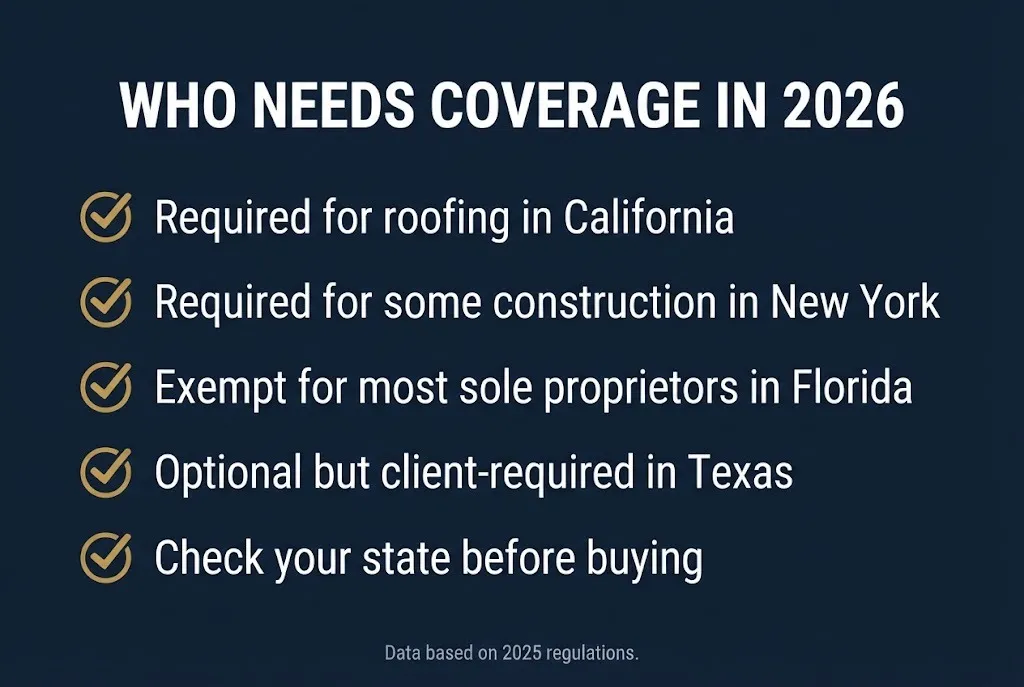
- California requires workers compensation coverage for roofing contractors even if they have no employees. Sole proprietors cannot opt out of this requirement.
- New York mandates coverage for certain construction and transportation classifications, including independent contractors in some situations.
- Florida requires coverage for construction businesses with one or more employees, but sole proprietors in non-construction fields are generally exempt.
- Texas does not require workers compensation at all, but client contracts often demand it anyway.
- Most other states fall somewhere between, with rules that vary by industry, license type, and whether you work on government-funded projects.
The rule that catches most self employed people: even if your state doesn’t require coverage, your client’s contract can.
A general contractor hiring you as a subcontractor may legally require you to carry workers compensation as a condition of the job. If you can’t show a certificate of insurance, you don’t get paid. It’s that simple.
Key Takeaway: Coverage rules depend more on your specific trade and client contracts than on any single state law.
What Does Self Employed Workers Compensation Insurance Actually Cover?
The coverage pays for three things: medical treatment for work injuries, a portion of lost income while you recover, and death benefits for your family if the worst happens.
Here’s what a standard policy includes:
- Medical costs: doctor visits, hospital stays, surgery, medication, physical therapy
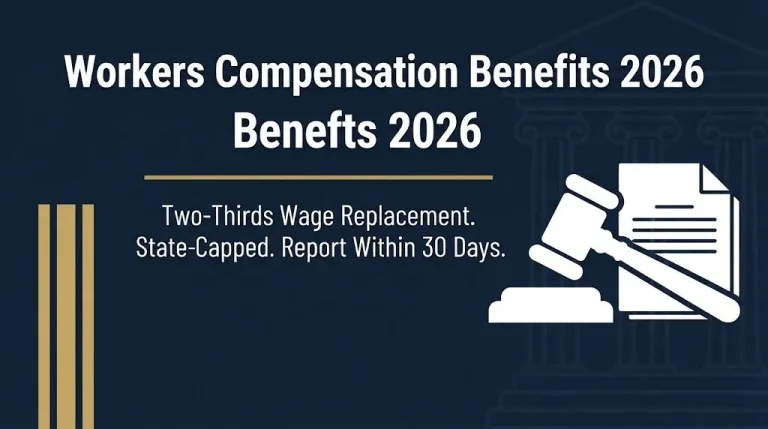
- Disability payments: typically two-thirds of your average weekly wage, up to state maximums
- Vocational rehabilitation: training for a new role if you can’t return to your old work
- Death benefits: payments to dependents if a work injury kills you
What it doesn’t cover: damage to your tools, damage to client property, lawsuits from clients, or injuries to anyone else. Those require general liability or commercial property coverage.
The most misunderstood part is the disability payment. It’s not your full income. It’s typically 66.67% of your average weekly wage, with a cap that varies by state. If you earn $80,000 a year, your weekly benefit might max out around $1,000, not the $1,538 you actually bring home.
For a self employed person, that cap is often calculated from a payroll amount you choose when you buy the policy. Choose too low, and your benefit shrinks. Choose too high, and you’re overpaying for nothing.
How Much Does Self Employed Workers Compensation Insurance Cost in 2026?
Expect to pay between $500 and $3,000 per year, with most sole proprietors landing in the $800 to $1,500 range.
The price depends on five verified factors:
| Factor | How It Affects Your Rate |
|---|---|
| State | High-cost states like California and New York run 30 to 60% higher than midwestern states |
| Industry class code | Roofing and tree work cost more than office or consulting work |
| Estimated payroll | Policies are priced per $100 of payroll, even if you’re the only worker |
| Claims history | Past claims raise your experience modification factor |
| Coverage limits | Higher benefit amounts cost more |
A freelance writer in Ohio might pay $400 a year. A self employed roofer in California might pay $6,000 or more. Same coverage type, wildly different risk.
Insurance companies use class codes, four-digit numbers assigned to every industry. Code 8810 is clerical, one of the cheapest. Code 5551 is roofing, one of the most expensive. You don’t get to choose your code. The insurer assigns it based on what you actually do.
Reality Check: No one texts you about workers compensation refunds. No one calls demanding payment to “activate” a policy you never bought. Filing is always free. Third-party “helpers” who charge fees are unnecessary. Buy direct or use a licensed broker.
How Do You File for Self Employed Workers Compensation Coverage?
Getting coverage is simpler than most people think. Here’s the step-by-step process:
- Determine if your state requires coverage for your specific trade and situation.
- Check if you can buy through your state’s assigned risk pool or a competitive private insurer.
- Gather your business license, tax ID, and a realistic estimate of your annual payroll.
- Request quotes from at least two licensed brokers or insurers.
- Compare premium, coverage limits, and whether the policy includes owner coverage by endorsement.
- Purchase the policy and request a certificate of insurance.
- Provide that certificate to any client that requires it.
- Set a calendar reminder 30 days before renewal, rates and requirements change yearly.
The fastest path is often your state’s workers compensation fund or assigned risk pool. These exist specifically for people private insurers won’t cover, including many self employed workers. Premiums there are sometimes higher, but approval is nearly guaranteed if you’re in a covered class.
Contractor Workers Compensation Insurance: Why Clients Demand It
Contractor workers compensation insurance exists because general contractors don’t want to pay for your injuries. If you get hurt on their job site and you’re uninsured, they can be held liable.
That’s the hidden mechanics of the whole system. Workers compensation was designed as a trade: you give up the right to sue your employer, and in exchange you get guaranteed medical and wage benefits without proving fault.
For contractors, the system creates a paper trail. A general contractor asks for your certificate of insurance. If you have it, you’re a legitimate subcontractor. If you don’t, you’re a liability, and in many states, you become their employee by legal default.
Several states use a simple test: no workers compensation certificate means you’re an employee of the general contractor, which means the general contractor owes payroll taxes, unemployment insurance, and workers compensation premiums on your behalf. That’s why they insist on seeing your certificate.
Key Takeaway: Your coverage certificate is often more valuable than the policy itself, it’s the document that unlocks contracts.
What Happens If You Skip Coverage and Get Hurt?
You pay out of pocket, and the bills add up fast.
A self employed carpenter who falls off a ladder and breaks an arm faces:
- Emergency room: $2,000 to $5,000
- Surgery if needed: $10,000 to $40,000
- Physical therapy: $3,000 to $8,000
- Lost income during 8 weeks of recovery: depends on your rate, but often $10,000 to $25,000
Total: anywhere from $15,000 to $70,000, none of it covered by general liability insurance.
Health insurance helps with medical costs, but it doesn’t replace lost income. Disability insurance, if you have it, replaces some income but often has a 30 to 90 day waiting period.
Workers compensation is the only policy that combines medical and wage benefits in one structure, with no deductible and no waiting period beyond a few days in most states.
The alternative is not having the coverage and hoping nothing happens. That works until it doesn’t.
Can You Opt Out of Workers Compensation If You’re Self Employed?
In many states, yes, but the opt-out process is specific and sometimes confusing.
States that allow self employed workers to opt out generally require you to file a formal waiver or exemption form with the state workers compensation board. You can’t just not buy the policy and assume you’re fine.
The waiver says you understand you’re not covered and you accept that risk. It protects general contractors and clients from liability for your injuries.
But even with a waiver on file, a client can still require you to carry coverage as a contract term. The waiver helps in some situations. It doesn’t override a private contract.
And here’s the part that surprises people: in some states, filing a waiver means you permanently lose the right to workers compensation benefits unless you formally rescind the waiver. If you change your mind later, it’s a process.
Self Employed Workers Compensation Insurance by State: The 2026 Picture
Rules vary enough that a state-by-state summary is useful.
| State | Self Employed Requirement | Notable 2026 Update |
|---|---|---|
| California | Required for roofing, optional for most others | Updated roofing contractor enforcement in January 2026 |
| New York | Required for certain construction roles | Clarified independent contractor rules in March 2026 |
| Florida | Exempt for sole proprietors in non-construction | Construction exemption rules clarified in June 2026 |
| Texas | Not required, optional for all | No change, but client contract requirements increasing |
| Pennsylvania | Optional for sole proprietors, can opt in | No major 2026 change |
| Ohio | Optional, can buy through state fund | Competitive pricing adjustments in early 2026 |
| Illinois | Optional for most, required for some trades | Enforcement focus on construction misclassification |
| Washington | Optional but widely required by clients | No major 2026 change |
This table is a snapshot, not a legal ruling. Your specific trade and license status can change the answer.
Key Takeaway: The trend in 2026 is tighter enforcement of existing rules, not new legislation, with construction trades facing the most scrutiny.
What About Independent Contractor Workers Compensation Insurance?
Independent contractor workers compensation insurance is the same product as self employed coverage, sold under a different label.
The distinction matters because the legal status of independent contractors is under attack. Several states have adopted stricter tests for who counts as an independent contractor versus an employee.
If a state agency reclassifies you as an employee, the business that pays you becomes responsible for workers compensation, payroll taxes, and unemployment insurance. That reclassification risk is why so many companies now require independent contractors to carry their own coverage.
The practical advice: if you work as an independent contractor, buy a policy that specifically names you as an owner or sole proprietor with owner coverage included. Many policies exclude owners by default, which means you’d pay premiums for a policy that doesn’t cover you.
That’s the most expensive mistake in this entire topic: paying for workers compensation that excludes the owner. It happens constantly.
How Does a Workers Compensation Claim Work for a Self Employed Person?
The claims process mirrors what employees experience, with a few differences.
- Report the injury to your insurer immediately, most states require notice within 30 days.
- Seek medical treatment, the insurer may direct you to an approved provider.
- The insurer investigates and either approves or denies the claim.
- If approved, medical bills go to the insurer and you receive wage replacement payments.
- If denied, you can appeal through your state’s workers compensation appeals process.
The difference for self employed people is proving your income. Without a W-2, you’ll need tax returns, invoices, and bank statements to establish your average weekly wage.
That’s why financial documentation matters more than you think. If you can’t prove income, your wage replacement benefit may be based on a lower amount, or your claim may be partially denied.
Is Workers Compensation Worth It for a Solo Business Owner?
For most self employed people, yes, if you work in a physical trade. For desk workers, maybe not.
Here’s the honest math:
- Annual premium: $800 to $1,500 for most trades
- Risk of a claim in any given year: 3 to 8% depending on your trade
- Average claim cost if something happens: $15,000 to $50,000
The expected value doesn’t favor you, that’s how insurance works. The insurer collects more in premiums than it pays in claims. But expected value isn’t the point. The point is avoiding a catastrophic financial hit you can’t absorb.
If you have $50,000 in savings and work in a low-risk field, skipping coverage might be rational. If you’re a self employed electrician with $8,000 in the bank, one bad fall changes your life.
The client contract angle tips the scale for most contractors. You don’t buy coverage because you want it. You buy it because the jobs you want require it.
Key Takeaway: Coverage is a business expense, not a lifestyle choice, and the decision usually comes down to your trade and your clients.
What Questions Are People Actually Asking in 2026?
Here are the real questions showing up in forums, search queries, and state agency help lines.
Do I need workers compensation insurance if I have an LLC?
An LLC alone doesn’t exempt you from workers compensation requirements. The legal structure of your business matters less than your state’s rules and your trade classification. In some states, LLC owners can opt out. In others, they can’t. In construction trades, the LLC form rarely changes anything.
Can I buy workers compensation insurance if I have no employees?
Yes. Most insurance companies and state funds sell policies specifically for sole proprietors and single-member LLCs. You’ll need to request owner coverage specifically. Without that endorsement, your policy covers imaginary employees and not you.
Is workers compensation tax deductible for self employed people?
Yes, in most cases. Workers compensation premiums are a business expense, deductible on your tax return like any other insurance cost. Consult a tax professional for your specific situation, but the general rule is clear.
What’s the cheapest way to get coverage?
The cheapest legitimate path is usually your state’s assigned risk pool or competitive state fund. Private insurers may offer lower rates if you’re in a low-risk class, but state funds are often the most accessible option. Avoid any service charging a “filing fee” to access coverage you can buy directly.
Can I be denied workers compensation insurance?
Yes. Private insurers can decline to cover you based on your trade, claims history, or state rules. State assigned risk pools exist as a backstop for people private insurers reject. You can’t be denied by a state fund if you’re in an eligible class.
What happens if I get hurt while working from home?
If you have a policy and the injury is work-related, it’s covered. The location matters less than the activity. A fall down your home stairs while carrying work materials could be a valid claim. A fall while walking your dog on a lunch break is not.
Do clients ever accept a waiver instead of insurance?
Sometimes, but less often in 2026 than in previous years. Larger clients, government contracts, and general contractors increasingly require actual coverage regardless of waivers. Small residential clients may accept a waiver. The trend is toward stricter requirements.
Is there a federal program for self employed workers compensation?
No. Workers compensation is a state system. There is no federal option, no federal mandate, and no federal subsidy for self employed coverage. Anyone claiming to sell “federal workers compensation” for self employed people is misrepresenting the product.
What Happens Next
The workers compensation landscape for self employed individuals will likely see these developments through the rest of 2026 and into 2027:
- October 2026: Several states begin annual workers compensation rate reviews, with possible premium adjustments for 2027.
- January 2027: New York and California typically update their construction trade rules at the start of the year.
- Early 2027: Expect continued enforcement focus on worker misclassification, which indirectly pressures more self employed people to carry coverage.
- Ongoing: Client contract requirements will keep tightening, especially in construction, technology staffing, and gig economy work.
The single most important date is your own policy renewal date. Mark it. Rates change, rules change, and your certificate of insurance expires if you don’t renew.
Frequently Asked Questions
Is self employed workers compensation insurance required by law?
It depends on your state and trade.
Most states don’t require it for all self employed workers.
Some states require it for specific trades like roofing or construction.
Client contracts can require it even when state law doesn’t.
How much does self employed workers compensation insurance cost?
Most sole proprietors pay between $500 and $3,000 annually.
Your rate depends on state, industry class code, and payroll estimate.
High-risk trades like roofing cost significantly more.
Can a sole proprietor get workers compensation insurance?
Yes.
Insurance companies and state funds sell policies for sole proprietors.
You must request owner coverage or you won’t be covered.
Does general liability insurance cover my own work injury?
No.
General liability covers damage to others and their property.
Your own injury requires workers compensation or health insurance.
Can I be sued as a self employed person without workers compensation?
Yes.
You can be sued by anyone injured by your work.
Workers compensation only covers your own injury, not your liability to others.
How do I prove income for a workers compensation claim?
Use tax returns, invoices, and bank statements.
Without W-2 income, these documents establish your average weekly wage.
Good records mean faster claim approval and accurate benefits.
What’s the difference between workers compensation and disability insurance?
Workers compensation covers only work-related injuries.
Disability insurance covers injuries and illnesses regardless of cause.
Workers compensation has no waiting period in most states.
Where do I buy workers compensation insurance?
Start with your state workers compensation fund.
Private insurers and licensed brokers also sell policies.
Avoid third-party services charging fees to file for you.
If you’re self employed and someone just asked for your certificate of insurance, don’t panic. Start with your state workers compensation board or fund. They’ll tell you if coverage is required, what it costs, and how to buy it. Do that before you pay anyone to do it for you.
The most important fact to remember: your state’s rules, not a blog post or a client’s assumption, determine whether you must have coverage. Check that first.