Workers’ Comp Settlement for Rotator Cuff and Bicep Tear in 2026
Quick Answer
- Workers’ comp covers medical bills and partial wages, but never pain and suffering.
- A combined rotator cuff and bicep tear is worth more than either injury alone.
- Settlement values depend on your impairment rating, work restrictions, and state benefit caps.
If you tore your rotator cuff and bicep on the job, the settlement you receive depends on far more than the diagnosis. Insurance companies start with low offers. Your documented losses, surgical outcome, and permanent restrictions drive the real number.
This article breaks down verified 2026 settlement ranges, the factors that push your claim higher, and the steps you need to take before accepting anything. You’ll also see how combined tears differ from single injuries and why the impairment rating matters more than the surgery itself.
The Facts
| Case Type | Individual workers’ compensation claim (no class action) |
| Status | Claims proceed through state workers’ comp systems; settlements vary by case |
| Fund Size | No centralized fund; each claim negotiated separately |
| Est. Per Person | $28,000 to $325,000 nationwide; combined tears typically higher |
| Claim Deadline | Varies by state; report injury within 30 days in most states |
| Administrator | State workers’ compensation board or commission |
| Proof Needed | Medical records, MRI results, surgical reports, wage statements |
Is Workers’ Comp for Rotator Cuff and Bicep Tear Legit?
Workers’ compensation for rotator cuff and bicep tears is a legitimate, state-mandated benefit system. If you tore your shoulder on the job, your employer’s workers’ comp insurance must cover reasonable medical treatment and partial wage replacement.
The system is no-fault. You don’t need to prove your employer did anything wrong. You only need to show the injury happened at work or developed from job duties.
But here’s the catch. Workers’ comp doesn’t pay for pain and suffering. That’s a common misconception. The system covers medical bills and lost wages, not the physical pain you endure.
If a third party caused your injury, you might have a separate personal injury claim. That path can include pain and suffering damages, but it’s separate from workers’ comp.
Reality Check: No one from workers’ comp will call you offering a settlement upfront. Insurance adjusters start with low offers. Filing is free. You never pay an application fee to open a workers’ comp claim.
How Much Is a Workers’ Comp Settlement for Rotator Cuff and Bicep Tear?
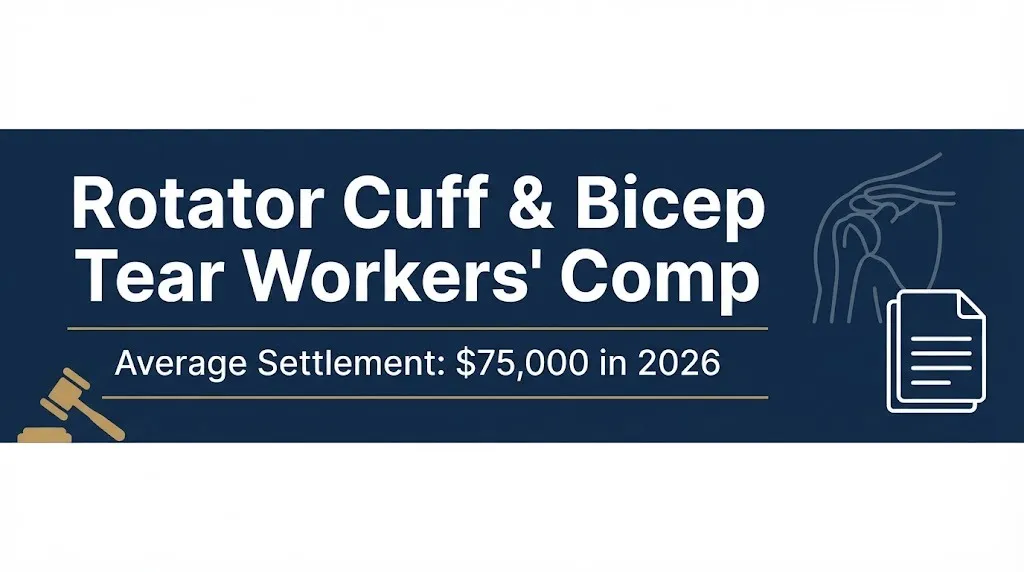
The average rotator cuff injury settlement is $75,000 nationwide in 2026. Typical settlements range from $28,000 to $325,000 depending on whether surgery was required, your impairment rating, and your state’s benefit caps .
Combined rotator cuff and bicep tears generally settle higher than either injury alone . The surgical repair is more complex. Recovery takes longer. The odds of a permanent impairment rating increase.
Nationwide Settlement Ranges (2026):
| Injury Type | Average Settlement | Typical Range |
|---|---|---|
| Rotator cuff (non-surgical) | $28,500 | $15,000 to $45,000 |
| Rotator cuff (surgical) | $82,400 | $45,000 to $150,000 |
| Full-thickness tear, open repair | $120,000+ | $90,000 to $200,000 |
| Combined rotator cuff and bicep tear | Varies | Higher than single injuries |
State matters enormously. California, New York, and Illinois settle 20 to 40 percent higher than the national average. Georgia, Mississippi, and Alabama settle 20 to 30 percent below average .
Key Takeaway: Surgery status and impairment rating drive settlement value more than the diagnosis itself.
What Factors Increase a Workers’ Comp Shoulder Settlement?
Several verified factors push settlement values higher. The biggest is your permanent impairment rating. A higher rating means more disability weeks and a larger payout.
Top Factors That Raise Settlement Value:
- Surgery required. Surgical cases settle 2 to 4 times higher than non-surgical cases .
- Permanent impairment rating. Ratings of 15 to 30 percent for surgical cases versus 5 to 12 percent for conservative treatment.
- Work restrictions. If you can’t lift over a certain weight or work overhead, your loss of earning capacity increases.
- Dominant arm injury. Your dominant shoulder affects work capacity more.
- Future medical needs. Hardware removal, revision surgery, or ongoing therapy adds value.
- Higher pre-injury wages. Lost wages are calculated from your average weekly wage.
A worker with a full-thickness tear, surgical repair, and permanent overhead-lifting restrictions typically settles for $120,000 or more .
How Is a Workers’ Comp Settlement for Rotator Cuff and Bicep Tear Calculated?
Workers’ comp settlements are calculated using a formula that combines your weekly benefit rate, disability weeks, impairment percentage, and future medical costs.
The core formula is: Weekly Benefit × Disability Weeks × Impairment % + Future Medical + Negotiation Adjustment .
Here’s what that means in plain terms. Your weekly benefit is usually two-thirds of your average weekly wage, capped by state law. Disability weeks come from your state’s schedule of injuries for shoulder impairments. Your impairment percentage is assigned by a doctor after you reach maximum medical improvement.
Future medical costs cover anticipated care like hardware removal or revision surgery. The negotiation adjustment reflects how hard your attorney pushes and how strong your evidence is.
Example: A 40 percent arm impairment in New York at $800 weekly benefit equals: 40% × 312 weeks × $800 = $99,840 .
Most final settlements end up 50 to 100 percent higher than the insurance company’s initial offer .
Who May Qualify for a Rotator Cuff and Bicep Tear Workers’ Comp Claim?
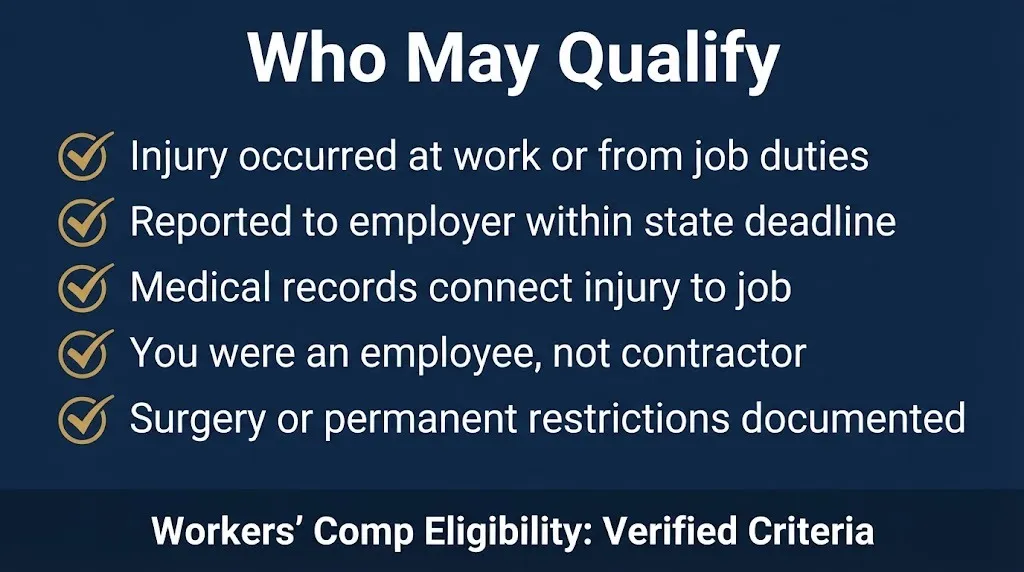
You may qualify if you tore your rotator cuff or bicep while performing job duties, whether from a sudden accident or repetitive motion over time.
Eligibility Criteria:
- The injury occurred at work or developed from work tasks
- You reported the injury to your employer within your state’s deadline (often 30 days)
- You have medical documentation connecting the injury to your job
- You were an employee, not an independent contractor
Jobs with high risk include construction, nursing, warehouse work, painting, and any role requiring repetitive overhead motion or heavy lifting .
You don’t need to have been injured in a single incident. Repetitive strain injuries that develop over months or years can qualify.
How Do You File a Workers’ Comp Claim for Shoulder Surgery?
Filing a workers’ comp claim means reporting your injury, seeking authorized medical care, and documenting everything before you accept any settlement.
Steps to File:
- Report the injury to your employer in writing within your state’s deadline.
- Get medical care from an authorized provider or your state’s approved list.
- Document everything. Keep copies of medical records, MRI results, surgical reports, and wage statements.
- Follow treatment recommendations. Missed appointments can hurt your claim.
- Reach maximum medical improvement (MMI). This is when your doctor says you’ve healed as much as you will.
- Get your impairment rating. A doctor assigns a percentage based on the AMA Guides.
- Review the settlement offer with an attorney before signing anything.
- Understand what you’re giving up. A full and final settlement usually closes your case permanently.
You don’t legally need an attorney, but the data is stark. Represented claimants receive settlements averaging $58,200 compared to $19,400 for unrepresented claimants .
How Long Does a Workers’ Comp Settlement Take for Shoulder Injuries?
Most shoulder injury settlements take six to 18 months from the date of injury to resolution . Complex cases involving surgery, disputes, or multiple body parts can take longer.
The timeline depends on how quickly you reach MMI, whether the insurer disputes your claim, and how far apart the two sides are on value.
Simple cases with conservative treatment can resolve in four to six months. Surgical cases typically take 12 to 18 months because recovery itself takes six to 12 months before MMI is reached.
Disputes over the impairment rating or future medical needs add delay. If the insurer denies the claim or disputes the surgery, an attorney can push back and keep negotiations moving.
What Happens Next in Your Workers’ Comp Claim
Immediately: Report your injury and seek authorized medical care.
Weeks 1-4: Begin treatment and document all medical findings.
Months 3-12: Surgery and rehabilitation, if required. Wage benefits continue during recovery.
At MMI: Your doctor assigns a permanent impairment rating.
After MMI: Settlement negotiations begin. Most cases settle within 6 to 18 months of the injury.
Before signing: Have an attorney review the offer and explain what rights you’re waiving.
Frequently Asked Questions
How much is a workers’ comp settlement for a rotator cuff and bicep tear?
The average rotator cuff settlement is $75,000 nationwide.
Combined rotator cuff and bicep tears settle higher because they require more complex surgery.
Actual amounts range from $28,000 to $325,000 depending on surgery, impairment rating, and state.
Do I need surgery to get a good settlement?
No, but surgical cases settle two to four times higher than non-surgical cases.
The reason is higher impairment ratings and documented future medical needs.
If your doctor recommends surgery, following that recommendation often increases claim value.
Can I sue my employer for pain and suffering?
No, workers’ compensation is a no-fault system that doesn’t cover pain and suffering.
You can only pursue pain and suffering if a third party caused your injury.
That would be a separate personal injury claim, not workers’ comp.
What is an impairment rating and why does it matter?
An impairment rating is a percentage your doctor assigns after you reach maximum medical improvement.
It represents the permanent damage to your shoulder.
Higher ratings mean more disability weeks and larger settlements. Surgical cases typically rate 15 to 30 percent versus 5 to 12 percent for non-surgical cases.
Should I accept the first settlement offer?
No, initial offers are typically 30 to 50 percent below fair value.
Represented claimants receive settlements nearly three times higher than unrepresented claimants.
Always have an attorney review any offer before signing.
How long do I have to file a workers’ comp claim?
Most states require you to report the injury within 30 days.
The deadline to file a formal claim varies by state, often one to two years.
Miss the deadline and you lose your right to benefits.
What You Should Do Now
Report your injury immediately if you haven’t already. Get medical care from an authorized provider. Document everything, from MRI results to wage statements.
Before you accept any settlement offer, have a workers’ comp attorney review it. The difference between an initial offer and a fair settlement can be tens of thousands of dollars. Don’t leave that money on the table.