Water Contamination Lawsuit 2026: PFAS Settlements, Deadlines, and Who Qualifies
Quick Answer
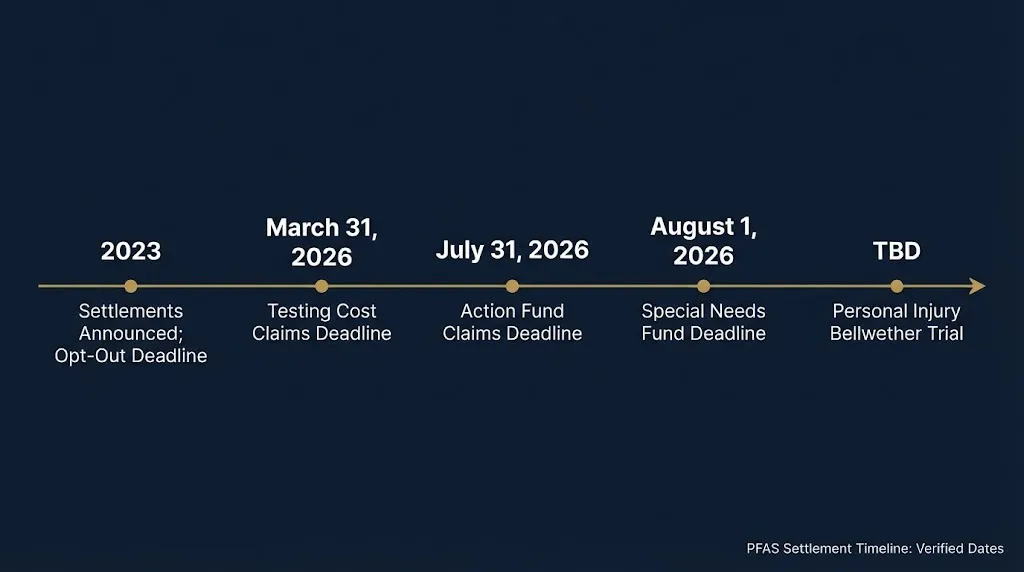
- Public water systems had until July 31, 2026 to file Action Fund claims under the $14 billion settlements.
- Individual injury claims for PFAS-related cancers remain unresolved with no settlement matrix or verdict.
- North Carolina secured a separate $590 million settlement with Chemours, DuPont, and Corteva in September 2026.
If you’re searching for a water contamination lawsuit update, the landscape splits into two distinct tracks. One track involves public water systems and their remediation costs. That track is largely closed. The other track involves individuals who developed cancers or diseases after drinking contaminated water. That track has no verdict, no settlement, and no clear timeline.
This article breaks down what’s verified, what’s still pending, and what you need to know if you believe your drinking water was contaminated by PFAS or other chemicals.
The Facts
| Case Type | Public water system class action settlements; individual personal injury MDL |
| Key Litigation | AFFF Products Liability Litigation, MDL No. 2873 (D.S.C.) |
| Status | Water system settlements finalized; personal injury track unresolved |
| Fund Size | $14 billion+ combined (3M and DuPont water system settlements) |
| Est. Per Person | No per-person payout; water systems receive allocated funds based on contamination levels |
| Claim Deadline | July 31, 2026 (Phase Two Action Fund); August 1, 2026 (Special Needs Fund) |
| Administrator | PFAS Water Settlement claims administrator |
| Proof Needed | Source-specific PFAS testing data, flow rates, production history |
Is the Water Contamination Lawsuit Legit?
The water contamination lawsuit is legitimate and resulted in the largest environmental settlements in U.S. history. The AFFF MDL consolidated claims from public water systems across the country against manufacturers of aqueous film-forming foam, a firefighting product containing PFAS.
3M and DuPont (along with Chemours and Corteva) agreed to pay more than $14 billion combined to resolve claims that their products contaminated drinking water with per- and polyfluoroalkyl substances. These chemicals are called “forever chemicals” because they don’t break down in the environment or the human body.
The settlements resolved remediation cost claims, not personal injury claims. Water systems received compensation for testing, treatment infrastructure, and related expenses. Individuals with health claims are in a separate, unresolved track.
Reality Check: No one will text you offering PFAS settlement money. Water system settlements went to municipalities, not individuals. If someone contacts you claiming you’re owed money from the water system settlements, it’s a scam.
How Much Did Water Systems Receive from PFAS Settlements?
Payouts to water systems varied dramatically based on contamination levels and system size. There is no fixed per-person amount because the settlements compensated systems, not individuals.
The allocation formula scored each water source based on the highest PFAS detection levels and the source’s production capacity. Systems with higher contamination and larger capacity received larger awards.
Verified Payment Examples:
| Water System | Location | Verified Payout |
|---|---|---|
| City of Corona | California | $21 million+ from 3M alone |
| City of Sacramento | California | $10.4 million |
| New Hampshire public systems | Statewide | $4.68 million initial payment; $34 million+ total |
The New Hampshire settlement represented the state’s Phase 1 Action Fund payment from a $750 million nationwide class action settlement . Additional 3M payments will continue annually through 2033.
Key Takeaway: Water system payouts went to municipalities and public utilities, not to individual residents; the money funds treatment infrastructure and testing, not personal compensation.
Who Qualified for the PFAS Water System Settlements?
Public water systems qualified automatically unless they opted out in 2023. But automatic inclusion didn’t guarantee payment. Systems had to submit complete, documented claims before the deadlines.
Phase 1 Eligibility (Deadlines Passed):
- Systems that detected PFAS in source water before June 2023
- Systems that did not formally opt out of the settlement
Phase 2 Eligibility (Deadlines July 31, 2026):
- Systems that did NOT detect PFAS until after June 2023
- Systems serving more than 3,300 people OR required to test under EPA’s UCMR-5 rule
- Systems that completed source-specific testing at each wellhead or intake
The DuPont settlement allowed any size system if state law required PFAS testing. The 3M settlement required the system to serve more than 3,300 people .
How Do Water Systems File PFAS Settlement Claims?
Filing a PFAS settlement claim required source-specific testing, documentation of flow rates, and submission before the deadline. The process was complex and left no room for incomplete submissions.
Steps to File (for reference on closed deadlines):
- Confirm eligibility by reviewing Phase 1 or Phase 2 criteria.
- Test every water source at the wellhead or treatment plant intake, not just entry points.
- Document flow rates and production history for each source.
- Gather lab documentation showing maximum PFAS detections with chain of custody records.
- Submit the Action Fund claim before July 31, 2026.
- Submit Special Needs Fund claims for incurred costs before August 1, 2026.
- Preserve supplemental claim rights for future PFAS detections above MCLs .
Testing data from EPA’s UCMR-5 program did NOT satisfy claim requirements because it tested only at distribution entry points, not individual sources . Systems had to conduct additional testing.
What Is the Status of PFAS Personal Injury Lawsuits?
The PFAS personal injury lawsuit track remains unresolved with no global settlement and no bellwether verdict. The first kidney cancer bellwether trial was vacated and has not been rescheduled .
The personal injury MDL covers six Listed Claims: kidney cancer, testicular cancer, liver cancer, thyroid cancer, ulcerative colitis, and pregnancy-induced hypertension . CMO 37, issued February 25, 2026, requires plaintiffs to substantiate injury claims with medical or insurance diagnosis records submitted through the MDL portal.
The C8 Science Panel, which studied PFOA exposure near DuPont’s Washington Works plant, found probable links to kidney cancer, testicular cancer, ulcerative colitis, thyroid disease, high cholesterol, and pregnancy-induced hypertension . The MDL’s Listed Claims don’t map identically to those findings.
No valuation anchor exists for individual injury claims. Settlement values will depend on bellwether verdicts that have not yet occurred .
What Is the North Carolina PFAS Settlement?
North Carolina secured a $590 million settlement with Chemours, DuPont, and Corteva in September 2026, the largest environmental damages recovery in state history . The agreement resolves lawsuits over PFAS contamination from the Fayetteville Works plant.
The settlement guarantees $455 million to the state and 11 local governments, paid over 10 to 15 years. Of that amount, $75 million goes to the state, with $55 million earmarked for a PFAS cleanup fund. The remaining $380 million goes to affected local governments .
DuPont and Corteva must establish a $135 million reserve fund guaranteeing Chemours continues providing clean drinking water to families with contaminated wells .
Chemours will bear 50% of the settlement cost, with DuPont and Corteva splitting the remainder .
What Happens Next in PFAS Litigation
Pending: Bellwether trial for kidney cancer rescheduled after vacatur; no new date set.
Expected late 2026: Daubert rulings on expert admissibility for the six Listed Claims.
Ongoing: Individual injury claims proceed through case-specific discovery under CMO 37.
EPA rulemaking: Proposed PFAS compliance extension and rescission rules open for comment through July 2026.
Frequently Asked Questions
Can I still file a PFAS water contamination lawsuit in 2026?
Water system claims are closed as of July 31, 2026.
Individual injury claims can still be filed if you have a qualifying diagnosis.
Consult a mass tort attorney to determine your options.
How much did individuals receive from PFAS settlements?
Individuals did not receive money from the water system settlements.
Those funds went to municipalities for testing and treatment infrastructure.
Personal injury claims have no settlement fund yet.
What cancers are linked to PFAS exposure?
The MDL covers kidney cancer, testicular cancer, liver cancer, and thyroid cancer.
Ulcerative colitis and pregnancy-induced hypertension are also listed claims.
The C8 Science Panel found probable links to additional conditions.
What is the deadline for PFAS personal injury claims?
There is no global settlement deadline for personal injury claims.
Statutes of limitations vary by state and injury type.
Consult an attorney to determine your filing deadline.
Did 3M and DuPont admit fault in the PFAS settlements?
No, the settlements resolved claims without admissions of liability.
The companies deny the allegations that their products caused harm.
The settlements avoided prolonged litigation and uncertain trial outcomes.
What is the AFFF MDL?
AFFF MDL is the Aqueous Film-Forming Foam Products Liability Litigation.
It consolidated PFAS claims against manufacturers in the District of South Carolina.
The MDL number is 2873.
What You Should Do Now
If you believe you developed cancer or another qualifying condition after PFAS exposure, consult a mass tort attorney. The personal injury track has no settlement matrix, meaning individual case evaluation is essential. Your state’s statute of limitations may be running.
Water system claims are closed. If you’re a municipal official, verify your system received allocated funds. For individuals, the path forward depends on medical documentation linking your diagnosis to PFAS exposure.